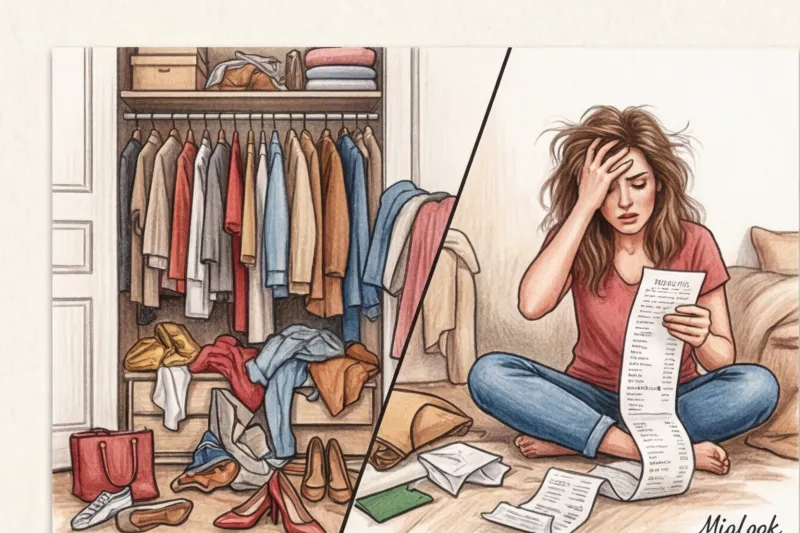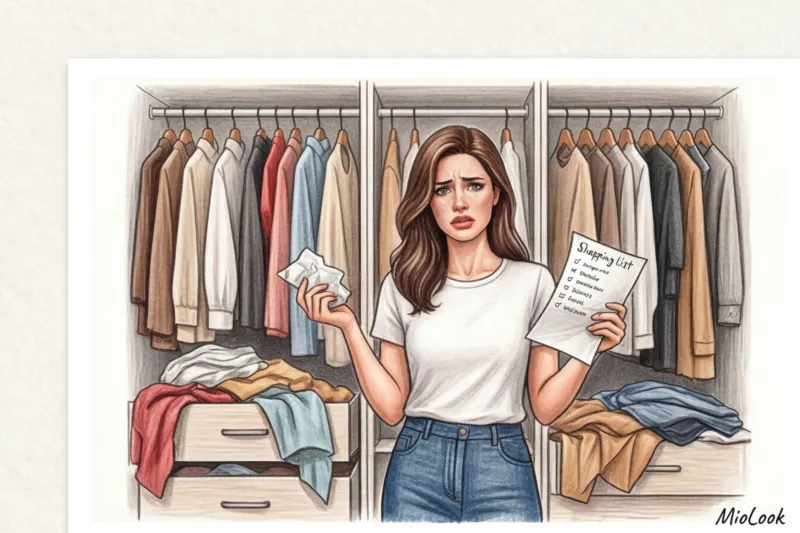
Do you know what the most common mistake my clients make is? They have three identical beige sweaters hanging in their closets. Why? Because before going to the mall, they simply wrote down "buy sweater" in their phone's notes. Then the magic of sensory overload happened, the bright lights of the display cases, a 20% discount, and voila—yet another clone is sent to the shelf. Let's be honest: abstract capsule wardrobe shopping list - this is not a help, but a path to impulsive spending.

Over the years of working as a personal stylist in Europe, I've learned one thing: a proper shopping list isn't a wish list, but a strict technical brief. If you simply copy glossy magazine advice about "10 things every woman should have," you risk wasting your money. I've already covered preparing for this step in more detail in our the complete guide to wardrobe decluttering , and today we will turn your chaotic desires into a precise mathematical plan.
Why Someone Else's Capsule Wardrobe Shopping List Will Ruin Your Style
There are no universal basic lists. Period. If you hate ironing, that proverbial perfect white shirt made of heavy cotton will become dead weight in your closet. If you work from home and commute by car, the classic beige trench coat that fashion magazines have been pushing as a must-have for years simply won't work.
A study by the environmental organization WRAP (Waste and Resources Action Programme) revealed a depressing statistic: on average, we only wear 20% of our clothes. The other 80% just takes up space. And you know why? Because 80% of impulse purchases don't match our current wardrobe.
The difference between a wish list and a shopping list is colossal. Wish list: "I want fashionable wide-leg trousers." Shopping list: "Gray wool palazzo trousers, high-waist, flat-soled, under €120."
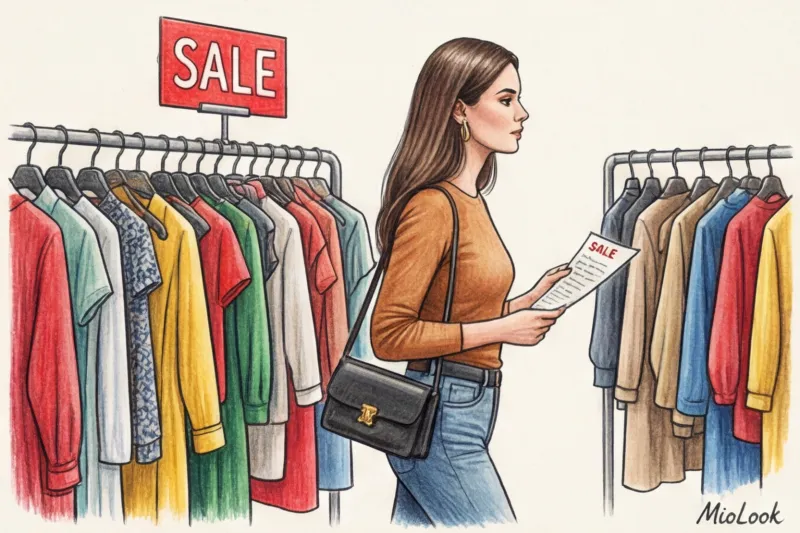
In a shopping mall (especially during sales), your brain experiences sensory overload. Without a detailed brief, you'll inevitably buy whatever brand marketers highlight with the most flattering light, not what will solve your daily problems in front of the mirror.
Access to MioLook for €0.99 — one-time payment
A smart AI stylist will select the perfect look and help you organize your wardrobe.
Get access — €0.99 onceThe Formula for a Smart Shopping List for a Capsule Wardrobe: From a Closet Audit to a Search for "Deficits"
The ideal list starts with the items you need to wear the 80% of your wardrobe you already own. In my own practice, I've come up with the concept wardrobe glue It's those subtle elements (a sleek turtleneck, a perfect leather belt, a structured top) that bring your bright or disparate pieces together into a cohesive ensemble.
Before writing your list, take inventory. Pull out the items you love but don't wear. Why are they just sitting there? More often than not, 90% of my clients have a severe imbalance: too many bottoms (pants, skirts) and too few basic tops. The formula for a working capsule wardrobe is: for every bottom, there should be 3-4 tops. Otherwise, you'll always feel like you're wearing the same thing.
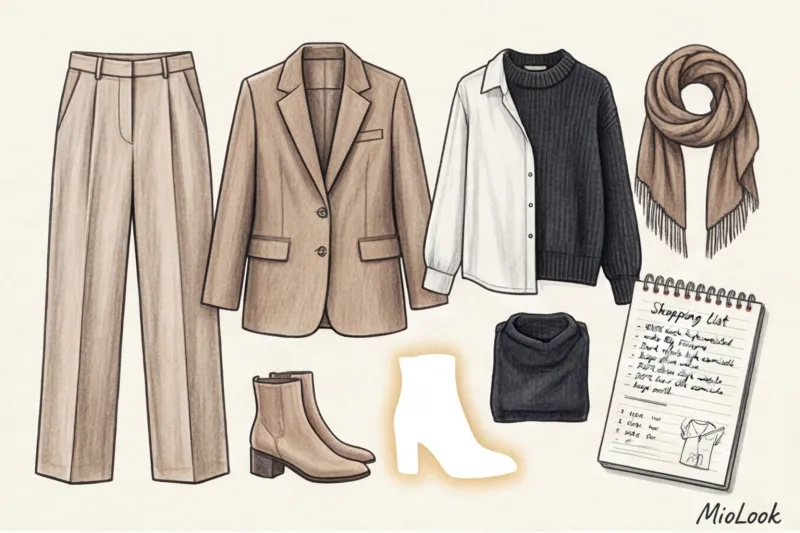
How to formulate queries correctly (to avoid buying clones)
Never list nouns without adjectives. Writing "blue jeans" is a mistake. With such a query, you'll bring home yet another pair of distressed skinny jeans that won't save your style.
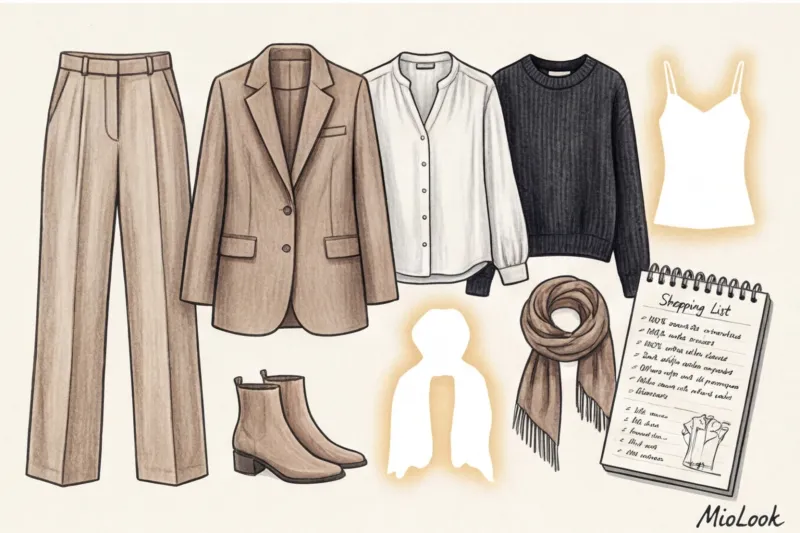
The correct way to write it is: "Full-length jeans, straight piping, high rise, 100% heavy cotton, solid navy blue, no fading or tears.".
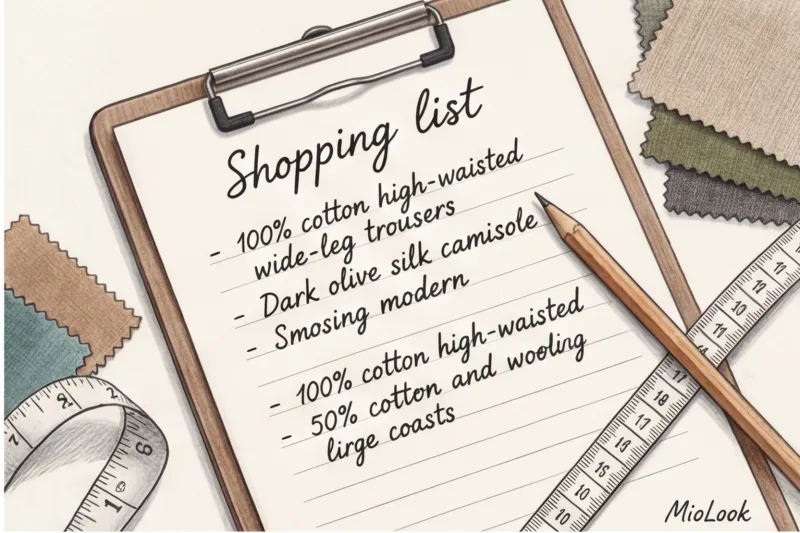
Another professional secret is to establish taboos. Write down in your notes what you absolutely cannot buy. For example: "No thin viscose (I sweat in it)," "No V-necks (they don't go with my pendants)," "No items that require dry cleaning."
Your perfect look starts here
Join thousands of users who look flawless every day with MioLook.
Get access — €0.99 onceBudgeting for a capsule: where to invest and where to save
How do you allocate your budget so your wardrobe looks "expensive" without breaking the bank? Use the 60/30/10 matrix. We spend about 60% of our budget on structured basics (well-fitting jackets, quality knitwear, the right trousers), 30% on shoes and bags (they're what really elevate your look), and only 10% on statement pieces and micro-trends.
It is important to remember the principle here Cost-per-wear (cost per exit) The mathematics of style are merciless: black leather loafers for €150, which you'll wear 100 times a season (costing €1.50 per outfit), are much more affordable than a brightly colored blouse from a mass-market store for €30, which you'll wear twice to a party (costing €15 per outfit).
To be fair, this method doesn't work for evening wear. You'll wear a bridesmaid dress once, and that's fine. But when it comes to a capsule collection, consider the cost of each wear.
The main trap of shopping malls is the red price tags. If you see a sweater that used to cost €90 and now costs €30, ask yourself: "Would I buy it at full price?" If the answer is "no," you're not saving €60; you're spending €30 on something that will become your loungewear.
Navigating European Brands: Where to Find Specific Items on the List
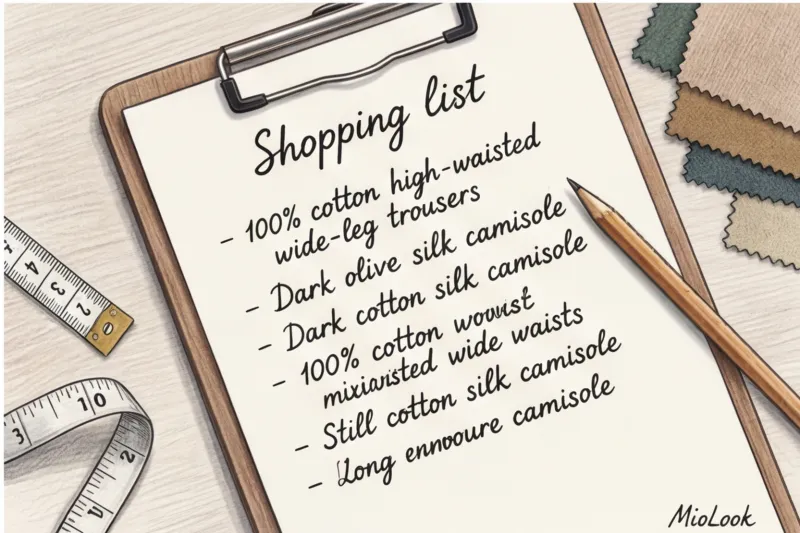
Having a clear list in hand means you don't have to wander around the entire mall. As a personal shopper, I've spent years studying brand assortment matrices. Each brand has its own strengths and weaknesses.
- COS and Arket: We come here for structured basics and sophisticated minimalism. Their white T-shirts made of heavy cotton (from 180 g/m²) and basic turtlenecks hold their shape for years. Budget: €30–€80 for basic tops.
- Massimo Dutti and &Other Stories: Ideal locations for finding quality knitwear, silk blends, and lightweight wool suiting.
- Zara and Mango: It's fast fashion, so basic cashmere is pointless to look for here (it'll shrink quickly). However, it's worth going here for fast trends and modern cuts. Pay attention to the premium lines. Zara Studio And SRPLS — there are often excellent jacket patterns there.
How to read fabric compositions from a list
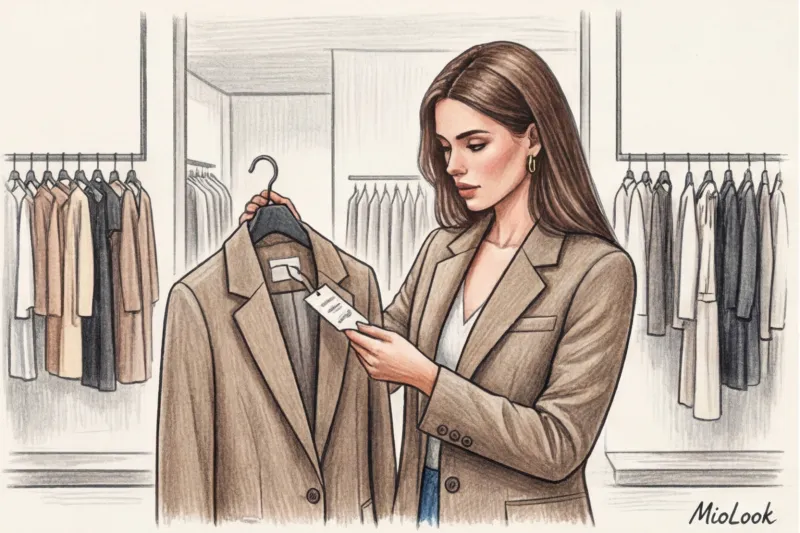
"High-quality fabric" is an abstract concept. Your list should specify specific compositions. Don't be afraid of synthetics, but be wary of their improper use. For example, pure wool can quickly wear out at the elbows, but a blend (wool + 10-20% polyamide or nylon) will last much longer.
What you should definitely avoid in a basic capsule collection is 100% acrylic (it doesn't keep you warm and shrinks instantly) and shiny polyester, which instantly cheapens the look. For a summer capsule collection, look for viscose, tencel, and lyocell—they breathe just as well as cotton but drape much more elegantly.
Ready to get started?
Try the MioLook free plan—no commitments required. An AI stylist will help you create a capsule wardrobe of your items.
Get access — €0.99 onceThe Three-Pair Rule: A Test Before the Checkout
I make all my clients learn this strict rule: if a new item from the list doesn't create at least three ready-made looks with what's ALREADY hanging in your closet, it stays in the store.
How can you check this? Right in the fitting room. I used to advise clients to create photo collages on their phones. Now it's easier: you can upload photos of your basic items to MioLook app , and the "smart wardrobe" feature will instantly help you try on a potential purchase with your favorite trousers or skirt.
If you try on a great jacket but realize you don't have the right top and need different shoes, you're not buying the jacket. You're buying a problem that will require at least two more unplanned purchases.

Summary: Your Step-by-Step Guide to Creating a Shopping List
Let's put it all together. To make your next shopping trip more efficient, follow this plan:
- Step 1: Clearing the rubble. Find the "orphans" (lonely items that have nothing to wear) and identify disproportions.
- Step 2: Finding the "glue". Write down those very connecting elements that are missing to create images.
- Step 3: Detailing the brief. Write down the exact style, desired color, texture, and, of course, your personal no-nos (fabrics, lengths, necklines).
- Step 4: Budget allocation. Focus on cost-per-wear: invest in shoes, bags, and outerwear, and save on trendy t-shirts. Assign a candidate brand to each item.
- Step 5: Testing by fire. In the fitting room, apply the "3-combination" rule by visualizing looks using your smartphone.
The secret to a stylish wardrobe isn't a limitless budget or innate taste. It lies in discipline during the preparation stage. A well-crafted brief frees your mind when shopping and protects your wallet from marketing pitfalls.