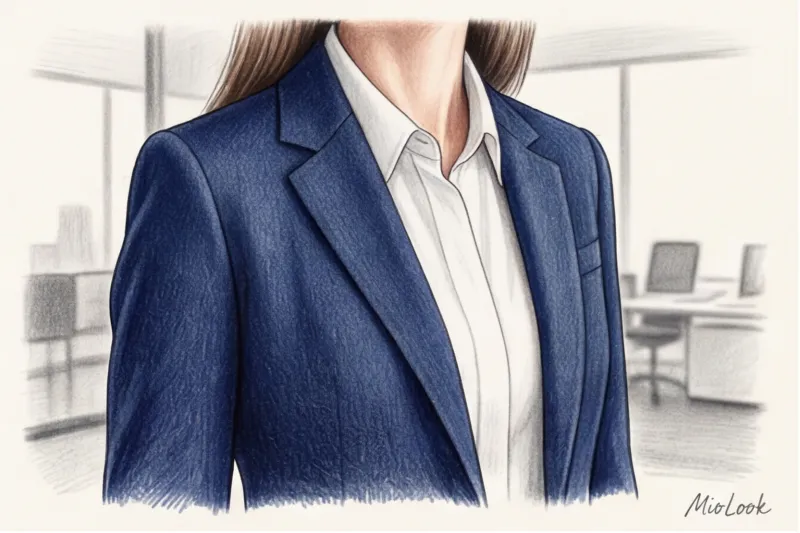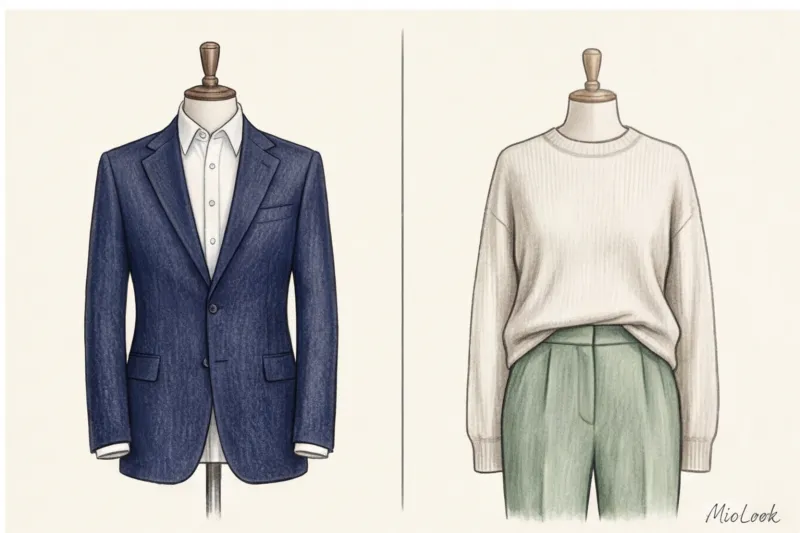
Forget for a moment everything you've been told about the impeccability of a black business suit. In today's business environment, all-black is increasingly perceived by others not as a symbol of absolute power, but as defensiveness, distance, or a simple lack of imagination. If you want to project a confident yet approachable authority, your best bet is deep blue.

We've already discussed the physiological impact of shades on the endocrine system in more detail in our complete guide. The Psychology of Color in Clothing: How to Manage Impressions Today, I want to examine a specific tool of influence. The right blue color for business attire isn't just a nod to a conservative dress code. It's a complex architecture of shades and textures that can literally change the course of negotiations. Let's explore why cheap navy blue is a status killer, while the right cobalt blue has become the new "power red" for female leaders.
Why blue works better than black in business attire
The human brain decides whether you can be trusted in a split second. According to the Institute for Color Research, a basic impression of a person is formed in the first 90 seconds of interaction, and 62% to 90% of this assessment is based solely on the color of their clothing. Black has historically created a visual barrier. It says, "I'm in charge here, but I'm closed." Blue, on the other hand, works completely differently.
In 2009, researchers at the University of British Columbia conducted a large-scale test comparing people's cognitive responses to the colors red and blue. It was found that a blue background not only lowered the opponent's heart rate but also doubled their receptivity to new information and creative ideas. Blue relaxes vigilance while maintaining respect.
"Blue is the most universally accepted color on the planet. According to YouGov statistics, 35% of women and 57% of men worldwide say it's their favorite. By wearing blue to an important meeting, you're literally speaking to most people in their favorite visual language."
I had a revealing case in my practice. One of my clients, a senior IT executive, was preparing for tough merger negotiations. She had initially planned to wear a formal black two-piece suit by Jil Sander. I insisted on a change: we chose a midnight blue suit made of thick matte wool. The result? As she later admitted, the level of aggression from the board of directors noticeably decreased. The dark blue maintained the necessary distance but alleviated the subconscious anxiety that black evokes in stressful situations.
The Anatomy of Shades: Which Blue to Choose for Your Business Needs
There's no such thing as just "blue." For a stylist, shades are like a control panel for visual impact. The choice of a specific hue depends on the specific emotion you want to evoke in your audience.
Navy Blue: Impeccable authority and conservatism
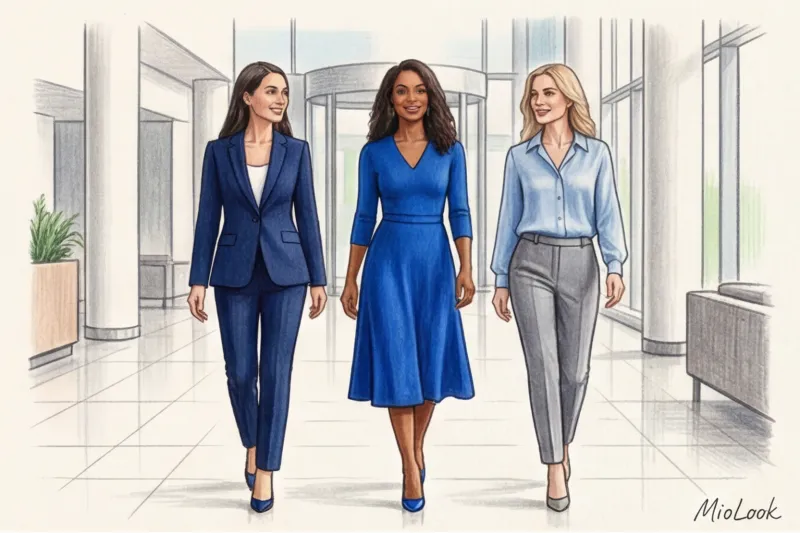
This is the most formal and historically rooted shade, originating in the uniforms of the British Royal Navy. Navy conveys reliability, financial stability, and ironclad logic. In 2020, the Pantone Color Institute named a similar shade (Classic Blue) the Color of the Year, noting its ability to "create a solid foundation in an era of uncertainty."
Ideal for: banking sector, law, meetings with old-school investors and first contacts with conservative partners.
Cobalt and Royal Blue: Dynamics and Leadership
This is a modern, intelligent alternative to red. While red screams aggressive sexuality or dominance, cobalt communicates charisma, innovation, and energy without the pressure. It's eye-catching without being too harsh on the eyes.
Ideal for: IT sector, marketing presentations, stage performances, and situations where you need to hold the audience's attention for a long time.
Blue and Cerulean: Empathy and Openness
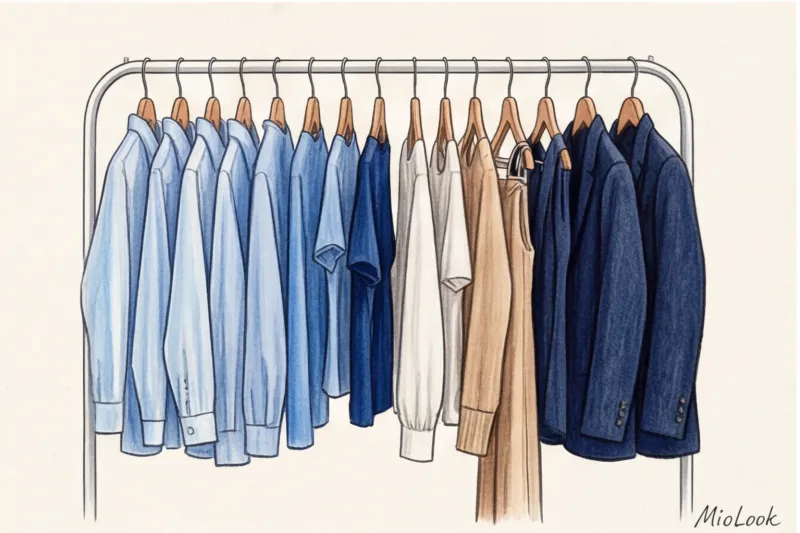
Light shades of blue dramatically reduce formality. They convey a willingness to listen, teamwork, and emotional intelligence. It's the color of a clear sky, which subconsciously calms.
Ideal for: HR directors, psychologists, brainstorming sessions and meetings dedicated to resolving corporate conflicts.
Your perfect look starts here
Join thousands of users who look flawless every day with MioLook. Our smart AI stylist will find the perfect blue shade for your skin tone.
Get access — €0.99 onceThe "safe blue" trap: when this color can be harmful
There's a dangerous myth that blue is indestructible. Over 12 years of working in fashion journalism and styling, I've seen dozens of disastrous looks built on a blind faith in the color's versatility. Blue doesn't always work and doesn't work for everyone.
The first pitfall is the "uniform effect." If you take a classic navy blue and pair it with an outdated, skimpy cut (for example, a fitted cropped jacket and a knee-length pencil skirt), you instantly transform into an early 2000s bank teller or a flight attendant. Blue is extremely conservative, so it requires an ultra-modern, relaxed, or architectural cut to look relevant.
The second problem lies in your skin temperature. This is a fair warning: cool, icy blue isn't flattering for everyone. If you have a warm, olive-toned skin tone, a cool blue shirt paired with harsh fluorescent lights in your office will give your complexion a sallow, downright sickly appearance. You'll look like you haven't slept in a week.

Textures Decide Everything: The Secret to Expensive Blue
Color doesn't exist in a vacuum—it's always tied to fabric. The same shade of navy blue, rendered in different materials, conveys diametrically opposed psychological messages.
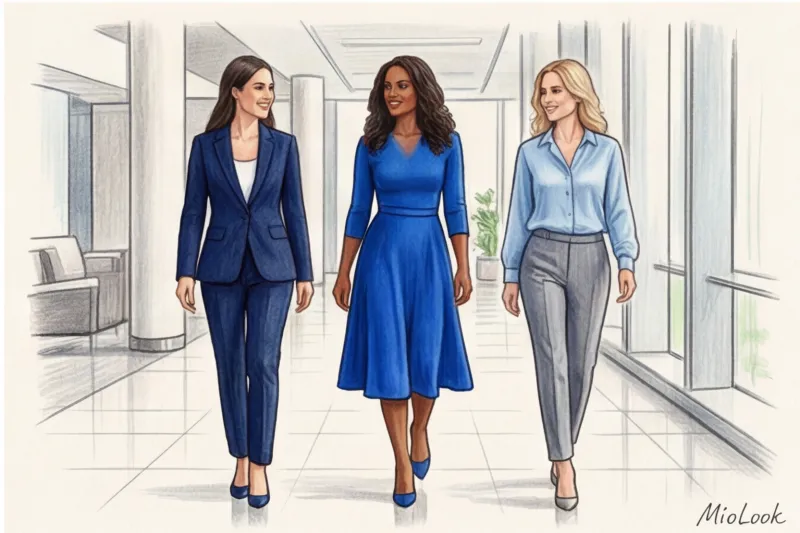
Cheap polyester or low-quality viscose with a characteristic glassy sheen instantly cheapens the look. Shiny blue screams frugality and undermines any sense of class. If you're on a budget, it's better to buy a garment made of thick cotton (at least 180 g/m²) than shiny synthetics.
Expensive blue always features matte textures that absorb light. 100s or 120s wool, dense cashmere, heavy crepe. These fabrics create a deep, bottomless hue. They convey that very "quiet luxury" (old money) that's so much talked about these days.
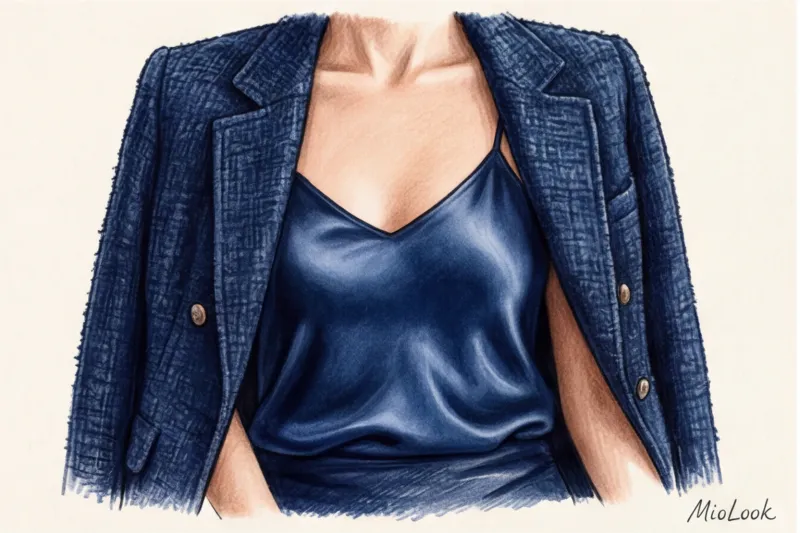
Professional secret: To prevent a monochrome blue look from looking flat, always contrast textures. Wear a matte, rough wool jacket with a smooth silk or cobalt satin blouse underneath. The difference in light reflection will create the desired volume and dynamism.
Blue in business attire for different scenarios
Let's move from theory to concrete life situations. Here's how I recommend using blue depending on your daily goal.
- For pitching investors: A three-piece suit or double-breasted jacket in midnight blue. This color is so dark it appears black until it's directly illuminated. It conveys absolute monumentality: "Your money is safe with me."
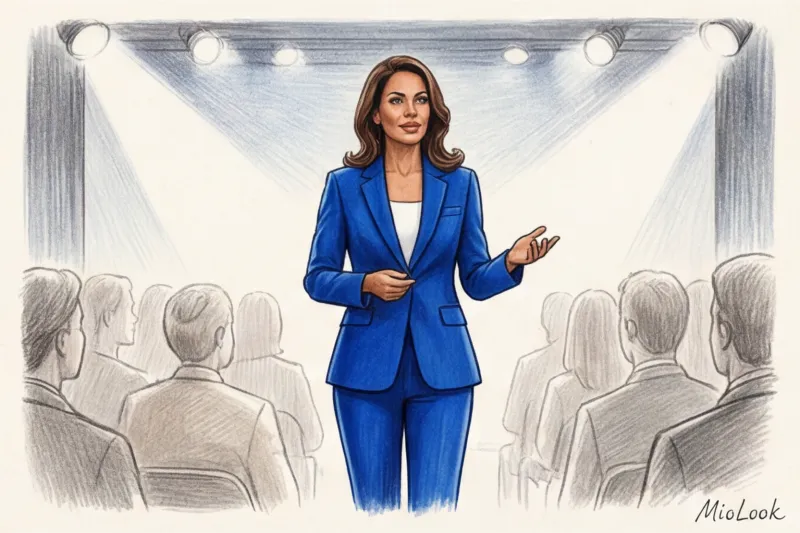
- For public speaking (TED format): Contrasting Royal Blue. Dark blue is absolutely out of the question on stage—you'll blend into the dark background or seats. A bright royal blue will make you stand out without strobing the camera.
- For Zoom meetings: Here, classic navy often plays a cruel joke. Due to poor lighting and video compression algorithms, dark blue turns into a shapeless black spot on the screen. For video calls, choose mid-tones—cornflower blue, muted azure, or light denim.
Access to MioLook for €0.99 — one-time payment
A smart AI stylist will select the perfect look for your next meeting or performance.
Get access — €0.99 onceWhat to combine blue with: status color formulas
Using Itten's color wheel, adapted to business realities, we can identify several surefire formulas that will work to increase your income and status.
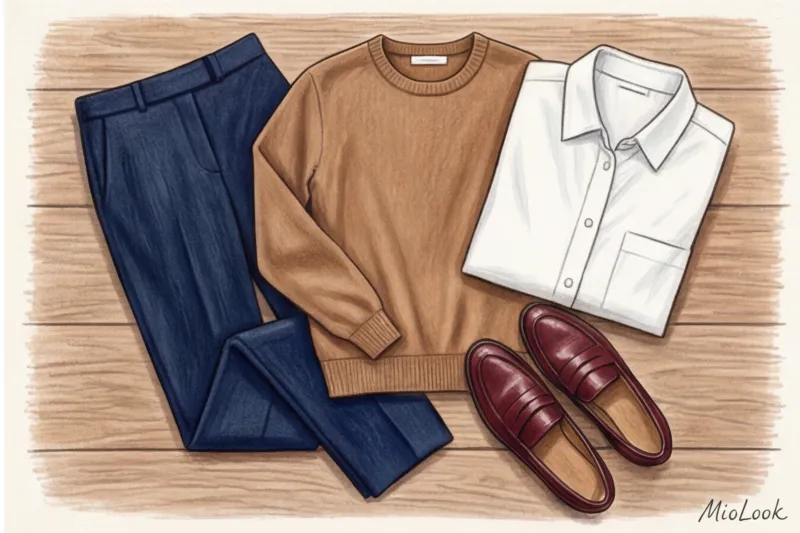
Blue + Camel / Burgundy. This is my favorite formula for status. Deep blue paired with a refined camel hue or burgundy accents (like leather loafers or a bag) looks far more expensive than plain blue and black. It's a European wardrobe classic.
Blue + White. An absolute, sterile classic. It conveys meticulousness, honesty, and a love of order. Ideal for auditors, accountants, and lawyers.
Blue + Emerald. A related combination for creative industries. It demonstrates your unconventional thinking, but keeps you within the bounds of business protocol.
What you should definitely avoid: Blue + Bright Yellow. Yes, it's a formally beautiful contrast, but in a strict dress code, this combination evokes associations with promoter uniforms. Too much contrast strains your opponent's eyes, and in negotiations, we want to relax them, not tense them.
By the way, if you are unsure which shades from your closet go together, I sincerely recommend using wardrobe digitization feature in MioLook You simply upload a photo of your clothes, and the algorithm shows you what will look best with your new blue skirt.
Checklist: Incorporating Blue into a Business Capsule Wardrobe
If you're ready to make blue your intellectual tool of influence, start small. You don't need to buy half a Massimo Dutti or COS store—just integrate it intelligently.
- Determine your base blue. Place a navy-colored fabric and a cobalt-colored fabric against your face in daylight. If you have a high-contrast complexion (dark hair, fair skin), choose the cobalt. If the contrast is medium or low, go for a muted navy.
- Invest in architecture. Buy a single, impeccable navy blue jacket, straight or slightly oversized. Make sure the fabric is matte.
- Add an accent. Buy a silk blouse in an azure shade. It will brighten your complexion and illuminate a formal dark suit from the inside.
- Conduct a lighting test. Never wear a new blue item to an important meeting without checking how it looks under artificial office lighting. Some shades of blue can have a cheap purple undertone under the lamps.
Blue in business attire is a hidden lever of control. It doesn't shout about your status like the logos of heavy luxury brands, nor does it shut you off from the world like a blank wall like all-black. Blue invites your interlocutor to engage in intellectual dialogue, in which you initially assume a strong yet empathetic stance. Find your ideal shade, pay attention to matte textures, and you'll be surprised how much easier your most challenging negotiations become.