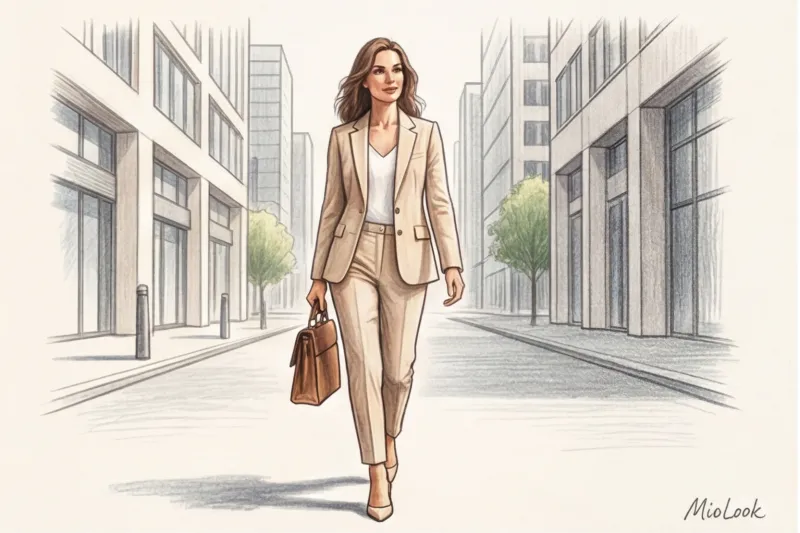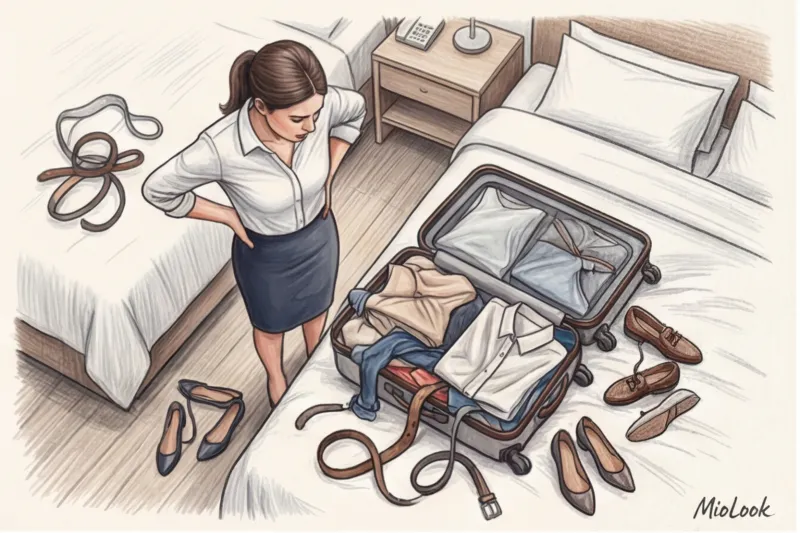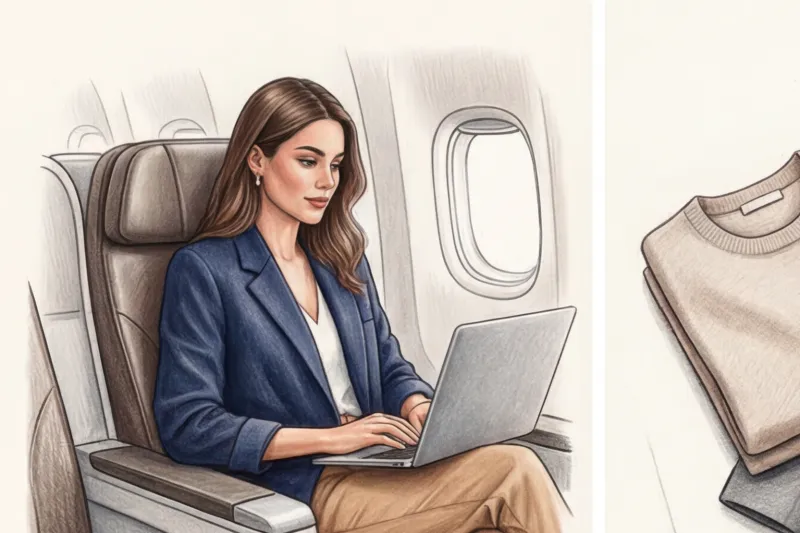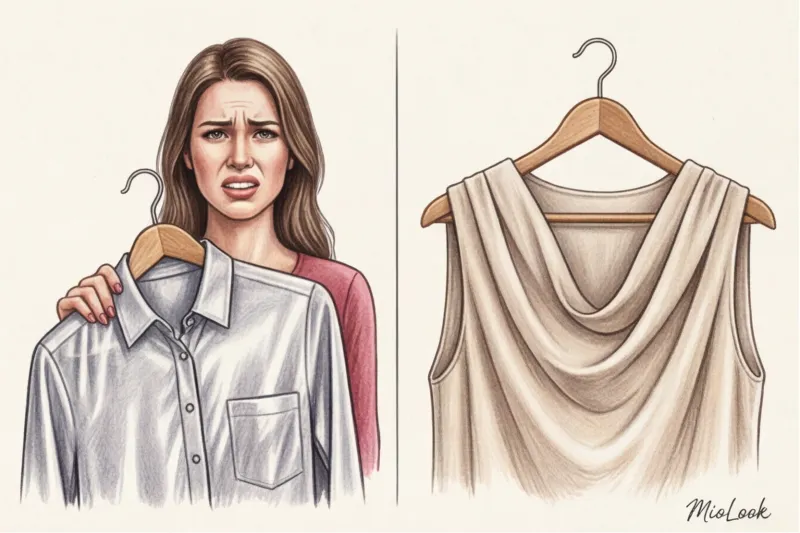
A few years ago, a client, a top manager at a large IT company, approached me. Her schedule was a logistical nightmare: a flight from snowy Moscow to Dubai, 45 minutes to get out of the airport, and then straight to the boardroom. "Camilla, I need a suit I can sleep in on the plane and then walk out to investors looking like I just got out of the dry cleaners," she said. It's at times like these that the question of... What fabric doesn't wrinkle? , ceases to be a theory and becomes a question of the survival of your reputation.
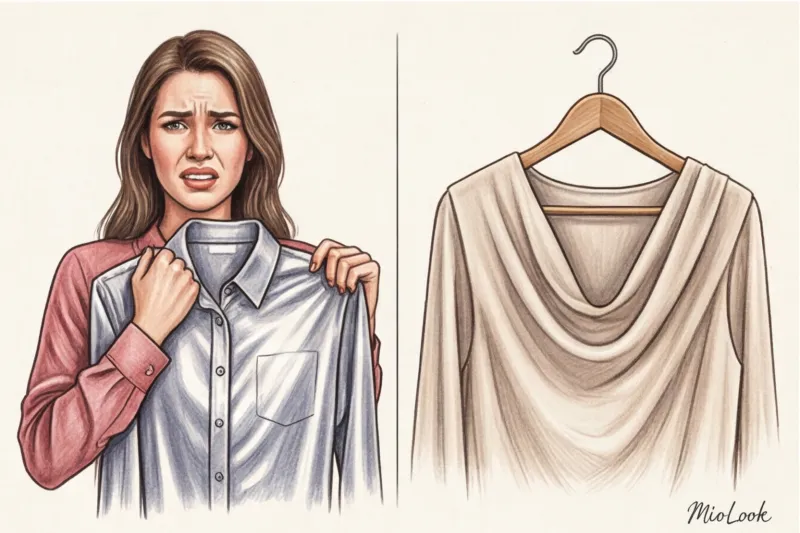
Usually, stylists respond to this request with the clichéd advice: "Buy polyester." But after 12 years of working at Fashion Weeks from Paris to New York, I've learned one lesson: the ideal travel fabric is determined not only by its composition but also by the yarn's structure. Cheap synthetics won't wrinkle, but they will give away their glossy sheen and odor. We've covered the basic principles of creating a base layer in more detail in our A complete guide to fabrics for the smart capsule , and today we'll dig deeper. I'll teach you to distinguish cheap, dented pieces from status pieces and find the pieces that work for you, not against you.
The Illusion of "Reinforced Concrete" Objects: Why the Wrinkle-Free Label Can Be a Trap
The "Non-Iron" label on a cotton shirt has a hypnotic effect on shoppers. It seems like technological magic. In reality, it's often a chemical trap.
One of my clients once bought such a crisp white shirt for an important presentation. After twenty minutes of speaking under the spotlights, she was literally suffocating from the greenhouse effect. Why is this? According to a 2023 report by the WGSN Textile Institute, to create a wrinkle-free effect, cotton fibers are impregnated with formaldehyde resins. This chemical "bath" permanently bonds the cellulose molecules. The fabric does indeed stop wrinkling, but it also loses its breathability. You end up with a plastic shell instead of clothing, and the impregnation itself washes out without a trace after about 15 cycles in the washing machine.
An even greater danger lurks in 100% cheap polyester. Sure, if you throw a €20 blouse like that in your suitcase, it'll come out smooth. But a 2021 study by the University of Alberta revealed alarming statistics: synthetic fibers without special antibacterial treatment retain odor-causing microorganisms 200% more effectively than natural fabrics. Cheap polyester becomes staticky, sticks to tights, and produces that signature "plastic" sheen in the light.
Your perfect look starts here
Join thousands of users who look flawless every day and pack stress-free with our smart app.
Get access — €0.99 onceWhat fabric is wrinkle-resistant and breathable: searching for the ideal composition for the office
The golden rule I always emphasize during shopping sessions is that there are no 100% natural fabrics that are absolutely wrinkle-free. Cotton, linen, and silk in their purest form will wrinkle—it's just physics. The secret to the perfect business wardrobe lies in the right blend of fibers and the right processing techniques.
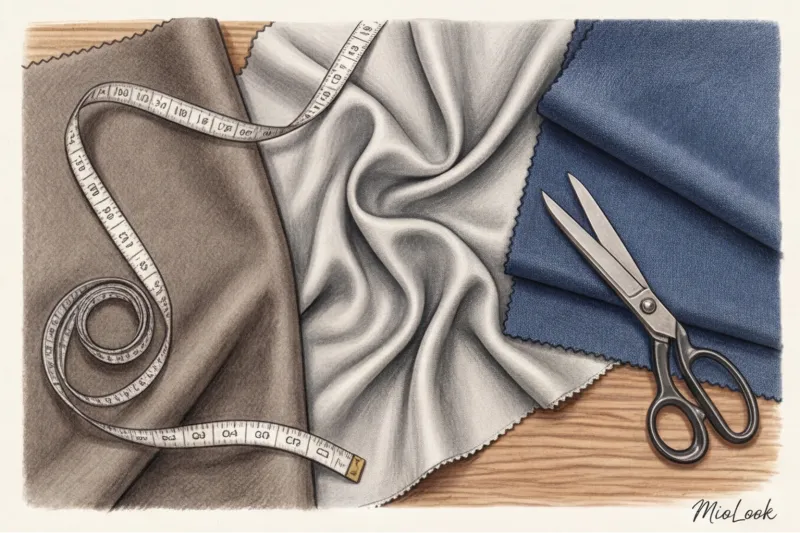
Smart synthetic fibers: Tencel, cupra, and Japanese triacetate
If you walk into a premium brand's boutique (like Theory or the senior COS lines) and look at the price tag on trousers priced at €150–€250, you'll be surprised to see triacetate included. To many, this sounds like "cheap synthetics," but Japanese triacetate is a secret weapon among business wear buyers.
Unlike regular polyester, which is made from petroleum products, triacetate is made from purified wood pulp. Its porous structure allows for excellent breathability while still maintaining a creased appearance, as if the fabric had just been steamed.
For blouses and dresses, I recommend looking for Tencel (lyocell) and cupra. These are heavy, flowing materials. Their main advantage is that they sag under their own weight. Even if you wrinkled your Tencel skirt a little while sitting in a taxi, just walk for five minutes, and the fabric will smooth out under the influence of body heat and gravity.
Natural fabrics with a special twist (High-Twist)
At the recent Première Vision textile exhibition in Paris, high-twist fabrics were a hit. The most famous example is Fresco wool.
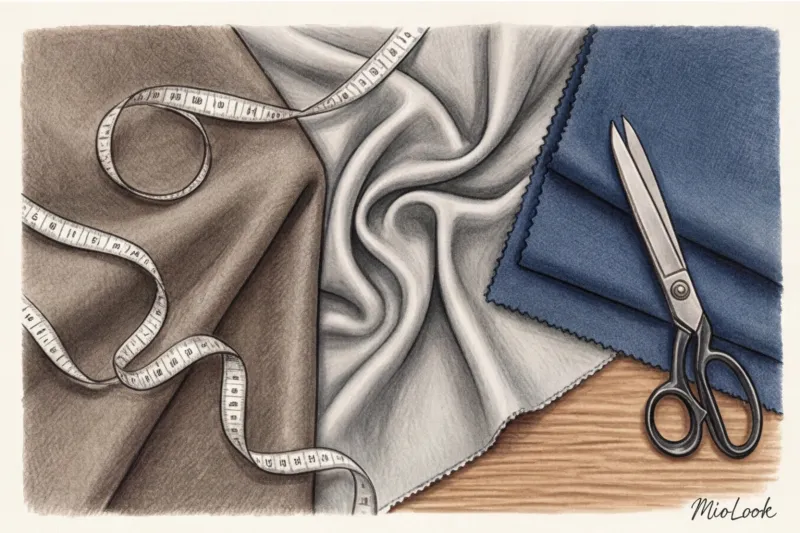
How does it work? The wool thread is twisted several times more tightly than normal. As a result, it resembles a taut, microscopic spring. When you sit down, the fabric crumples, but as soon as you stand up, the thread "springs back" to its original state. A suit made of Fresco wool or wool crepe can survive a transatlantic flight looking flawless.
The same goes for silk. Fine satin will develop micro-creases before you've even finished your morning coffee. But heavy crepe de Chine (a dense, grainy silk) will stay smooth all day thanks to its strong twist.
Correct Mixing Compositions: The Golden Formula
If you're not ready to invest in high-tech Japanese fabrics, look for the right balance on the labels. The ideal formula for a casual office suit in the mid-price range (€80–€150) looks like this:
- 70-80% natural base: wool for winter, thick cotton for summer (responsible for thermoregulation).
- 15-25% polyamide or high-quality viscose: adds wear resistance and prevents deep creases.
- 2-5% elastane: critical component.
Many people think elastane is only needed to make clothes stretch. In fact, its main function is to restore shape. It's the 3% elastane in the composition that prevents the knees of trousers and elbows of jackets from stretching out by the end of the workday.
Weaving Architecture: Why Texture is More Important than Composition
You can buy a shirt made from the perfect blend, but it will still look sloppy if you get the texture wrong. As a stylist who regularly prepares speakers for video shoots, I know: light is texture's best friend and gloss's worst enemy.
Smooth fabrics (satin, satin, fine poplin) act like mirrors. Due to the refraction of light, even the smallest wrinkle will be visible on a glossy surface. Therefore, I never recommend smooth, thin skirts for long periods of sitting in the office.
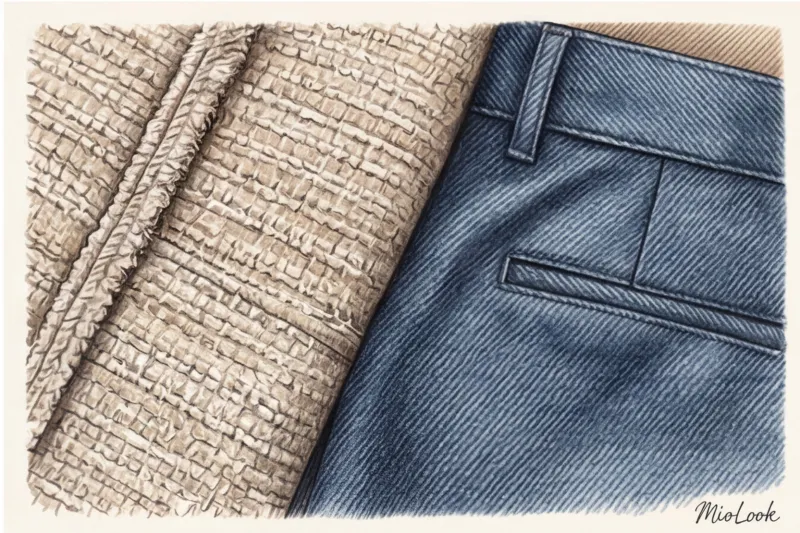
"Texture absorbs shadows. The more textured the fabric's surface, the less visible creases are, because the material's structure itself creates micro-shadows that mask the wrinkles."
What to choose instead of smooth textures?
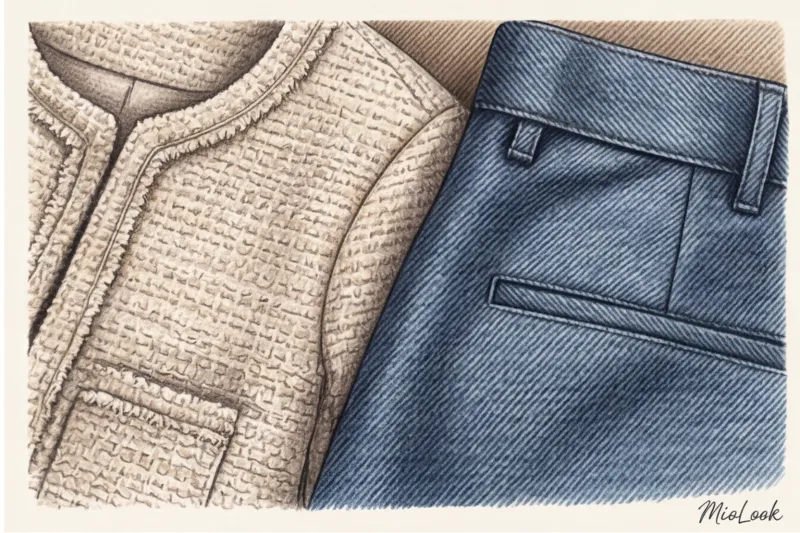
- Gabardine: A dense fabric with a fine diagonal rib. Ideal for trench coats and tailored trousers.
- Boucle and tweed: a loose, voluminous structure is physically incapable of forming sharp folds.
- Pique: ribbed or honeycomb fabric (like on classic polo shirts).
Access to MioLook for €0.99 — one-time payment
A smart AI stylist will select the perfect look for the office, taking into account textures, colors, and your personal style.
Get access — €0.99 oncePacking for a Business Trip: A Capsule That Doesn't Need an Iron
Let's get back to my client Elena. That day, a capsule of five items flew to Dubai, covering all her needs for three days without ever having to iron. This is the universal set:
- Loose jacket made of Japanese triacetate.
- Wide trousers made of wool crepe (with the addition of 3% elastane).
- Blouse made of heavy silk (crepe de chine).
- Midi dress made of thick viscose (ribbed texture).
- Basic top made of thick knit viscose jersey.
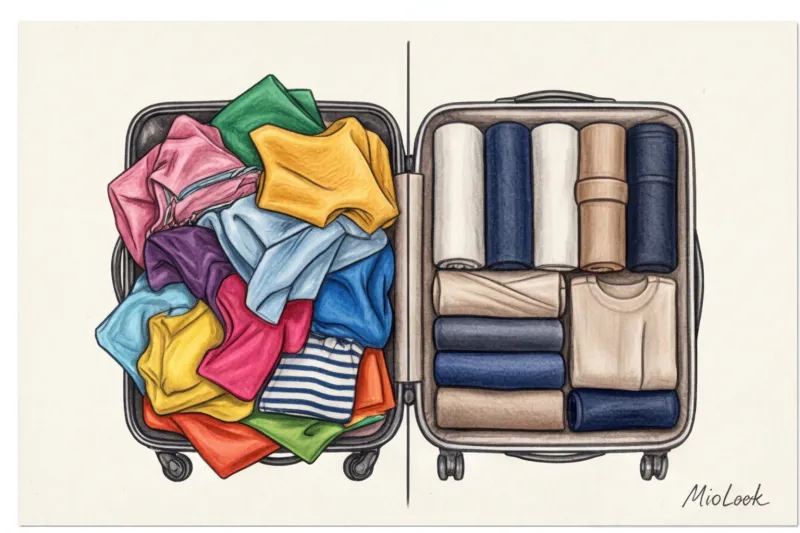
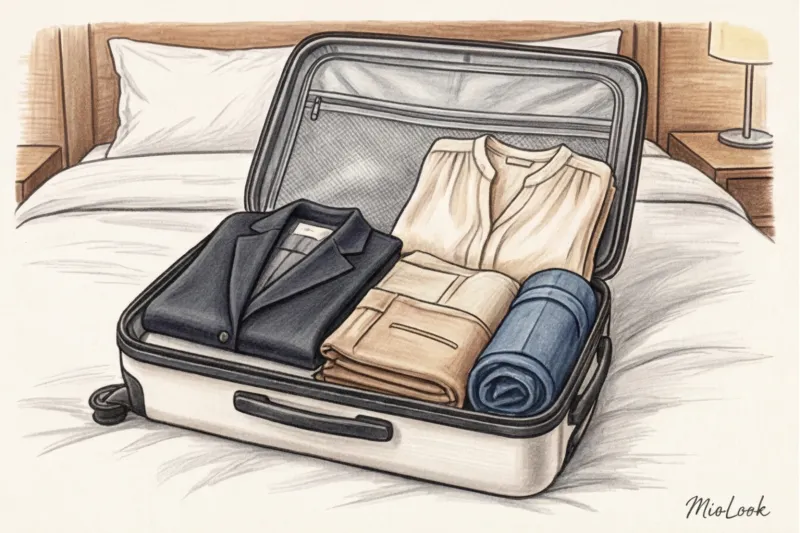
The secret isn't just in your clothes, but also in how you pack them. Forget about stacking them—the weight of the top layers will inevitably cause sharp creases at the folds. Roll your clothes into tight rolls. Fold pants in half along the crease and roll them from the bottom to the waistband.
And finally, the famous "hotel shower secret." If your item is slightly wrinkled upon arrival, hang it on a hanger in the bathroom, turn on the hot shower for 10 minutes, close the door, and let the steam do the work. The fabric will absorb the moisture and straighten out under its own weight.
Important limitation: This life hack absolutely does NOT work for classic jackets with a rigid adhesive backing (ribbing) in the chest area. Hot steam can cause the adhesive backing to peel off, causing the jacket to develop irreparable blisters. This method can only be used on blouses, dresses, and unstructured soft jackets.
Test Drive in the Fitting Room: How to Check Materials Before Buying
Never rely solely on the composition label. Weaving technologies today are so diverse that two rolls of fabric with the identical composition "95% cotton, 5% elastane" can behave completely differently.
In boutiques, I perform a professional test that takes exactly 10 seconds. You can try it yourself:
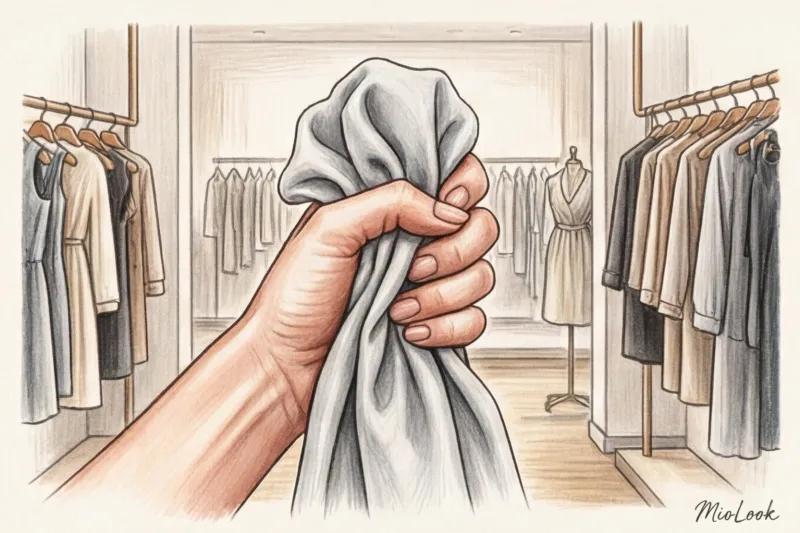
- 10 Seconds in a Fist Technique: Take the edge of the garment (preferably the hem or sleeve, where there are no seams) and squeeze it tightly in your fist. Don't be stingy; squeeze as tightly as you can. This simulates the pressure the fabric experiences when you sit in an office chair.
- Recovery Test: Open your palm sharply. The perfect fabric will spring back and begin to unravel before your eyes.
- Heat test: If any slight creases remain, run a warm hand over them once or twice. High-tech blends and high-quality wool respond to body heat and instantly remove small creases. If the fabric looks like chewed paper after this, hang the garment back on the rail.
Also, always pay attention to the mannequins in the showroom or the samples on display. Look at the elbows and the creases of the hips—if an item has already stretched or wrinkled simply from being placed on a plastic figure, it will look the same on a real person within an hour.
Status wrinkles: when folds work for your image
Finally, I want to challenge the popular stereotype that a successful woman should always be ironed to the point of being cardboard. In the premium segment, there is a concept sprezzatura — an Italian term meaning thoughtful, expensive carelessness.
According to a 2024 McKinsey research report on the evolution of luxury, today's premium consumers increasingly embrace "visual naturalness" as a status symbol. What does this mean in practice? Perfectly ironed, stiff linen often looks like a cheap, polyester-infused knockoff. But heavy suit linen (costing from €200 per item), which develops soft, large, natural folds around the elbows and knees, screams eco-friendliness and premium price.
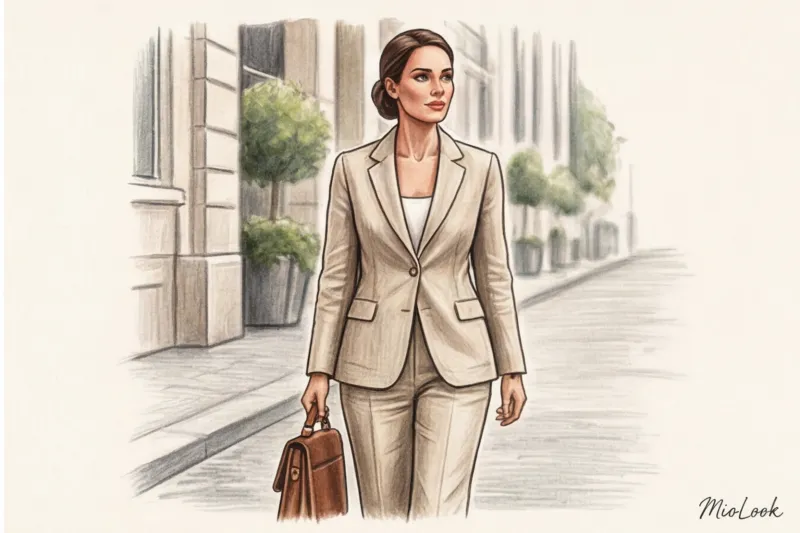
If smart casual is acceptable in your office, don't be afraid to wear premium fabrics that wrinkle easily in the summer (wild silk, linen, ramie). The key to wearing these pieces without looking like you've been sleeping on the job is to play with contrasts.
If you're wearing a wrinkled linen suit, your shoes should be immaculately clean and crisp, your bag structured (no soft tote bags), and your hair styled to perfection. The crisp, clean lines of your accessories offset the relaxed feel of the fabric, elevating the look from sloppy to classy.
Ready to get started?
Try the MioLook plan for free—no commitments required. Organize your wardrobe and plan your looks in just a few clicks.
Get access — €0.99 onceChoosing fabric isn't just about finding a compromise between beauty and comfort. It's about understanding how a material works dynamically. Next time you go shopping, don't look for "wrinkle-free" labels. Look for the right yarn twist, clever additions of elastane, and textures that work as optical illusions. And remember: the perfect wardrobe is one that serves you, not one that makes you iron.