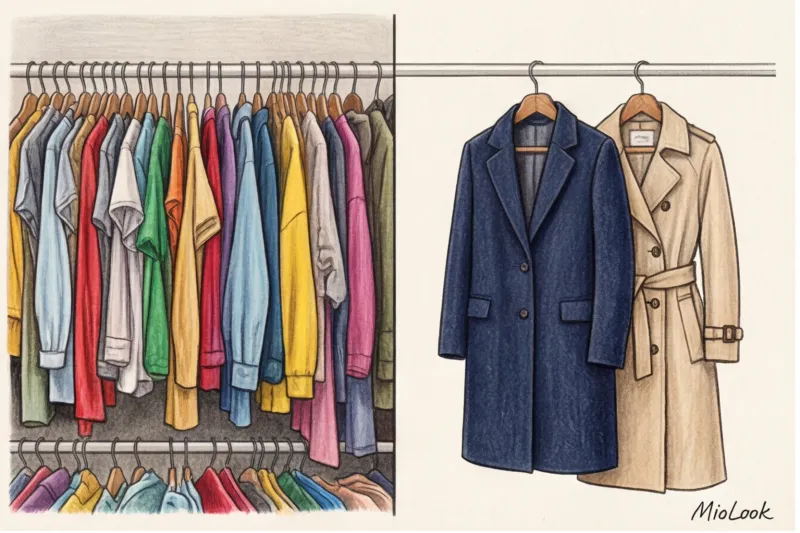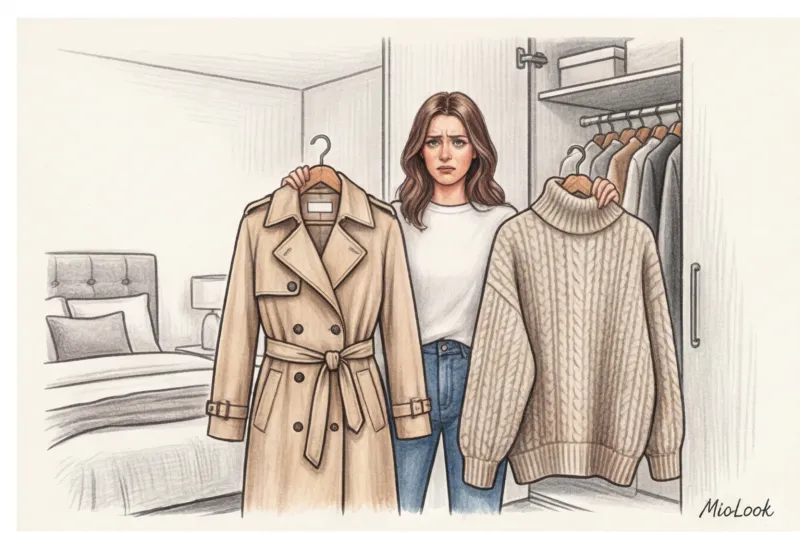
Elena is 34 years old, works as a project manager, drives every day, and before we met, she had 15 jackets and coats hanging in her closet. Every autumn morning, she would start with a panic: "I have nothing to wear with this dress" or "This sweater makes me look like a cabbage." Sound familiar? In 14 years of working as a personal stylist, I've learned: the problem is never the number of clothes. The problem is the lack of a system. A properly organized wardrobe basic outerwear wardrobe solves this problem once and for all.
For decades, the industry has been hyping us up to buy a new jacket every season. But the rules have changed. We've covered the evolution of silhouettes and long-term trends in more detail in our comprehensive guide: Fashionable outerwear: current styles and trends Today I want to talk not about fleeting trends, but about the mathematics of style—how to assemble the perfect capsule wardrobe that will last for years.
The Anatomy of the Ideal Capsule: What's Today's Basic Outerwear Wardrobe?
We are experiencing a global paradigm shift. According to the analytical agency WGSN, demand for extravagant outerwear with complex embellishments fell by 34% in 2024. Microtrends have been replaced by the concept modern classics (modern classics), which The Business of Fashion regularly writes about in its reports.
What does this mean in practice? A basic outerwear wardrobe today is a balance between relaxed comfort and strict, architectural lines. Jackets with complex designs, an abundance of zippers, rhinestones, or unnaturally exaggerated shoulders are the quickest to end up on the back shelves because they dictate the look rather than adapt to it.
"A modern base is a canvas. Your outerwear should be simple enough to pair with both a business suit and a sporty hoodie"—this is a rule I repeat during every wardrobe review.
The statistics are relentless: 80% of the time, a woman wears only 20% of her outerwear. To be in that 20%, a piece must be functional. If you want to understand which silhouettes are sitting idle in your closet, I highly recommend digitizing your pieces using MioLook — Artificial intelligence will clearly show you the gaps in your capsule.
Cost to Wear (CPW) Index for Jackets and Coats
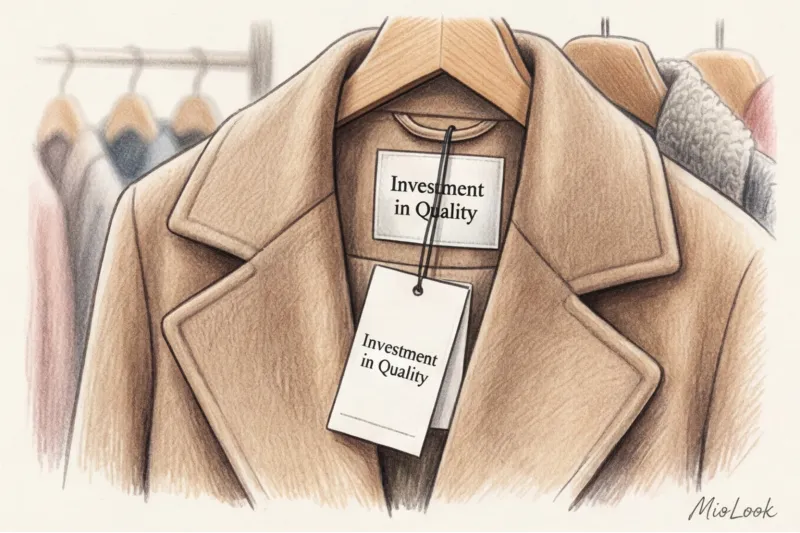
Before we get into specifics, let's learn how to count money like a stylist. I always use the Cost Per Wear formula: (Price of the item + Dry cleaning cost) / Number of times.
Let's compare two purchases:
- Ultra-fashionable neon down jacket for €100 You'll wear it 10 times a season because it gets boring quickly and doesn't go with everything. CPW = €10 per outfit.
- A perfect basic coat made of quality wool for €400 You'll wear it 50 days a year for at least 3 years (150 outings). Add €50 for dry cleaning. CPW = €3 per outing.
A coat that seems four times more expensive at the checkout actually costs you three times less. We're not just buying fabric—we're buying warmth, status, and peace of mind in the morning.
Access to MioLook for €0.99 — one-time payment
A smart AI stylist will analyze your outerwear and select the perfect looks for every day.
Get access — €0.99 onceThe Beige Trench Coat Myth: Why There's No One-Stop List
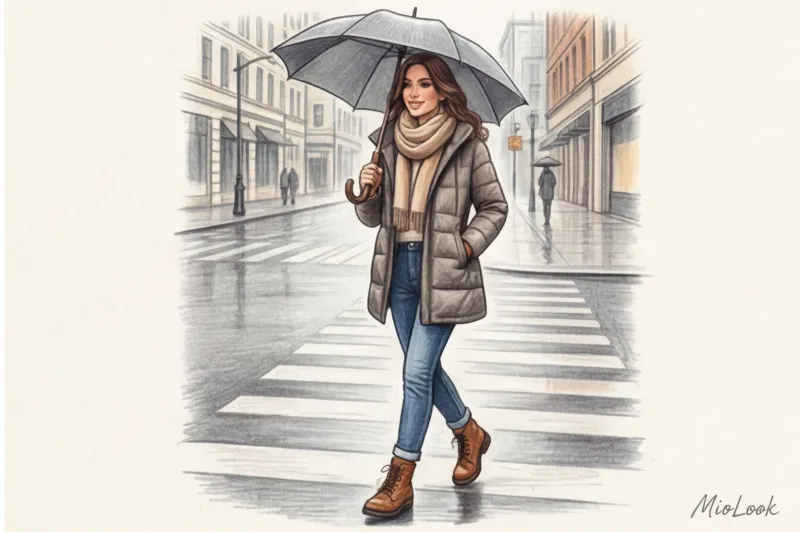
If you open a glossy magazine from 2015, you're guaranteed to find the phrase, "A beige trench coat is a must-have for every self-respecting woman." As a practicing stylist, I can officially declare: it's the most overrated staple in the history of wardrobe essentials.
Yes, if you live in Milan or Madrid, a trench coat is magnificent. But for the 80% of women living in cold climates, battling piercing winds, or jumping behind the wheel of a car every day, a classic double-breasted trench coat made of heavy gabardine is completely unusable. It hangs in the closet 350 days a year: it's too cold for winter, too easily soiled for the rainy off-season, and driving in a stiff, knee-length trench coat is simply uncomfortable.
Instead of blindly copying “Must-Have” lists, I offer my clients a system Three Habitats:
- Office / City: meetings, theaters, restaurants (structural lines are needed here).
- Weekend / Comfort: walks, trips out of town, shopping (layers are king here).
- Bad weather / Extreme: rain, slush, severe frost (fabric technology is important here).
Honestly assess your commute from home to work. If you're a stay-at-home mom, you don't need a double-breasted maxi coat. If you're a top manager, a parka jacket won't do.
The basic minimum: 4 pieces of outerwear that will cover 90% of your needs

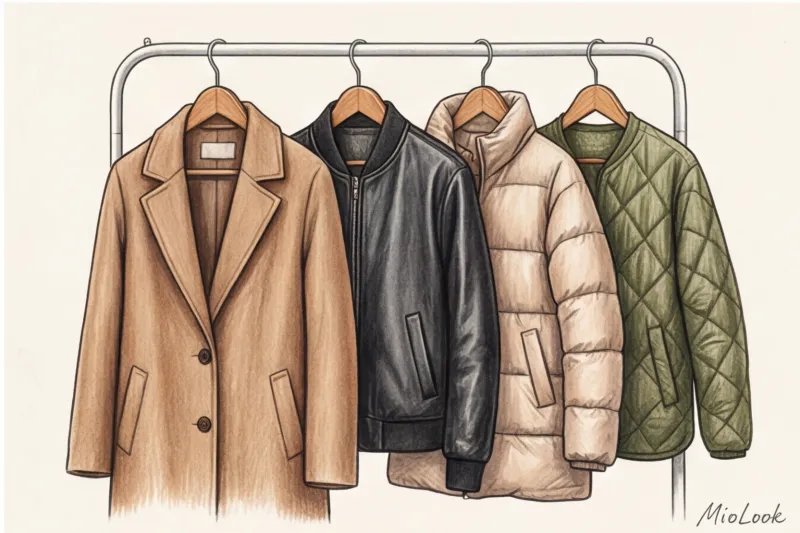
Over the years, I've developed a formula consisting of four elements. These pieces are easy to mix and match and are a lifesaver in any situation. By eschewing microtrends in favor of these architectural silhouettes, my clients save up to 40% of their seasonal budget.
1. Structured midi or maxi coat
It should have a strong shoulder line (an element of power dressing), but a loose enough cut (straight or slightly oversized) to accommodate a heavy sweater or jacket. Colors: camel, graphite, deep navy, or chocolate. Black often looks too flat if the fabric is inexpensive.
2. Quilted jacket (liner)
The perfect alternative to a beige trench coat. A thin quilted jacket in a matte shade (olive, ecru, black) works as a standalone piece in warm autumn and as an extra insulating layer under a light coat in winter.
Look formula: quilted jacket + cashmere turtleneck + straight jeans + loafers = perfect Italian relaxation.
3. Leather bomber jacket or new generation biker jacket
Classic biker jackets with their abundance of chrome hardware are giving way to simple leather bombers and minimalist straight-cut jackets. The lack of unnecessary details makes these pieces a statement piece and allows them to be worn even over silk slip dresses.
4. Basic mid-length down jacket
The key rules for a basic down jacket are: matte (not shiny!) fabric, hidden hardware, no fur trim on the hood, and no elastic waistband. The volume should be moderate—the era of hyper-oversized, elevator-friendly jackets is over.
Your perfect look starts here
Join thousands of users who look flawless every day with MioLook. Digitize your jackets and coats in 5 minutes.
Get access — €0.99 onceInvesting in Quality: How to Choose Fabric That Won't Pill
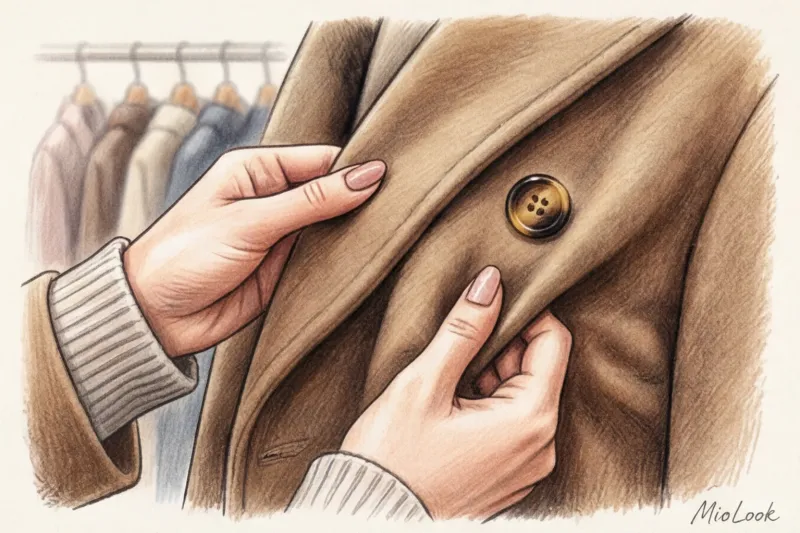
The most annoying thing is to buy a beautiful coat and two weeks later discover telltale pilling on the sleeves and sides. As a stylist, I spend hundreds of hours in stores and always do a tactile test before taking the item to the fitting room.
The secret to reading labels lies in the proportions. Many people think 100% wool is ideal. But that's not always the case. A coat made from 100% loose wool will lose its shape and pill much faster than a blended fabric. 70-80% wool and 20-30% polyamide (nylon) Synthetic thread acts as a scaffold, holding natural fibers together. However, if the composition is more than 30% acrylic or polyester, hang the item back up—you'll sweat in it on the subway and freeze outside.
My personal test drive in the store:
Take the edge of the sleeve and lightly (without excessive force, to avoid damaging the garment) rub the fabric against itself for 10 seconds. If a light fuzz immediately forms on the surface, it will become pilled within a week.
Hardware is the main indicator of price. Mass-market brands often skimp on it. Horn buttons (or high-quality imitation buttons), hidden zippers that match the fabric, and a thick viscose lining (rather than rustling polyester) instantly elevate a jacket to the "looks expensive" category.
Stylist Secrets: How to Incorporate Outerwear into Business and Casual Wardrobe

One of the common problems my business clients face is how to pair a business suit with a warm jacket without looking like a schoolgirl wearing a down jacket over her uniform. The secret lies in matte textures. If you need a down jacket for the winter office, choose a straight-cut, unstitched style (with the quilted seams hidden inside). Visually, this looks like a puffer coat.
Combining lengths is a separate science. The golden rule: the length of outerwear should either completely cover the skirt/dress, or be at least 15-20 centimeters shorter The hem of the skirt sticking out 3 centimeters from under the coat cuts the silhouette and looks sloppy.
When this rule does NOT work: If you're wearing a maxi skirt and a cropped, waist-length bomber jacket, the contrast in volume works to your advantage, creating the perfect proportions for your legs, but it requires the bomber jacket to sit perfectly at your waist.
Don't forget about accessories for a Mediterranean chic look. A voluminous cashmere-blend scarf in a deep wine or emerald shade and quality leather gloves can elevate even an inexpensive basic down jacket (€70–€120).
Checklist: Audit your outerwear before the new season
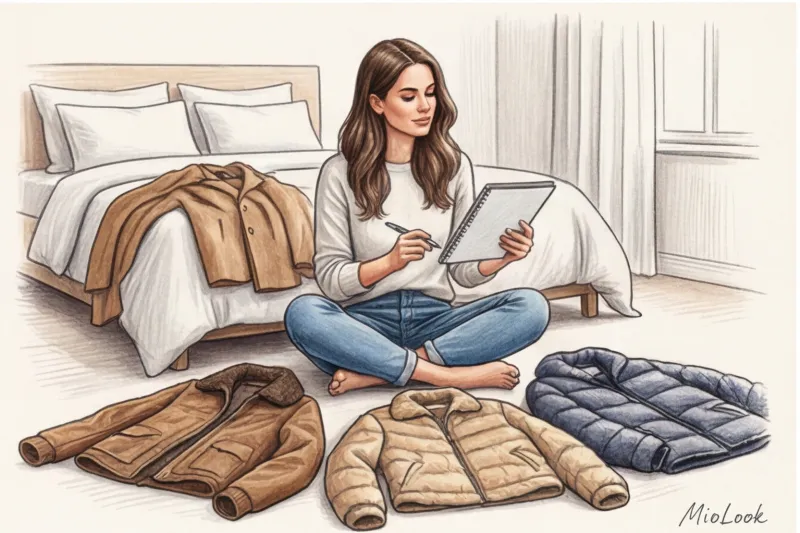
Never go shopping without first doing your homework. I offer a step-by-step algorithm that takes just 40 minutes but can save you hundreds of euros:
- Step 1: Get everything out. Lay out every jacket, coat, raincoat, and vest on the bed. Divide them into three piles: "Worn constantly," "Worn rarely (only with a specific dress)," and "Haven't worn in over a year." The last pile should be sold or recycled.
- Step 2: Check the status. Take a look at your favorite items. Take that shiny collar to the dry cleaner. Buy a lint remover and revive that wool coat. Replace cheap plastic buttons with horn ones—it's a fantastic styling trick.
- Step 3: Make a list. Look at the remaining inventory. What's missing from your "Three Habitats"? Write down a specific goal, such as "A mid-thigh, khaki quilted jacket."
- Step 4: Digitization. Upload photos of the remaining items to MioLook The app will help you create ready-made outfit formulas for your sweaters and jeans, so you can simply open your phone in the morning and know what to wear.
Your Personal Renewal Plan: From Quantity to Quality

Building a basic outerwear wardrobe is a marathon, not a sprint. Don't try to buy all four key pieces in one shopping trip. Avoid impulse buys during mid-season sales when you're tempted to reach for that neon jacket at 70% off. It's better to invest €250-350 in one flawless coat than to buy three mediocre pieces that you'll feel insecure in.
Style is always about self-confidence. In the urban jungle, where inclement weather reigns for half the year, the right outerwear becomes your personal armor. It should protect you, keep you warm, and at the same time convey to the world, "I know who I am and I'm comfortable in my skin."
Start auditing your wardrobe today, create a strict shopping list, and remember: the perfect wardrobe isn't one with too many items. It's one in which every single item works for you.
Ready to get started?
Try the free plan—no commitments required. Start creating a capsule wardrobe where everything coordinates perfectly.
Get access — €0.99 once