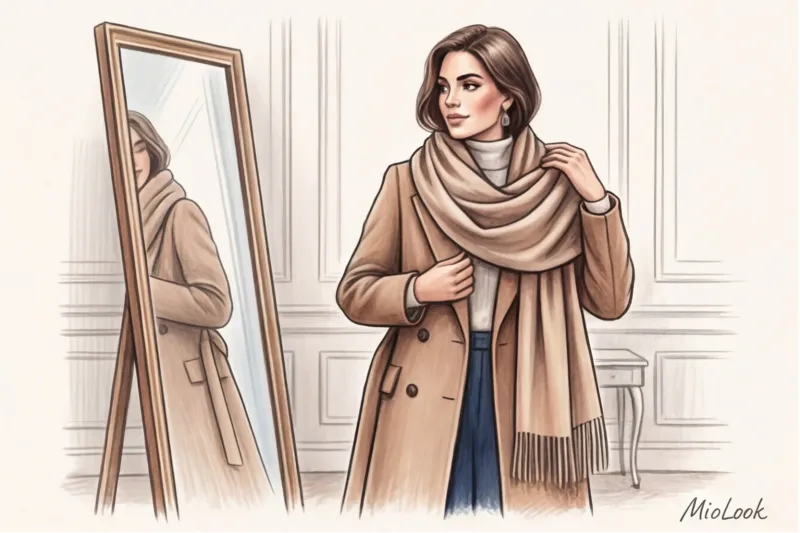
Have you ever considered that we spend about 80% of our wardrobe budget on dresses, blouses, and those perfect trousers that others only see for half the year? In our climate, there's a ruthless "six-month rule." For six months, coworkers on the street, baristas at coffee shops, and random passersby only see your "facade"—what you wear over your main outfit. That's why basic outerwear — it’s not just a utilitarian thing for warmth, it’s the main stylistic cement of your image.
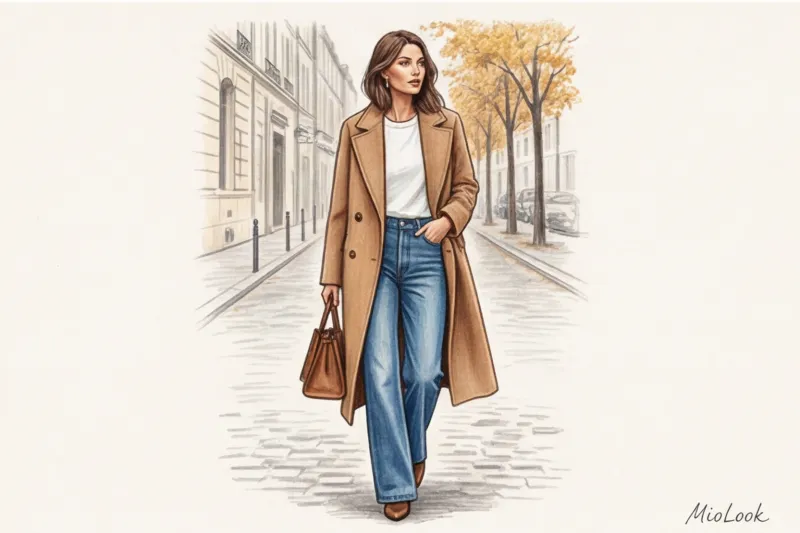
We talked about the foundation of personal style in more detail in our The complete guide to the perfect basic wardrobe for a woman However, outerwear deserves a separate, almost architectural approach. Over 12 years of working as a stylist and regularly attending Fashion Weeks, I've learned one important thing: a luxurious coat can stretch out even the most stretched-out sweatpants, whereas a cheap jacket will instantly ruin the impression of a cashmere sweater costing hundreds of euros.
Basic Outerwear: Why Your Style's Facade Matters More Than Its Interior
At Paris Fashion Week, I love watching not only the runway but also the glossy editors rushing out for coffee early in the morning. Do you know what their secret is? Under their impeccable, voluminous basic coats, they often conceal simple tracksuits, and sometimes even pajamas. But thanks to the perfect cut and texture of the outer layer, their looks consistently catch the eye of street style photographers.
The right basic outerwear acts as a filter: it pulls an outfit together, conceals minor proportional imperfections, and sets the tone. Today, we'll debunk the stereotype that basics are necessarily boring and dull, and learn how to choose pieces based on a strict Cost Per Wear calculation and the percentage of fabric content.
By the way, to visually evaluate how your new coat will match your existing wardrobe, I recommend digitizing your items. Upload photos of your sweaters and pants to MioLook app — its algorithms will help you create dozens of multi-layered outfits before you even go to the checkout.
Your perfect look starts here
Join thousands of users who look flawless every day with MioLook. Digitize your wardrobe and create smart capsule wardrobes in one click.
Get access — €0.99 onceThe Anatomy of the Perfect Coat: Cut, Composition, and Hidden Details
If I were asked to keep only one item in my wardrobe, it would be a high-quality double-breasted midi coat. The iconic Max Mara 101801, created in 1981, is considered the epitome of this cut. Its secret lies not in the brand, but in its design: dropped shoulders and kimono sleeves. Unlike a stiff set-in sleeve, this cut allows you to wear a thin silk blouse or the most voluminous men's jacket underneath. The coat won't bunch up or restrict movement.
Length also matters. Midi or maxi are the optimal choice. Short, knee-length coats cut into the silhouette when worn with a skirt or dress of a different length, creating a sloppy, layered look. A midi, on the other hand, covers everything, creating a single, elongated vertical line.
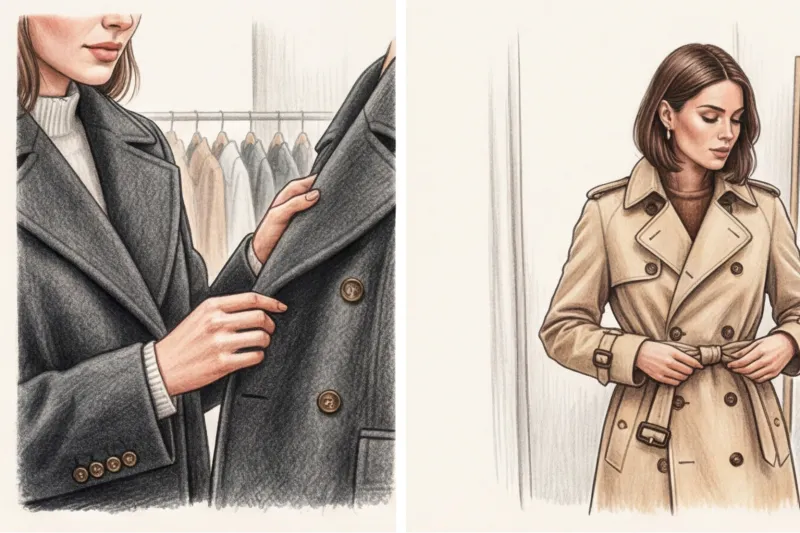
"A coat doesn't keep you warm by its thickness, but by the proper ventilation of its fibers. If it's less than 70% natural wool, you're buying a greenhouse in which you'll sweat on public transport and shiver in the wind."
Look for the cherished 70/30 rule on tags: a minimum of 70% natural fibers (virgin wool, alpaca for lightness and fluffiness, or cashmere for softness) and a maximum of 30% synthetics (polyamide or nylon). This amount of synthetics is beneficial—it prevents the fabric from pilling quickly and keeps its shape.
Why the Black Coat Is a Trap (and What to Choose Instead)
The most pernicious style myth is, "Buy a black coat; it goes with everything." In practice, a black coat is the worst choice for basic outerwear.
- Practicality is zero: Every lint, speck of dust, and hair of your pet is visible on black cloth. By midday, it often looks unkempt.
- Light absorption: On cloudy winter days, black fabric looks flat, absorbing light and highlighting the winter pallor of the face, accentuating the shadows under the eyes.
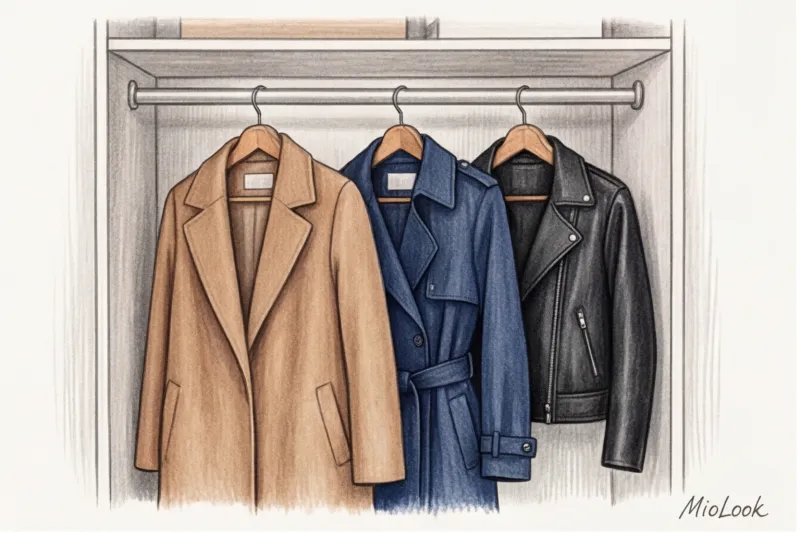
If you want to look expensive, choose alternatives: camel (from sand to dark caramel), deep navy, graphite gray, or dark chocolate. According to the 2024 WGSN report, it is the café au lait and rich graphite colors that show the longest lifespan in consumers' wardrobes.
The Classic Trench Coat: From the Trenches of World War I to the Streets of Paris
The history of the trench coat is a shining example of how utility becomes aesthetic. In 1914, Thomas Burberry received a commission to create raincoats for British officers. He used his patented gabardine—a dense, diagonally woven cotton fabric that repelled water. Every detail of the trench coat had a specific function: the epaulettes served to attach insignia, the back yoke diverted rainwater from running down the trousers, and the D-rings on the waistband were used to attach grenades.
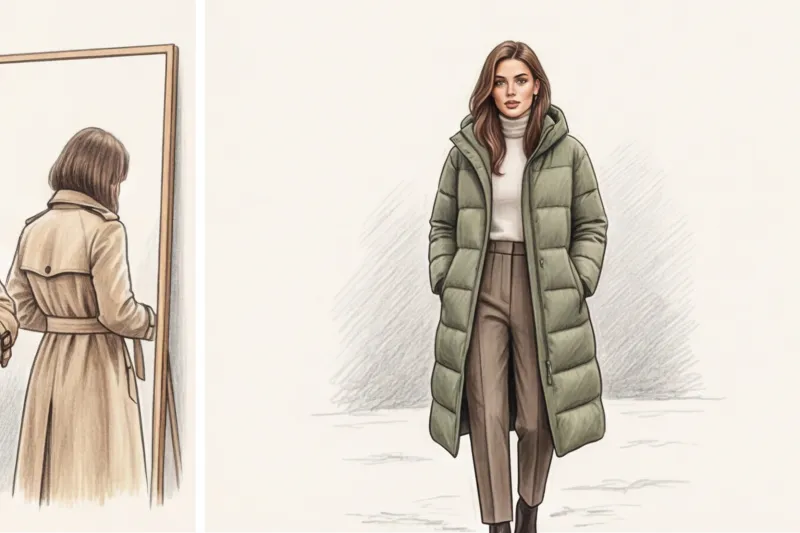
Today, these military details create contrast. To avoid looking like you're attending a corporate meeting in 2005, tone down the formality of your trench coat. Wear it over an oversized gray hoodie, paired with sneakers or wide-leg jeans.
Fair Limit: The classic double-breasted trench coat with epaulettes is categorically doesn't work On figures with broad shoulders and a full bust (inverted triangle), it creates a massive, square top. In such cases, it's better to look for single-breasted macintoshes without unnecessary detailing on the shoulders.
Ready to get started?
Try the MioLook plan for free—no commitments required. Artificial intelligence will help you find the perfect pairings for your new trench coat.
Get access — €0.99 onceJackets and down jackets: how to incorporate warmth into an elegant basic wardrobe
The biggest mistake when choosing a winter base is trying to integrate an overtly sporty down jacket with tons of zippers and logos into a casual urban look. One of my clients, a top manager at an IT company, couldn't figure out for a long time why her winter outfits with expensive wool trousers just didn't look right. The problem lay in her down jacket—shiny, short, with contrasting stripes. Replacing this jacket with a minimalist matte-finish graphite-colored down coat instantly elevated the status of her entire wardrobe.
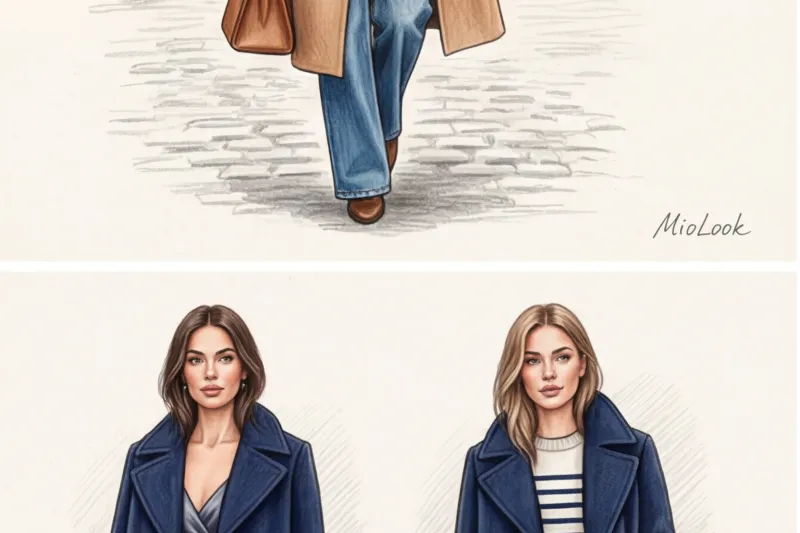
The rules for an "expensive" down jacket are simple:
- Matte texture of the fabric. Glitter often cheapens things and makes them look like they're on a ski slope.
- Hidden fittings. Ideally, the zipper should be covered with a button placket in the same color as the fabric.
- Lack of horizontal caterpillar stitch (especially fine ones). Smooth cocoon-style down jackets or models with large, architectural quilting look much more modern.
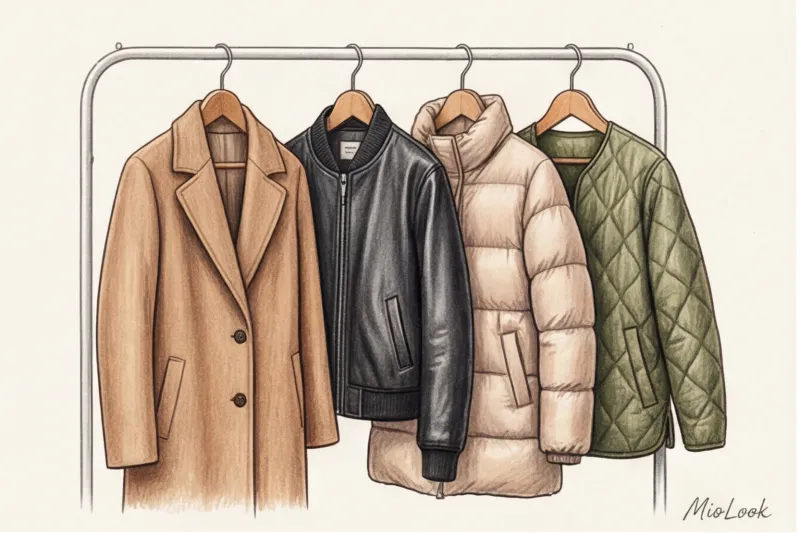
Don't forget about liners—thin, quilted jackets (like those from Uniqlo or COS) that work as a transitional piece. They can be worn alone in early fall or layered under a thin autumn coat in winter, creating a warm and sophisticated layered look.
A leather jacket, bomber jacket, and denim: a demi-season essential with character
Basic outerwear doesn't have to be bland. It's a great tool for channeling your inner archetype (we wrote about this in more detail in the article about rebel archetype ). A leather biker jacket or an oversized bomber jacket can be as versatile a base as a trench coat.
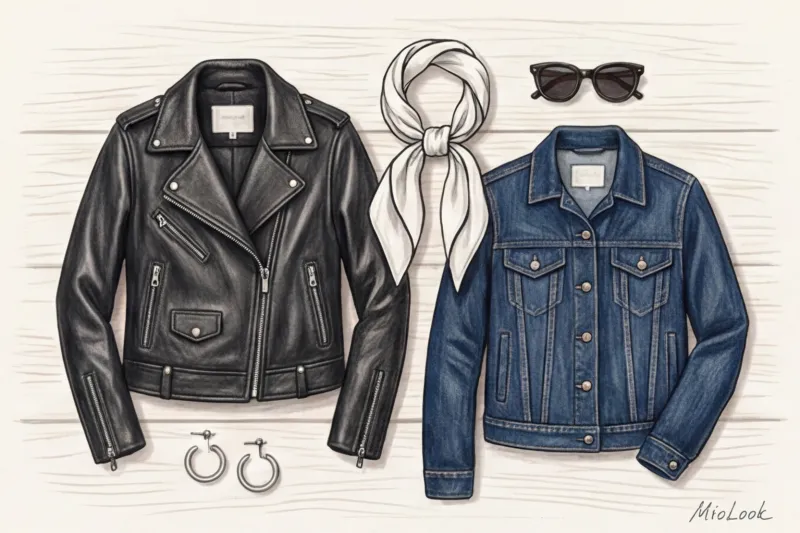
When choosing a leather jacket, pay attention to the thickness of the leather—it should stand up straight, not cling to your figure like a cardigan. Opt for a masculine, slightly oversized cut with dropped shoulders. A style tip: play with contrasts. A chunky biker jacket over a delicate silk slip dress looks much more interesting than paired with ripped jeans.
For a denim jacket to be considered an investment, look for styles made of 100% dense cotton in a raw indigo color with no fraying, rhinestones, or heavy embellishments. The clean, uniform blue color pairs easily with even light trousers for the office on Fridays.
Stylist's Checklist: 5 Strict Tests to Follow Before Purchasing in the Fitting Room
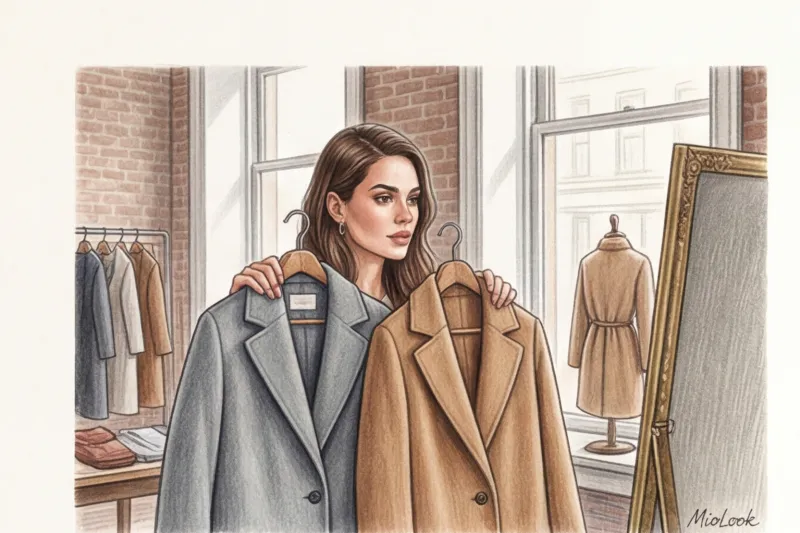
Over the years of shopping guiding, I've developed a formula for the tests a garment must pass before it reaches the checkout counter. Never buy outerwear if it fails even one of them.
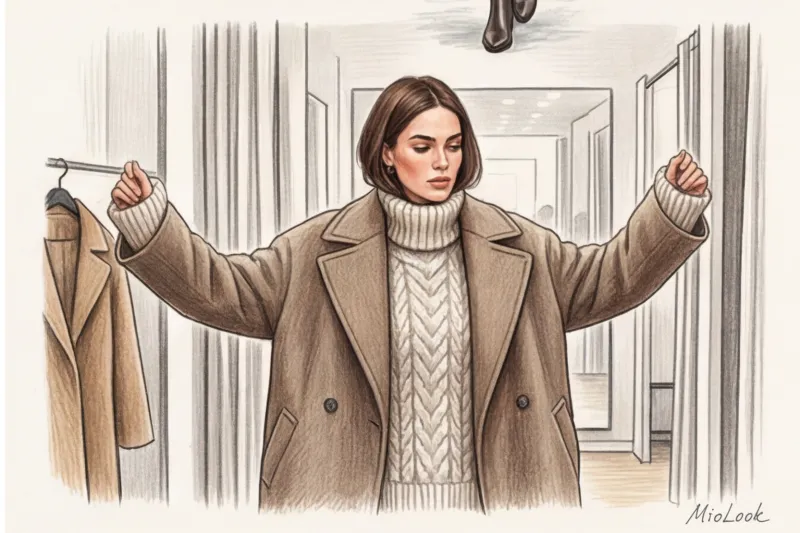
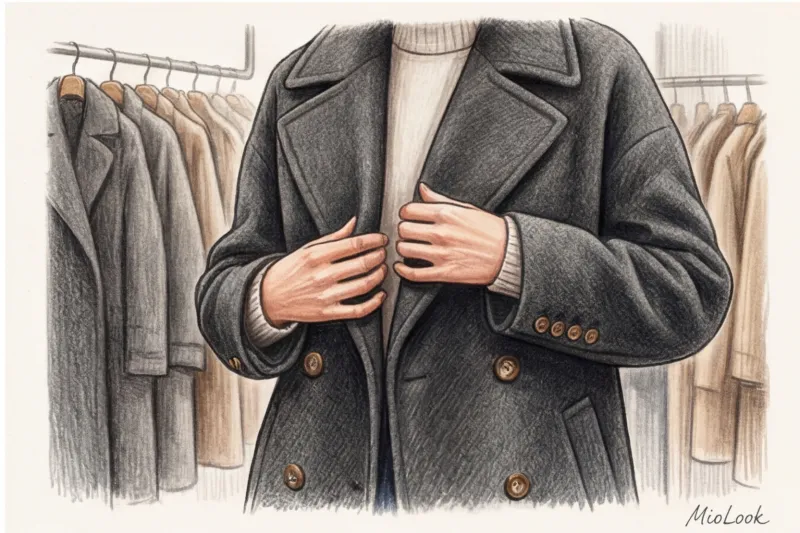
- "The Hug Test." When putting on a coat or jacket, button it up and wrap your arms around yourself, as if giving yourself a tight hug. If the fabric is ragged at the back and the sleeves are digging into your forearms, the armholes are too small. Look for a larger size or a different cut.
- The Thick Sweater Test. It's a golden rule: you should always try on basic outerwear over the bulkiest knitwear in your closet.
- "Driving test" (or step up the stairs). Take a wide lunge or mimic sitting in a car. A properly designed coat vent shouldn't extend all the way to the waist, exposing underwear.
- Checking the lining. Brands often skimp on what's not visible. If the lining is 100% polyester, a luxurious wool coat is pointless—you'll still sweat. Look for viscose or cupro.
- Button test. Are they sewn on a thread "shank"? If the button is sewn tightly to the fabric, buttoning thick cloth will be a pain, and the fabric around the buttonhole will quickly become deformed.
Cost Per Wear Calculator: Why Basic Outerwear Is Worth the Investment
Finally, let's talk about the math behind a conscious wardrobe. In styling, we use the Cost Per Wear (CPW) formula—the price per wear. It's calculated like this: Cost of the item / Number of days you wore it.
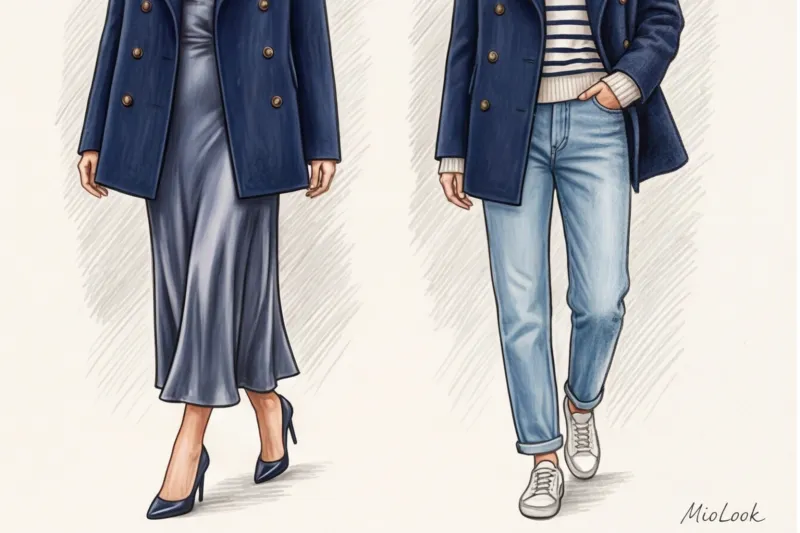
Let's do the math. Let's say you bought a trendy neon jacket with a complex print at a high-street store for €80. You only wore it four times this season because it didn't go with anything and quickly became too familiar. Your CPW = €20.
Now let's take a classic double-breasted camel coat made of high-quality wool for €400. You wear it every fall and spring, say, 60 days a year. The coat lasts for 5 years (300 wears). Your CPW = €1.30. The expensive item ended up costing you 15 times less per wear!
Basic outerwear isn't the category for chasing the latest microtrends. Create your own personal capsule wardrobe: a quality coat, a reliable matte down jacket, a structured trench coat, and a jacket with character (biker or denim). And to masterfully mix and match them with your wardrobe, upload your looks to MioLook.
Invest in the right facade. After all, it's how others will judge your taste 180 days a year.