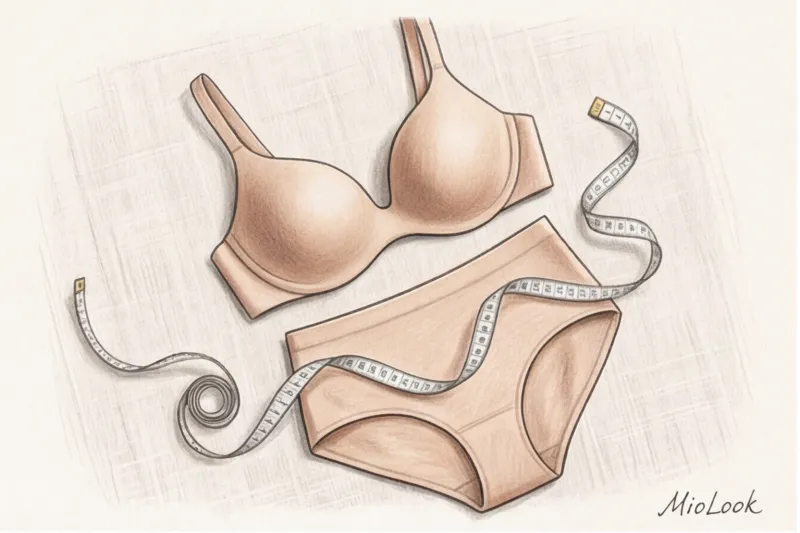
Have you ever noticed how a flawless cashmere sweater or a perfectly tailored silk blouse suddenly looks like it was bought at a bargain basement store? The lace reveals itself beneath the thin fabric, the straps pull in across your shoulders, and treacherous rolls form at your back. After 12 years of working as a personal stylist in Europe, I've developed a strict rule: your appearance is only as good as your foundation. And that foundation... basic lingerie wardrobe.
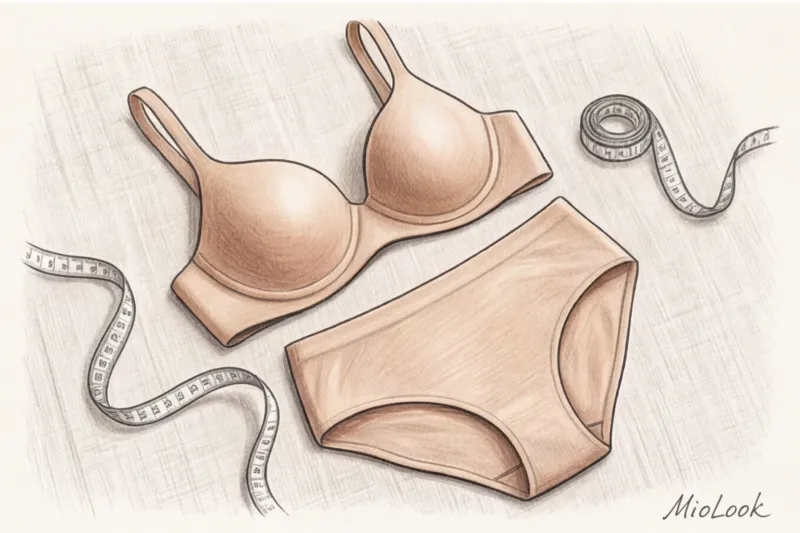
One of my clients, a top manager from Vienna, complained that she had "nothing to wear" despite having a closet full of Max Mara and COS. When we began sorting through her closet, it turned out that her dresser contained 20 sets of luxurious lace lingerie and not a single smooth basic bra. Eighty percent of her expensive clothes simply couldn't fit such a basic set. We wrote more about how technology can help solve this problem even before the purchase stage in our The complete guide to online lingerie selection using AI , and today let's take a look at the mathematics and physics of your lingerie capsule.
Why a Basic Lingerie Wardrobe Is an Engineering Project, Not Just a Shopping Trip
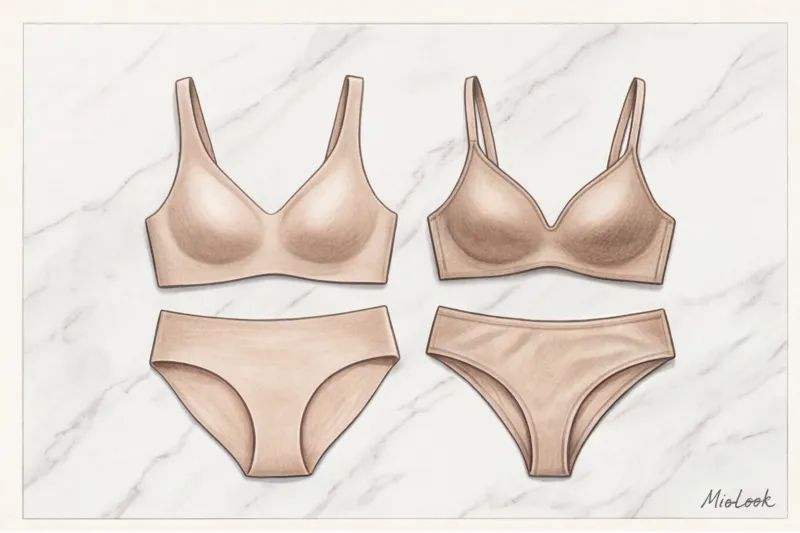
Lingerie isn't about ruffles and seduction. It's about silhouette engineering. The main rule of basic lingerie is absolute invisibility It shouldn't make a statement with its color, texture, or cut lines while you're wearing it.
We're used to thinking in terms of "everyday sets." It's a brilliant marketing ploy by brands to trick us into overpaying. In reality, bras and panties wear out at dramatically different rates. Building a basic wardrobe shouldn't be done with ready-made sets, but rather with "smart separates" (individual items) that address your specific needs.
"Underwear is the architectural framework of your image. If the foundation is crooked, even the most expensive building will crack."
According to the 2024 global report by the analytical agency WGSN, consumer interest has finally shifted from aggressive push-ups to seamless technologies and natural support. Comfort is no longer synonymous with sloppiness—it's now a technological norm.
Your perfect look starts here
Join thousands of users who look flawless every day with MioLook.
Get access — €0.99 onceLaundry Capsule Formula: How Much and What You Really Need
Let's use the calculator. According to professional bra fitting standards, a bra should absolutely not be worn two days in a row. Why? It's the physics of polymers. The elastane fibers in the bra band require at least 24 hours to regain their original shape after being stretched around your body throughout the day. If you wear one "favorite" bra every day, the elastane will burn out within a couple of months, the band will stretch, and the weight of your breasts will fall on your shoulders, ruining your posture.
The average lifespan of a quality bra is 100–120 washes. If you wear it twice a week, it should be replaced every 8–10 months. There shouldn't be any "I've been wearing this bra for five years" arguments—it's long since stopped providing support.
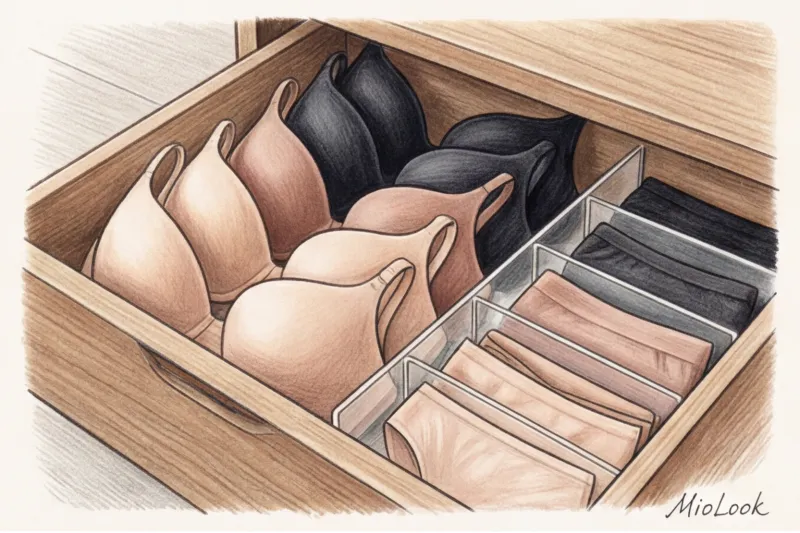
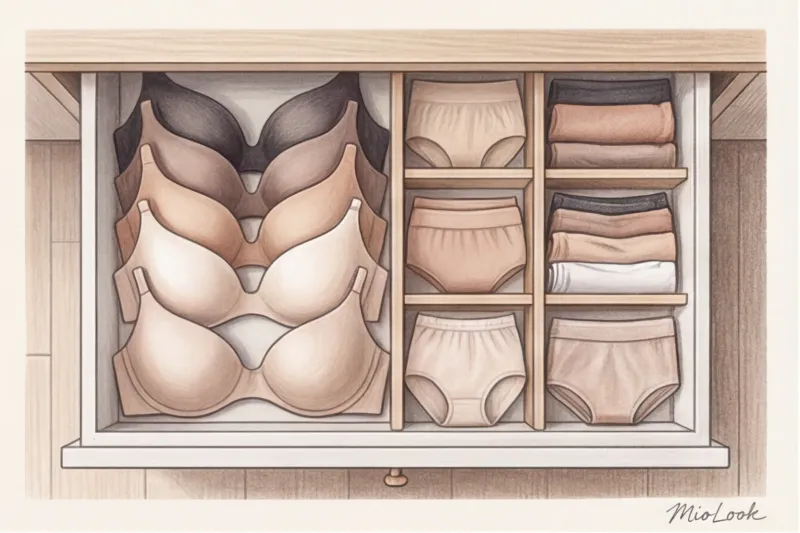
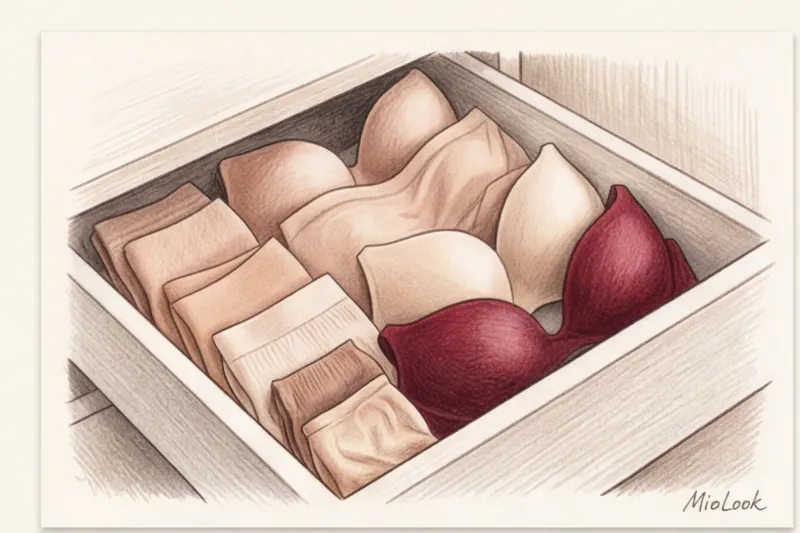
Bras: minimum working set (3-4 pieces)
You don't need a whole chest of drawers to cover 95% of your wardrobe needs. The bare minimum is enough:
- 2 T-shirt bras (smooth cups) — a strictly nude shade, as close as possible to your skin tone. One has a more closed cup for firm support, the other has a plunge neckline for a cleavage.
- 1 dark bra — dark, bitter chocolate, or graphite. It goes well with dark knitwear and heavy shirts.
- 1 multifunctional bra - balconette (with removable straps) for off-the-shoulder tops or dresses with a non-standard neckline.
Panties: How to calculate the quantity
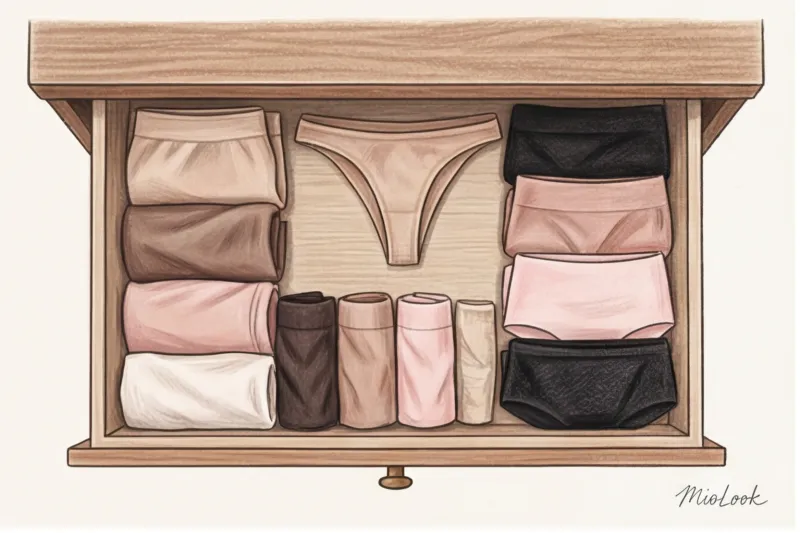
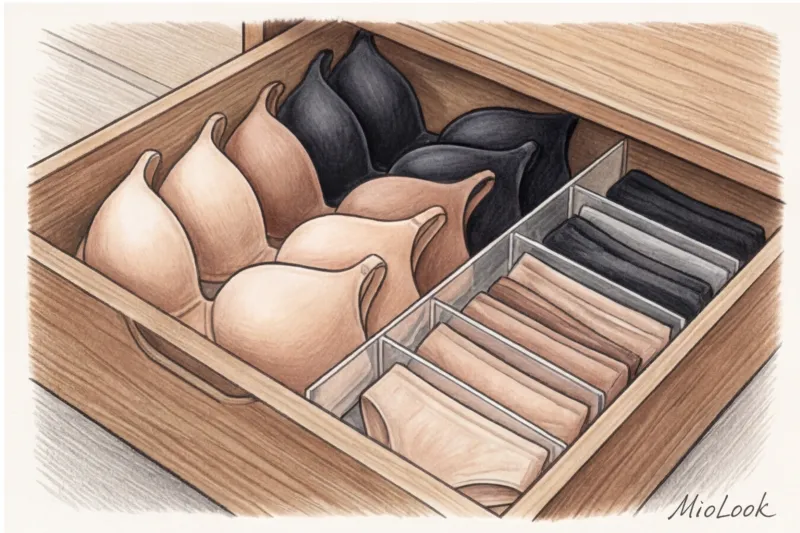
The golden formula works here: "weekly cycle plus 3 spare" The optimal number for a base is 10-12 pairs. You don't need dozens of lace thongs. The proportions depend on your bottom:
- Smooth seamless briefs (5-6 pieces) - under trousers made of suit fabric and classic jeans.
- Microfiber thongs with laser-cut edges (3-4 pieces) - under tight knitwear, pencil skirts and thin summer dresses.
- Shorts or culottes (2-3 pieces) — under flowing A-line skirts and midi dresses, where comfort and lack of friction are important.
Critical rule: No matter what high-tech material the garment is made of, the gusset should always be 100% cotton. This is a matter of your health, and there's no room for compromise.
The White Lingerie Myth and Other Fatal Style Mistakes
Now I will destroy the main misconception that is still being propagated on outdated forums. Myth: You should wear white underwear under a white shirt.
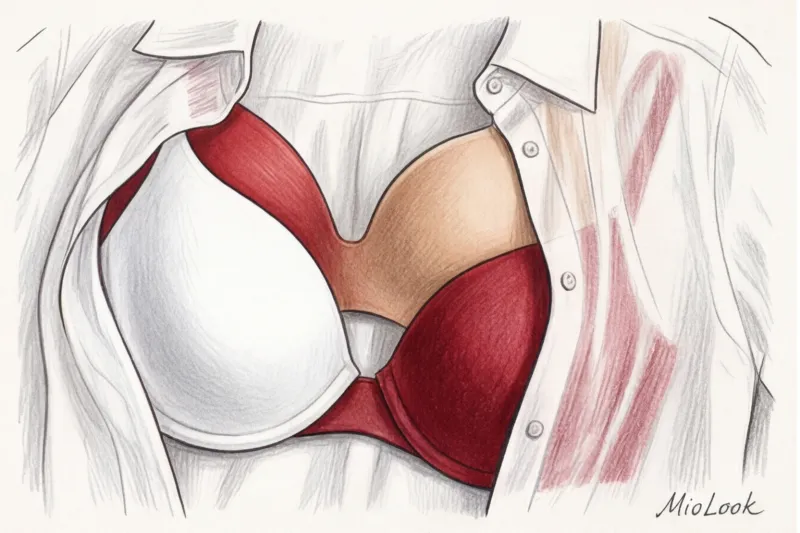
Fact: The white bra glows like a neon sign under the white fabric. It looks cheap and instantly ruins any pretense of status image The base for white clothes is exclusively smooth underwear in a flesh-colored shade.
But there is also a secret trick of stylists: red underwear under a white shirt works just as well as nude It's a paradoxical optical illusion. Red (if you choose a deep, non-fluorescent shade that matches your skin's undertone) absorbs light in the same way our skin does, blending in completely under a layer of white fabric. If you don't believe me, just test it out in front of a mirror.
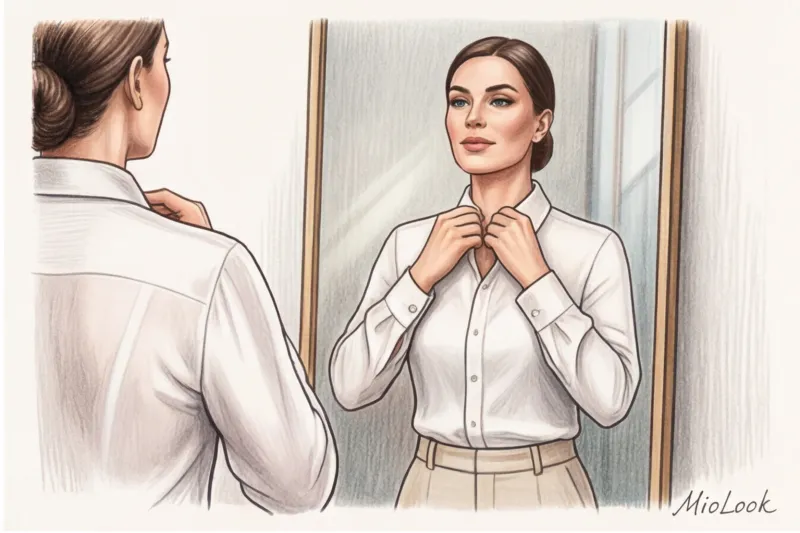
Another fatal mistake is buying a bra one size too small in hopes of a push-up effect. According to statistics, about 80% of women wear the wrong bra size. An over-tightened band won't lift your breasts, but it's guaranteed to create prominent "rolls" on your back, which will visually add 3-5 extra pounds.
Anatomy of the Base: Tissues That Work for You
If we're talking about a basic lingerie wardrobe, forget about cotton as a base for bras. Yes, cotton is beautiful, but it doesn't hold its shape, quickly stretches out, and bunches up under tight clothing.
The queen of modern lingerie base - microfiber (a blend of high-quality polyamide and elastane). How can you tell good microfiber from cheap, squeaky synthetics? Run your fingertips over it: it should feel like thick, cool silk, and when stretched, it should instantly spring back to its original shape with a resilient click.
For cups the best technology today is spacer (spacer 3D) Instead of stuffy, dense foam that acts like a thermos, the cup is formed from two thin layers of fabric connected by microscopic 3D threads. This cup "breathes," adjusts to breast asymmetry (which 99% of women experience), and doesn't create a bulletproof vest-like effect.
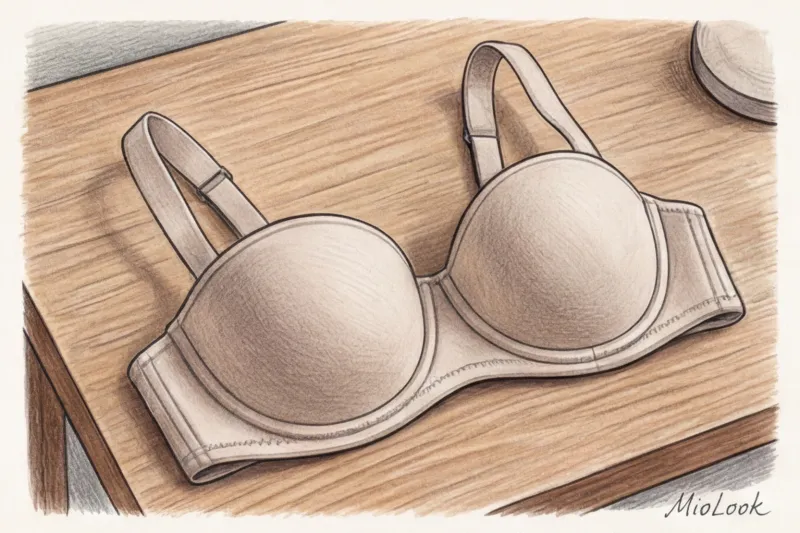
"The only exception when we forgo microfiber in favor of cotton is in cases of severe contact allergies or direct doctor's orders. Otherwise, high-tech synthetics are your best friend for creating a smooth silhouette."
Access to MioLook for €0.99 — one-time payment
A smart AI stylist will select the perfect look for you and help you create a functional base.
Get access — €0.99 onceHigh-street vs. premium: where to invest and where to save
In my practice, clients often go to extremes: they either buy all their lingerie from mass-market stores, complaining about the poor fit, or they spend thousands of euros on premium brands, afraid of damaging them in the wash. There's a golden rule for investing in lingerie: We spend more on architecture (bras) and save on consumables (panties).
If you have a standard size (cups AC, waistband 75-85), you can find excellent basics in the European mass market. In the 30-50€ range, excellent smooth models are offered by Intimissimi (their microfiber is one of the best in the segment), Oysho And Women'secret I strongly recommend buying basic seamless panties (10–15 €) from the line H&M Premium or Uniqlo.
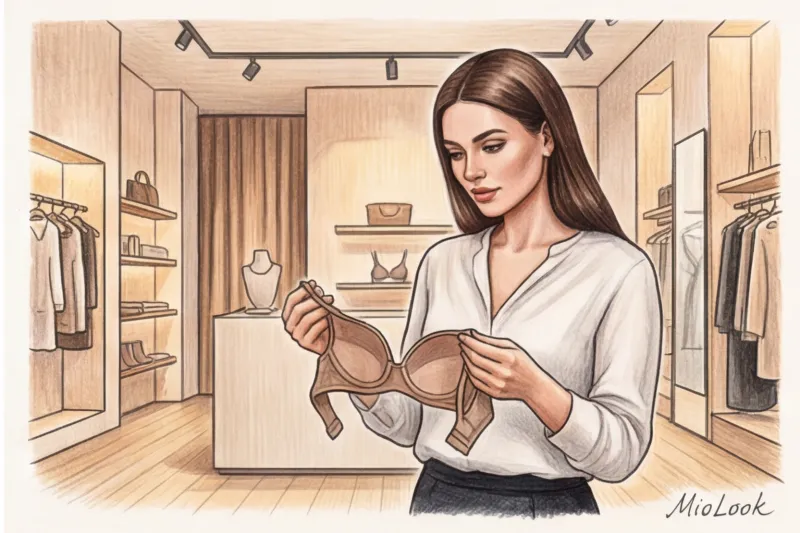
When the mass market is closed: If you have a large bust, a narrow back (for example, a size 65F), or complex asymmetry, standard Zara or H&M styles won't work for you. This is where specialized D+ brands enter the realm of. Invest €70–€130 in a basic bra from Panache , Freya or Chantelle Their engineers develop a design with 40-50 components (instead of 15-20 in mass-market products) to transfer weight from your shoulders to the bra's waistband. This investment will pay off in your health and the elimination of headaches from neck strain.
Checklist: How to Know When Your Lingerie Storage Needs an Overhaul
Open your dresser today and give it a ruthless inspection. create a shopping list wisely , if you notice at least one of these signs on your underwear:
- The belt is pulled up towards the shoulder blades. This means your underbust measurement is too large. The band should lie strictly parallel to the floor and support 80% of your bust's weight.
- The bones extend from the sternum in the center. The frame should fit snugly against the bone in the hollow (unless it's a wire-free model). If it hangs in the air, the cup is too small.
- The fabric of the cup wrinkled. If dents and creases appear on a smooth bodice that bulge outward under clothing, the foam rubber is broken and the bodice is damaged (most often due to machine washing without a special bag).
- The elastic on my panties leaves red marks. The elastane has dried out and lost its elasticity. Get rid of it without regret.
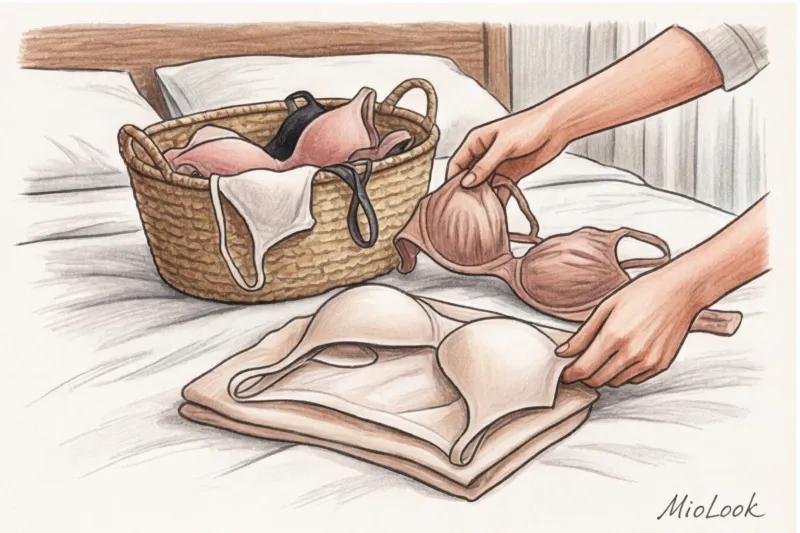
Smart online shopping: how to update your database without trying on
Buying basic lingerie online is a huge risk if you're doing it blindly, but it's a total lifesaver if you use modern technology. The problem is that a size 75B at Oysho and a size 75B at Chantelle are physically different measurements, as the brands use different sizing charts and patterns.
This is where virtual assistants come in. By digitizing your parameters once in the app MioLook You can use smart wardrobe features to understand which basic items you need to purchase for perfect combinations, and AI algorithms will help predict how a specific brand will fit your body. The basics are assembled once and then simply duplicated as they wear out.
A basic lingerie wardrobe isn't boring. It's that invisible superpower that allows you to wear a simple white t-shirt with palazzo pants and look like a million bucks. Start by clearing out your drawer today, throw out everything cluttered and drab, and build a functional foundation that works for you, not against you.