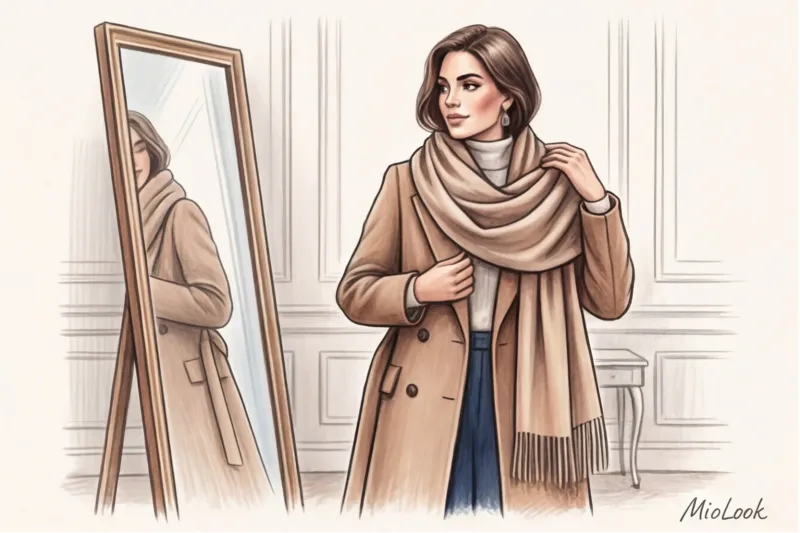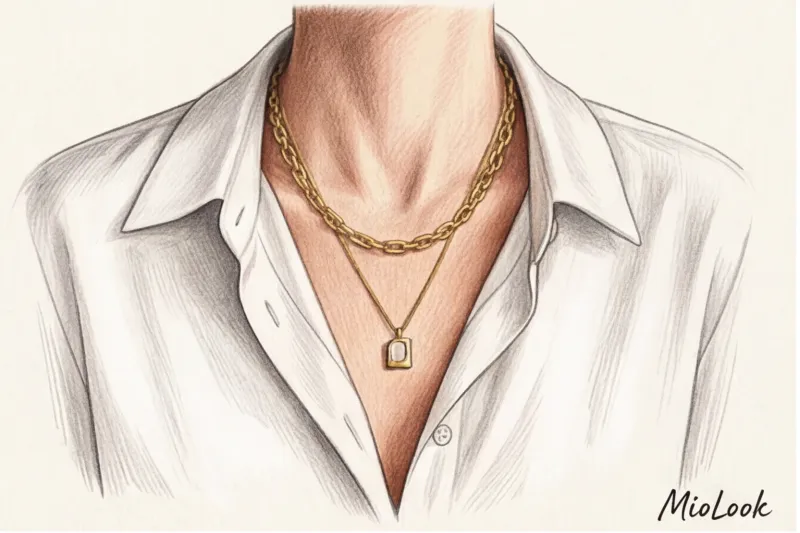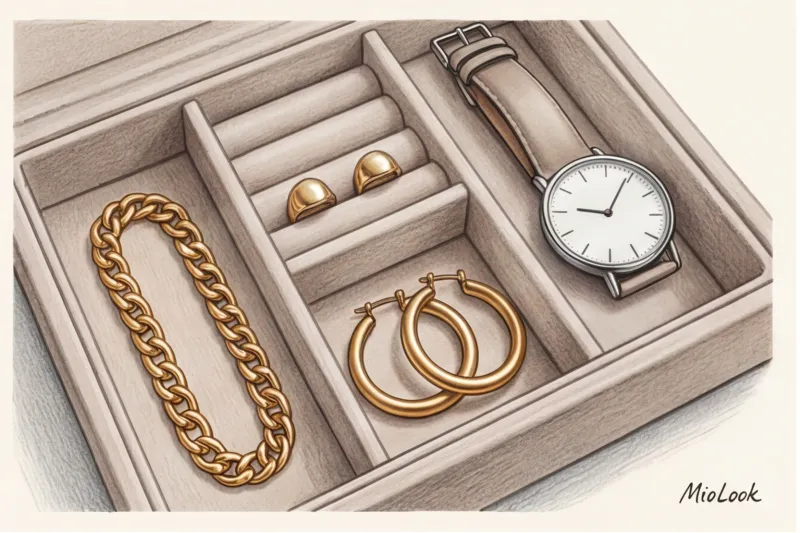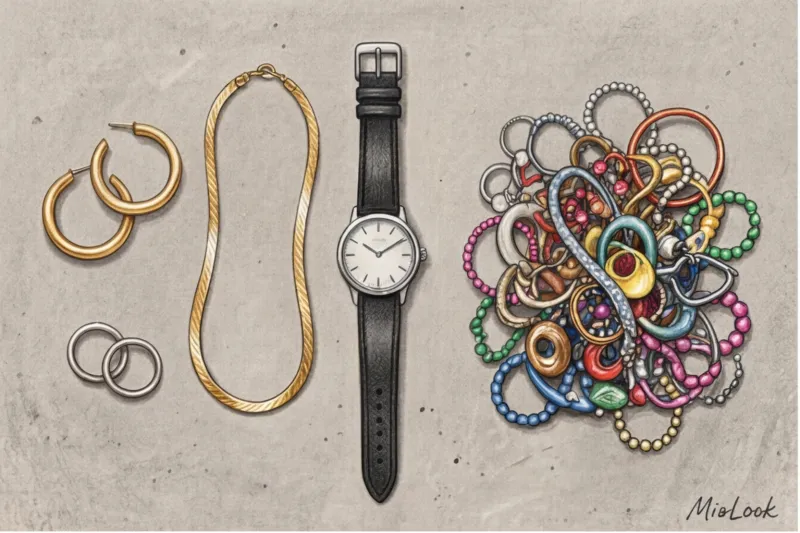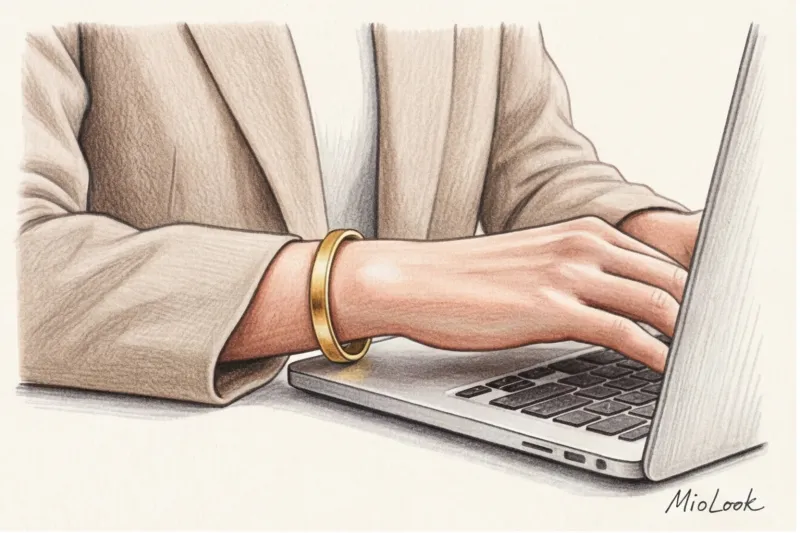
Click-click-click. You know that annoying sound you hear when your wrist hits your desk or laptop keyboard? In 12 years of working as a personal stylist and textile expert, I've learned one painful lesson: the wrong piece of jewelry can not only ruin your work ethic but also literally ruin your outfit. One client of mine once ruined a luxurious €400 silk blouse simply because the crudely crafted toggle clasp on her wrist pulled a thread from the delicate fabric.
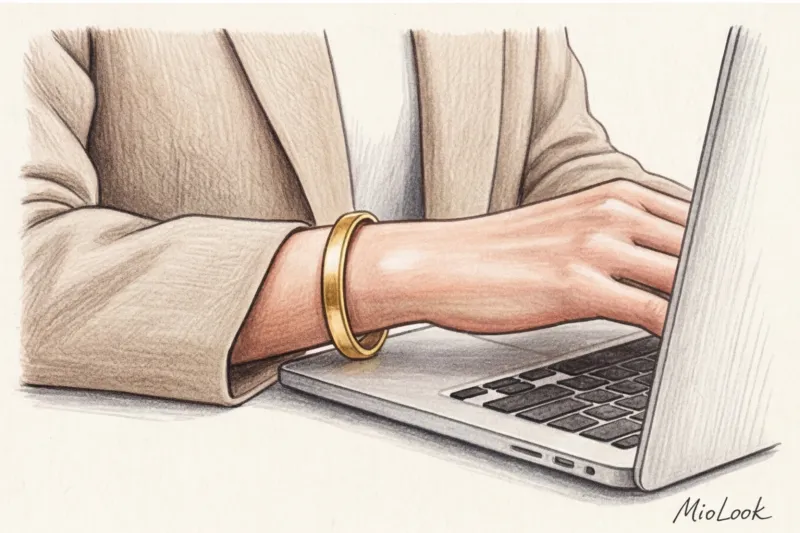
Correct basic bracelets — these aren't just shiny accents. They're functional style tools that should work in perfect symbiosis with your wardrobe, without snagging on cuffs or oxidizing from hand cream. We've covered more about how to strike this balance in our The Complete Guide to a Basic Jewelry Wardrobe: A Capsule for Every Day Today, we'll examine the anatomy of the ideal bracelet from the perspective of wear physics, textile adjacency, and wardrobe mathematics.
What distinguishes basic bracelets from seasonal jewelry?
The main criterion for a basic piece of jewelry is ergonomics. I always ask my clients to perform a simple "keyboard test": put on the bracelet, rest your hands on the table, and simulate typing on a laptop. If the metal jingles loudly, scratches the surface, or digs unpleasantly into the bone, it's not an everyday piece. The basic piece adheres to the "second skin" rule: you should forget the bracelet exists within five minutes of putting it on.
The second aspect is harsh mathematics, namely the indicator cost-per-wear (cost per wear). The "fast jewelry" industry made from zinc alloys (zamak) causes colossal environmental damage. These €15-€20 items turn green or black within a month due to a reaction with sweat and end up in landfill.
"Buying one high-quality, simple bracelet for €200 that you'll wear 300 times a year (cost-per-wear is only €0.66) is not only budget-conscious, but also the only sustainable approach to your jewelry wardrobe."
The basic design avoids complex embellishments: no colored enamel, large brand logos (which cheapen the look), or bulky accent stones. Clean geometry and high-quality metal speak for themselves.
Hard Bangles: The Architectural Foundation of a Jewelry Wardrobe
In the world of accessories, the bangle performs the same role as white shirt in a casual wardrobe - it structures the image and gives it rigor.
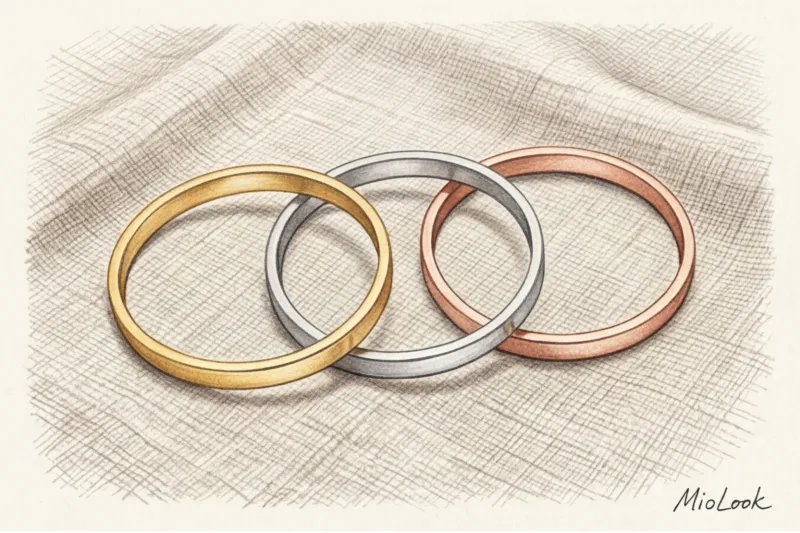
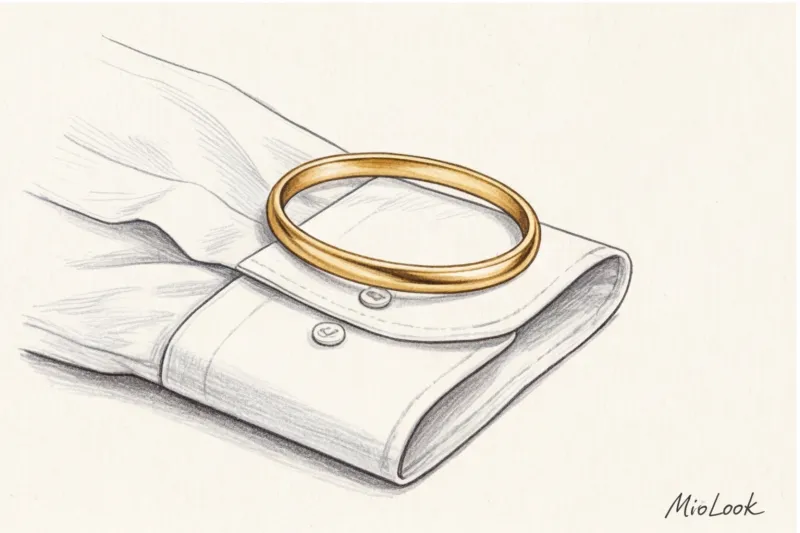
The bangle's shape is critically important. Many mass-market brands cast perfectly round bracelets because they're cheaper to produce. But the human wrist is oval! A round bangle will constantly tip over, catch on the edge of a jacket sleeve, and visually widen your hand. Look exclusively for oval models.
Sizing advice: The right bracelet should fit over your wrist with a slight push. When your arm is at your sides, it should rest at the base of your wrist, not slipping onto your fingers, but also not squeezing the prominent radius bone. For slender wrists (up to 15 cm), the ideal metal width is 2–3 mm. If you want to make a statement or wear voluminous knitwear , choose a width of 4–5 mm.
Ethics and Durability: What a Bangle Should Be Made Of
Never buy jewelry blindly. Reading jewelry labels will save you money. If the tag simply says "Brass" or "Gold Plated," be prepared for the plating to wear off after 3-6 months of heavy wear.
For a basic wardrobe, I recommend looking for labels. Gold Vermeil (vermeil). According to FTC standards, for a piece of jewelry to be called vermeil, it must be made of 925 sterling silver and have a gold plating thickness of at least 2.5 microns. In the €100–€250 price range, this is the best investment—with proper care, this plating lasts 3 to 5 years.
If your budget allows, choose solid gold. But keep in mind the Mohs scale (a mineral scale of hardness). 24-karat (pure) gold is too soft and will dent with the slightest knock against a table. For everyday wear, 14K (585 fineness) is ideal—alloying additives make it scratch-resistant.
Your perfect look starts here
Unsure how to incorporate hard bangles into your everyday style? MioLook's AI stylist will analyze your appearance and create the perfect capsule wardrobe based on your accessories.
Get access — €0.99 onceThin and medium chains: the art of perfect weaving
Wrist chains add dynamism and femininity to any look. But as a fabric expert, I'm obligated to warn you about the hidden dangers of certain weaves.
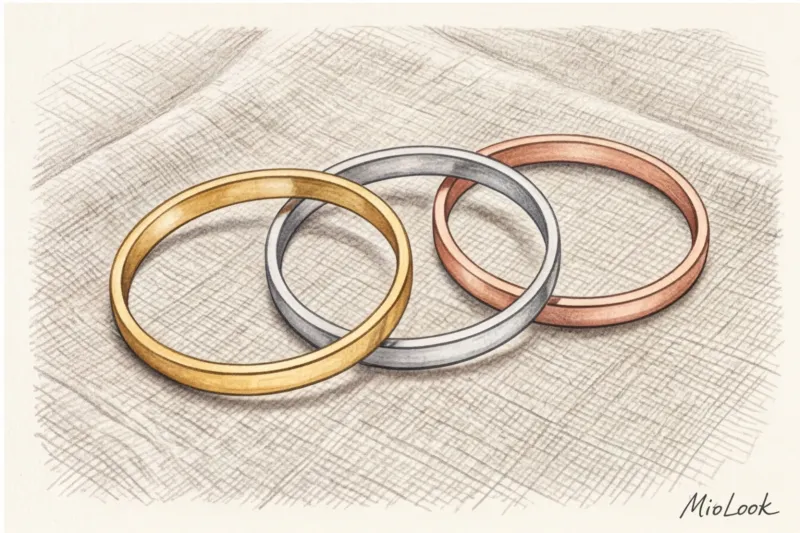
The most dangerous enemy of your sweaters is the popular weave snake Its seemingly smooth surface is made up of tightly fitting links. When the bracelet bends on the wrist, micro-gaps form between the links. These gaps act like a microscopic epilator, catching the finest hairs of alpaca or cashmere wool, and when the bracelet is straightened, they pinch them tightly. As a result, the weave breaks under the tension of outerwear, and the sweater becomes covered in pilling.
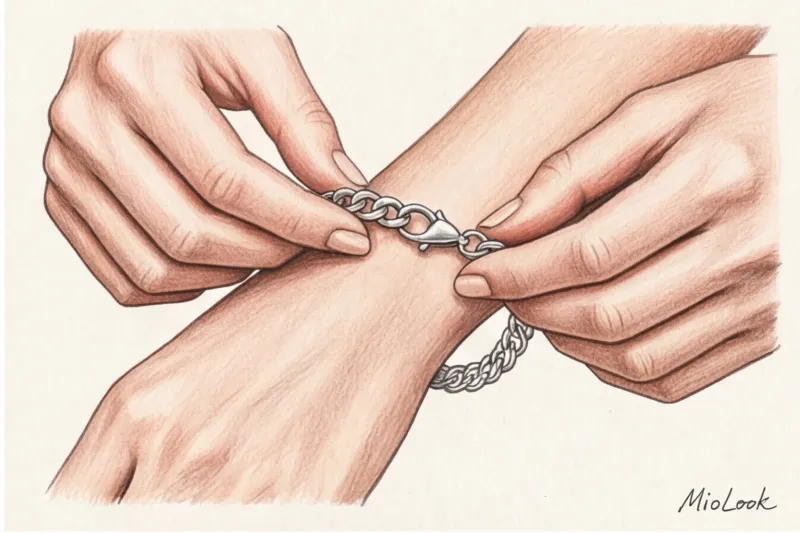
Safe alternatives for the base:
- Curb weave — the links are flat, polished on both sides. They lie smoothly on the skin and are completely safe for any clothing.
- Anchor and Rollo - a classic where the links are connected perpendicularly.
The clasp deserves special attention. Avoid flimsy spring-loaded clasps (a round ring with a spring). For a basic bracelet that you plan to wear for decades, a lobster clasp is the standard for reliability.
The Tennis Bracelet Myth: Why It Has No Place in Your Daily Database
Glossy magazines often list a tennis bracelet (a thin band of diamonds or cubic zirconia) as a "must-have." In my experience, this is the worst advice for a woman living in the hectic pace of a big city. It's a classic accessory for an evening cocktail, but definitely not for smart casual style or office.
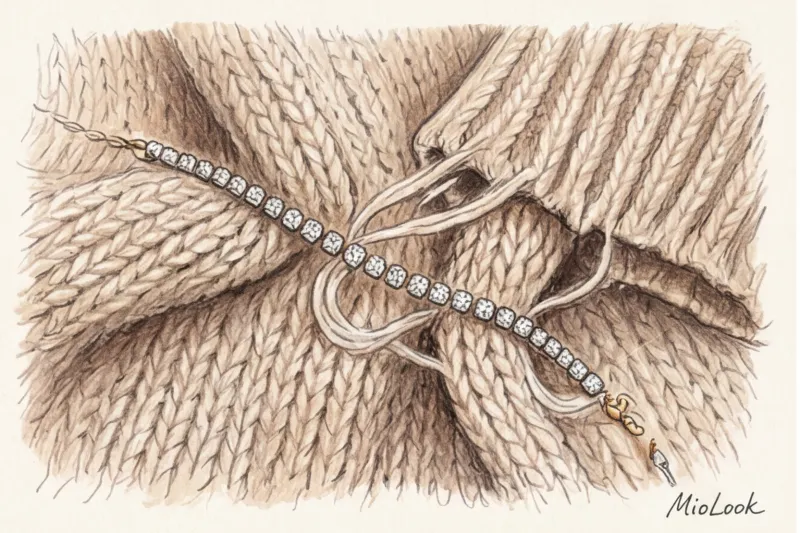
The problem lies in the prongs—the tiny metal "claws" that hold the stones in place. The microscopic gap between the stone and the metal is the same thickness as a fine silk thread. One of my clients literally burst into tears when her everyday tennis bracelet left an irreparable snag on her new €1,500 Loro Piana cashmere cardigan.
Furthermore, if you regularly use hand cream, the dimethicone and oils in the cream will immediately settle on the edges of the stones (especially cubic zirconia). Within two weeks, your "base shine" will turn into a dull gray streak.
"If you can't imagine your base without stones, look for bracelets with a bezel setting. In this case, the metal smoothly and continuously wraps around the stone along the entire perimeter. No sharp corners, no snagging on tights or blouses."
Organize your jewelry in one click
Forgetting which bracelets you already own? Digitize your wardrobe and accessories with MioLook to create harmonious combinations in just a few minutes every morning.
Get access — €0.99 onceLayering and Watches: How to Style Basic Bracelets
Modern status casual requires a touch of casualness. The ideal way to achieve this is through deliberate layering.
Forget the outdated rule that silver and gold can't mix. Pairing the cool shine of white gold or silver with the warm yellow metal adds depth and complexity to your look. The key to Mix & Match is to combine pieces that are similar in texture (for example, only glossy or only matte) or thickness.
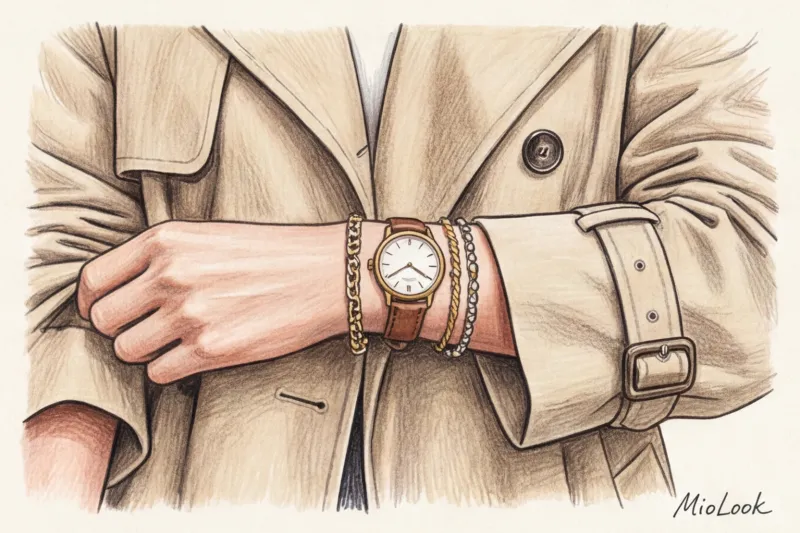
Neighborhood with the clock: A hard gold bangle hitting the steel case of an expensive watch will quickly scratch both. To avoid this, use a buffer zone. Place a soft layer between the watch and the hard bracelet: a thin curb chain or a bracelet with a leather element.
Integration with clothing: My favorite styling trick is rolling up the sleeves of a shirt to a 3/4 length. This visually reveals the thinnest part of a woman's hand (the wrist) and creates the perfect canvas for showcasing bracelets. In colder weather, thin metal chains look stunning layered over the sleek sleeves of a cashmere turtleneck (make sure the clasp doesn't snag the fabric!).
Pre-purchase checklist: clothing quality and safety testing
Before investing in a jewelry base, conduct a quality check. Here's my professional algorithm that will save you from disappointment:
- Test with nylon tights. Here's my personal test: take an old pair of 15-20 denier nylon tights and run them tightly over the entire bracelet, including the clasp. If the nylon snags even the slightest bit, the bracelet will ruin your clothes. Leave it at the store.
- Checking the markings. Look for stamps on the clasp. "925" means sterling silver, "14K" means 585 gold. If there's no stamp, it's just regular costume jewelry, typically priced at €30.
- Weight rating (hollow vs solid). If a bracelet appears bulky but is suspiciously light, it's hollow. This is a bad investment. The walls of a hollow bracelet are as thin as foil. If you accidentally hit your wrist on a doorknob, it will create a dent that no jeweler can perfectly repair. Choose heavy, solid chains and bangles.
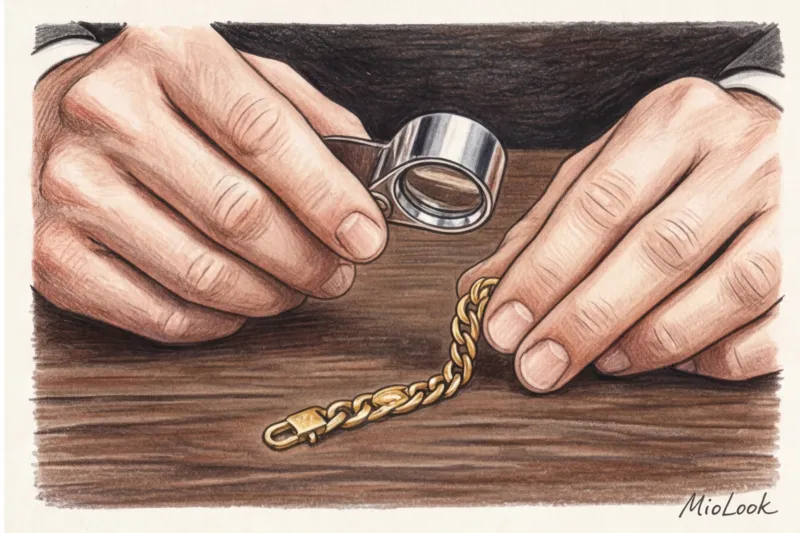
- Visual inspection of soldering. Ask the consultant for a magnifying glass. Inspect the joints—the soldering should be completely smooth, without any metal burrs or dark spots.
Brand Guide: What to Look For (Ethical Manufacturing)
If you're looking for a balance between price, quality, and ethical production in the €80-€250 range, consider brands that use recycled metals (recycled silver/gold). Brands like Mejuri , Monica Vinader or Missoma , have made production transparency their main asset. They use silver obtained from recycled electronics and old jewelry, which reduces CO2 emissions by 60% compared to mining new ore. For lovers of total minimalism, excellent basic silver options can be found in their premium lines. COS or Massimo Dutti (in the segment from 50 to 100 €).
A basic bracelet isn't just a piece of jewelry; it's a detail that speaks to your self-esteem. Your jewelry wardrobe should serve you, adapting to your movements, not dictating how you move for fear of ruining your silk blouse. Invest in the right geometric shapes, choose smooth textures, and your wrist will always look flawless.