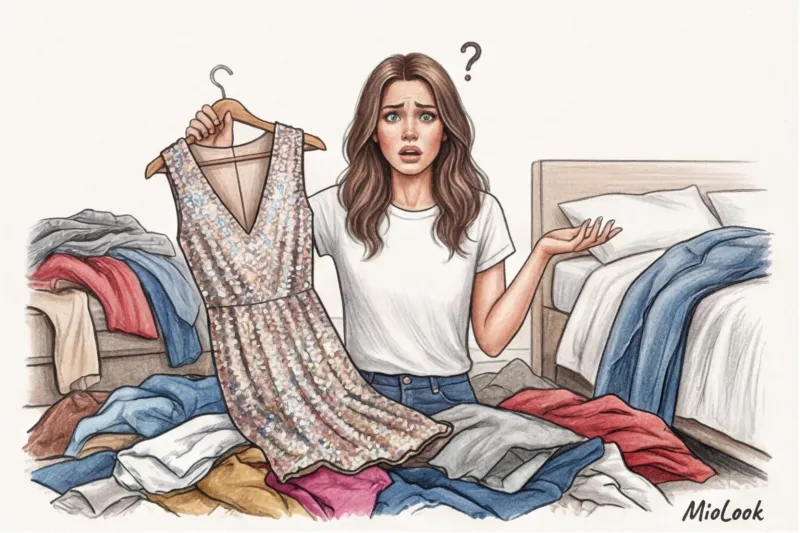
You're sitting on your bedroom floor, surrounded by an Everest of skirts, sweaters, and dresses. In your hands, you're clutching a sequined dress you wore once three years ago. You're trying to figure out if it brings you joy, as popular methods claim. Sound familiar? In 10 years of working as a fashion journalist and stylist at fashion weeks, I've seen this scenario hundreds of times. Women spend weekends gruelingly sorting through their closets, only to find their closets in the same chaos a month later.
Today is high quality decluttering your wardrobe through the app is changing the very paradigm. We're moving from emotional turmoil to precise personal style diagnostics using neural networks. We discussed the smart closet architecture in more detail in our The Complete Guide to Digital Wardrobe , and today I propose dissecting the first and most painful stage—cleaning. Let's explore how algorithms use the metadata of your things to transform stressful tidying into a fun exercise in style.
Emotions vs. Data: Why Traditional Decluttering No Longer Works
Marie Kondo's popular method of keeping only those items that spark joy has played a cruel joke on the modern wardrobe. As a practicing stylist, I can confirm that this approach is detrimental to functional essentials. A perfectly fitting white T-shirt made of heavy cotton (at least 180 g/m²) or classic black straight-leg trousers rarely inspire a burst of delight. But they are the architectural framework upon which your entire look rests.
The "throw away everything you haven't worn in a year" rule is also hopelessly outdated. It doesn't take into account climate change, lifestyle changes, or the simple lack of the right pair of shoes to go with your pants. Getting rid of an item simply because it's old sets you up for impulse purchases in the future.
Our closets are constantly subject to cognitive bias. We remember bright, statement pieces (a leopard-print skirt, a fuchsia jacket), but completely forget about utilitarian elements. As a result, our wardrobes become a museum of beautiful but incompatible pieces. AI solves this problem by shifting the focus from momentary emotion to strict utility and combination.
How Decluttering Your Wardrobe with an App is a Game Changer
According to the independent organization WRAP (Worldwide Responsible Accredited Production), approximately 70% of the items in the average closet are never worn. You might be surprised, but the Pareto principle works reliably in fashion: we wear 20% of our clothes 80% of the time. A digital inventory clearly illustrates these stark statistics.
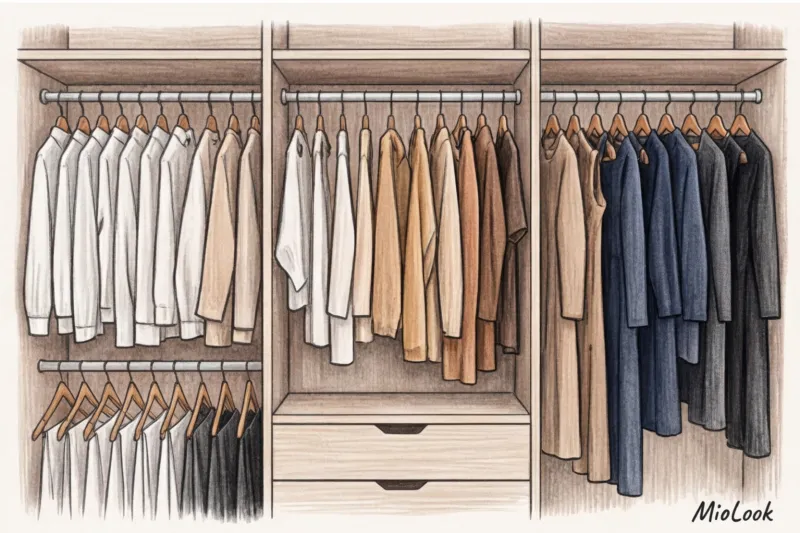
By creating a digital twin of your closet, you get a 100% overview of your assets on a single smartphone screen. One of my clients, a top manager at an IT company, was convinced she had "absolutely nothing to wear to the office." When we digitized her closet, the algorithm mercilessly highlighted the blind pattern: she had 40 silk blouses of complex cuts and not a single one a basic T-shirt or turtleneck. The brain simply blocked this information during a normal scan of the shelves.
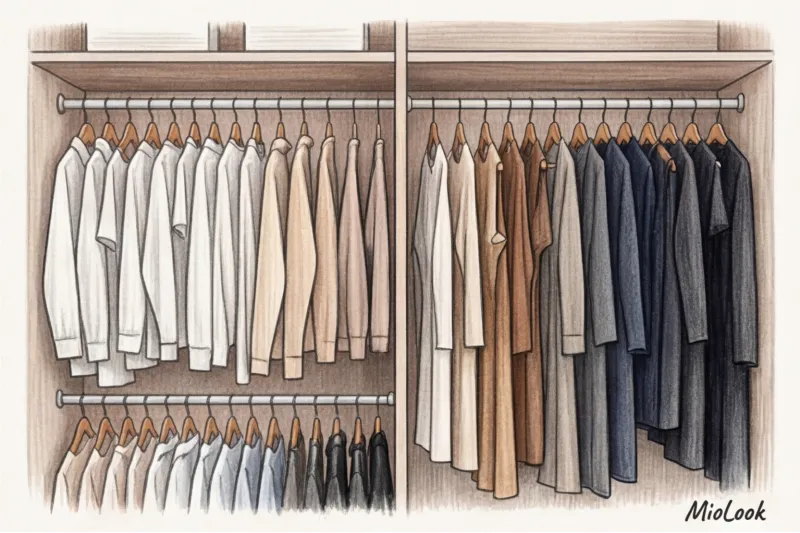
Moreover, apps instantly identify "wardrobe clones." It's very difficult to notice that you've already bought a fifth black turtleneck when they're all in different piles. AI-powered analysis of color palettes and silhouettes reveals the real picture: why your clothes don't match and where the imbalance lies.
Cost-per-Wear Formula: Algorithms Instead of Guesswork
If emotions are a poor guide when decluttering, what should you rely on? The fashion industry's main KPI—the Cost-per-Wear (CPW) formula. Smart apps calculate it automatically by dividing the cost of an item by the number of wears.
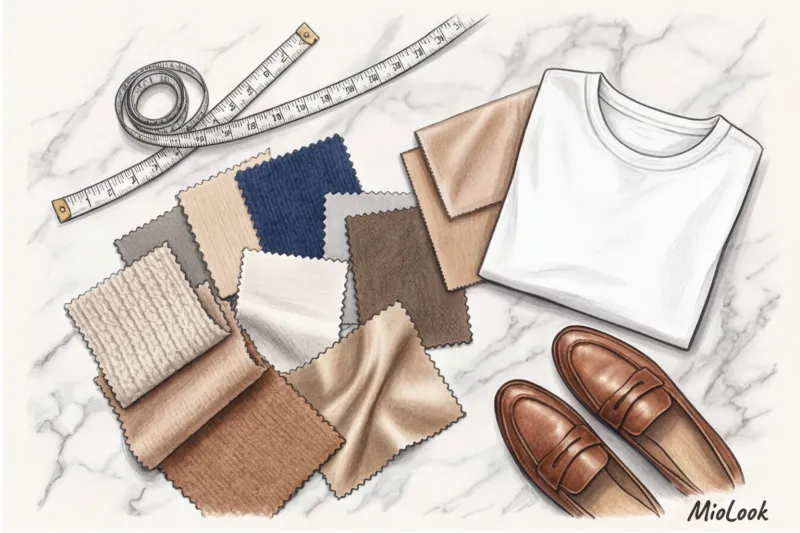
This is where the most interesting counterintuitive discovery lies. An expensive $200 Massimo Dutti jacket, worn 50 times to the office (CPW = $4), turns out to be significantly cheaper than a bargain buy from a mass-market sale for $30, worn just once (CPW = $30). The AI uses this data to make an objective recommendation: which item is worth reselling, which to give away, and which to immediately integrate into your everyday looks.
Access to MioLook for €0.99 — one-time payment
A smart AI stylist will select the perfect look based on your digital wardrobe.
Get access — €0.99 onceOnline Wardrobe Review: A Fashion Stylist's Step-by-Step Method
Transferring a closet to a smartphone seems like an impossible task, but over the years of working with clients, I've developed a clear algorithm. The secret is to not try to do everything in one go.
- Technical preparation: Find a location with good natural light. A solid background (a clean sheet on the floor or a blank wall) is crucial—it will make it easier for the neural network to "cut out" the object and remove the background.
- Smart categorization: When uploading an item, don't be lazy with tags. Note the season (winter/mid-season), occasion (office/casual), and brand. The more metadata the algorithm receives, the more accurate its recommendations will be.
- Creation of a "quarantine zone": This is my favorite professional trick. If you're unsure about something, don't throw it away right away. Create a virtual "Quarantine" folder in the app. If the AI doesn't suggest using it in a look for 30 days, and you don't think of it yourself, feel free to say goodbye.
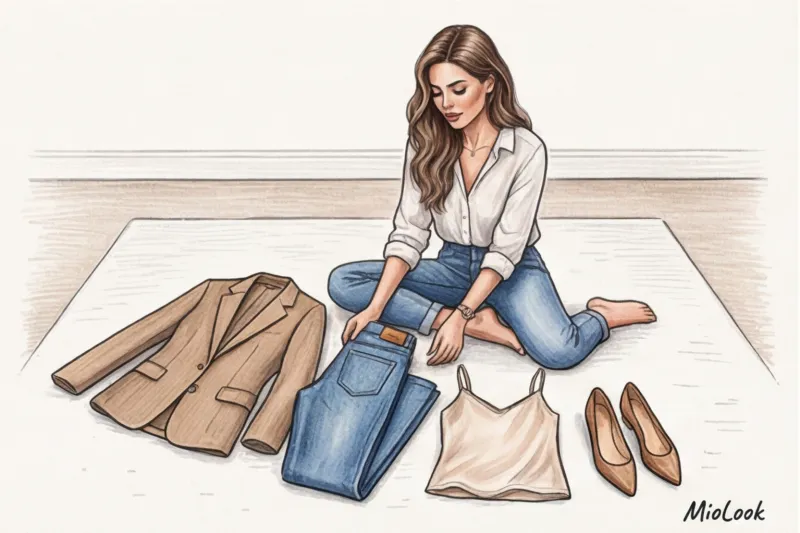
Combinatorics test using neural networks
Often, an item ends up on the "throw away" list simply because we don't know how to style it. This is where technology comes to the rescue. If you use MioLook for digitization, you can upload a "single thing" and ask the algorithm to assemble images from it already exists in your virtual closet. You'll be surprised how often a jumper you thought was hopeless works perfectly with a layered shirt and blazer.
3 Critical Mistakes When Digitizing and Cleaning a Closet
Even with smart technology, it's easy to take a wrong turn. Here are the three main pitfalls my clients fall into when doing their own audits (and when the method fails):
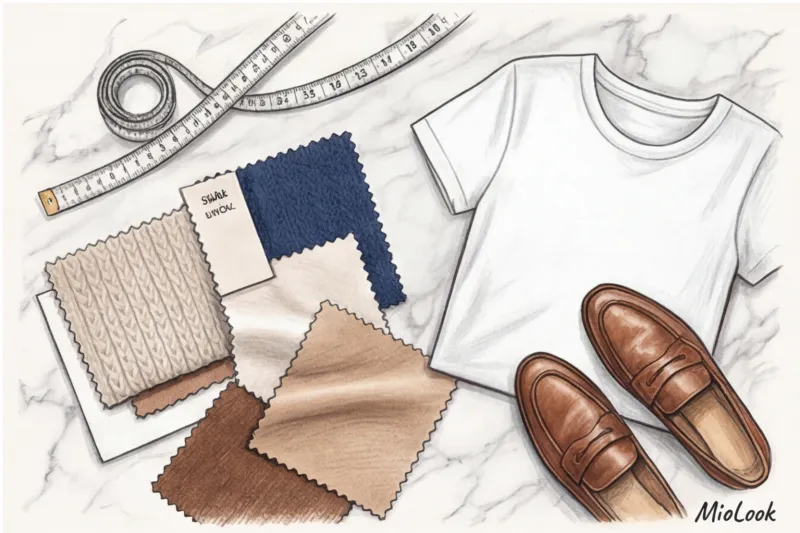
Mistake 1: Trying to digitize 300 things in one day. This is a surefire way to burnout. After the 50th T-shirt, you'll lose your ability to accurately assess the fabric's condition and start missing important tags. Divide the process: today, just shoes and bags, tomorrow, knitwear.
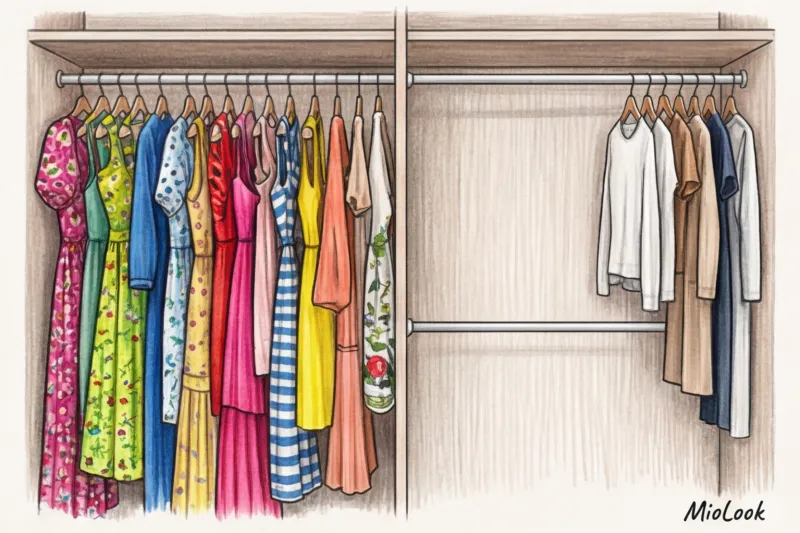
Mistake 2: Ignoring the boring base. Girls love to photograph beautiful dresses and statement jackets, but they forget to include ordinary blue jeans, white T-shirts, and black tights in the app. The algorithm won't be able to create a workable look for you if it lacks these basic connecting elements.
Mistake 3: Deleting items outside the current size without taking into account the cut. Ruthlessly getting rid of clothes that are too small or too big is standard advice, but it doesn't always work. A men's size L shirt that's become too big can make a great oversized layer over a top. Don't look at the number on the tag, but rather at the current silhouette.
Your perfect look starts here
Join thousands of users who look flawless every day with MioLook, without wasting time getting ready in the morning.
Get access — €0.99 onceLife after digital detox: moving to smart capsules
Once the "quarantine zone" has been cleared and the unused items have been donated, the moment of truth arrives—an assessment of the bottom line. According to research by the Ellen MacArthur Foundation (2022), the transition to circularity in fashion and conscious consumption begins here: we buy less, but wear these items two to three times more often.
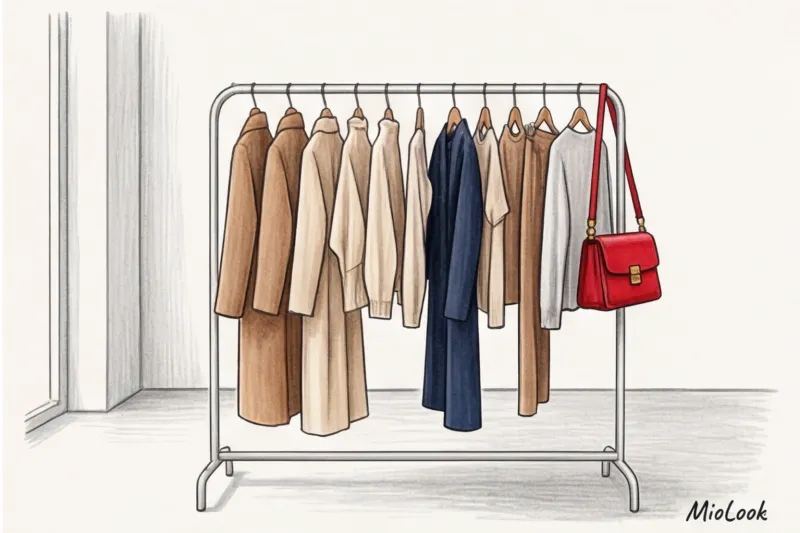
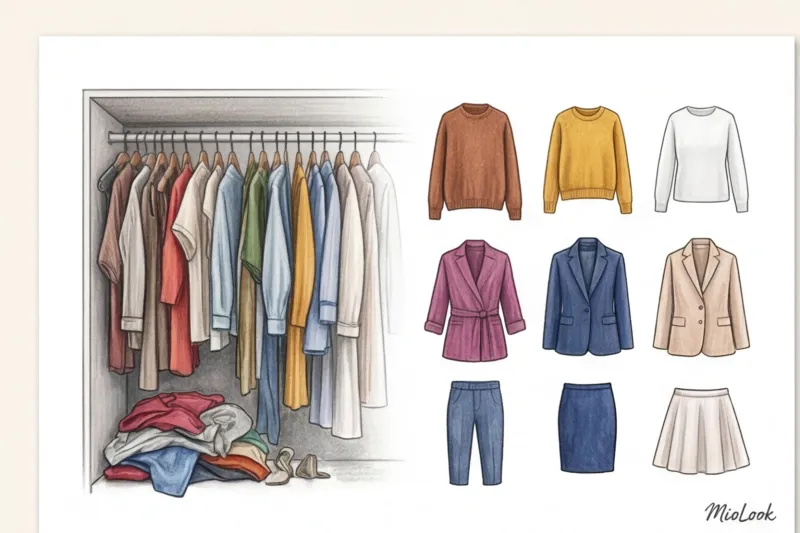
Now your app clearly identifies gaps. For example, you have four great bottoms and three jackets, but only one suitable top. Instead of wandering aimlessly around the mall, you create a targeted shopping list. Shifting to capsule thinking means that from the 15 quality items remaining after a rigorous audit, the app can easily generate 30 unique outfits for every day.
Checklist: A Plan for the Perfect Weekend Review
To turn theory into practical skill this Saturday, here's my tried-and-true checklist:
- Prepare a bridgehead: Wipe down the mirror, adjust the window's natural light, and clear out the bed—it'll become your sorting station.
- Divide the closet into 4 sprints: Basics (tops, jeans, shirts), Accents (dresses, suits, complex tailoring), Shoes, Accessories. Don't move on to the next category until you've completed the previous one.
- Time management: Set aside a strict 30-40 minutes for each zone. Limiting your time will kill the urge to spend hours basking in nostalgia over an old sweater.
- 30 Day Rule: Anything that raises doubts is photographed, sent to the "Quarantine" folder in the app, and put away on the far shelf of the physical cabinet.
"A modern wardrobe isn't a collection of items, but a database. The cleaner this database, the more seamless your personal style system will be."
Incorporating AI into your clothing care routine will forever eliminate the "closet full, nothing to wear" syndrome. A digital inventory allows you to finally see your style from a different perspective, without the emotional attachment to price tags and past memories. Stop hoarding clothes and start managing them—and you'll be surprised how much less clothes you actually need to look amazing every day.