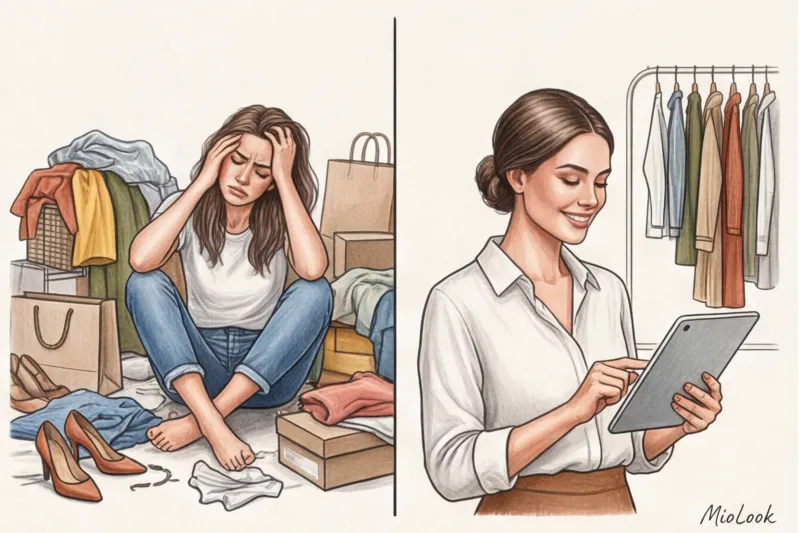
I remember an evening in 2019. I was sitting on the floor of my Milan studio, surrounded by six enormous shopping bags from Massimo Dutti, COS, and local boutiques, clutching a cold espresso. I was trying to remember which of the three sweaters I'd paired these terracotta wool trousers with for a client. My phone had 40 unread messages, and half the links to the items I'd spent the entire night collecting had treacherously burned out—the sizes were sold out.
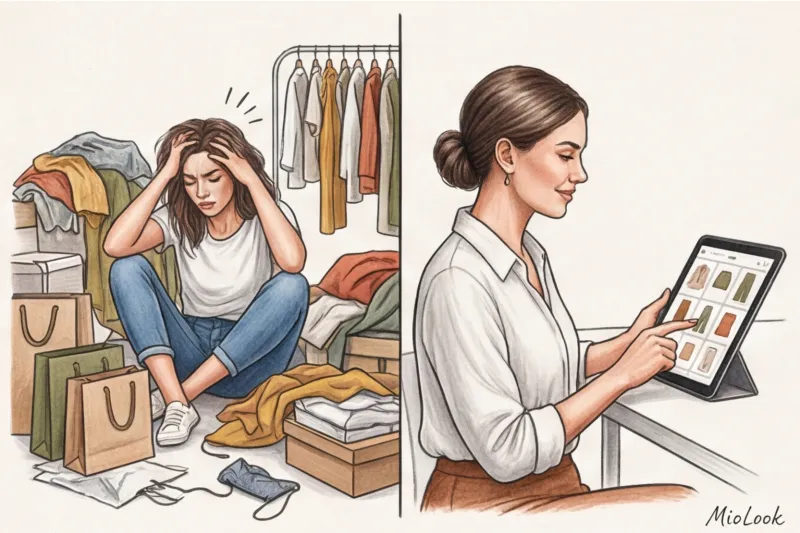
It was at that moment that I realized I needed to change my profession. Not leave it, but change my approach. Today neural networks for stylists — it's no longer a toy for generating funny pictures, but a basic tool for survival in the industry. We've already discussed the fundamental setup of remote work in more detail in our The complete guide to the best apps for stylists and online client management , but today I want to dig deeper.
I'll show you how to transform yourself from a "heavy-bag shopper" into a digital style architect. We'll explore how algorithms take away the routine, leaving you with what matters most: pure creativity and genuine empathy.
Evolution of the profession: why neural networks are a salvation from burnout for stylists
Let's be honest: a stylist's creative block isn't cured by sudden inspiration after a trip to a museum. It's cured by smart automation.
According to a large-scale WGSN study (2024) on the digitalization of the fashion industry, the main reason for personal stylist burnout is mathematical: 80% of their time is spent on technical routine (cutting out backgrounds, creating collages, checking dimensions) and only 20% on creativity and communication.
Many colleagues share their fear behind the scenes: "What if artificial intelligence takes our jobs?" This is a huge misconception. AI is completely helpless when it comes to assessing fabric fit. It won't understand that your client has a complex about the shape of her knees, and it won't sense how 100% cashmere fits differently on her shoulders than a wool blend.
"Neural networks aren't killing the stylist profession. They're killing burnout from meaningless routine. AI will only replace those professionals who refuse to use it."
Your keen eye, sense of proportion and Mediterranean lightness (that very effortless elegance ) are unique. But spending four hours putting together a lookbook presentation in 2025 when it can be done in 15 minutes is a crime against your own business.
Your perfect look starts here
Join thousands of users who look flawless every day with MioLook.
Get access — €0.99 onceFrom WhatsApp Chaos to a Smart System: Automating Customer Routines
Have you ever heard of a customer texting you, "Isabella, does this silk skirt go with that top from message number 10 or 2?"? And when you open the chat to check, you realize the Zara link is already redirected to the "Item Not Found" page.
Wardrobe design should be a visual system, not a machine gun of random photos in a messenger. This is where specialized algorithms come into play.
Intelligent brief analysis and wardrobe analysis
When a new client fills out a form, it's often a stream of consciousness: "I want to look classy, but I work with children, I hate yellow, I sometimes wear sneakers, but I generally love heels." I used to spend half an hour distilling that into a style core.
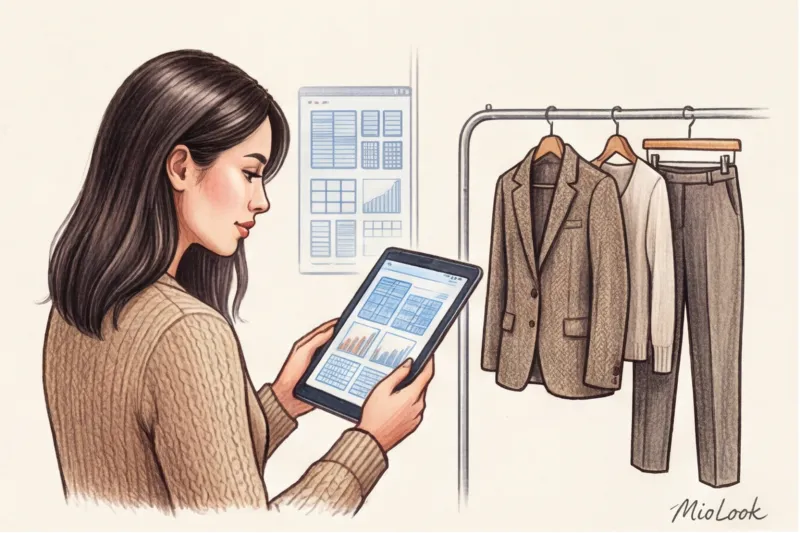
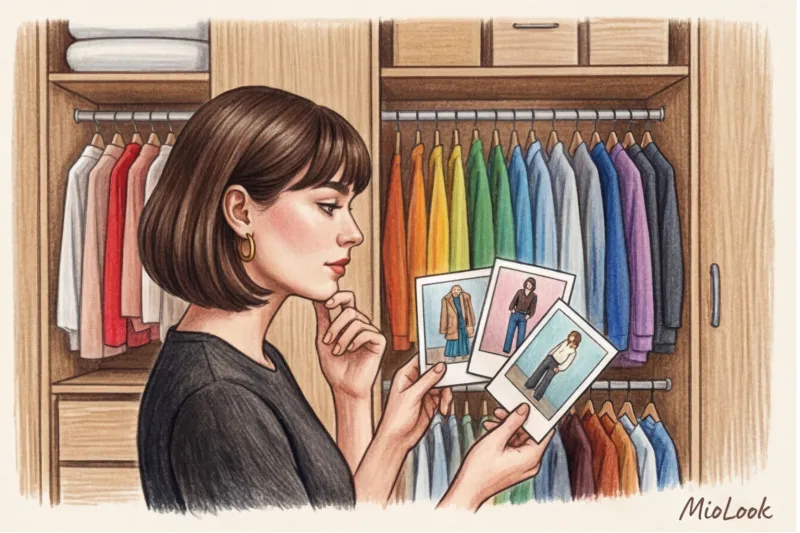
Now text-based neural networks (like ChatGPT) help bring structure to this chaos. Simply upload responses and ask the AI to identify key archetypes, dress code restrictions, and create a style preference matrix. Furthermore, computer vision algorithms have learned to recognize and tag items from a client's home photos. You upload a photo of a crowded closet, and the system automatically sorts them: "straight-leg trousers – 4 pcs.", "basic t-shirts – 6 pcs."
Background removal and automatic capsule assembly
The end of the era of manually cutting out clothes in Photoshop is my favorite advancement. Tools with built-in AI allow you to create perfect collages on transparent backgrounds in seconds.
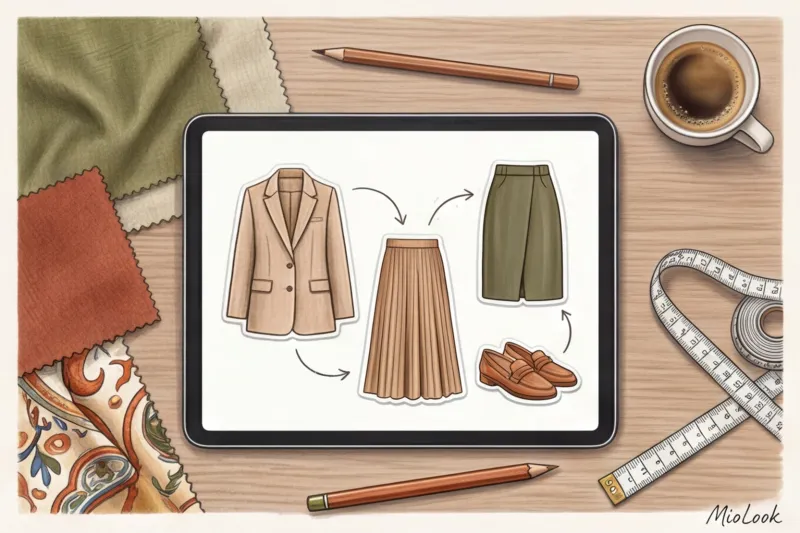
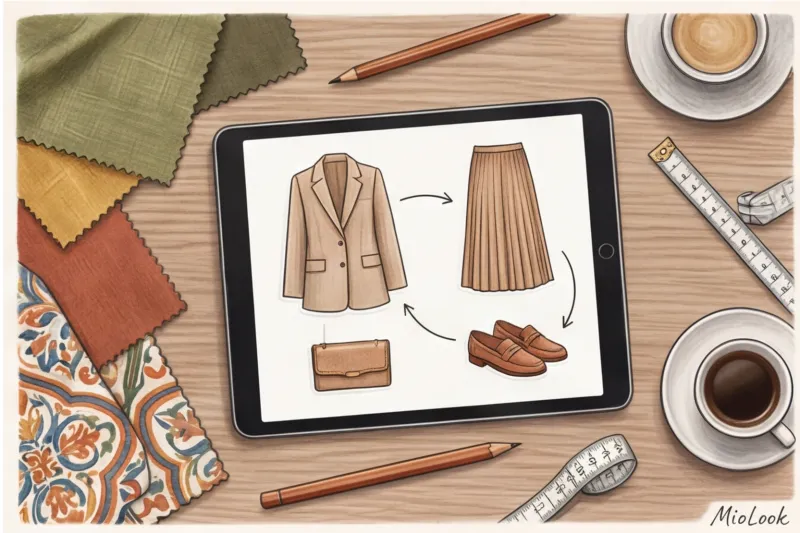
My signature formula for perfect visualization: A menswear-inspired blazer + a bias-cut midi skirt + leather loafers = instant chic. Previously, it took 15 minutes to carefully assemble this set. Now, smart erasers recognize the contours of even complex textures (like fluffy mohair) in one click. You save energy for coming up with unique combinations instead of fighting pixels.
Visualizing Ideas: How to Create Mood Boards Faster Than Your Competitors
One of the most powerful applications of neural networks in styling is selling an idea BEFORE you go looking for the real thing. How often have you spent hours searching for the perfect Pinterest reference to show a client how to style something? black and white dress code , but only found outdated images from 2014?
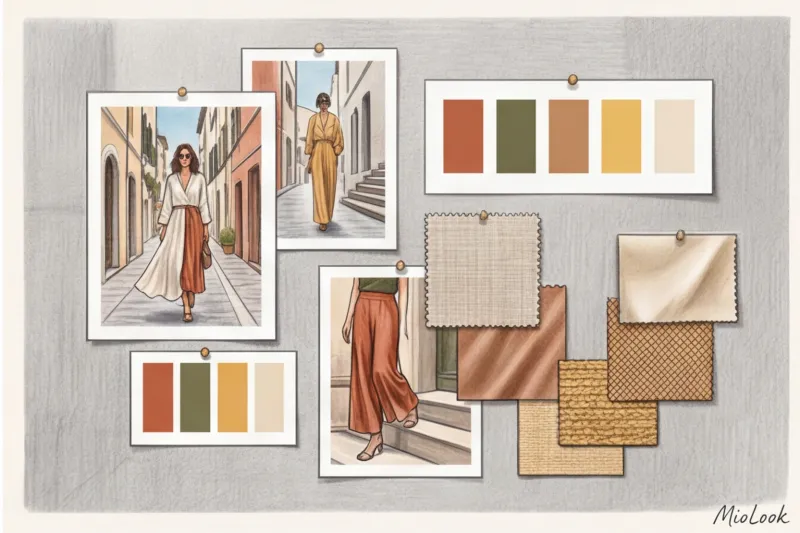
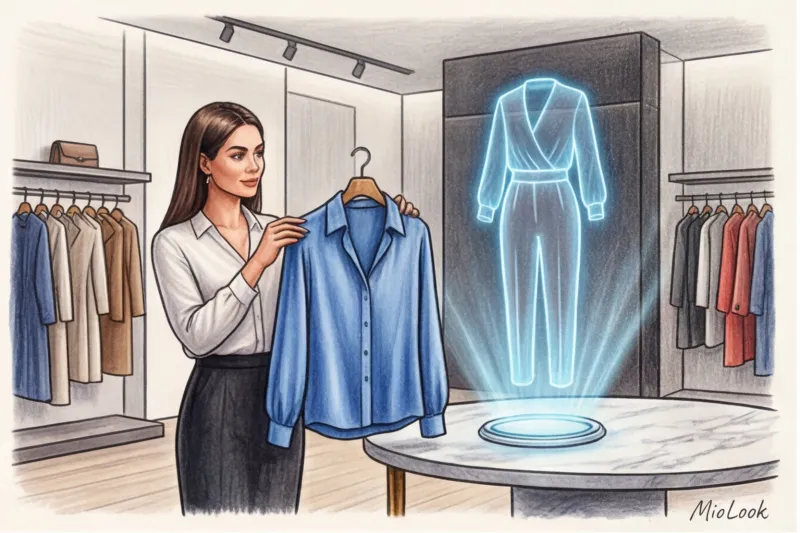
Using Midjourney or DALL-E, you can generate a precise visual concept. It's important to understand the difference: we're not just generating a "pretty picture," but a working reference.
Life hack from practice: Clients have a hard time identifying with size zero models. I create prompts (requests) that include the measurements of a real woman. For example: Milan street fashion, 45 year old woman, pear-shaped body type, wears wide olive linen trousers and a loose poplin shirt, sunglasses, casual elegance, photorealism.
By showing a mood board like this, you immediately eliminate any objections like "it won't suit me." The client sees her figure in a luxurious Mediterranean style and says, "I want it just like that!"
Access to MioLook for €0.99 — one-time payment
A smart AI stylist will select the perfect look.
Get access — €0.99 onceWhere AI Fails: The Pitfalls of Online Styling
To be an expert, you need to be honest about the limitations of technology. I've learned from my own experience that algorithms aren't omnipotent. Moreover, blindly trusting neural networks can lead to returns and dissatisfied customers.
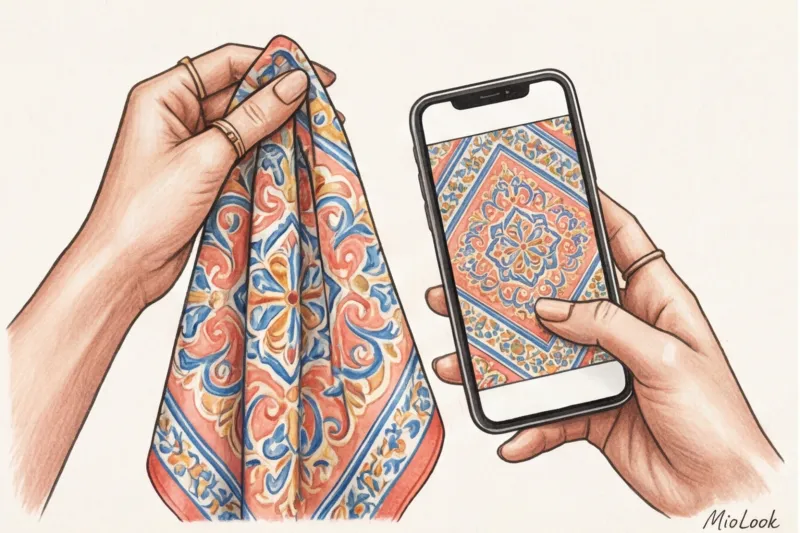
The main scourge of remote work is distorted color rendering As a certified color analyst, I constantly encounter a technical pitfall: smartphone system filters (like Apple's True Tone) automatically warm up the colors on the screen to adjust for ambient lighting.
The neural network analyzing a client's photo is working with already compressed and distorted pixels. A cool skin tone in a photo captured in the rays of the setting sun will be recognized by the AI as a warm autumn color scheme. The machine will suggest mustard and terracotta, although in reality, the client wants a cool emerald. According to the PANTONE Color Institute's technical report (2023), the difference in sensor calibration between top smartphones from different brands reaches 15% in the rendering of red spectrum tones. This is where the machine's work ends and your trained expert eye begins.
The second blind spot of AI is weight and density of the fabric A neural network will visually assemble a perfect outfit of a white shirt and trousers. But it doesn't know that a 100 g/m² cotton shirt will reveal underwear, and that for the right texture, poplin weighing at least 130 g/m² is needed. Choosing clothes online based solely on pictures without understanding materials science is a surefire way to fail.
Content Generation: How to Manage Social Media Without Wasting Time
Promoting yourself as an expert requires regular content. But when you're managing three clients simultaneously, writing long-form pieces about trends is simply impossible.
The AI is excellent at drafting posts, Reels scenarios, and capsule descriptions. But there's a hard and fast rule: Never copy neural network texts blindly. Robotic enthusiasm and words like "amazing," "incredible," and "must-have" instantly betray a cheap approach and destroy trust.
The secret is in teaching the algorithm your signature style (Tone of Voice). Here's an example of my working prompt, which you can adapt to your own:
"Write a post about essential office shoes. You're a personal stylist with 10 years of experience. Your tone: confident, elegant, and straightforward. Avoid using words like 'delicious,' 'look,' or 'must-have.' Be specific about how smooth leather loafers look more classy than suede ones in a formal dress code. Keep your paragraphs brief."
You get a great framework, into which you can add your story in 2 minutes: “Yesterday, during a fitting with a client at Massimo Dutti, we realized that...” — and the post is ready.
MioLook: How Specialized Apps Are Changing the Game
General neural networks (ChatGPT, Midjourney) are good for specific tasks. But when it comes to managing a client base, you need a closed ecosystem. Using a dozen different tabs is the same chaos, only digital.
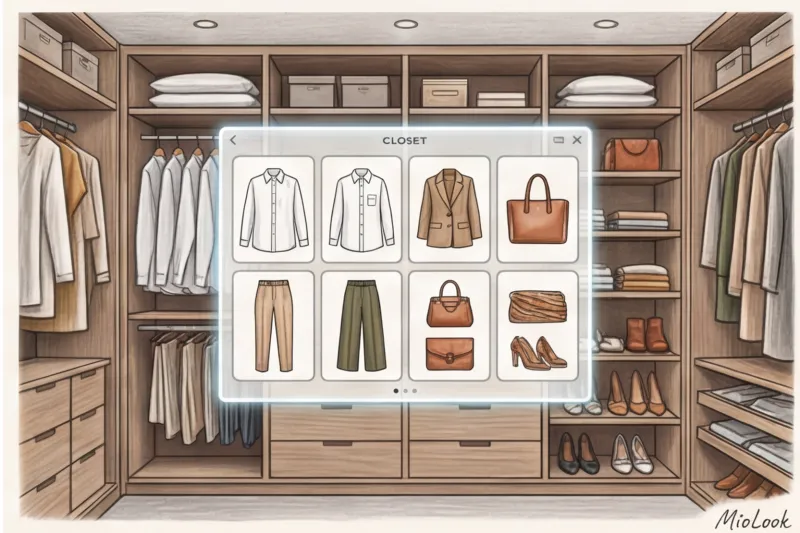
This is where specialized apps come in handy. For example, MioLook It solves the very same problem from the first section of my article—it eliminates WhatsApp clutter. It's a smart wardrobe manager that allows you to:
- Create a personal virtual wardrobe for each client (the client sees their items and your selections in a beautiful interface on their phone).
- Automatically save product links without the risk of losing them.
- Generate new combination looks based on items you've already purchased using built-in AI.
This isn't just convenience. It's scaling your business. When all your routine processes are digitized in an app, you can efficiently manage 10 clients simultaneously, devoting maximum creative attention to each. For the client, this feels like a premium service: instead of links in a chat, they receive a beautiful personal app with its own style.
Checklist: 5 Steps to Implementing AI into Your Personal Stylist's Work
Transitioning to a new path can be daunting. Don't try to implement everything at once. I recommend my students start small, following this algorithm:
- Step 1: Digitization of the database. Bring all your disparate questionnaires, briefs, and mood boards from your notes into a single cloud space.
- Step 2: Background removal test. Find a convenient AI collage tool (like your smartphone's built-in eraser or specialized web services) and assemble a capsule using this new method. Time your steps—you'll be amazed.
- Step 3: Transition to the ecosystem. Transfer your communications with your most loyal clients from messaging to a professional app like MioLook. See how much fewer follow-up questions you have.
- Step 4: Delegating texts. Create prompt templates for writing social media posts and lookbook descriptions.
- Step 5: Create a personal reference base. Start generating and saving AI moodboards for different archetypes and complex dress codes so you can pull them out as an ace up your sleeve during your first client meeting.
Technology won't take away your job. It will take away your heavy packages, lost links, and sleepless nights. Artificial intelligence is your tireless digital assistant, taking care of the grunt work so you can remain an artist. Free up your time for what really matters—your clients, their confidence, and your professional growth.