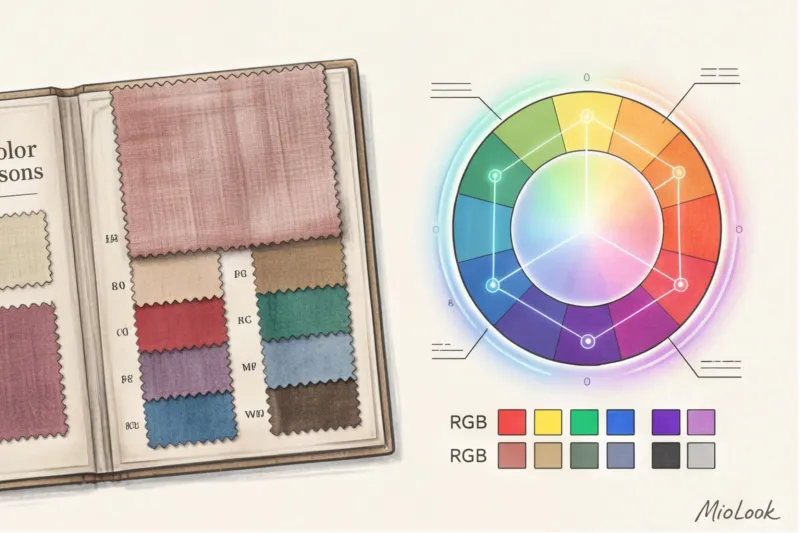
Last week, my client Anna tearfully paid €320 to change her "fashionable" copper hair color. Why? Because a glossy magazine test convinced her she was a "Warm Autumn." The magazine had overlooked one detail: Anna had a slight olive undertone, which instantly made her face look sickly green against her red locks. If she had known how modern algorithms work, this mistake could have been avoided in a second.
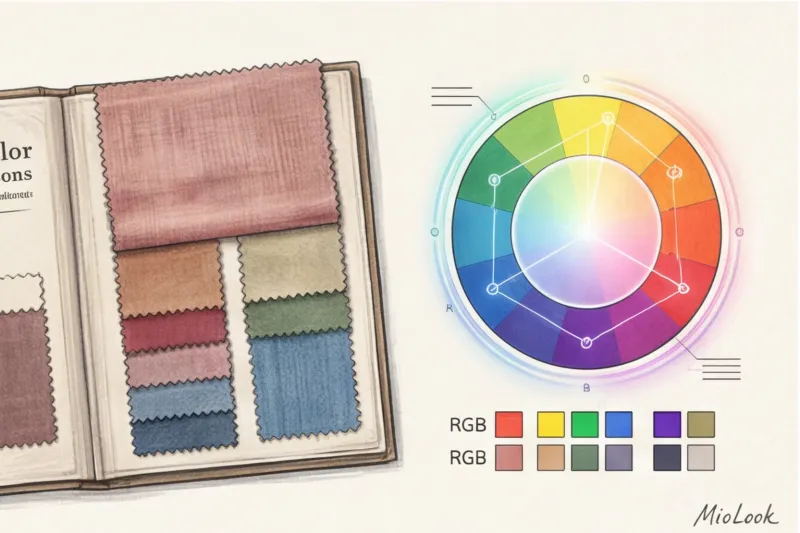
We've already covered the evolution of these technologies in more detail in our complete guide. Virtual Hairstyle Try-Ons: How AI is Changing the Beauty Industry In my 12 years as a stylist, I've seen hundreds of beauty fails like this. We used to have to guess. Today, we have math.
You no longer need to apply handkerchiefs to your face in front of the mirror. Technology has advanced so far that now choose makeup according to color type online This isn't a fun five-question test, but a complex biometric analysis. AI translates your appearance into precise HEX codes, saving you hundreds of euros on unsuccessful beauty purchases and salon experiments.
Why 12 color types are outdated, and AI is the new standard of coloristics
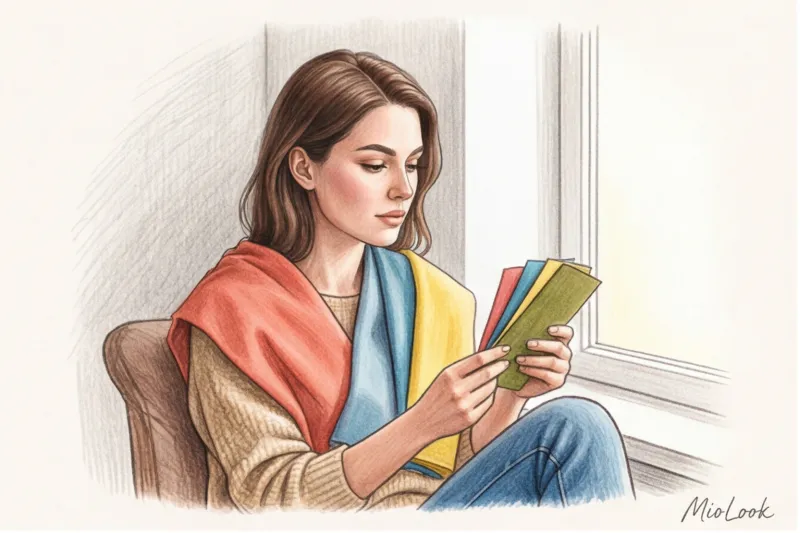
The theory of the four seasons and 12 color types (popularized by Carole Jackson in the 1980s) was created for an analog world. It demands that a living, complex person be fitted into a rigid framework. But let's be honest: pure color types almost never exist.
I often see clients with cool skin undertones but warm golden highlights in their irises and a completely neutral ash hair color. Where do they fit? "Soft Summer"? "Cold Winter"?
"The human eye can distinguish about a million shades, but our brain is subjective—it distorts color perception depending on lighting and background. A neural network, however, sees pure RGB spectrum data," state the principles of machine vision used in the beauty industry.
Algorithms have debunked the myth of "seasons." They've proven that each person has their own unique contrast and temperature matrix. You don't need generic mass-market palettes, but personalized calculations. If you're still trying to figure out which season you belong to, I recommend reading this article. 12 Color Types of Appearance: A Photo Test with a Neural Network to see the difference in approaches.
Access to MioLook for €0.99 — one-time payment
A smart AI stylist will select the perfect look.
Get access — €0.99 onceHow Algorithms Analyze Your Face: Color Biometrics
When you upload a photo to a modern facial analysis app, the magic ends and the science begins. Advanced AR algorithms (like those developed by Perfect Corp or L'Oréal ModiFace) don't just look at a picture.
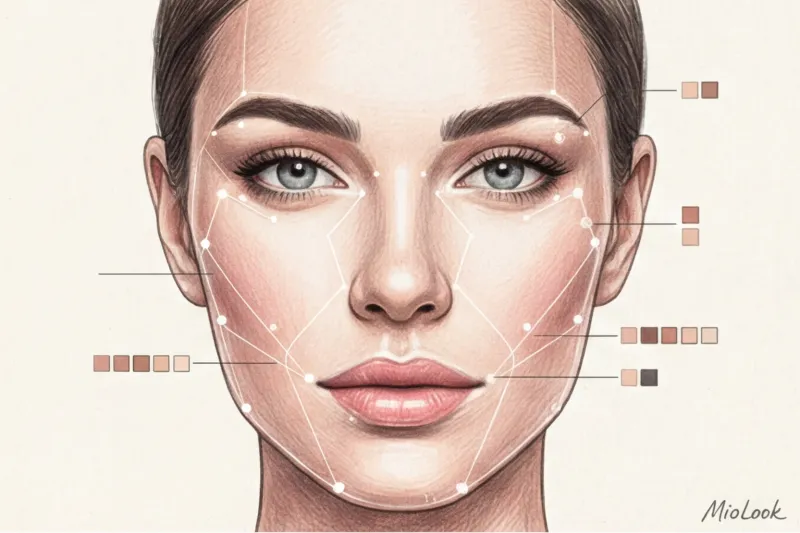
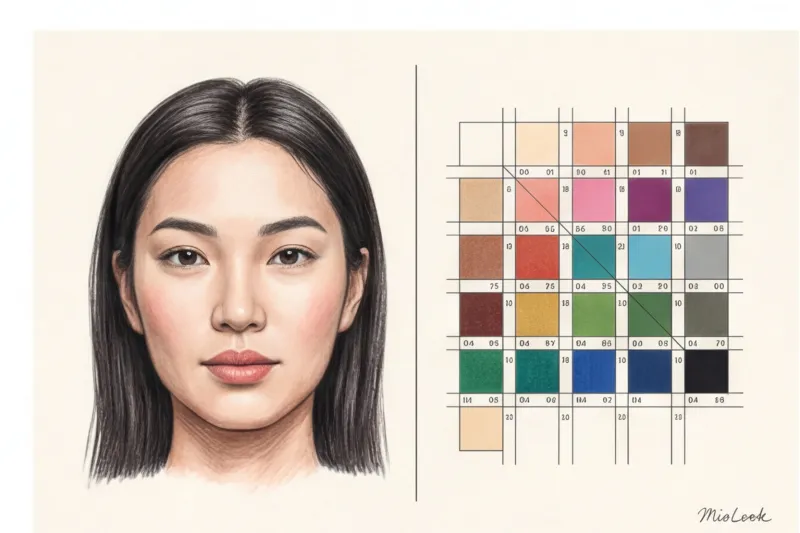
They scan over 150 points on your face. What exactly is the neural network looking for?
- Base pigment: AI can distinguish temporary factors (redness, acne, light tanning) from your true skin color.
- Contrast level: The difference in pixels between the color of the whites of the eyes, the iris, the skin, and the eyebrows is measured. This is what determines whether a bright fuchsia will "eat up" your face or whether you can handle the color naturally. Learn more about contrast online ).
- Division into undertone and overtone.
The last point is the most important. People constantly confuse surface overtones with deep undertones. For example, rosacea or reactive skin produces a red overtone. A woman looks in the mirror, sees redness, and buys foundation with a cool, pink undertone. The result? Her face looks gray. AI sees through this redness, revealing, for example, a true warm, yellow base ( How AI determines undertone ).
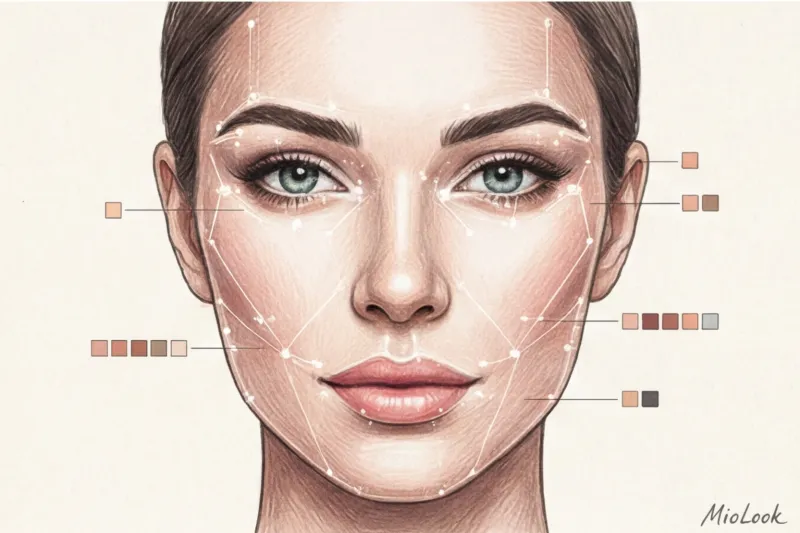
How to choose makeup online based on your color type and avoid making a mistake with your purchase
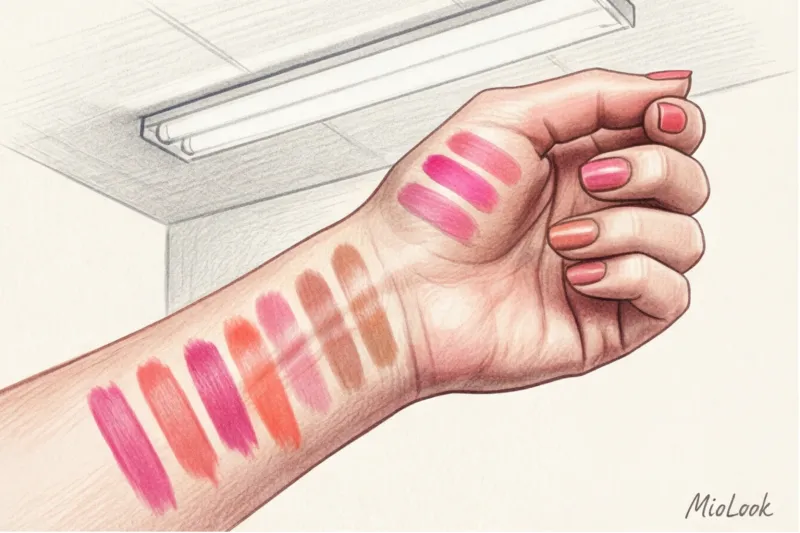
According to statistics from the research agency WGSN (2024), about 80% of women wear the wrong shade of foundation. And this is logical: store-bought fluorescent light mercilessly distorts colors. To choose the right shade choose makeup according to color type online , algorithms solve three main problems.
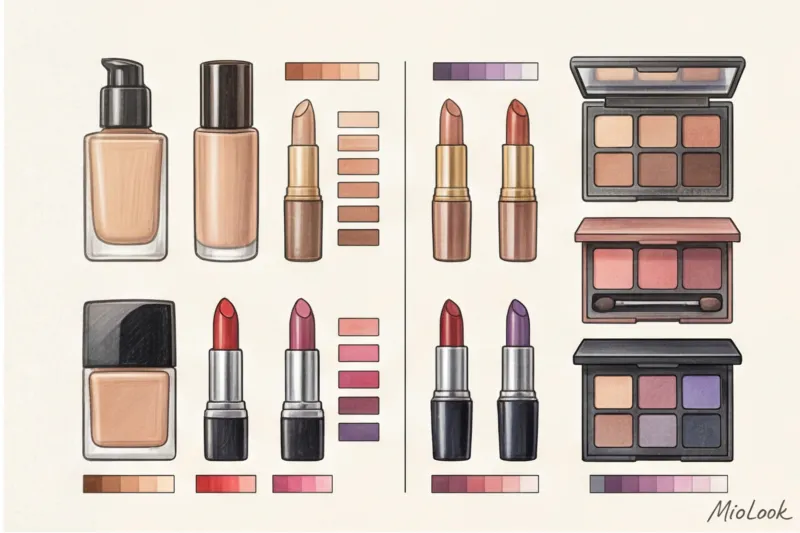
1. Finding the perfect tone (Depth & Temperature)
The AI calculates not only temperature (warm/cool/neutral), but also color depth on a scale of 1 to 10. This eliminates the famous "separate head" effect, where the neck appears strikingly different from the face.
2. Custom eyeshadow palette
The algorithms use Itten's digital color wheel. If you have brown eyes with honey highlights, the AI will find a complementary blue-violet spectrum of the right muted tone, which will brighten your eyes and not make you look like a '90s saleswoman.
3. The formula for the perfect red lipstick
Red suits everyone, it's just a matter of balancing blue and yellow pigments. AI analyzes the color of your tooth enamel. If it has a slight yellow tint (which is perfectly normal), the algorithm will suggest a lipstick with a cool blue base to visually whiten your teeth.
Your perfect look starts here
Join thousands of users who look flawless every day with MioLook.
Get access — €0.99 onceIntegrating a beauty palette into a capsule wardrobe
Makeup doesn't exist in a vacuum. The shades of your cosmetics should work synergistically with the clothing in the portrait area (collars, scarves, blouses). If you're building a neutral capsule wardrobe (beige, gray, navy), makeup selected by AI can become the main accent of your look.
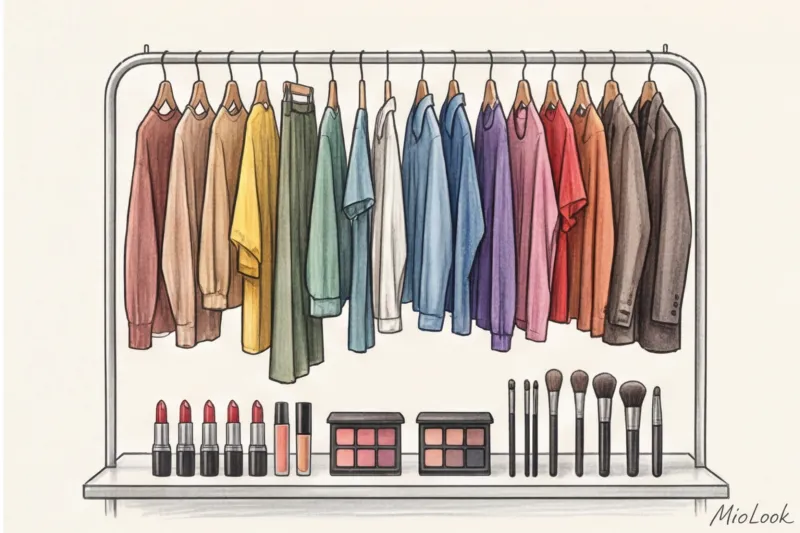
I always advise my clients: if you have any doubts, upload your image to MioLook to see how your lipstick shade complements the color of your jacket. Impeccable style is based on the principle of contrast. We wrote more about how to combine them in the article How to Match Lipstick to Your Outfit: Tips from a Colorist.
Virtual Hair Color Try-On: Test Drive Before Your Visit to the Colorist
Spontaneous hair experiments are the most expensive expense when it comes to emotions. A couple of years ago, after a difficult breakup, one of my clients went to a salon, cut her gorgeous light brown hair into a bob, and dyed it jet-black. The next day, she realized the color had visually added 10 years to her age (about What colors make you look older? , we already wrote about it). Correcting this error cost her eight months of recovery and about €450.
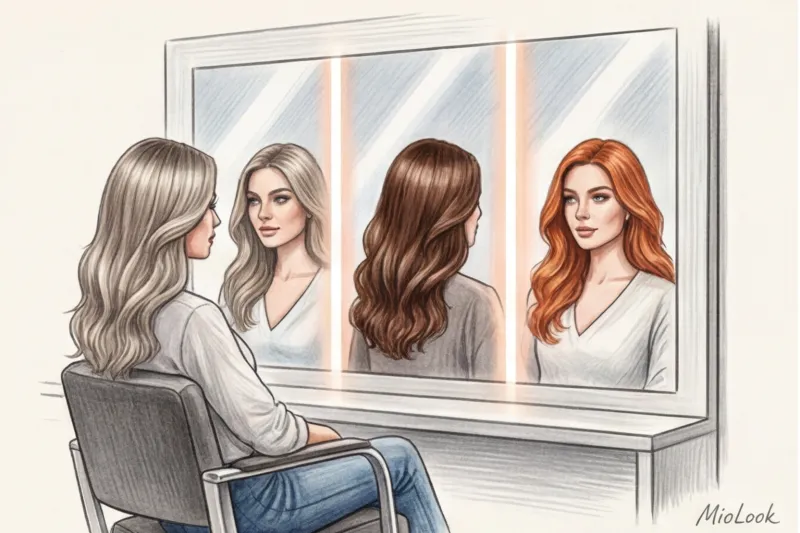
A high-quality virtual try-on is completely different from Instagram filters. Advanced neural networks take into account your current UGT (tone depth level).
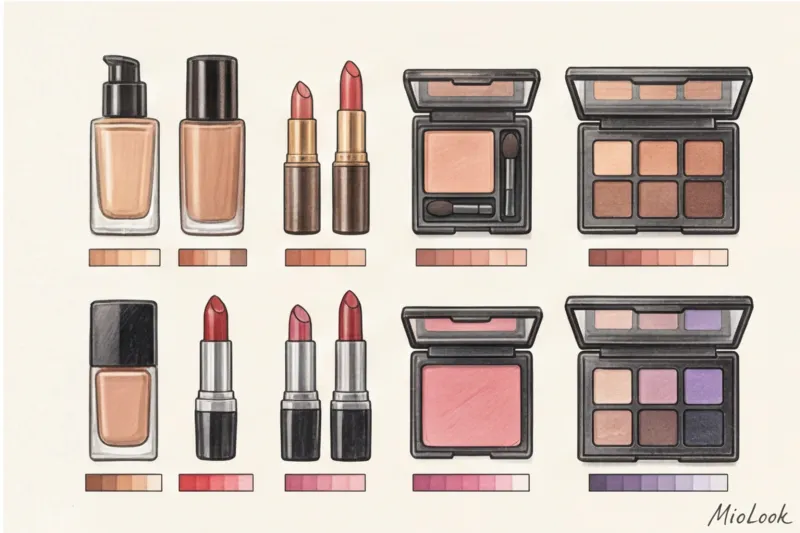
If you're a brunette with a skin tone level of 4, the algorithm won't simply slap a platinum blonde on top of your hair. It will show you the realistic texture and how the shade will complement your skin tone. This allows you to test copper, ash, or caramel shades with millimeter-level accuracy, without damaging the hair cuticle at all.
Stylists' Checklist: How to Take Photos to Get Accurate AI Results
AI has one inherent limitation: it only works with the data you give it. If the photo is bad, the result will be erroneous. No neural network can overcome the laws of physics and poor lighting.
I recently conducted an experiment: I uploaded a photo of myself to a beauty analysis app under five different lighting conditions. The results were shocking. The LED ring light made me look like a contrasting "Winter" (whitened my face), the setting sun by the window transformed me into an "Autumn" look, and the office fluorescent light gave my skin an earthy undertone.
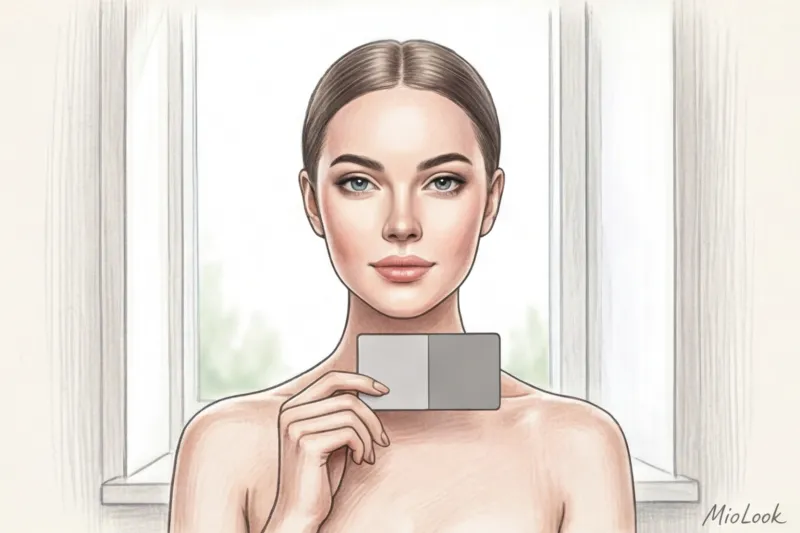
To ensure the algorithm produces flawless results, follow these 3 rules:
- Ideal light: Stand facing a window during the day, away from direct sunlight. You want soft, diffused light. Turn off any chandeliers or floor lamps in the room—they cast yellow or blue shadows.
- Blank canvas: Remove all makeup. Pull your hair back into a sleek ponytail or wear a white or gray headband to prevent your hair color from distracting the algorithm from analyzing your skin.
- Neutral background: Shoot against a white or light gray wall. Bright wallpaper behind you will cast a color reflection on your cheeks. Hold the phone at arm's length, exactly at eye level, to avoid distorting the proportions of your face.
The Future of Style: From Lottery to Precise Calculations
Today, using artificial intelligence in style isn't just a toy for an evening out. It's a utilitarian tool for conscious consumption. According to McKinsey, women wear only 20-30% of what's in their closets or makeup bags, precisely because the items are impulse buys and don't suit their natural features.
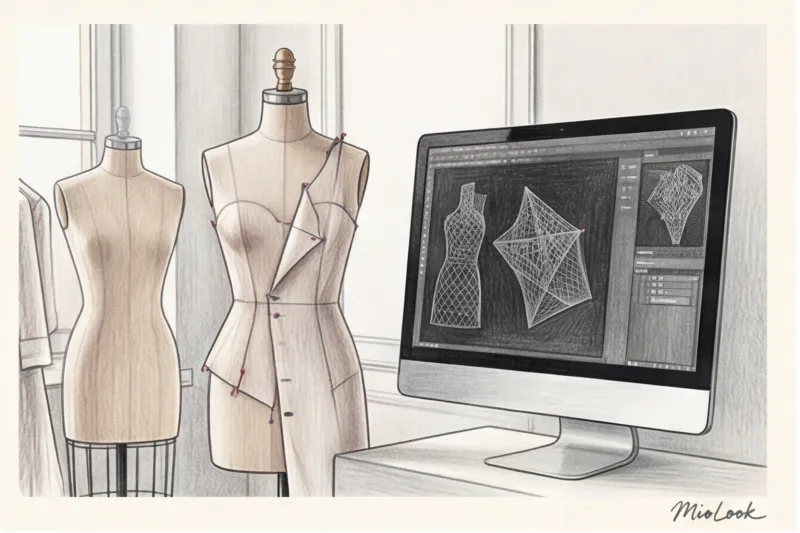
Create your own digital biometric card in the app MioLook It allows you to combine your clothes, makeup, and hair into a single, seamless system. AI won't replace your personal taste, but it will provide a solid technical foundation.
The main conclusion you should draw is this: stop guessing in fitting rooms. Digitalize your natural measurements once, and every subsequent purchase—from a basic T-shirt to an expensive lipstick—will be an investment that works for you 100%.