You know what irritates me most about the maternity industry? How easily marketers pressure women into buying downright ugly clothes that will only last one season. As a stylist, I'm categorically against disposable clothing. My approach is simple: every item in your closet should be worth every penny and not turn you into a shapeless cloud.

Specialized maternity clothes are usually a waste of money. I discussed this trap in more detail in our The complete guide to stylish maternity outerwear But there is one brilliant exception to this strict rule. And that is 3-in-1 sling jacket.
Unlike typical "mommy" blogs, we won't be discussing ruffles and cute prints here. We'll examine this wardrobe staple through the lens of the strict Cost-Per-Wear formula and the minimalist aesthetic of European brands. Spoiler alert: this could be your most stylish maternity investment, not a forced, ugly compromise.
What is a 3-in-1 sling jacket and why is it an exception to the rule?
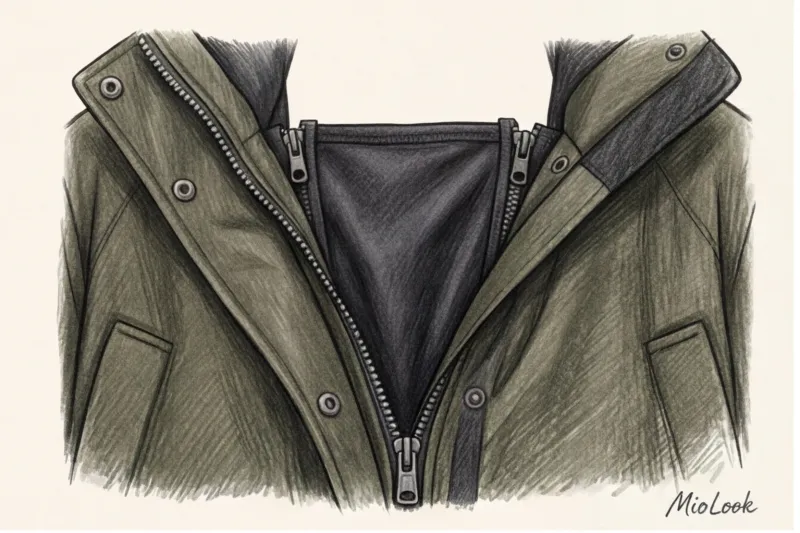
Let's get down to the anatomy. A true 3-in-1 modular jacket is a technological construct. It consists of three elements:
- Basic jacket: a full-fledged stylish parka or coat that you wear solo.
- Maternity insert: a narrow zippered panel that widens the jacket in the stomach area.
- Sling insert: A wide panel with a hood for the baby, which allows the jacket to be zipped over the child in an ergo-backpack or sling.
How does this system work? It transforms with your body. But herein lies my main requirement as a stylist: A basic jacket without inserts should look like a stylish piece from COS, Arket or Massimo Dutti If without the inserts it looks like a shapeless travel bag, we don't buy it.
Over 12 years of experience, I've tested dozens of models: from inexpensive mass-market options to specialized brands like Mamalila. The main conclusion is to look for a brand that first creates a great urban jacket and then designs its inserts, not the other way around.
The main myth of stylists: why the trendy oversized jacket won't replace the 3-in-1 sling jacket
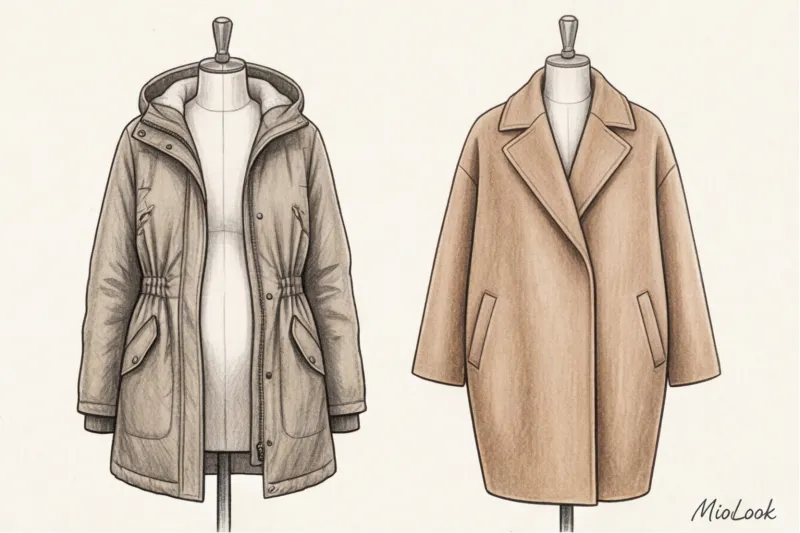
Open any fashion magazine and you'll see this lazy maternity advice: "Just buy a men's down jacket or cocoon coat three sizes too big." For babywearing, this isn't just awful, it's dangerous advice.
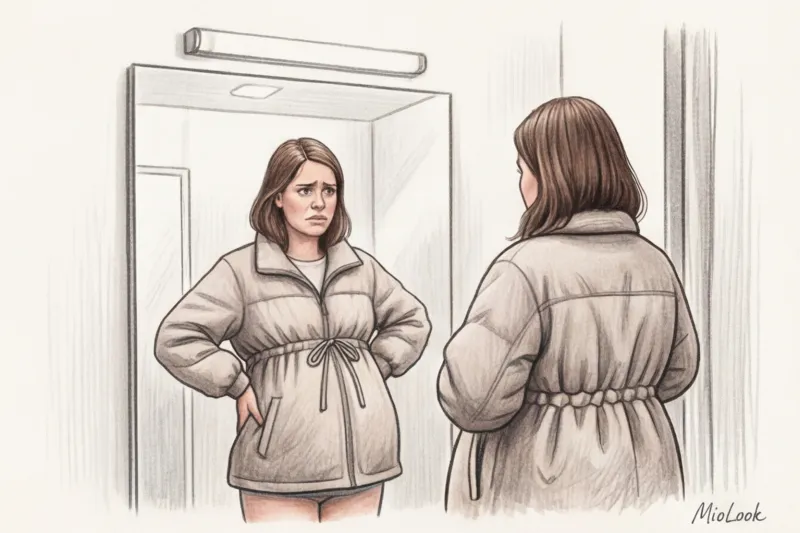
One of my clients from Berlin, Emma, spent €400 on a luxurious oversized designer coat, hoping to carry her baby underneath. After two weeks of winter walks, she developed cervical myositis, and her baby was constantly cold. Why?

Problem #1: Open throat and chest. An oversized coat won't zip up over a bulky baby carrier to protect your neck. It'll leave a huge hole (literally a funnel) in your chest, allowing snow to collect.
Problem #2: Bell aerodynamics. A regular, wide jacket doesn't have a drawstring system at the bottom. The icy wind will blow freely from below, directly onto the child's legs.
Problem #3: Breathing hazard. An oversized babywearing bag risks your baby falling too deeply. You won't be able to visually monitor their face, which is a serious violation of babywearing safety rules.
Your perfect look starts here
Join thousands of users who look flawless every day with MioLook, choosing their clothes wisely.
Get access — €0.99 onceWardrobe Math: Calculating Cost-Per-Wear for a Babywearing Jacket
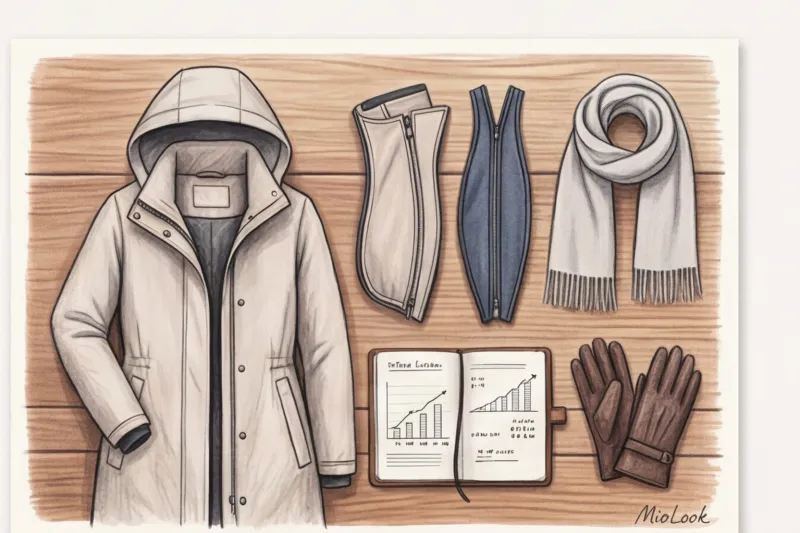
I love numbers because they don't lie. Let's apply my favorite formula. Cost-Per-Wear (CPW) — the cost of putting on an item of clothing. Let's compare two winter preparation scenarios.
"A quality item isn't worth what it says on the price tag, but what it costs to use it for one day." — Katarzyna Nowak
Scenario A (typical):
You buy an inexpensive maternity jacket (around €150), which you wear for maybe 3-4 months. After giving birth, it's too big, so you buy a regular winter down jacket for stroller walks (another €200). Total: €350 spent. The maternity jacket ends up in the trash or gathering dust in the closet. The CPW of the first jacket is exorbitant—around €1.60 for each walk.
Scenario B (smart shopping):
You invest in a high-quality 3-in-1 babywearing jacket for €250-€300. You wear it for four months of pregnancy, 1.5 years of active babywearing, and another 2-3 years as a regular, stylish parka with all the inserts removed. At this rate, you wear it hundreds of times, and your CPW drops to a paltry €0.20 per day.
It's also an investment in freedom. The ability to go out in the snow for coffee without pushing a 15-kilogram stroller through the snowdrifts is priceless.

How to choose a 3-in-1 babywearing jacket without looking too touristy
The biggest problem with the maternity clothing market is its infantile design. For some reason, manufacturers believe that after giving birth, a woman is bound to fall in love with toxic fuchsia, turquoise accents, and owl prints. This is detrimental to any aesthetic.
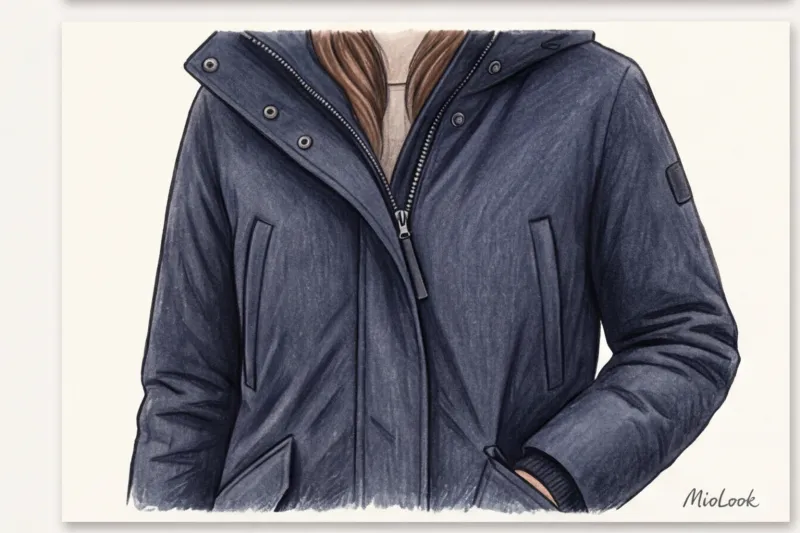
To ensure your jacket serves you for years as part of your smart-casual wardrobe, follow these three rules:
- Color rule: Choose deep, "premium" base shades. Camel, graphite, classic navy (deep blue), khaki, or crisp black. They easily complement any look.
- Hardware rule: Look for hidden zippers and matte buttons that match the fabric. No contrasting white zippers on a black background!
- Cut: The ideal sling jacket is based on the silhouette of a classic parka (fishtail) or a straight quilted urban coat.
Fabrics and insulation: a technical approach to style
Avoid cheap, shiny polyester—it creates a "garbage bag" effect and cheapens the look. If you read my article about How to choose lining and outer materials , you know that texture decides everything.
Opt for matte membrane fabrics (with a waterproof rating of at least 5000 mm). They look classy and are windproof. As for the lining, forget about thick, lumpy synthetic padding. Look for modern insulation materials like Thinsulate or Isosoft with a density of 150-200 g/m². They're three times thinner than synthetic padding, retain warmth like down, but prevent the "Michelin Man" effect.
Length and silhouette: how to maintain proportions
The optimal length is mid-thigh or just below the knee. Short babywearing jackets (to the pelvis) are a disaster. Firstly, they interfere with heat exchange (the baby's legs in the sling often end up below the edge of the jacket). Secondly, they visually "cut" your figure into squares, adding extra bulk where it's not needed.
Make sure there are hidden drawstrings at the waist. They will create a flattering silhouette when worn without the inserts.
Ready to get started?
Try the MioLook free plan—no commitments required. Organize your closet and create capsule wardrobes with just one click.
Get access — €0.99 onceSafety and dress code: rules for wearing a sling jacket
Here we move from style to health. A babywearing jacket is just a cover! She doesn't hold the child on her own. A properly wrapped fabric sling or a physiological ergo-backpack must be placed underneath.
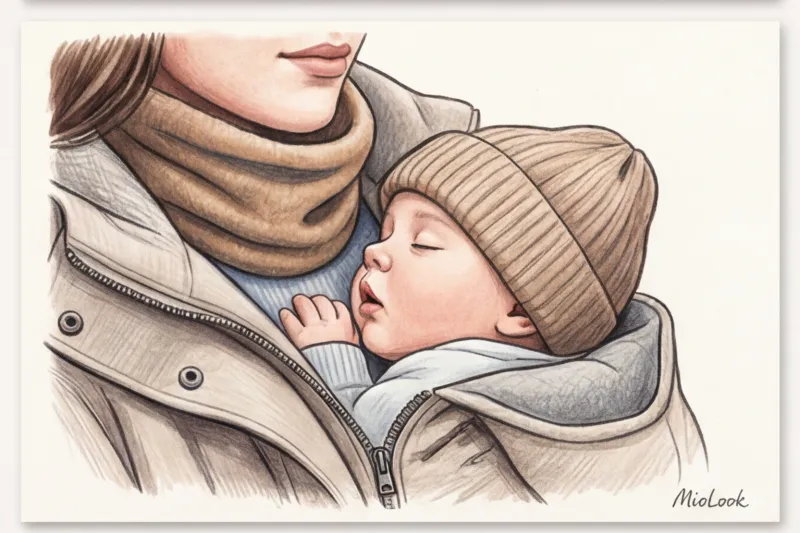
The UK Sling Consortium (2010) developed a gold standard for safety – rules TICKS The most important one is that the baby's face should always be visible, and the chin should not be pressed against the chest. This is why the sling insert's hood never should not cover the baby's nose.
Thermoregulation is also important. Pediatricians, using the TOG (Thermal Overall Grade) system, warn that overheating is more dangerous for a baby than hypothermia. Statistically, up to 80% of the body heat is retained inside a babywearing jacket due to the combined heat exchange between mother and baby.
The "one layer" rule: A mother's jacket replaces a full-fledged winter jumpsuit for her baby. Bundling a baby in thick wool or fleece under a winter sling jacket is a huge mistake.
What about mom's neck? A high-quality 3-in-1 jacket always comes with a fleece neck warmer (also called a bib). It elegantly covers your neck and chest without disturbing your baby.
What to wear with a sling jacket: putting together stylish urban looks
Since a jacket with a babywearing insert inevitably creates massive volume on top, the rule of proportion dictates a minimalist bottom. If you wear wide palazzo pants with a babywearing jacket, you'll visually transform into a closet.

Here's my tried-and-true winter look formula for the active mom:
- Bottom: Thick thermal leggings, straight-cut or skinny jeans. We discussed excellent options for this base in the article about Basic wardrobe for short women.
- Shoes: Chunky Chelsea boots with a cleat sole or stylish hiking boots. Safety first—you need perfect traction on the ice when you're carrying a child. No heels or slippery boots.
- Accessories: Beanies are smooth-knit. Avoid long, bulky scarves—the ends will get in your child's face, which is uncomfortable and unsafe.
- Bags: Forget about shoulder bags—they'll always fall off due to the thickness of your jacket. Your choice is a minimalist leather backpack or a crossbody bag worn UNDER the jacket (before you put the baby on).
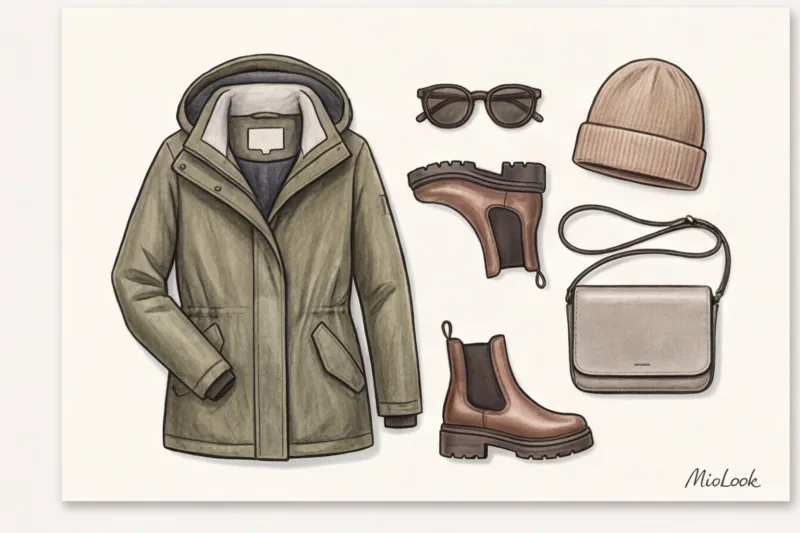
To quickly put together these looks in the morning when you only have 5 minutes before heading out, I recommend digitizing your items. Upload a photo of your jacket, leggings, and boots to the "smart wardrobe" feature in MioLook , and the app will suggest stylish combinations for the day.
Stylist checklist: check your 3-in-1 babywearing jacket before buying
So, you're in the fitting room (or in front of the mirror if you're getting delivery). Before you cut off the tags, go through my checklist:
- Independence test: Unzip all the inserts. Put the jacket on. Does it look like you bought it at a good boutique? Will you still wear it to work in three years? If not, return it.
- One-hand test: Try zipping up the sling insert with one hand (you'll often be holding the baby with the other). If the zipper gets stuck, that's a bad sign. High-quality YKK hardware works like clockwork.
- Caring for Mom: Check for deep fleece pockets. You'll be hiking for a long time, and warm pockets for your hands are a necessity, not a luxury.
- Carrying on the back: If you plan to carry your toddler on your back (relevant for children from 1 year old), make sure the jacket has a hidden zipper on the back for re-zipping the insert.
A 3-in-1 babywearing jacket isn't a short-term investment. Choosing the right one is a long-term investment in your mobility, back health, and, just as importantly, maintaining your personal style even during the most chaotic months of motherhood.