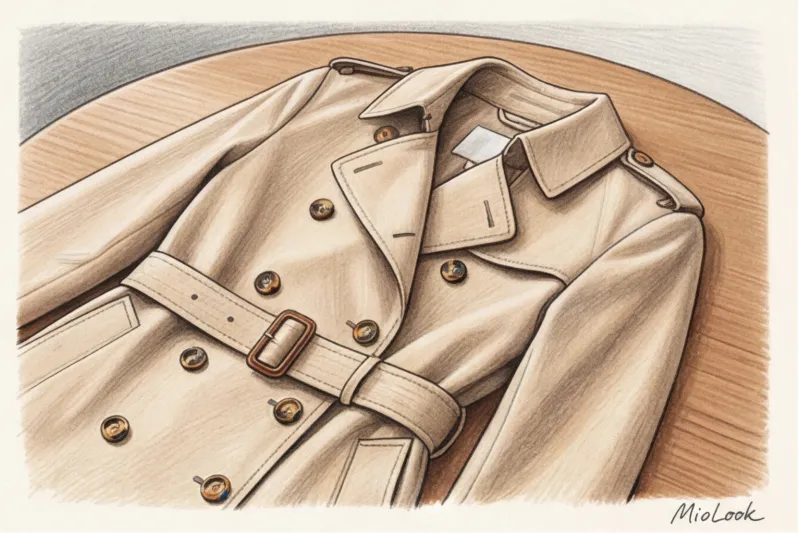
Recently, a client and I were doing a seasonal wardrobe review. She pulled out a vintage Burberry, bought in London back in 2012, and hung a fresh, classic beige trench coat from a popular high-street store next to it for visual reference. From a distance, they looked like identical twins on the hanger. But as soon as she got closer, touched the fabric, and turned the pieces inside out, the magic of the cheap knockoff vanished without a trace.
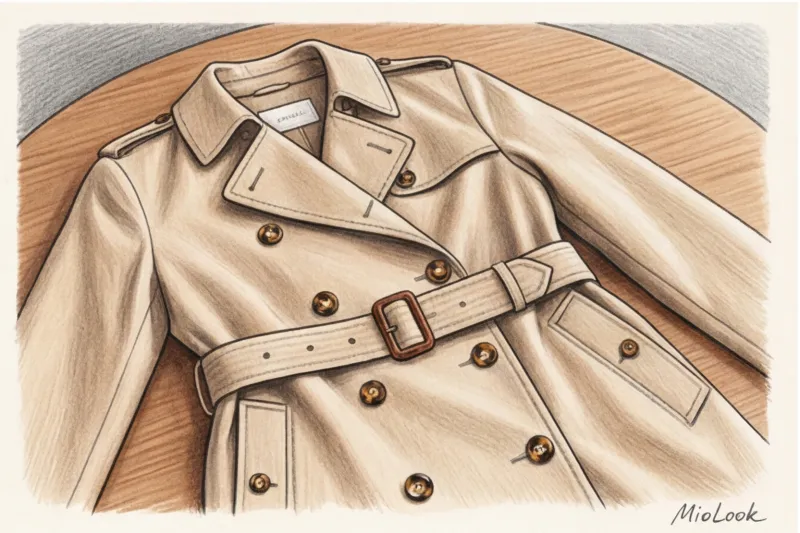
It's not about the recognizable checkered pattern on the lining or the status label. It's about the garment's architecture itself. I've already discussed in more detail how the price of basic items is determined in our the complete guide to investing in the perfect base Today, we'll be dissecting trench coats. I'll show you how to read quality based on gabardine density, seams, and hardware to find a mid-range coat that looks, wears, and ages like a true luxury item.
Anatomy of a legend: what are we paying for when we buy a Burberry trench coat?
Why have we been relying on this British standard for decades? In 1879, Thomas Burberry patented gabardine—a then-unique fabric made of long-staple Egyptian cotton, with the threads woven in a twill at a 63-degree angle. Water simply rolled off this armor, while the body continued to breathe. According to research by the Fashion Institute of Technology (FIT, 2023), it is the density of the weave and the quality of the thread that determine a coat's lifespan, not the name on the tag.
The original design was driven by rugged military utility. Epaulets were used to attach officer insignia, D-rings on the belt held grenades and canteens, and the rifle flap (the front yoke) cushioned the rifle's recoil. Do you need half of these details on your way to the office for your morning coffee? Probably not. But they do set that very composed, slightly militaristic tone.
The hidden difference is in the numbers. In the premium segment, there are 11-12 stitches per inch of collar seam. In inexpensive counterparts, there are only 7-8. This isn't tailoring snobbery, it's physics: more stitches means the collar will hold its shape flawlessly for decades, rather than sagging after its first season in the rain.
The Basic Myth: Why the Classic Beige Trench Coat Isn't for Everyone
Open any glossy magazine's "10 Essential Wardrobe Items" list, and it's almost certain to top the list: a stiff, double-breasted trench coat. As a practicing stylist, I can officially declare that this is one of the most dangerous fashion myths.
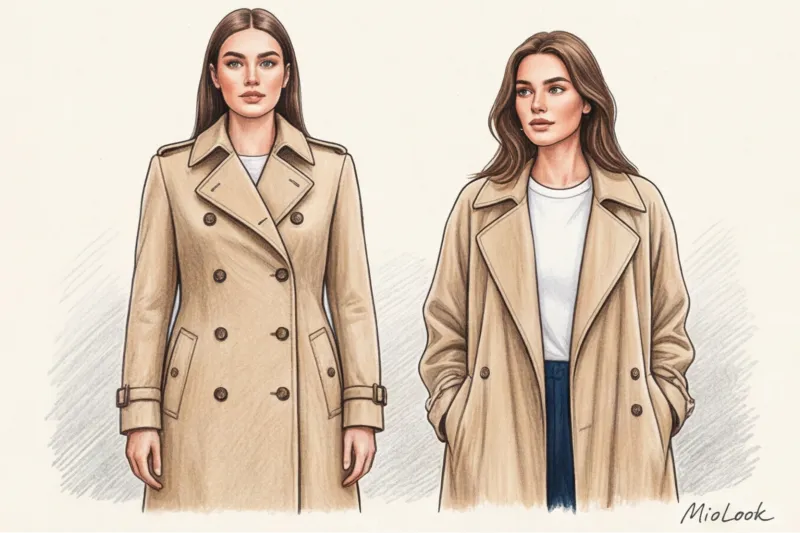
Over 14 years of working, I've noticed a clear pattern: 80% of clients larger than a size L, petite, or with a prominent bust who came to me looking for a "timeless classic" ultimately rejected it. Why? The double-breasted cut of stiff gabardine, reinforced with a fly-away yoke at the front and epaulettes on the shoulders, creates the effect of a solid, monolithic box on such figures. It visually widens the ribcage and "consumes" the neck.
A classic, rigid trench coat isn't a one-size-fits-all solution. If it makes you feel armored, it's not your go-to piece, no matter how many must-have lists it tops.
What to do? Look for alternatives. A single-breasted macintosh (it elongates the silhouette with vertical buttons) or a trench coat made of flowing fabrics like lyocell or thick copper often proves a more modern and expensive investment. We discussed in detail how body geometry dictates the choice of style in our article about body types and style types.
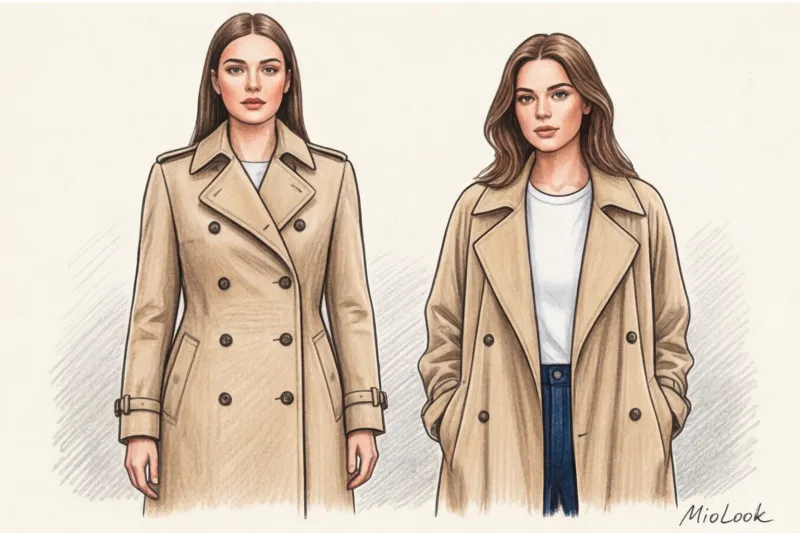
Stylist's Checklist: How to Find a Quality Mid-Segment Alternative
I regularly select pieces for photo shoots and know where to look with a discerning eye. To find a gem among brands like Massimo Dutti, COS, or 12Storeez, you'll need this algorithm.
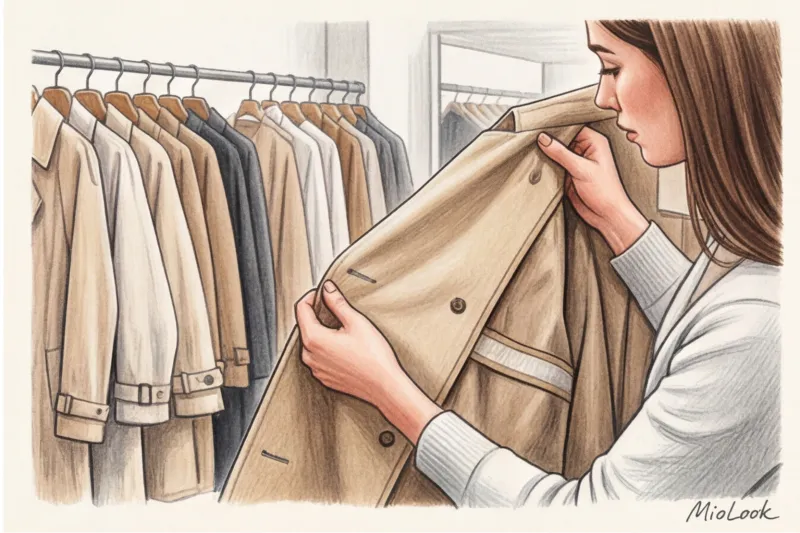
First, learn to "read" the composition. Looking for 100% cotton is an intuitive but serious mistake. Pure, dense, untreated cotton will wrinkle while you're in a taxi to an important meeting. As noted by textile technologists at the Première Vision (2024) exhibition, the ideal formula for an urban trench coat is dense cotton with 15-20% polyamide or nylon. This fabric holds its shape and resists wrinkling.
Second, conduct a DWR (Durable Water Repellent) test. If the consultant can't see, discreetly drip a small amount of water from a bottle onto the sleeve. On the right fabric with a water-repellent finish, the drop will form a mercury ball and roll off. If the water immediately soaks in as a dark spot, the coat will be soaked through at the first drizzle.
Third, turn the garment inside out. A quality garment's interior seams aren't simply overlocked, but neatly bound with bias binding (finished). This is a sign of high-end production, and the first place mass-market garments skimp.
Hardware: The detail that reveals the true value
Nothing cheapens a look like flimsy, shiny plastic. Cheap, imitation horn buttons and thin plastic buckles scream economy.
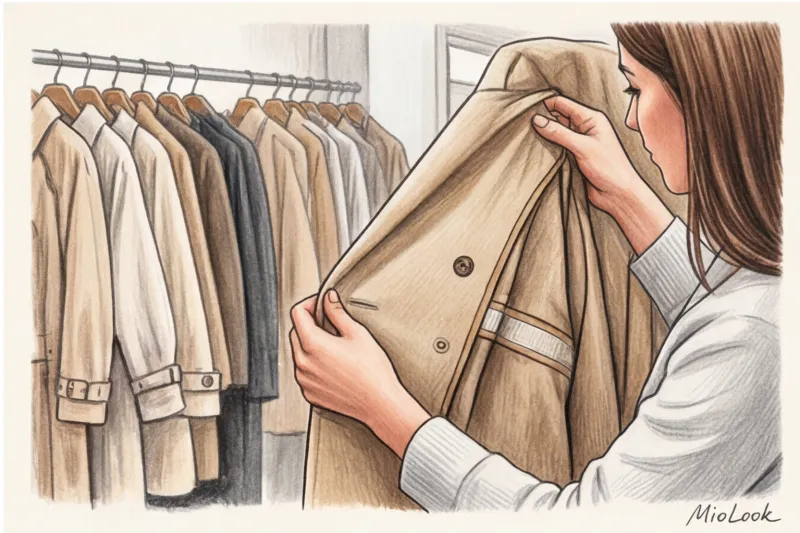
My personal life hack: Buy a well-cut, heavy-weight coat at a mid-market store and take it to a tailor immediately. Replace the basic plastic buttons with real horn, and the plastic sleeve buckles with metal or leather-covered ones. This will cost you next to nothing in terms of wardrobe investment, but will visually add hundreds of dollars to the garment's value.
Also, pay attention to the belt. It should be lined with interlining and thick enough. If the belt curls into a thin, shapeless tube when you tie it, leave the item in the store.
Your perfect look starts here
Join thousands of users who look flawless every day with MioLook. Its smart algorithm will help you sort through your wardrobe and create stylish capsule wardrobes.
Start for freeTop trench coat styles for different body types and heights
Fit is everything. That classic beige trench coat will only look chic if it's proportionate to your frame.

- For tall people (from 170 cm): You're looking for hyper-volume and a maxi (ankle-length) look. Feel free to choose wide lapels, thick, almost stand-up gabardine fabrics, and voluminous sleeves. Knee-length dresses will cut into your silhouette at the worst possible place.
- For miniatures (up to 160 cm): A midi length (just below the knee or mid-calf) is your best bet. Avoid chunky epaulets and oversized yokes—they'll weigh you down. A medium-width belt is recommended. Be sure to roll up your sleeves, revealing slender wrists—this will lighten the look.
- For plus-size: Look for a raglan cut (where the sleeve is one piece with the shoulder). The absence of a stiff shoulder seam will soften the silhouette. Avoid double-breasted styles in favor of single-breasted or wrap-style trench coats made of flowing fabrics (lyocell, tencel), which delicately hug the curves without adding bulk.
If you are unsure which proportions and lengths are right for you, I recommend using MioLook — a smart AI stylist analyzes your measurements and suggests the optimal outerwear styles.
How to wear a classic beige trench coat: modern look formulas
Forget the tired trench coat + fitted sheath dress + beige pumps combination. In 2025, it looks too forced and outdated. Modern styling is all about relaxed style and contrasts.

One of my clients, a top manager at an IT company, complained that her trench coat was lying around unused because she rarely wore suits. We compiled a few formulas for her that worked flawlessly:
- Sport chic: Layer a crisp gabardine coat over a voluminous gray hoodie, adding knit joggers or leggings, high socks, and chunky sneakers (like the New Balance 530). The juxtaposition of classic and sporty styles creates the ultimate street style look.
- Relaxed classic: Wide-leg, straight-leg jeans (full-length, straight-leg), a basic white T-shirt, a loose, open trench coat, and sturdy leather loafers. Perfect for weekends or casual Friday wear.
- Complex multi-layered: In early spring, when a trench coat alone is still chilly, wear it as an outer layer. Layer it underneath with an ultra-thin down jacket, a vintage denim jacket, or even a voluminous wool jacket. The key is to keep the trench coat loose enough (oversized) so that the entire structure doesn't restrict movement.
Trench Coat Care: How to Maintain a Classy Look for Years to Come
Buying the right item is half the battle. It's important not to ruin it. And there's one strict limitation here that brands often fail to mention: frequent dry cleaning destroys the fabric's finish.
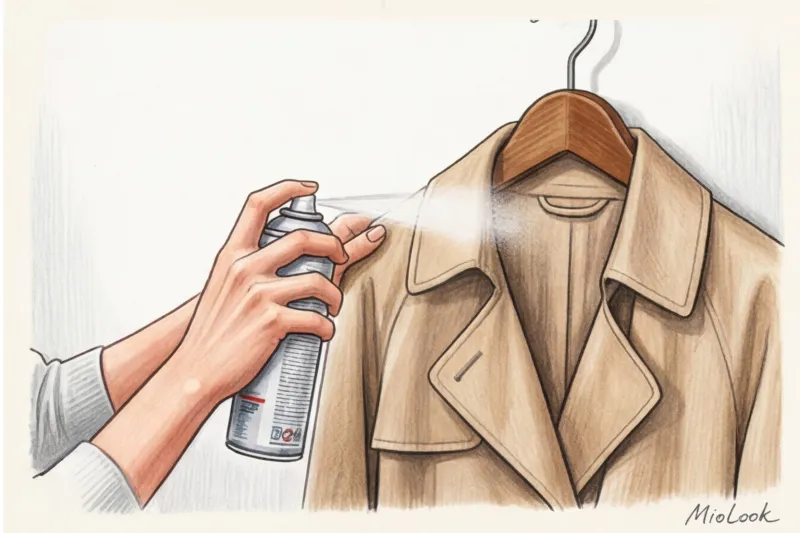
Harsh solvents used in dry cleaning will strip away the polymers in the DWR coating. If you dry clean your raincoat every season, after a couple of years it will begin to absorb water like a sponge. Remove localized stains with a damp cloth or mild soap. If dry cleaning is unavoidable, be sure to restore the water-repellent layer afterwards. Invest in a good aerosol hydrophobic spray (such as those from Saphir or Tarrago) and spray it evenly over the clean garment on the balcony.
And the last rule: shape. Never hang a heavy gabardine coat on thin wire hangers from the dry cleaner. They stretch and distort the shoulder line. Invest in wide wooden hangers that follow the natural curve of your back.
Ready to get started?
Try the free plan—no commitments required. Upload your items to the smart wardrobe and let AI create looks for you.
Start for freeDon't blindly copy a specific brand. The right beige trench coat isn't one that's confusingly similar to a two-thousand-dollar London original. It's a piece that's physically comfortable to lift your arms in, one that doesn't turn into crumpled paper after forty minutes on the subway, and one that protects you from a real, not a movie-quality, autumn wind. Invest in quality fabric and a proper fit, and your coat will be worth every penny.