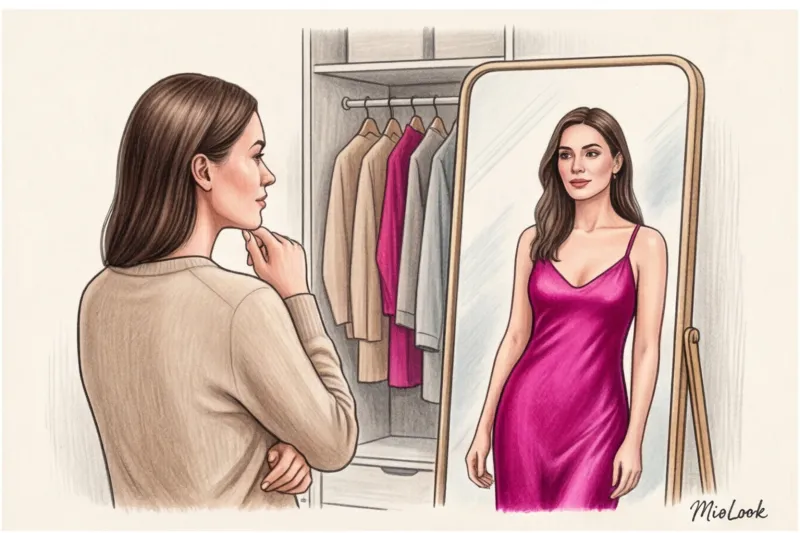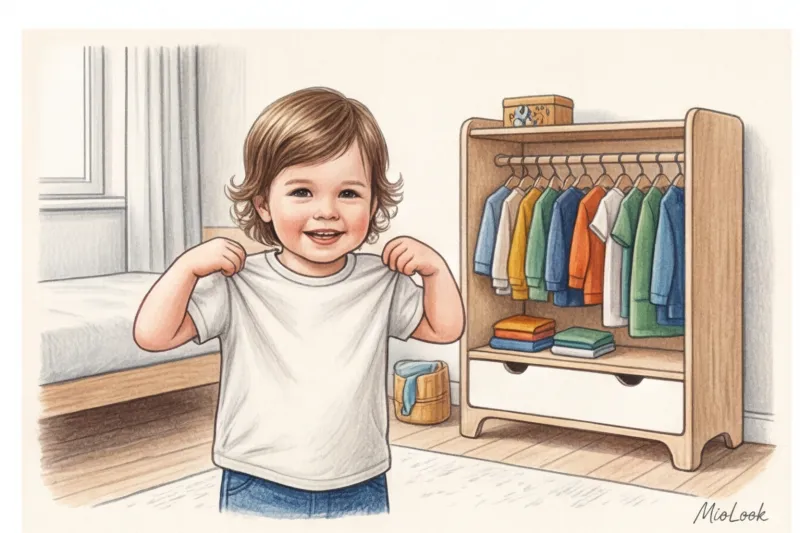
Every morning, the same drama plays out in thousands of families: tears over an itchy sweater, hysterics over leggings that clash with a favorite princess, and an uncompromising desire to wear a summer dress in -10 degrees. Sound familiar? Over 12 years of working as a stylist and studying textiles in-depth, I've realized one thing: children's clothing isn't just fashion. It's a complex engineering project.
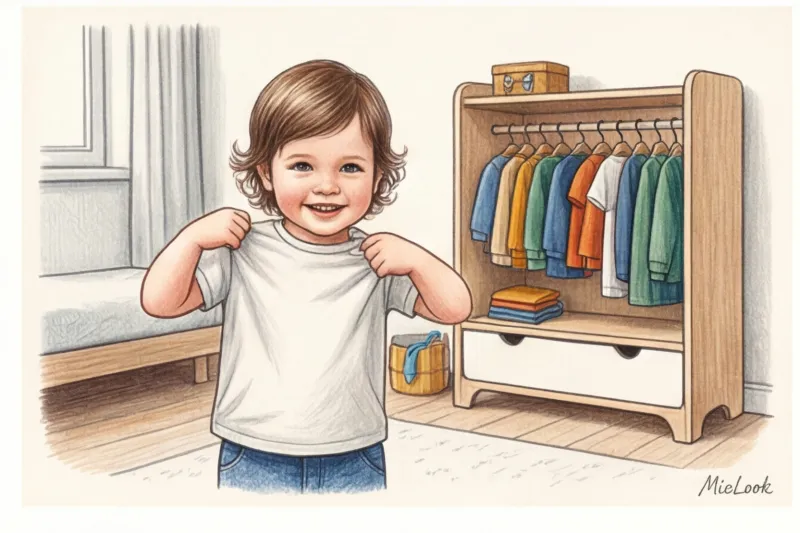
We have already discussed in more detail the basic principles of creating a children's wardrobe in our The complete guide to a child's capsule wardrobe , but today we'll take a closer look at the harsh reality of kindergarten life. And we'll start by debunking the main myth.
Buying "cheap" items for kindergarten because they'll be damaged by paint and torn anyway is the most common and most expensive mistake parents make. It's false economy.
Cheap mass-market knitwear loses its shape after just three washes, warps along the grain, and begins to press and irritate the skin. The child experiences physical discomfort, which directly translates into morning tantrums. High-quality capsule for kindergarten — this is your investment in a calm morning routine and your child’s health.
What is a capsule in kindergarten and why does it work better than chaos?
A child's capsule wardrobe is a well-thought-out ecosystem of 12-15 items that can be combined seamlessly, creating over 30 harmonious looks. You simply pull out any top and bottom, and they'll pair perfectly.
But there's also a profound psychological aspect here. According to the American Occupational Therapy Association (AOTA, 2023), a limited but aesthetically pleasing selection of clothing reduces cognitive load and anxiety in children. The Montessori method clearly states: give a child a choice of two or three correct options, and you'll foster independence in them.
My calculations show that an organized capsule saves a family an average of 15-20 minutes of morning preparation each day. That's about 5-7 hours of saved sleep per month! And to simplify the process of planning these routines, I always recommend that clients use wardrobe visualization feature in the MioLook app , where you can upload all your children's items once and create outfits in just two clicks.
Your perfect look starts here
Join thousands of users who look flawless every day with MioLook. A smart AI stylist will create looks for you and your child.
Start for freeTextiles and Health: Which Fabrics Can Withstand Play-Doh, Soup, and 50 Washes?
In children's clothing, the fabric composition is everything. Many parents intuitively look for "100% cotton" labels, believing it to be the benchmark for quality. But this isn't always the case. In my experience testing dozens of children's pants, 100% pure cotton on joggers or leggings is a guaranteed way to have stretched knees by lunchtime on the first day.
The ideal formula for active carpet play: 80–95% cotton and 5–20% polyester or elastane The synthetic thread in this volume does not impair breathability, but acts as reinforcement—returning the fabric to its original state after stretching.
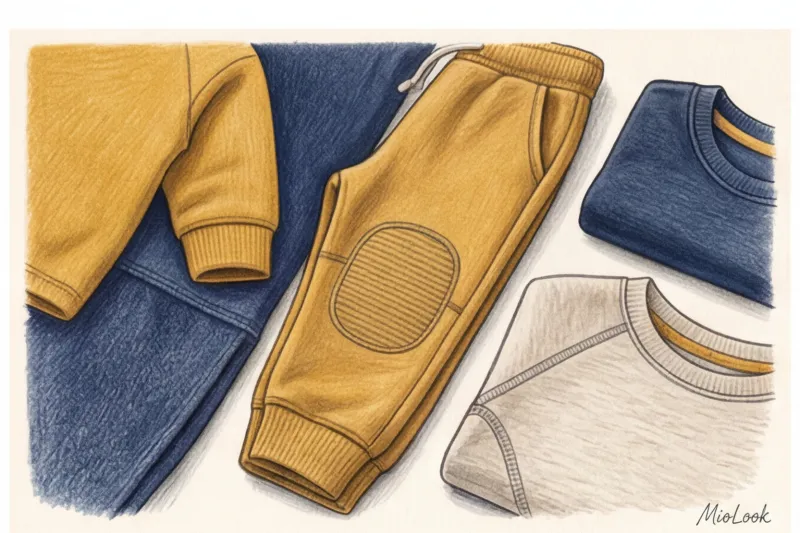
The second golden rule is to pay attention to the density and type of weave. Choose a dense one. interlock (smooth knitwear on both sides) or plain jersey with a minimum weight of 180–200 g/m². They won't warp after washing at 40 degrees. It's also crucial to check for a certificate. OEKO-TEX Standard 100 — is an international guarantee that vibrant prints are free of toxic phthalates and heavy metals that can be absorbed through the skin through sweat.
Hidden enemies: fittings, seams, and prickly tags
One of my clients complained that her son flatly refused to wear half the clothes he bought for kindergarten, throwing tantrums. The kindergarten staff suspected behavioral issues. It turned out to be simple sensory overload. The cheap polyester threads in the seams scratched his skin, and the stiff tags sewn into his sides pricked every time he leaned over.
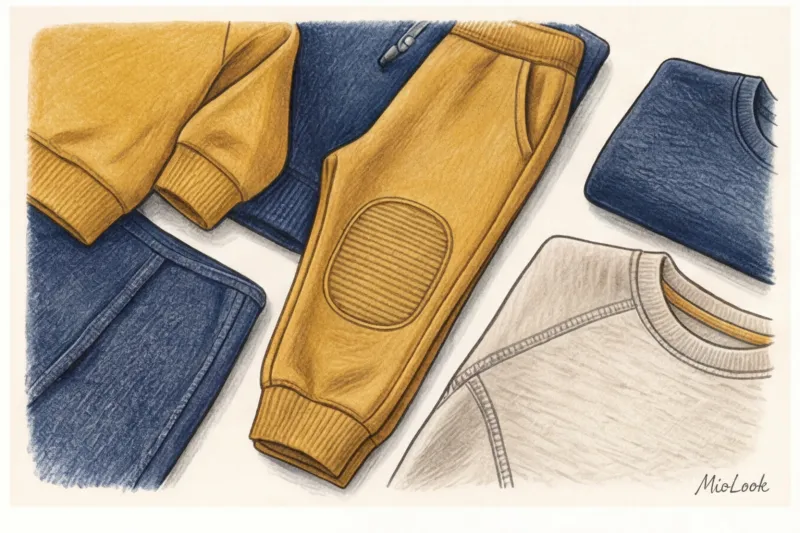
- Always look for things with flat seams (flatlock) or soft overlock processing.
- The neckline should be finished with soft twill tape covering the back seam.
- No tight buttons, complicated back zippers, or stiff elastic that leaves a red mark on your stomach. The elastic should be wide (at least 3 cm) and stitched to prevent it from twisting inside the waistband.
The Perfect Capsule Formula: The Mathematics of a Weekly Children's Wardrobe
To wash your children's clothes without panicking every night, but calmly once a weekend, you need a well-thought-out laundry list. Here's a precise list for creating a laundry capsule:
- 5-6 tops: T-shirts made of thick cotton and long sleeves.
- 3-4 bottoms: joggers, soft fleece trousers, leggings or culottes.
- 2 warm layers: zip-up sweatshirts or thick cardigans.
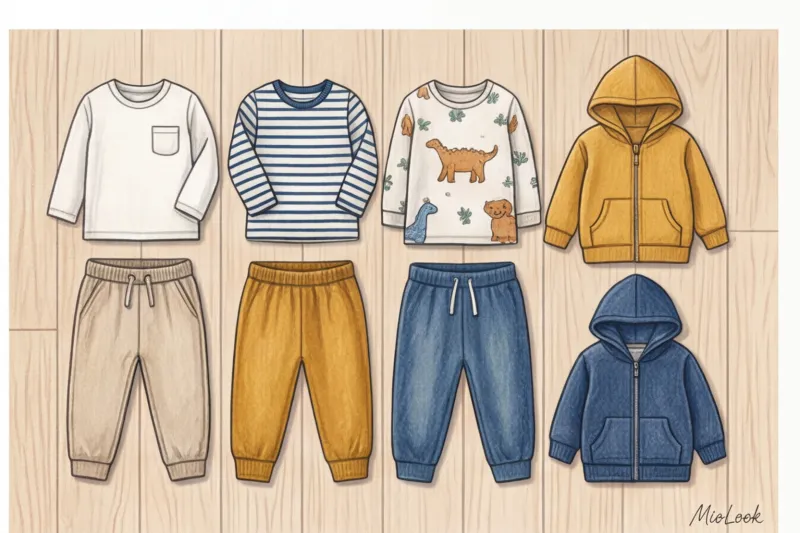
Why zip-up hoodies instead of sweatshirts? Layering in kindergarten is a matter of thermoregulation. Temperatures in the classroom can fluctuate: cool in the morning, hot after active play. A 4- to 5-year-old can easily unzip a hoodie themselves, but pulling a tight sweatshirt over their head without a teacher's help is a challenge.
Let's count Cost Per Wear (cost per wear). A high-quality basic long-sleeve from COS or Zara Kids, priced at €25 and worn 50 times a season without losing its color, costs €0.50 per wear. A cheap €8 T-shirt, which will pill after 5 washes and then be sent to the dacha, costs €1.60 per wear. A quality capsule collection can save you up to 30% of your budget in the long run.
Try MioLook for free
A smart AI stylist will select the perfect look from your items. Upload your wardrobe once and forget about the "nothing to wear" problem.
Start for freeSpecifics for girls and boys: removing stereotypes
I often discourage mothers from buying formal tulle dresses for everyday wear to kindergarten. Children spend 70% of their time on the carpet: building construction sets, crawling, and playing. Dresses ride up, restricting freedom of movement, and tights underneath quickly wear out.
A modern alternative for girls is knit culottes, ribbed leggings, or comfortable straight-cut sundresses worn with cycling shorts. Furthermore, basic unisex cuts (oversized hoodies, straight joggers in khaki, camel, and graphite) are a great investment. This method, of course, It doesn't work , if you have a strict dress code in a private kindergarten that requires formal attire, but for 90% of preschools, this is an ideal choice for later handing things over to younger children.
Color Palette: How to Bring Your Favorite Dinosaurs and Basic Beige Together
The key to a stylish yet low-staining wardrobe is the right color base. The stylist's rule: 3 base colors + 2 accent colors. To hide the inevitable small stains from food or paint, use sophisticated, dusty shades: mustard, khaki, dusty rose, navy, and mélange.
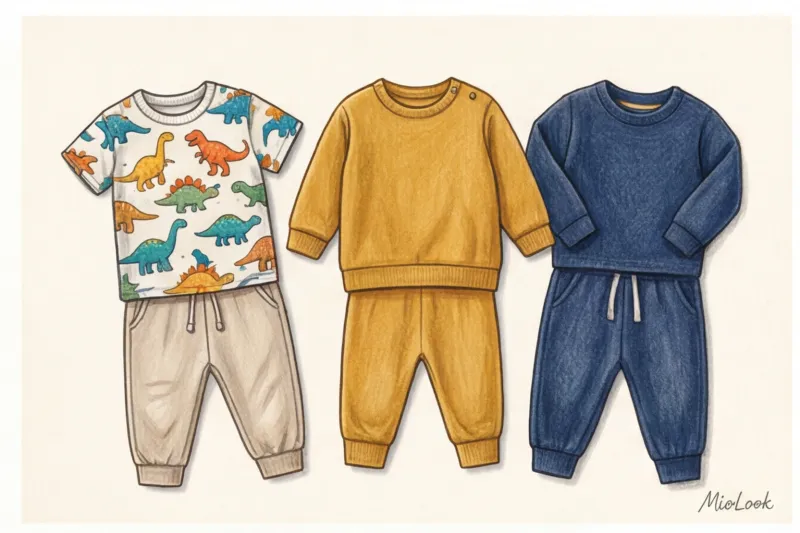
But what about children's tastes? As a stylist, I constantly encounter conflict: a mother wants to put together an aesthetically pleasing beige capsule wardrobe, while the child demands an acid-colored Paw Patrol T-shirt. Forbidding them would only provoke morning drama.
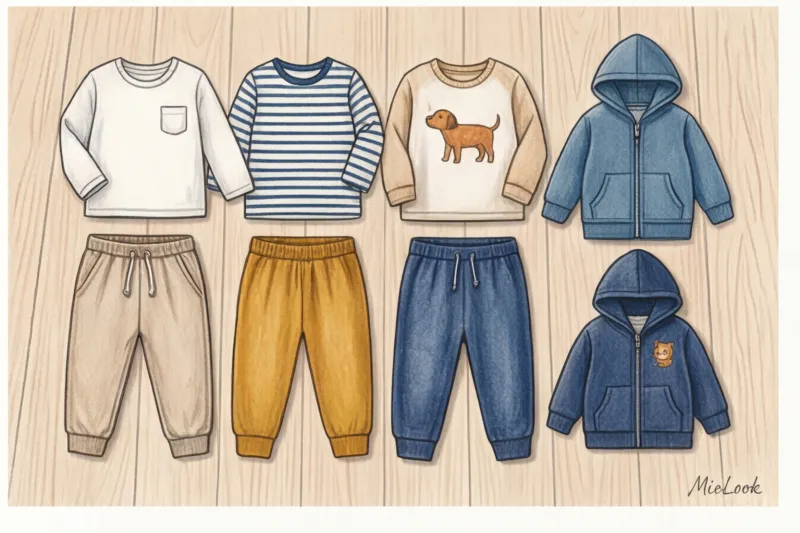
Solution - concept "active print + calm background" We're incorporating a loud T-shirt into the capsule collection so it serves as an accent. If the top has a bright print, the bottoms should be a simple solid color (for example, graphite or navy joggers). This way, you teach your child the rule of contrast from an early age. You can even upload these favorite bright pieces to MioLook and show your child on the phone screen which pants the program recommends wearing with the dinosaur—kids love gamification!
Garden Shoes: Orthopedics Meets Style
Replacement footwear is essential. According to research in pediatric podiatry, rigid shoes with arch support are more harmful than helpful for healthy feet. Feet need movement.
The ideal "change" has three criteria:
- Flexion test: You should be able to bend the sole with one hand at the base of the toes (not the middle of the foot).
- Wide toe: The toes should not be squeezed, this is critical for the formation of the arch of the foot.
- Secure heel hold (without a hard plastic back, but with firm support).
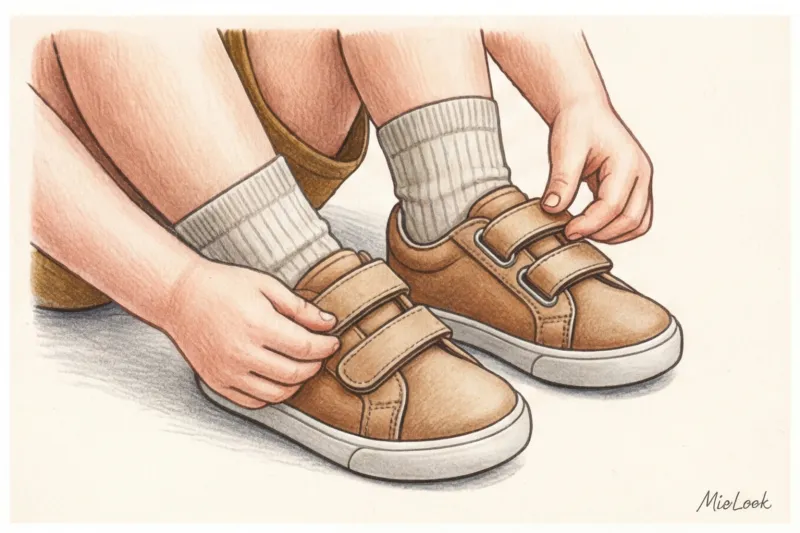
And the main rule of independence is categorical No Laces and complex fasteners are a no-brainer. Only Velcro fasteners, which a child can handle in 10 seconds. Basic colored shoes (beige, gray, blue) will tie your entire color scheme together.
Checklist: Assembling a capsule for kindergarten from scratch in a weekend
Putting together a capsule doesn't require a week of shopping mall shopping. If you follow the steps, you can do it in a single weekend.
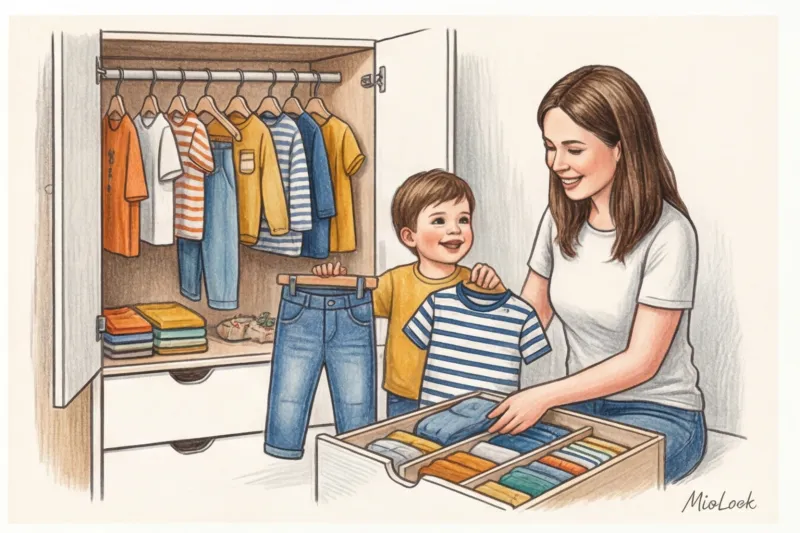
Step 1: Hard audit. Take out all your clothes. Ruthlessly discard anything with stubborn stains, stretched collars, frayed seams, or anything that's too small. Keep only the basics your child wears happily.
Step 2: Select a palette. Look at your remaining high-quality and most expensive items. What colors are they? Use them as the basis for your palette. If you have some great blue joggers and a mustard cardigan left, build your capsule wardrobe around navy blue, mustard, gray melange, and white.
Step 3: Spot shopping. Write a shopping list strictly for the missing items from the formula above (for example: "I need 2 basic t-shirts and 1 zip-up hoodie"). No spontaneous purchases in the store.
Ready to get started?
Try the MioLook plan for free—no commitments required. Organize your closet right now.
Start for freeA capsule wardrobe for kindergarten is more than just a convenient closet. It's your child's first step toward understanding conscious consumption. A limited but high-quality selection teaches children to value their belongings, understand comfort, and dress tastefully from a very early age. Start small: remove the unnecessary, keep the best, and your morning routine will no longer be a battlefield.