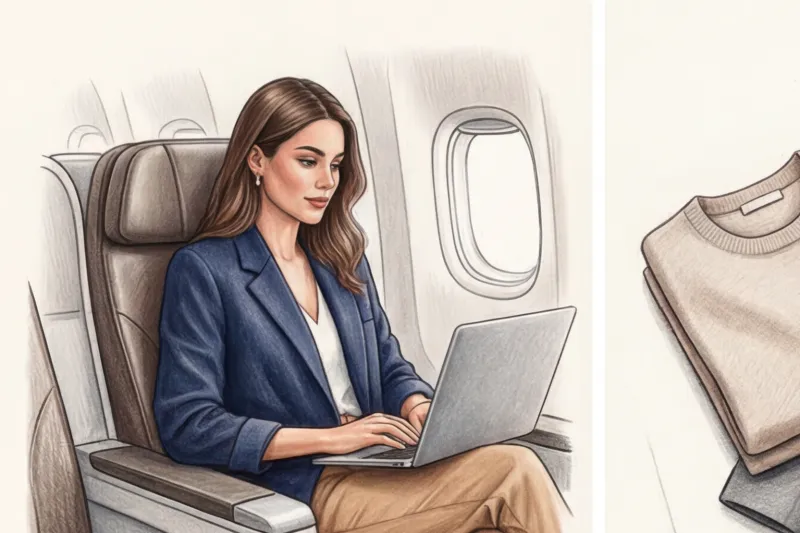
I remember my client Elena, the CEO of a successful fintech startup, arriving in London on a red-eye flight. She had exactly an hour and a half to get from Heathrow to the conference room where she was scheduled to speak on a morning panel and then spend the evening meeting with investors. Her luggage was delayed. The only saving grace was that she had the right outfit, put together according to the "wear-it-for-life" principle, which didn't wrinkle on the plane and looked impeccable under the spotlight.

When we think about it, What should a woman wear to a business conference? We often make the same mistake: choosing clothes for a static image in front of a mirror. But the reality of large-scale events is 14 hours of non-stop movement, temperature fluctuations, uncomfortable chairs, and standing coffee breaks.
If your goal isn't just to sit through hours in the auditorium, but to make useful connections and perhaps deliver a pitch, your appearance should work for you, not distract you. By the way, if you plan to take the stage, I recommend checking out our The Complete Guide to Dressing for Public Speaking: How to Look Classy , where we examine in detail the psychology of color and working with light.
Conference Dress Code: How to Properly "Read" the Invitation
Over 12 years of working as a stylist, I've discovered a golden rule: the location of an event tells you much more about the dress code than the fine print on the ticket. A "Business Casual" dress code at a five-star Ritz hotel and the same "Business Casual" at a trendy loft are two completely different stylistic universes.
If you're attending a financial or legal forum, the rules remain conservative: covered shoulders, a subdued palette, structured forms. But if it's an IT conference, a creative summit, or a marketing forum, excessive formality will work against you. You'll look like you accidentally walked through the wrong door.
My personal lifehack before packing: find the official hashtag for last year's event on social media. Look not at staged photos of the speakers, but at pictures from the sidelines. This will give you the exact "degree of formality."
From Business Formal to Smart Casual: Where is the Line?
The most insidious invitation choice is "Business Casual." It's the safest, but also the most difficult, choice, because the line between "relaxed professional" and "boring office worker" is incredibly thin.
Business formal calls for a full suit in a single fabric. Smart casual allows for high-quality dark jeans with a silk blouse and tweed jacket. Business casual, however, is the domain of unpaired suits, thick-knit midi dresses, and palazzo pants. To avoid becoming boring, play with textures: the smooth wool of the trousers contrasts beautifully with the matte cashmere of the turtleneck.
Your perfect look starts here
Join thousands of users who look flawless every day with a smart wardrobe.
Get access — €0.99 once14-Hour Wardrobe Strategy: From Morning Session to Networking
A conference is a marathon. Your look should transform from a morning lecture to an evening cocktail without even checking into a hotel. I call this the "endurance wardrobe" concept.
According to ASHRAE (American Society of Heating, Refrigerating, and Air-Conditioning Engineers) international standards, the average temperature in large conference rooms is maintained at 18-20°C. Sitting there in a silk blouse without a jacket is physically cold. Layering here isn't a fashion statement, but a matter of survival and thermoregulation.
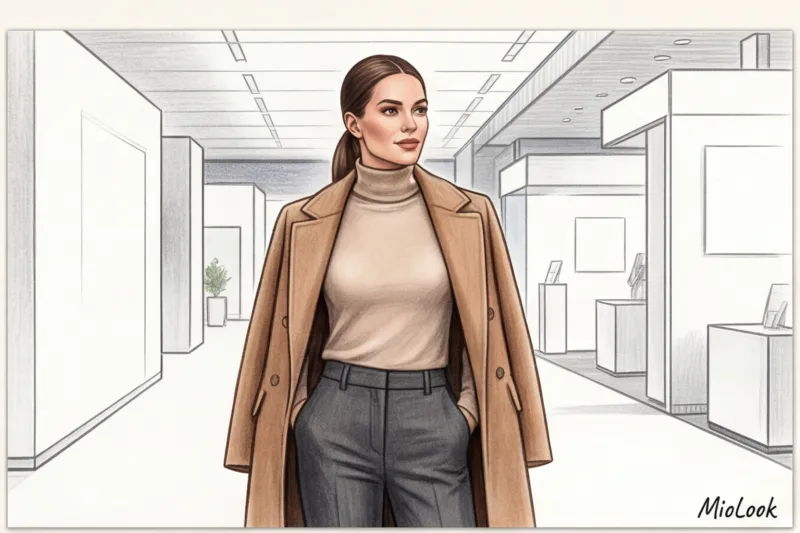
Invest in the right fabrics. Avoid 100% linen and thin viscose—after two hours of sitting in a chair, they'll crease, ruining their shine. Choose finely spun wool (look for Super 120s or Super 130s, it's virtually wrinkle-free), dense matte silk (crepe de Chine), and cashmere.
The transformation to eveningwear is accomplished solely through accessories. During the day, you wear a roomy tote bag and minimalist stud earrings. In the evening, leave the tote bag in your closet, pull out a stiff leather clutch, swap the stud earrings for statement earrings, refresh your lipstick—and you're ready for an informal networking event with a glass of champagne.
What to Wear to a Business Conference for Women: Speaker vs. Participant
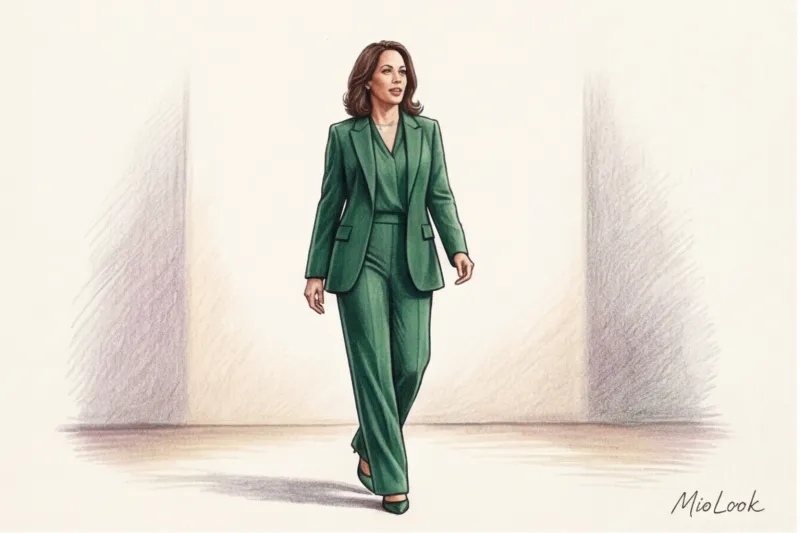
The roles of a woman on stage and a woman in the audience are radically different. If you're a speaker, your primary goal is to command attention and blend into the background. According to research on the psychology of perception (specifically, WGSN's 2024 reports), contrasting, deep colors (emerald, sapphire, deep burgundy) increase audience trust and look stunning under the spotlight.
Additionally, the speaker needs to consider technical details: where to attach the lavalier microphone (a thick jacket lapel is needed) and where to hide the transmitter (a pocket or a thick waistband on trousers or skirts is needed. On a thin silk dress, the transmitter will simply pull the fabric down).
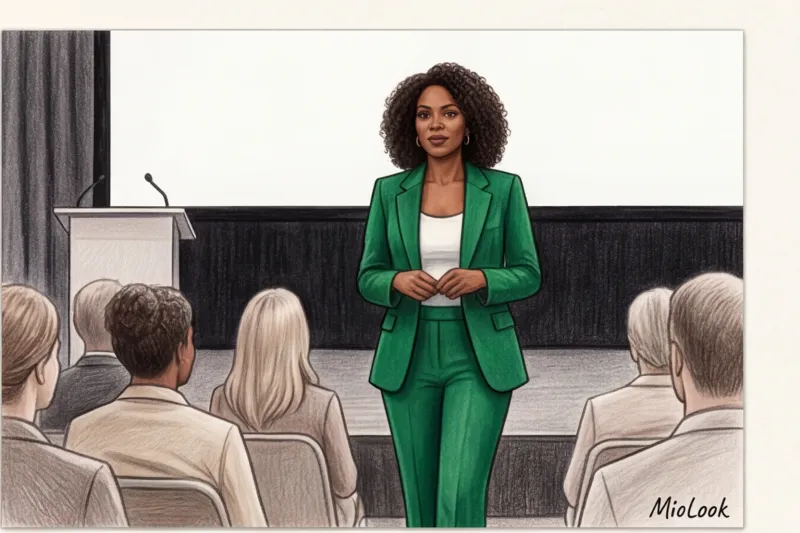
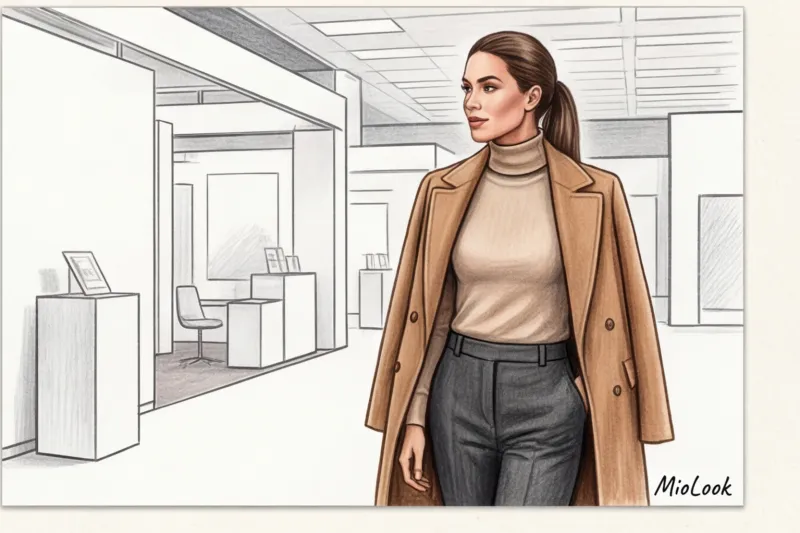
If you're a participant, your goal is to feel comfortable and ready to engage in conversation. A welcoming palette works best here: shades of beige, camel, soft gray, and muted blue. These colors psychologically shorten the distance, making you more approachable and ready to start a conversation in the coffee break area.
Investing in a Database: 3 Things You Shouldn't Skimp On
In the world of luxury styling, we don't count a garment's value by its price tag. We count its cost-per-wear (CPW)—the price per wear. A $50 mass-market jacket that will lose its shape after the first dry cleaning and that you wear twice (CPW = $25) costs you more than a perfectly tailored $500 blazer that you wear 50 times (CPW = $10).
At business events, cheap plastic fittings, crooked stitching, and poorly crafted patterns are easily spotted within the first three seconds of eye contact. There are three elements that form the basis of your status.
The perfect jacket is your armor
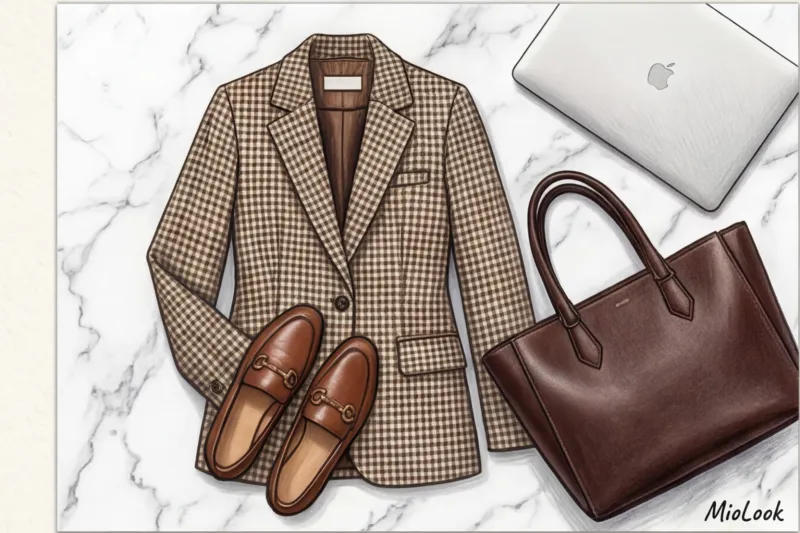
The design of your jacket defines your posture. A well-placed shoulder line instantly brings your silhouette together, projecting confidence. Choose textured fabrics: English tweed, heavy wool, or wool-silk blends. They look luxurious and hold their shape well, even at the end of a long day.
Status footwear: a balance of luxury and comfort
Forget 10-centimeter stilettos if you'll be on your feet for more than two hours. Shoes should be your foundation. Soft Italian leather loafers, oxfords, or classic pumps with a stable 4-5 cm (kitten heel) are ideal investments. And remember the unspoken rule of conservative business circles: shoes should always be closed-toed.
Structured bag (Tote bag)
Your bag should be able to accommodate a 13-inch laptop, a notepad, and a business card holder, but not feel like a sack. Choose a sturdy leather (such as saffiano or embossed). Avoid flashy logos all over the bag—a "quiet luxury" aesthetic works much better in business circles.
Access to MioLook for €0.99 — one-time payment
A smart AI stylist will select the perfect look for your next business trip from the items you already have in your closet.
Get access — €0.99 onceThe Biggest Mistake: Why the Classic Two-Piece Suit No Longer Works
Here I want to debunk one of the most persistent myths. Many women still believe that if they have an important conference coming up, they need to go out and buy a formal two-piece suit (matching jacket and trousers/skirt in the same fabric). This is a mistake.
In today's world (unless you work in the protocol department of a state-owned bank), a suit looks too stiff, outdated, and pretentious. Psychologically, it creates a barrier between you and your interlocutor. You look like you're there to sell insurance, not to exchange ideas.
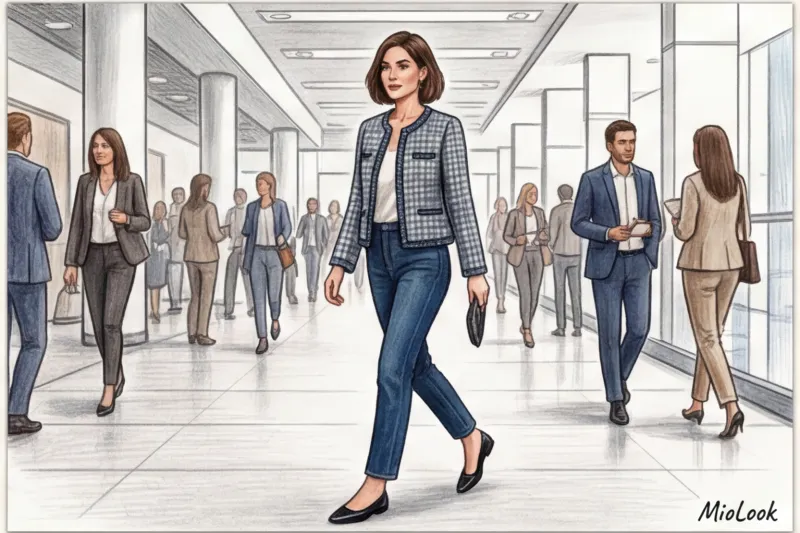
"A two-piece suit today is seen not as a status symbol, but as a uniform. If you want to show real class, demonstrate your ability to combine different textures."
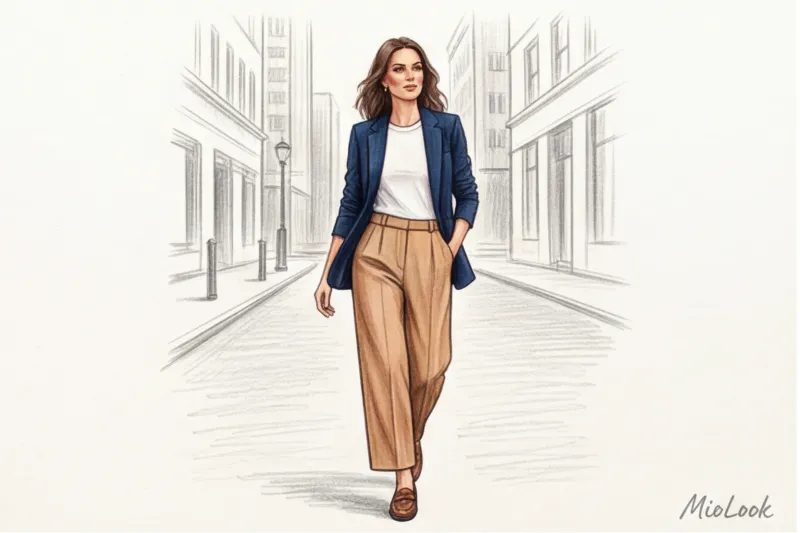
What to do instead? Use technology. Broken Suit (Unpaired suit). Pair a premium houndstooth jacket with solid navy blue trousers. Or wear a camel-colored blazer with graphite wool palazzo pants. This demonstrates taste, individuality, and makes you appear more network-friendly.
Of course, there are exceptions to this rule. If you're addressing the board of directors of a conservative corporation in Switzerland, the classic two-piece suit would be appropriate. But for 90% of modern forums, choose the Broken Suit.
A practical checklist: packing a capsule for a 2-day business trip
To avoid carrying half a closet with you, I always recommend my clients to use MioLook app To visualize a capsule wardrobe, or rely on the tried-and-true 1-2-3 formula: one jacket, two bottoms (pants and a skirt/jeans), and three tops (a silk blouse, a thin cashmere turtleneck, a high-quality heavy cotton top). This set creates at least six complete looks.
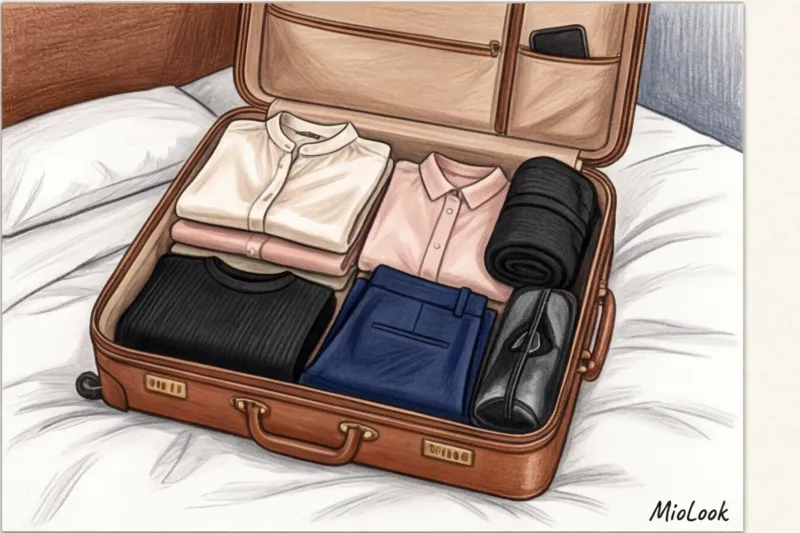
How to properly pack expensive fabrics? My personal life hack for saving blazers: turn the jacket inside out, place one shoulder inside the other (so they're right sides together), align the lapels, and fold it neatly in half. This will prevent the outer fabric from rubbing against other items, and the shoulder pads will retain their shape.
And the most important rule for frequent business trips: your essential business attire (blouse, trousers, underwear) and basic cosmetics should always be in your carry-on. Luggage may get lost, but you'll arrive fully prepared.
Summary: Your style is your calling card
Clothing at a business conference is more than just covering your body. It's a powerful tool for nonverbal communication. Your appearance begins to impact you seconds before you even say "Hello."
Investing in high-quality cuts, premium fabrics, and high-status shoes pays off not in social media likes, but in your inner confidence. When you know your jacket fits perfectly and the fabric hasn't creased after sitting for a long time, you stop thinking about your clothes. And it's at that moment that you can fully focus on business, negotiations, and new contacts.
Before your next conference, don't rush out to the store for another casual dress. Conduct an audit of your wardrobe, find the perfect textured jacket, and assemble your own "endurance wardrobe."