One of my clients, a top manager at an IT company, once complained to me over coffee: "Isabella, I can't find the zen in Downward-Facing Dog. Instead of focusing on my breathing, I'm constantly worrying about my leggings slipping down and my T-shirt covering my face." Sound familiar? We spend huge sums on memberships to premium studios, but we often forget that our practice attire is our most important tool after our own bodies.
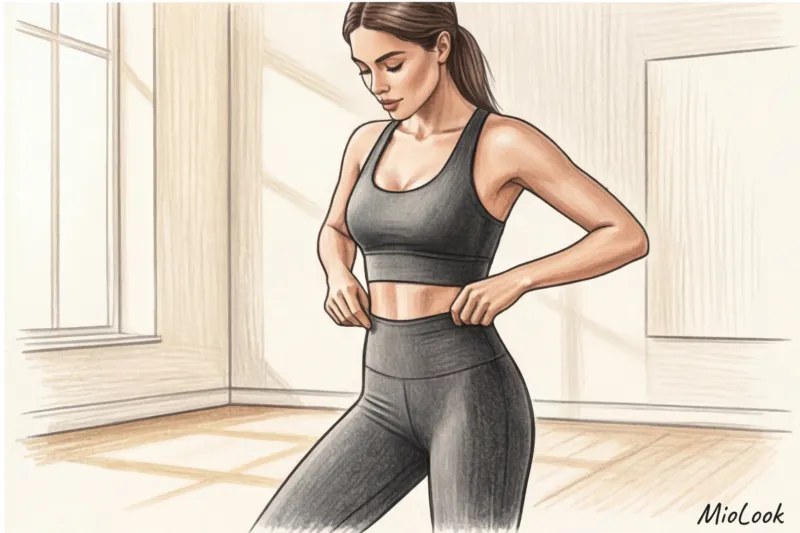
Well chosen women's yoga clothes — it's not just another pretty set for a mirror selfie. It's your "second skin" that works on your biomechanics, improves proprioception (body awareness in space), and is a logical extension of your everyday, high-status wardrobe. We've already discussed the architecture of a smart approach to clothing in more detail in our the complete guide to the premium sports capsule , and today we'll look at the anatomy of ideal equipment for practice.
Architecture of Movement: Why Women's Yoga Wear Is More Than Just Leggings and a Tank Top
Your attitude towards fitness directly reflects your respect for your body. In psychology, there is a concept enclothed cognition (embodied cognition). A 2012 study from Northwestern University (USA) demonstrated that what we wear physically alters our cognitive processes. By wearing a well-constructed, well-designed silhouette in the gym, you automatically improve your posture and switch your brain to focused mode.
Just as a perfectly tailored Jil Sander jacket gets you ready for an important business meeting, the right pair of leggings with just the right amount of compression works on the mat.
What is proprioception in the context of clothing? It's your body's ability to sense itself in space. The light yet firm compression of premium fabrics provides your nervous system with micro-signals about the position of your limbs. You literally feel better about whether you've rotated your pelvis in Warrior II because the fabric hugs your thighs tightly, eliminating any looseness or folds.
Yoga vs. Pilates: Equipment Selection Considerations
In my 12 years as a stylist, I've often heard the question: "Can't you just buy one universal fitness outfit for everything?" My answer is always a resounding no. The mechanics of movement on a mat are fundamentally different from working on spring-loaded machines.
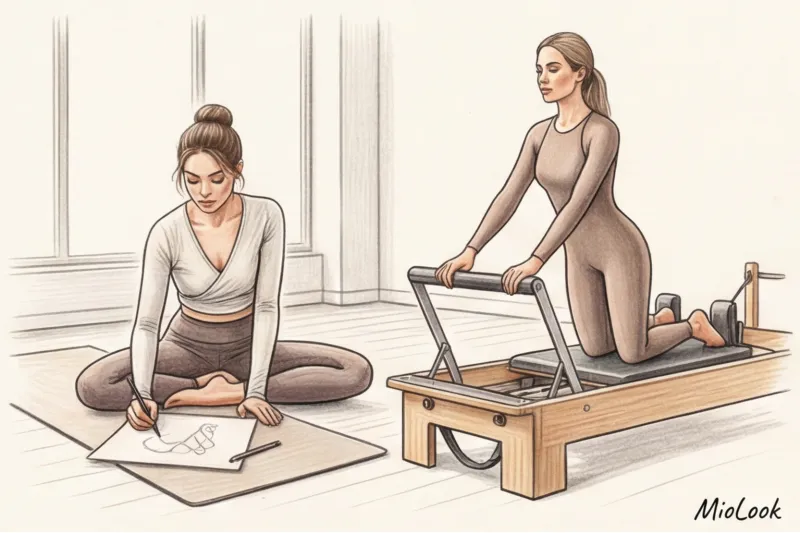
The main enemy of any thoughtful workout is hardware. Forget about zippers at the waist, bulky seams, flap pockets, and plastic strap adjusters. The slightest stiffness will turn rolling on your back into torture.
Yoga Mat Wear: Freedom in Inversions
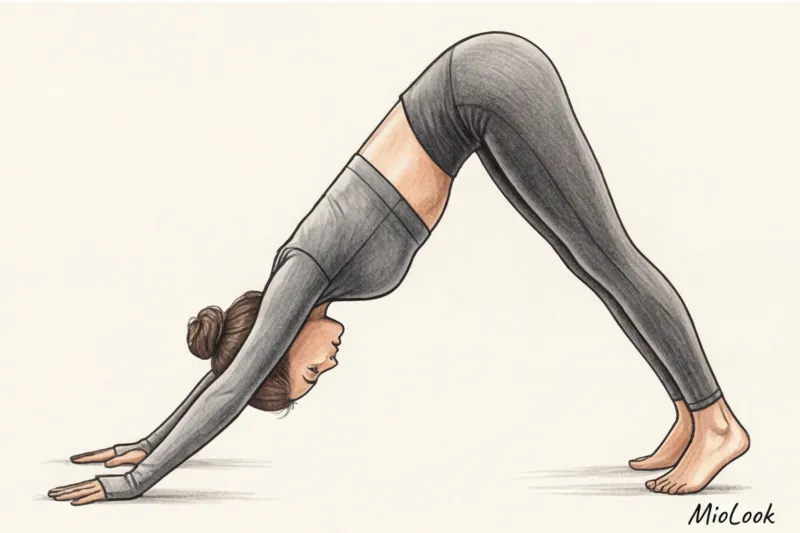
Yoga requires maximum range of motion and frequent changes in plane. The problem with loose tank tops and baggy t-shirts is that they instantly fall onto your face during any inverted asana (from a simple forward bend to a headstand). This is not only distracting but also disrupts the rhythm of your ujjayi breathing. Look for form-fitting long sleeves or tops with technology. 4-way stretch (4-way elasticity) that will move in sync with your torso in deep twists.
Pilates Reformer Clothing: Streamlined and Safe
Certified instructors at Romana's Pilates are very strict about the dress code, and for good reason. Wide palazzo pants or flared leggings are a complete no-no for the Reformer. The fabric can easily get caught in the carriage mechanisms or tangled in the springs. A perfectly smooth back is crucial for Pilates: no sports bra clasps that will mercilessly dig into your vertebrae during exercise. rolling like a ball.
Your perfect look starts here
Join thousands of users who look flawless every day with MioLook. A smart wardrobe is always at your fingertips.
Start for freeFabric Anatomy: Debunking the 100% Cotton Myth
One of the most harmful myths I regularly debunk during shopping trips is the belief that you should only choose "breathable organic cotton" for sports. Contrary to the trend for eco-friendly materials, 100% cotton is the worst choice for intense exercise.
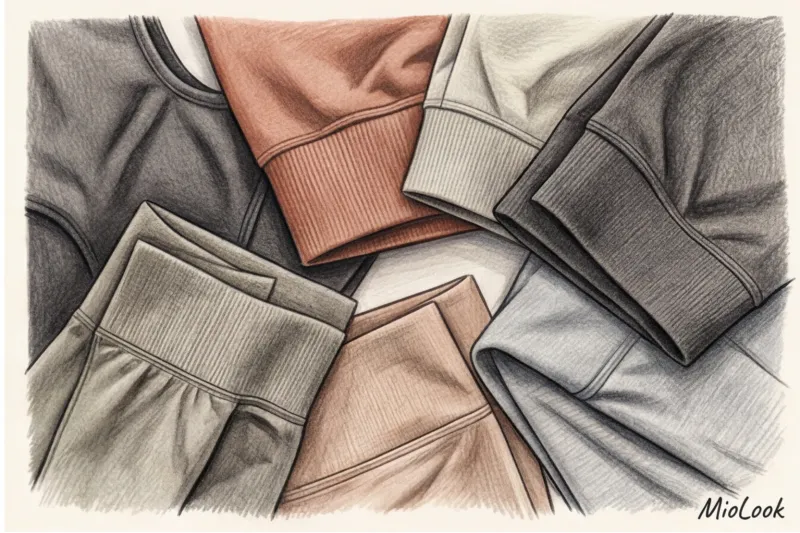
Cotton acts like a sponge: it absorbs moisture but doesn't evaporate it. As a result, after 20 minutes of active vinyasa, you'll feel like you're in a heavy, wet compress. Furthermore, pure cotton has no memory—the knees on these pants will stretch out straight after your very first session.
The ideal formula used by premium line manufacturers is a high-tech blend. Look for a combination of high-quality nylon (it provides a luxurious matte finish and incredible durability) and 15–25% elastane (or Lycra). This ratio creates that special effect. Naked sensation (second skin feeling), patented by leading brands.
The Perfect Leggings: What a Personal Stylist Looks for
In my experience, we've tried on hundreds of pairs of leggings with dozens of clients with completely different body types. And I can confidently say: the devil is in the design details, which mass-market brands prefer not to think about.
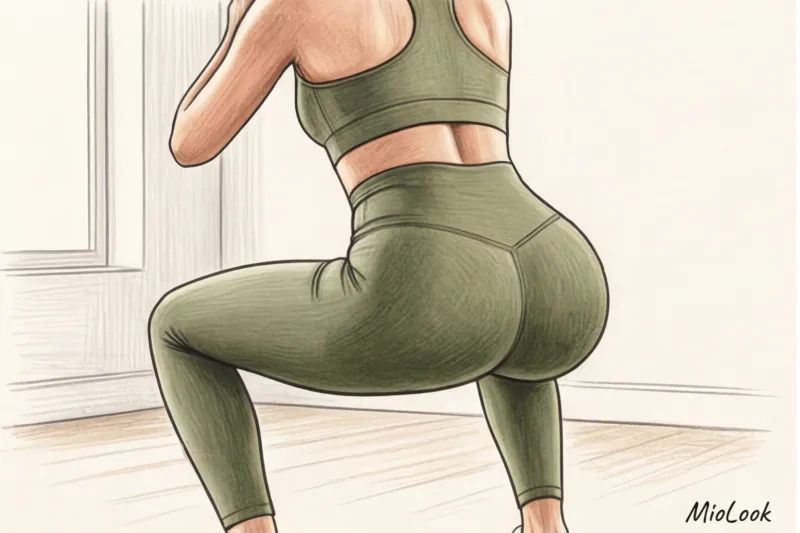
Here are three rules for the design of perfect leggings:
- V-shaped seam at the waist: A straight horizontal seam visually flattens and widens the buttocks. A V-shaped (or heart-shaped) yoke creates a subtle lifting effect and follows the body's natural curves.
- Hidden gusset: It's a diamond-shaped or triangular piece of fabric sewn into the crotch seam. Its presence is critical—it prevents the formation of an unsightly camel toe and relieves tension from the fabric in the transverse twine, protecting it from tearing.
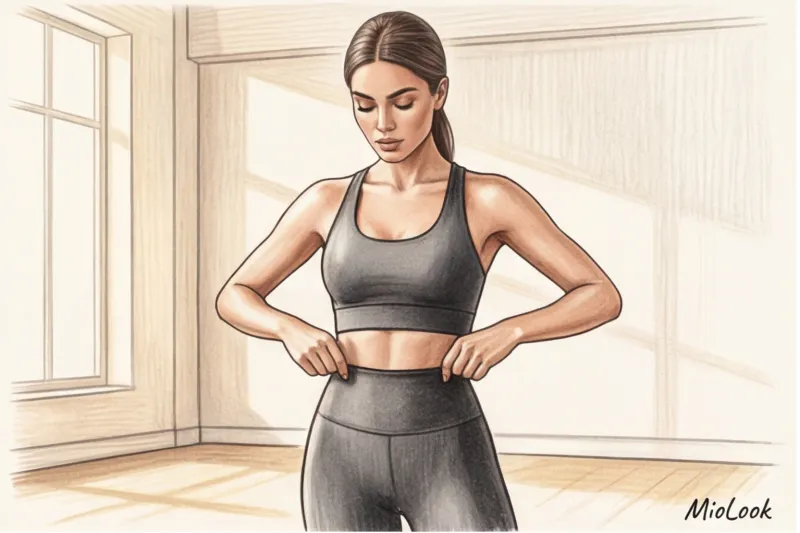
- Waist height: The belt should end just above the navel. If it runs along the navel or below, it will cut into the stomach with each twist, creating a roll even where there isn't one.
An important caveat: seamless knitwear is incredibly popular right now. But it has a serious drawback: these leggings often lack zonal compression. On hourglass or pear-shaped figures, they don't stay in place around a narrow waist and tend to slide down with every squat.
Sports bras and tops: a balance of support and breathability
The biomechanics of breathing in pranayama require a loose chest. Unlike running or CrossFit, which require extreme support (High Support), for yoga and Pilates, Low or Medium Support is sufficient. A bra that's too tight will restrict the movement of the lower ribs, preventing you from taking a full diaphragmatic breath.
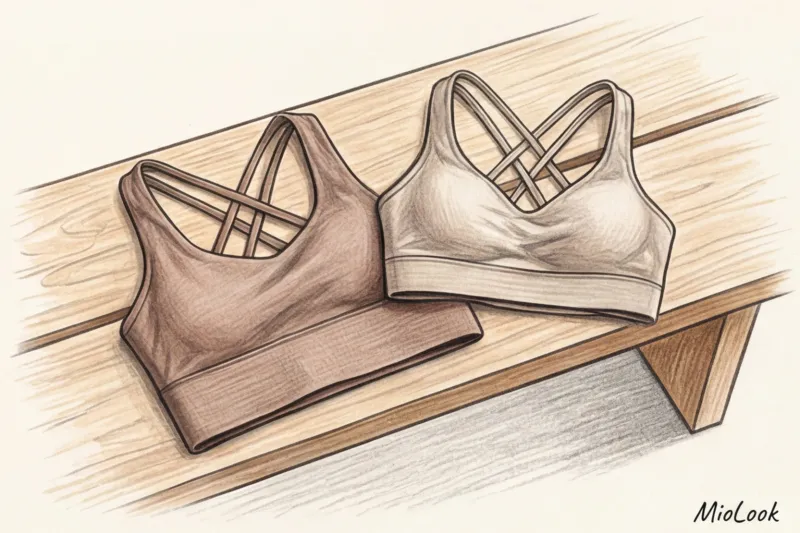
Pay attention to the back. Wide X-shaped and U-shaped straps work best. They shift the load from the sensitive trapezius muscle to the latissimus dorsi, preventing tension headaches after a workout. As for the cups, integrated (sewn-in) ones are always better than removable pads. Removable pads wrinkle after the first wash, shift during movement, and look extremely sloppy.
Try MioLook for free
A smart AI stylist will select the perfect workout look and integrate it into your everyday wardrobe.
Start for freeThe aesthetics of 'quiet luxury': colors and silhouettes for status women
According to the analytical agency WGSN (2024), the trend studio-to-street has finally shifted toward minimalism and "quiet luxury." Acid-colored prints, loud patterns, and logomania are a thing of the past decade. A prestigious sports wardrobe is built on complex, refined shades.
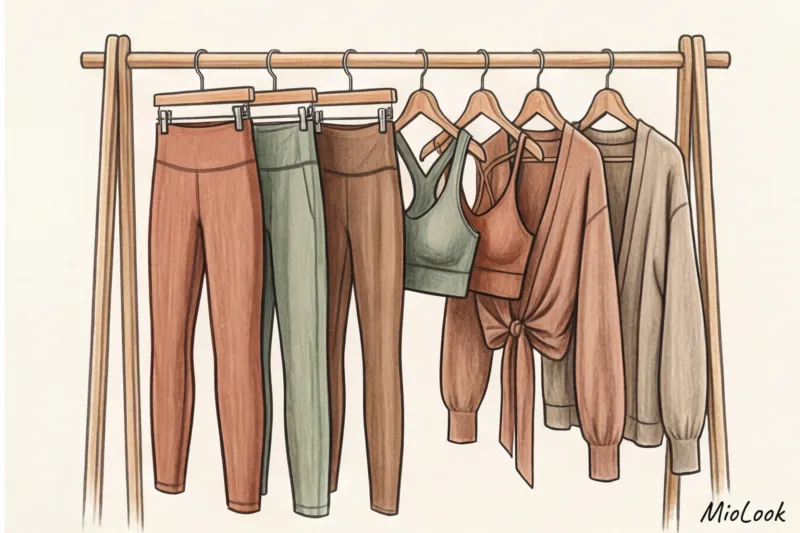
Instead of black, which often looks too utilitarian and collects all the dust from rugs, choose a palette of Mediterranean elegance. Terracotta, dusty sage, deep indigo, dark chocolate, and mocha—these colors look expensive and pair perfectly with everyday wear.
My favorite styling formula for clients: A monochrome sports set + an oversized menswear-style jacket (or cashmere hoodie) + suede mules or Birkenstocks = impeccable Old Money aesthetic This outfit allows you to go to a match after training and look perfectly appropriate in an urban setting.
An Investment Approach to Wardrobe: Calculating Cost-per-Wear
Many people wonder why they should buy €120 leggings when they cost €25 at the mass market. This is where the stylists' favorite formula, cost-per-wear, comes into play.
A pair of €25 leggings made of cheap polyester lasts a maximum of 5-10 washes. After that, the elastane fibers are destroyed by sweat and laundry detergent. The fabric becomes see-through, bubbles appear at the knees, and pilling occurs along the seams. The end result: the item ends up in the trash, costing about €2.50 per wear.
Premium clothing made from patented, high-density nylon (from 200 g/m²) withstands over 150 machine washing cycles without any loss of color or shape. At €120, the cost per wear drops to €0.80. It's pure math: investing in one high-quality basic is more cost-effective than regularly updating a cheap, unusable wardrobe.
Pre-purchase checklist: test drive in the fitting room
To avoid making a mistake, never buy sportswear just by looking at yourself in the mirror. You should conduct a thorough test drive in the fitting room. Save this checklist:
- Squat test: Stand with your back to the mirror in the brightest light in the fitting room and do a deep squat. The fabric on your buttocks shouldn't turn white or show through your underwear. If the outline is visible, leave the item in the store.
- Roll test: Sit on a ottoman or lean forward. The waistband of the leggings shouldn't bunch up at your stomach. It should remain flat and even.
- Reach test: Raise both arms sharply upward, as if entering Tree Pose. If your top, long sleeve, or bra band rides up and exposes the lower part of your chest, the style isn't designed for full range of motion.
Your body is an incredibly complex and beautiful mechanism. And it deserves a frame that will encourage its movement, not hinder it. Choose your form thoughtfully, test it in movement, and you'll see how the quality of your practice changes when clothing stops distracting and begins to work with you.
", "tags": [ "yoga clothes", "sports wardrobe", "pilates", "premium capsule", "quiet luxury", "legging selection" ] }