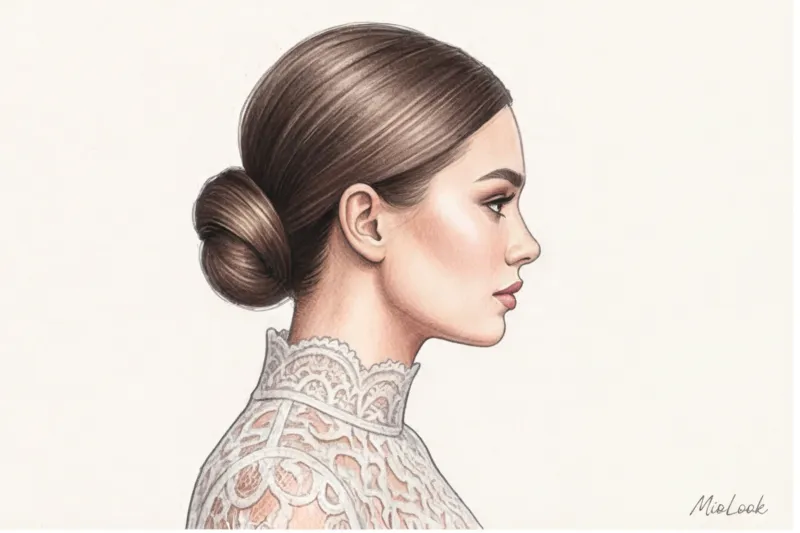
Wedding hairstyles and image architecture: the main rule of the stylist
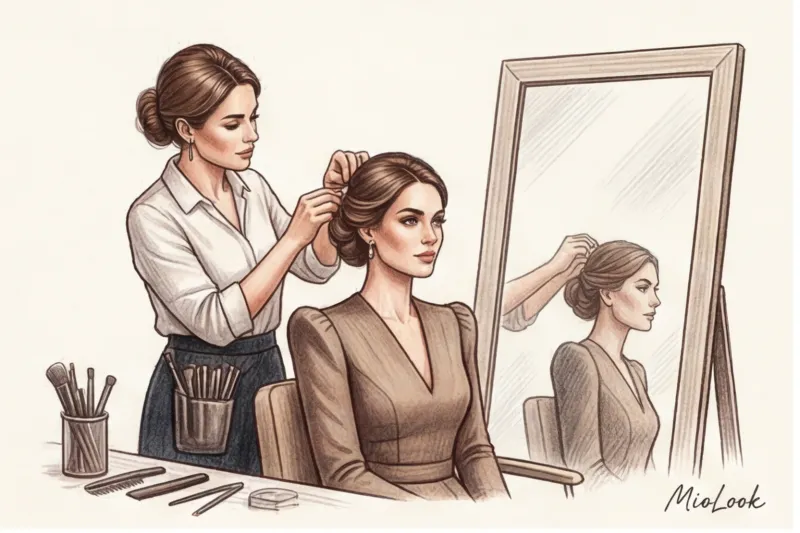
In my 12 years as a personal stylist, I've seen this mistake hundreds of times. A woman buys a stunning €3,000 dress, spends months getting the corset perfectly tailored to her figure, and then, on the big day, simply sits down in the stylist's chair and shows a random photo from Pinterest, saying, "I want it like this." The result? The luxurious outfit clashes with the hairstyle, the neck visually disappears, and the look disintegrates into disjointed pieces. Choosing wedding hairstyles , many forget the basic truth: hair is not a separate element, but your main accessory, logically completing the lines of the dress.
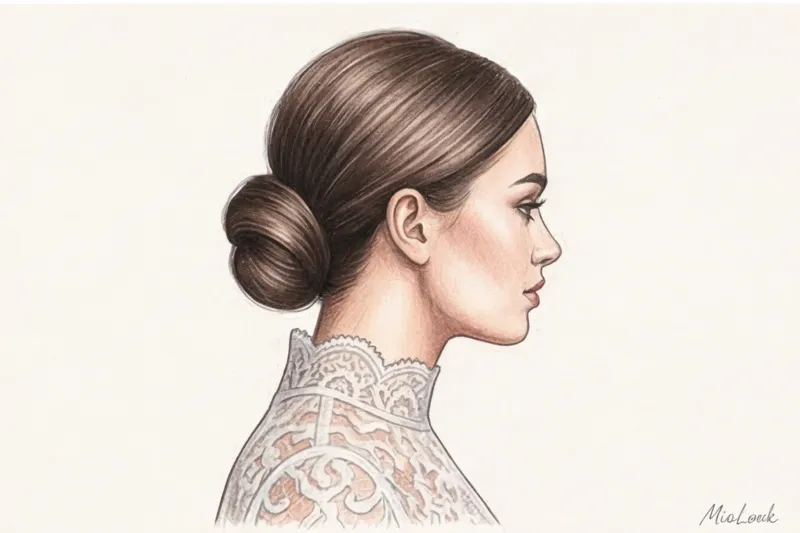
In my practice, analyzing a client's proportions always begins before we choose a hair clip, veil, or curling iron size. In professional styling, I use the concept "architectural framework" of the hairstyle This means that the hairstyle is built like an inverted foundation—it must support the visual weight of the entire outfit, harmoniously continuing the established silhouette rather than disrupting it.
The first and most important tool here is the law of volume balance. Imagine a classic ballgown with a multi-layered skirt made of thick tulle. If you add a giant "tower" of curls or super-voluminous loose locks to such a massive bottom, the proportions will be distorted, and the figure will appear bulky and squat. The style formula works strictly: a full dress requires a sleek or compactly pulled-back hairstyle. Conversely, if you've chosen a simple, figure-flattering slip dress made of flowing fabric, a small, slicked-back hairstyle is absolutely out of the question. Volume is acceptable and even desirable—for example, a luxurious Hollywood wave or a textured bun with air at the roots to balance out a narrow bottom.
The next level of evening look design is a detailed consideration of fabric texture. This rule works flawlessly and instantly betrays an expensive taste: smooth, flowing silk, dense satin, or crepe satin call for glossy, polished hairstyles. There's no room for frizz or dishevelment—only a mirror-like shine and clean lines. However, if your dress is made of voluminous French Chantilly lace or macramé in a relaxed boho style, a perfectly textured shell will look incredibly boring and out of place. Such a dress literally begs for textured braids, matte styling products, and deliberately careless loose strands.
Face geometry and dress neckline: looking for common ground
Let's move on to the most delicate area—the portrait. The way the neckline of your dress interacts with your face and neck determines 80% of the success of your close-up wedding photos. Incidentally, the laws of the portrait zone are absolutely universal—I apply the same principle when creating hairstyle for a business portrait or a strict corporate dress code, where it is critically important to look presentable on camera.
A dress's neckline can either elongate a swan-like neck or visually "cut" it. For example, a stand-up collar or a halter neck dress instantly shorten the neck. Leaving your hair loose makes your head appear to rest directly on your shoulders (the aforementioned "neckless head" effect). Your hairstyle should compensate for this: we sweep the hair up, creating a vertical line and revealing the collarbone. A deep V-neckline, on the other hand, perfectly elongates the silhouette, giving us complete freedom to wear low buns or elegant asymmetrical side-swept hair.
But why can't you simply copy a beautiful look, ignoring the face shape when choosing a "picture hairstyle"? A model in a glossy photo might have an elongated oval face, a narrow chin, and a long neck. A center parting and a sleek back look flawless on her. If you have a round face, active cheeks, or a pronounced square jawline, the same sleek backcombed with an open corset will work like a magnifying glass, highlighting any volume you'd like to soften. We'll definitely need curtain strands released near the face for soft contouring.
To avoid guessing how a hairstyle will work with your individual proportions, I always advise my clients to visualize ideas beforehand. You can upload a photo of your dress and try on different hairstyles. MioLook — it saves a lot of nerves before an important event and helps you find your perfect silhouette without dozens of exhausting trial visits to the stylist.
Micro-tip from a stylist: When going for a trial styling, be sure to wear a top or blouse with the exact same neckline as your wedding or evening dress. This way, you'll see the true geometry of your future look in the mirror, not just a pretty hairstyle.
Ideal wedding hairstyles for different neckline types
According to a 2023 study by the Color and Line Institute, 78% of unsuccessful looks on the red carpet and social events aren't due to a poorly tailored dress or poor makeup. The problem lies in the conflict between the neckline and the hairstyle. The neck and collarbone area is the aesthetic bridge between your face and your outfit. If you build this bridge incorrectly, you can add 5 kilograms to your appearance or make your neck look disproportionately short.
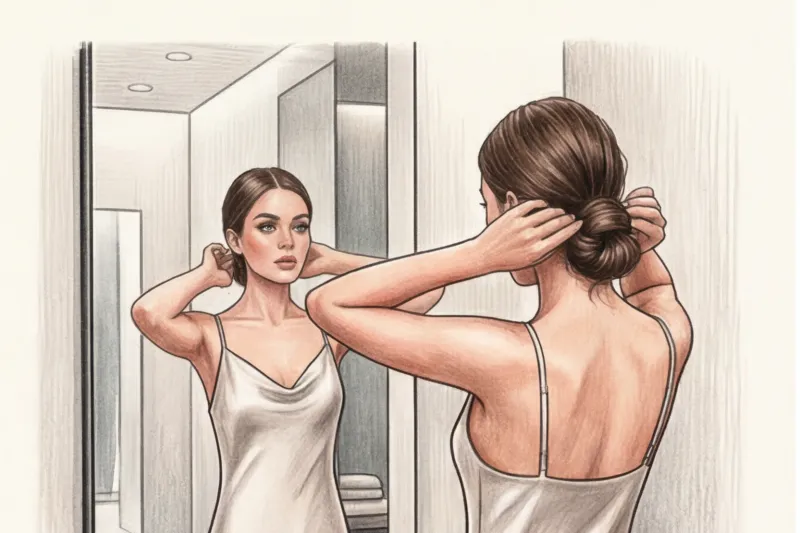
Working with clients in Barcelona and Madrid, I've developed a rock-solid rule: wedding hairstyles aren't chosen on Pinterest, but in front of the mirror, after you've put on your dress. There are five most popular necklines: the classic bateau, the deep V-neck, the revealing corset, the strict stand-up collar, and the dynamic asymmetry. Each of these shapes requires its own volume calculations.
In my personal consultations I always start with the basics Style formulas: neckline + styling = perfect silhouette Here's what it looks like in practice:
- Bateau + sleek low bun = regal presence (remember Meghan Markle's iconic wedding look in Givenchy).
- V-neck + hair pulled back from the face = maximum elongation of the silhouette.
- Corset + voluminous, mobile textures = harmonious balance of exposed skin.
- Stand-up collar + high architectural shape = aristocratic grace.
- Asymmetry + contrasting volume on the opposite side = visual dynamics.
Now let's look at the two most fatal mistakes I see season after season. The first is heavy, thick curls falling over a turtleneck dress. This instantly reduces the length of the neck, creating a heavy "head resting directly on the shoulders" effect. The second mistake is a tight, sleek bun with a wide bustier dress. Without softening strands near the face, this style makes the shoulder line appear massive, like that of a professional swimmer.
V-neck: Hollywood wave or gathered hem?
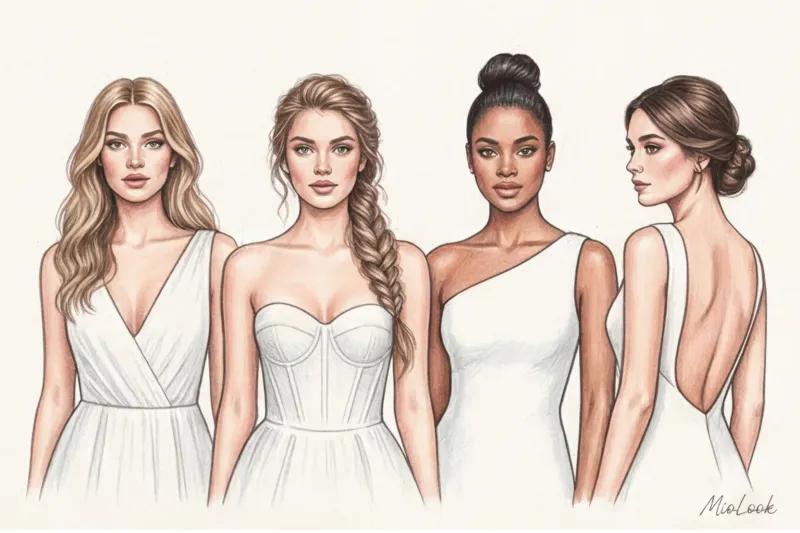
A deep V-neckline is a powerful vertical vector. In terms of style geometry, it's the most flattering shape for 90% of body types. It directs the viewer's gaze from top to bottom, dramatically elongating the neck and slimming the entire silhouette. But have you ever noticed how this flawless effect instantly disappears as soon as you let your thick hair down over both shoulders?
The main rule for a V-neckline: hair should never obscure this line. Don't block the "arrow" that points toward your face. If you dream of loose hair, the only true solution is a Hollywood wave with a distinct asymmetry. We create a deep side parting, sweeping the entire mass of hair over one shoulder, and pinning the other side sleekly behind the ear with bobby pins. This way, we preserve the luxurious look of loose hair while leaving one side of the neckline exposed.
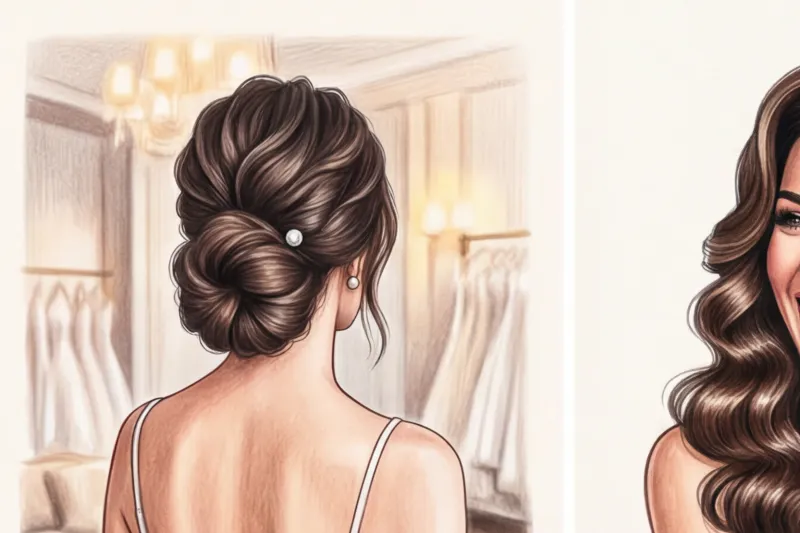
However, when it comes to absolute perfection, my favorite is the classic updo. An elegant low bun, a textured chignon, or a neat French knot at the nape of the neck work flawlessly. I recently styled a bride in Lake Como: she chose a heavy crepe gown with a low-waist neckline that cost $4,500. She originally requested voluminous curls, but at the rehearsal, we saw how her hair competed with the gown. Once we pulled her hair into a flawless, glossy bun, she instantly appeared a good two inches taller, focusing all attention on her face and the luxurious cut of the gown.
Not sure which hairstyle will go with your dress?
Try MioLook for free: A smart AI stylist will analyze your outfit's neckline and select the perfect hairstyle for a flawless silhouette.
Get access — €0.99 onceOff-the-shoulder (corset): loose curls and asymmetry
Corsets (straight or sweetheart) are an absolute classic, offering a huge amount of freedom. Because the shoulders, collarbones, and a significant portion of the bust remain exposed, they allow for what's forbidden with other necklines: maximum, luxurious volume.
There's a subtle pitfall here that professionals call the "bare neck" effect. If you pull your hair back into a tight, flat-top hairstyle with your shoulders completely exposed, you'll look like you've lost a part of your look in medium- and long-shot photos. Excessively exposed décolletage can visually broaden your shoulders and ruin your delicate proportions.
The corset is the perfect canvas for loose curls, large surf waves, and voluminous textures. The hair fills the open space, creating a harmonious balance. If you're committed to a style that's up-do-able, be sure to use a "veiling" technique. Ask your stylist to leave a few textured, slightly careless strands around your face and temples. These soft lines will bridge the gap between the strict corset and the hairstyle, softening the entire look and adding a romantic yet modern touch.
High neck and stand-up collar: high evening hairstyles
High collars, Victorian lace necklines, and halter necklines require strict discipline. This is where I tell my clients a categorical "no" to loose hair. Any compromise here will result in aesthetic failure.
When hair falls on a closed neckline, it creates a visual block. The neck visually disappears, the shoulders become heavy, and the chin visually merges with the chest. Add to this the fact that the fabric on the collar often has an intricate texture (macramé lace, beaded embroidery, thick mikado silk)—loose hair will simply hide this expensive design detail.
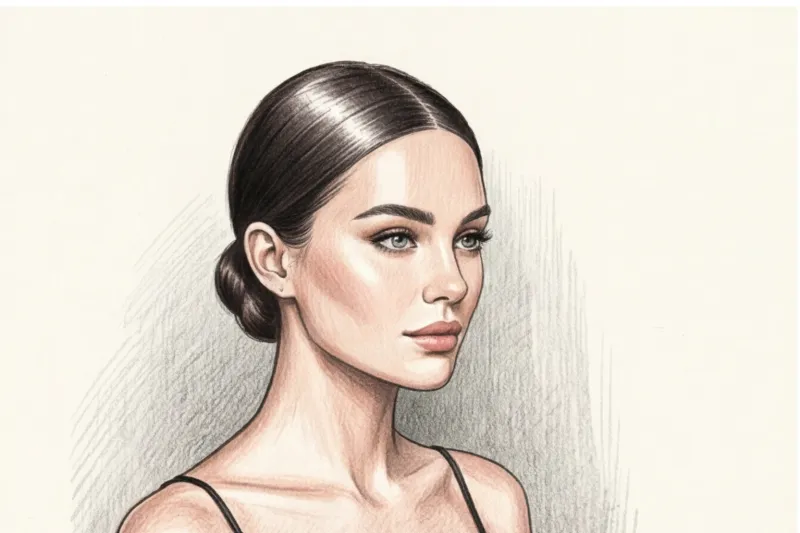
The only true choice for Grace Kelly-style dresses is high evening hairstyles. Sleek shell buns, sculpted high buns, tight ponytails with a wrapped strand at the base. The goal is to continue the line created by the collar and elongate the silhouette. Important: for these styles, I recommend using liquid wax or a strong-hold pomade. The hairstyle should be clean. Any baby hair sticking out at the neck will create visual noise against the strict collar. This is a rare case where a glossy, almost glassy texture of hair wins out over fashionable casualness.
Asymmetrical neckline and open back: how not to hide the main thing
Asymmetrical (one-shoulder) dresses obey the strict laws of physics and visual weight. The rule of balance is infallible here: if a decorative strap, voluminous flounce, or sleeve is on the right shoulder, the bulk of the hair should be carried to the left side. If you place your hair on the same side as the fabric, you'll create unbearable heaviness on one side of the body, leaving the other completely empty. The silhouette will be lopsided. Gather your hair into an asymmetrical low bun or drape a voluminous braid over the free shoulder, and the balance will be restored.
Backless dresses are a particular pet peeve of stylists. Women often fall in love with dresses with incredible back cutouts that reach below the shoulder blades, trimmed with pearls or the finest Chantilly. And then... they ask for long, flowing locks. Why pay thousands of euros for a stunning back design if you're going to hide it under a layer of hair?
An open back is your main asset, and it should be shown off with pride. Hair should definitely be pulled back. If the bride absolutely hates an open neck and wants to keep her hair long, I suggest an elegant compromise: a high, intricate braid (such as a fishtail or a voluminous 3D braid) that falls precisely along the spine. This style doesn't completely cover the back, but rather acts as a graphic wing, highlighting the depth and beauty of the neckline.
The "Romantic Curls" Myth: Why Wearing Your Hair Down for a Wedding Is Often a Bad Idea
Let's be honest: glossy magazines and wedding blogs sell us a stunningly beautiful, yet completely unsustainable, illusion. When women bring me references, 80% of the time I see perfect, bouncy Hollywood waves flowing over their shoulders. However, the harsh reality is this: such wedding hairstyles look flawless for exactly two hours. And this happens during a staged morning photo shoot, where a stylist stands behind the camera with a comb, adjusting every strand before the shutter clicks. According to extensive wear testing of salon hairstyles (WGSN Beauty data, 2024), heavy, loose curls lose up to 65% of their intended volume and texture by the end of the third hour of active wear, regardless of the strength of the setting spray.
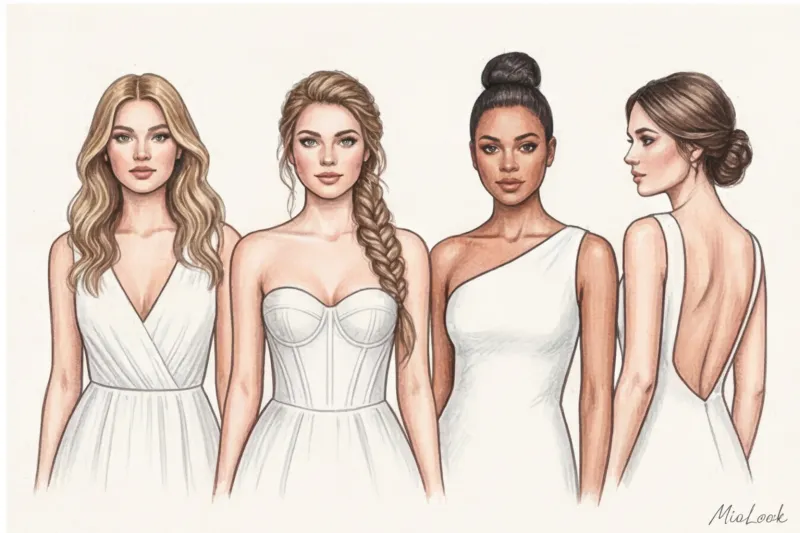
The second hidden threat, one that almost no one thinks about, is the so-called "hug factor." Imagine this scenario: you're walking out to your guests after the ceremony. You're being embraced with genuine, warm, and loving affection by 50, 70, or 100 people. With each hug, a guest inevitably presses your carefully curled locks to their shoulders, rubs them against the thick fabric of their jacket, or brushes their hands against them. This mechanical friction acts like a merciless eraser on any hairstyle. By the time the welcome reception is over, your hair has become a tangled mess, and the graceful curls around your face hang like lifeless icicles.
Add to this the temperature. A big event always brings adrenaline, excitement, hot spotlights, dancing, and, often, warm weather. In such conditions, your neck and back will inevitably sweat. Loose hair will act like a thick wool scarf: you'll feel unbearably hot, and your skin's natural moisture will instantly destroy the curl structure, turning a smooth, glossy lock into a fluffy cloud.
Last season, I had a very revealing experience with a client named Sofia. She purchased a fantastic couture gown for €4,500 with an incredibly intricate, crystal-embroidered sheer back—it was the main feature of the look. At the first rehearsal, Sofia insisted on voluminous, loose, waist-length hair. I silently styled her hair, we put on the dress, and the magic instantly vanished. The dense mass of hair completely obliterated the designer's work, transforming the luxurious, fragile silhouette into a heavy, shapeless rectangle. The hair literally "ate" the dress, depriving the look of air and the intended aesthetic. We changed the concept just in time, tying her hair up, and it saved her look.
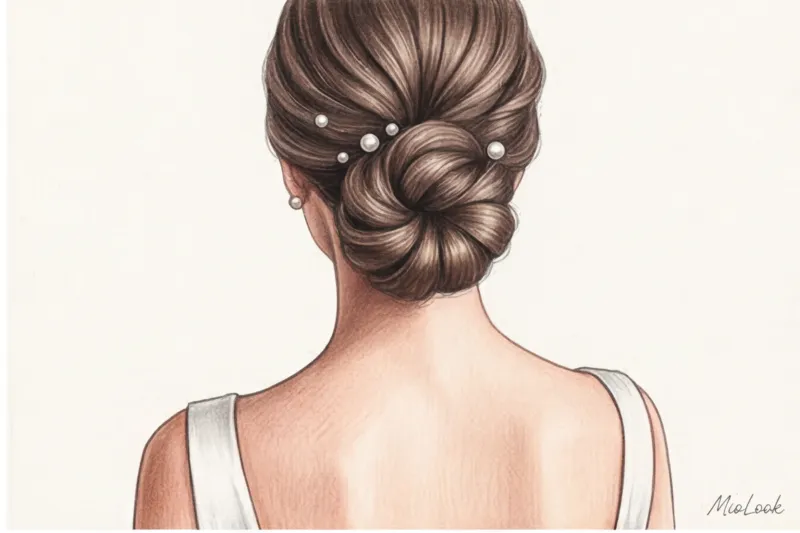
What if sleek, sleek buns aren't your thing, but you want to maintain a flawless, fresh look until cake-cutting time? My absolute favorite for these occasions is a textured low ponytail. It maintains the length and the coveted "loose" feel, while removing excess volume from the neck and keeping strands securely in place. For added elegance, you can secure the ponytail with a velvet ribbon or conceal the elastic with a strand of your own hair.
Another great alternative is a semi-updo, a "malvinka" hairstyle. We pull the temples back, opening up the face and emphasizing the cheekbones and collarbone, and leave the bottom layer of hair loose, draped over the back. A properly styled "malvinka" with crisscrossed strands at the nape creates a strong, architectural structure that will withstand tears of joy and vigorous dancing.
Micro-tip from a stylist: To avoid guessing at rehearsal whether your hair will hide important details of your outfit, take a photo of the dress from the back. Upload this photo to MioLook Use the hairstyle matching feature to visually compare loose curls and a low ponytail. This digital try-on is incredibly sobering, saving hours in the stylist's chair and saving you from stress.
Evening hairstyles for the mother of the bride and bridesmaids
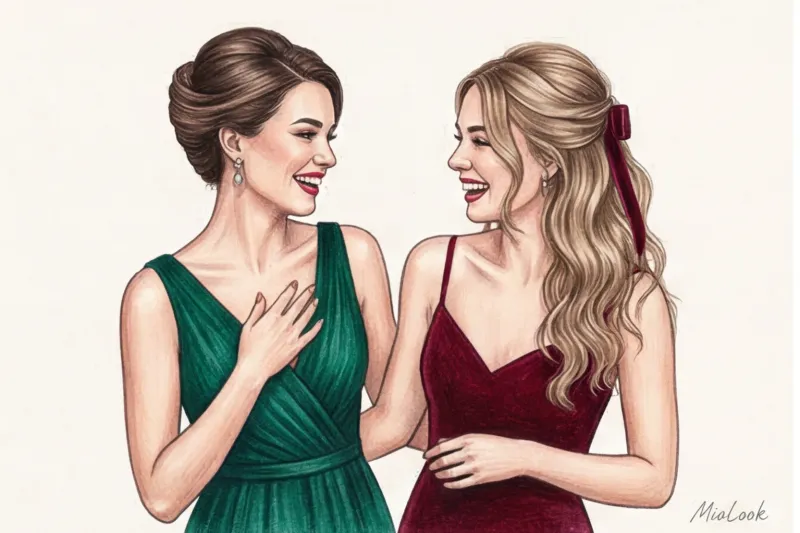
Have you ever noticed how in many group wedding photos, the eye gets completely lost, completely unable to figure out who the main character is? A European photographer I know recently complained to me about a veritable "volume war" in the frame. There's an unspoken but ironclad rule of etiquette: guests' hairstyles should never be more complex, higher, or more voluminous than the rest of the group. wedding hairstyles The bride herself. If the bridesmaid has chosen a simple, sleek, minimalist bun, her bridesmaids are strictly prohibited from creating three-dimensional textured braids or gigantic Hollywood waves with backcombing. This would severely disrupt the visual hierarchy of the event.
Anti-aging hairstyles for mom and mother-in-law: the architecture of youth
Working with aging faces requires pinpoint precision and a complete rejection of outdated clichés. The main mistake women over 50 make year after year is choosing overly tight, sleek hairstyles or, conversely, rigid, springy, concrete-like curls. Sleek, pulled-back hair mercilessly accentuates gravitational ptosis (the drooping of the face) and every wrinkle, depriving the face of air. And tight curls instantly create the effect of a 2000s-era wig.
Last wedding season, the bride's mother approached me with adamant insistence on a classic, tight, strong-hold "shell" bun—she believed it represented a classy elegance. I gently suggested an alternative: we created a low, slightly messy French bun with soft, rejuvenating strands released around the face. The difference was dramatic—the client visually lost at least 10 years. The subtle movement around the face acts like a subtle blur on camera, softening harsh features.
Celebrity stylist Guido Palau brilliantly summed up this principle in his 2023 masterclass: "The older the face, the more movement the hair texture should have." Swap out extra-strong hold hairspray for dry texturizing sprays (like the iconic Oribe Dry Texturizing Spray, $49), which keep hair looking vibrant.
Uniform Bridesmaid Style: Harmony Without Cloning
Gathering five women with completely different hair thicknesses, lengths, and textures into a single visual concept is a challenge. Don't try to force a hairstylist to create identical hairstyles for everyone. It always looks unnatural and rarely suits everyone equally well. The secret lies in the careful synchronization of details.
To create different styling options within a single concept, use the rule of common denominator. Agree on one basic element for everyone:
- Single point volume: Keep everyone's hair low-slung (low ponytail, sleek bun at the back, or loose hair with strands pinned back).
- Overall texture: Decide in advance whether all hairstyles will have a wet, glossy finish, or, conversely, everyone will choose a matte, beachy look.
- Same parting: Set the rhythm - all the girls have a strict straight parting or a deep asymmetrical parting on the left side.
I'll be honest: this styling trick doesn't always work. If one of your friends has an ultra-short pixie cut and the other has a thick, waist-length Asian braid, it's simply impossible to combine their hairstyles. In such extreme cases, I recommend tying the looks not with hair, but with matching minimalist accessories—for example, deep wine-colored velvet headbands or baroque pearl hairpins.
Try MioLook for free
Start creating perfect looks with the help of artificial intelligence and choose hairstyles without any hesitation.
Get access — €0.99 onceVeils, tiaras, and jewelry: how to integrate accessories effectively
Have you ever weighed a cathedral-length veil (about three meters)? Together with the encrusted metal comb, it can weigh over three hundred grams. It doesn't seem like much, but if you simply insert this weight into sleekly combed hair, after exactly twenty minutes of vigorous movement, the veil will slide down, ruining any wedding hairstyles in its path. That's why integrating accessories is a matter not only of aesthetics but also of rigorous physics.
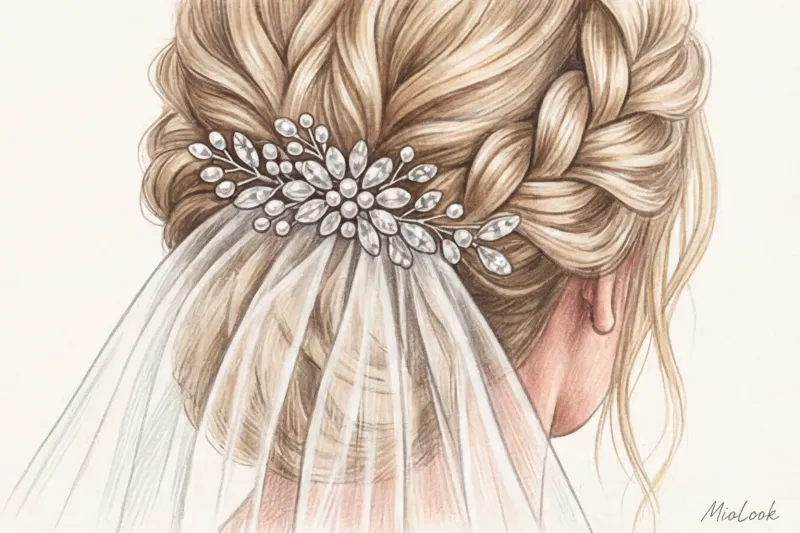
I'll let you in on some insider information that's rarely mentioned in magazines. No experienced stylist relies solely on the teeth of a comb. To properly distribute the weight of a long veil or a massive tiara, we always create a hidden "frame" of crisscrossing bobby pins within the hairstyle. At the nape of the neck, beneath the top layer of hair, we create a tight, interwoven base of bobby pins to which the accessory clings securely. You can dance until the early hours, and the structure won't budge a millimeter. If the veil is pinned on top (for example, above a low bun), this frame is made even more rigid to prevent the pins from scratching the scalp under the weight of the fabric.
The second golden rule of integration is one accent rule I often see girls trying to wear "the best of everything at once" during fittings. Remember: if your dress (even a €3,000 masterpiece) is lavishly embroidered with glass beads, crystals, or beads, hair accessories should be minimalist. Choose a smooth silk ribbon, a thin strand of pearls, or a completely sheer veil without a lace trim. Conversely, a simple, straight-cut satin dress will be a magnificent canvas for a statement tiara. To assess the balance of volumes and textures in advance, I recommend uploading a photo of the dress and planned accessories to MioLook — the app's features will clearly show whether you've overloaded the portrait area and whether the details are harmoniously combined.
A particular theme that brings many tears to the eyes at summer events is fresh flowers in hair. It looks incredibly poetic in morning photos, but the scorching sun and lack of humidity quickly take their toll. To avoid the buds wilting by the middle of the reception, be sure to ask your florist to taping of stems.
A quick stylist tip: Never insert a freshly cut flower directly into your hair. The proper technique involves the florist wrapping a very short stem with a piece of cotton wool soaked in a nutrient solution, then sealing it tightly with floral tape.
In some cases, the petals are additionally treated with a special floral spray that blocks moisture evaporation. This is the only way fragile orchids, freesias, or spray roses can survive the 12-hour marathon, dozens of hugs from guests, and remain impeccably fresh until the cake is served.
Step-by-step plan: preparing your hair for evening styling
Did you know that 90% of the longevity of any complex hairstyle is achieved not in the hairdresser's chair with a can of hairspray in hand, but in your own bathroom? Preparation protocols from the world's leading hairdressing academies state: the texture of the hair is everything. If the base is improperly prepared, even the most flawless wedding hairstyles can fall apart after a couple of hours of dancing. Let's explore a rigorous algorithm that will completely eliminate any unforeseen circumstances on the big day.
In 1 month: haircut architecture and color
A categorical rule of professional styling is no drastic experiments the day before the event. Coloring, toning, and haircuts should be scheduled 3-4 weeks before the event.
Firstly, a fresh, tight cut needs time to settle and fall naturally. Secondly, a rushed touch-up of a bad blonde or color stains two days before the wedding will cost you an extra €300–400 and a tremendous amount of stress. If you're planning an updo with loose strands around your face, be sure to ask your stylist for face-framing layers. Without them, the loose strands will hang in heavy, straight lines, weighing down your jawline.
In 1 week: deep hydration without slipping
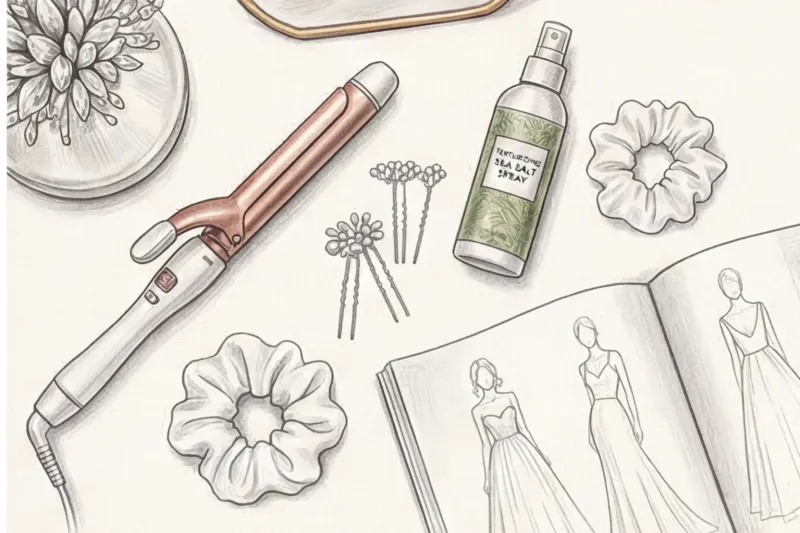
At this stage, our goal is to nourish the ends without turning the hair into a smooth glass. Seven to 10 days before the event, completely avoid treatments containing heavy oils (argan, shea, macadamia) and dense silicones (read the ingredients carefully, avoiding ingredients ending in "-"). -cone , For example, dimethicone ).
These ingredients create the notorious "slip effect." This causes bobby pins to simply slip off your hair, forcing your stylist to use aggressive backcombing and three times as much hairspray to maintain their shape. Replace your usual nourishing masks with lightweight, moisturizing products containing hyaluronic acid or keratin.
The evening before the event: to wash or not to wash?
This is perhaps the most popular question during consultations. For decades, the ironclad rule was that "yesterday's" hair holds a style better, as natural sebum acts as a natural styling product. This truly worked in the era of weak styling products.
Today, based on my experience working backstage at fashion shows, I can say the opposite. Modern professional dry texturizing sprays (such as the cult formulas from Oribe or Kevin Murphy) allow stylists to create phenomenal hold even on crystal-clear, freshly washed hair. However, there's an important nuance here, which depends on your physiology.
If you have an oily scalp, be sure to wash your hair the morning of the event. Freshness and root volume are much more important than the mythical hold of "yesterday's" hair. Simply use a lightweight shampoo and apply conditioner only to the ends.
To make sure nothing gets missed in the pre-holiday rush, I recommend my clients keep a preparation checklist. You can use MioLook app functionality , adding the dates of your colorist appointments to your planner in sync with your final outfit fittings.
Your ideal image begins Here
Join thousands of users who look flawless every day with MioLook.
Get access — €0.99 onceSummary and checklist: 5 questions for your stylist during a hair trial
Let's imagine: you're leaving the salon after a look rehearsal. Everything looks flawless in the mirror, every strand. But a large celebration isn't a static photo shoot. It's 12 hours of active movement, touching hugs, fiery dances, and changing locations. According to statistics from the Wedding Professionals Association (WPIA, 2023), about 40% of brides begin to experience severe physical discomfort due to heavy hair or tight skin by the middle of the reception. To ensure their chosen wedding hairstyles don't become a source of stress, I always ask my clients to follow a strict protocol. Ask your stylist these five questions right in the chair.
1. How will the installation behave in strong winds?
This point is crucial for outdoor weddings near water, in the mountains, or on open terraces. If a stylist nonchalantly replies, "Don't worry, we'll just spray it with extra-strong hold hairspray," it's a warning sign. A strand of hair sealed in hairspray won't flutter in the wind; it'll visibly break and fall into a stiff, impossible-to-comb layer. The right expert approach is to use texturizing powders and dry, flexible hold sprays. They create an invisible framework, allowing the hair to "breathe" and easily return to its original shape once the wind subsides.
2. Is it possible to easily remove the veil without ruining the hairstyle?
The vast majority of women prefer to remove their long veils after the official ceremony to allow them to move freely between tables. If the metal comb is firmly sewn into the center of a complex bun, attempting to remove it yourself will end in disaster—you'll simply pull out the supporting strands. Ask your stylist to create a hidden "pocket" of bobby pins at the very base of the bun. This micro-technique ensures the comb is firmly secured but can be removed with one smooth, upward sliding motion, without disturbing the structure of the bun.
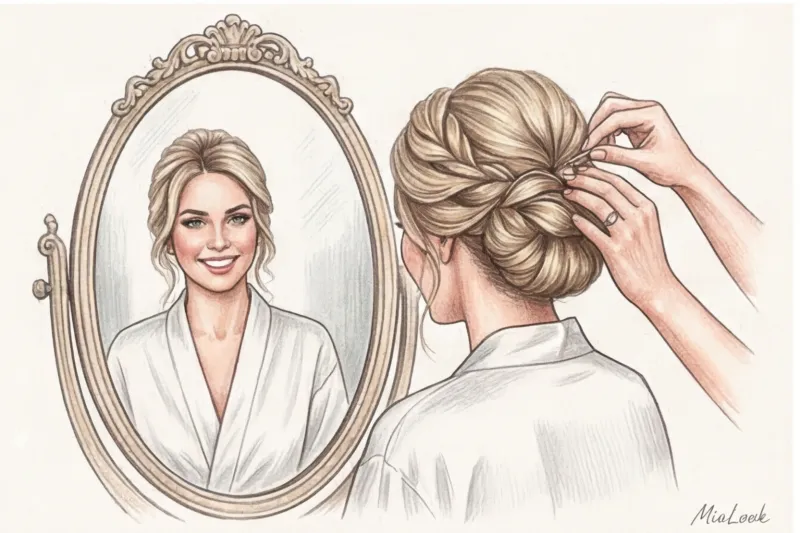
3. Will I be able to fix a fallen strand of hair myself?
The structure on your head shouldn't be a daunting engineering puzzle. Be sure to ask your stylist to show you exactly where and how to pin a lock of hair if it gets out of place while dancing. I always pack a mini SOS kit for my brides: several bobby pins that match the exact hair color and a mini texturizing spray. Believe me, just knowing you can save the situation in 30 seconds in the ladies' room is a huge anxiety reliever.
4. Does styling my hair weigh down my head (headache test)?
Conduct a ruthless crash test right during rehearsal: turn your head sharply left and right, jump slightly, and lean forward. Do you feel a sharp pin digging into your skin? Or do all your hair noticeably pull the back of your head? By evening, this gentle tension is guaranteed to transform into a throbbing headache. A well-designed evening hairstyle always distributes the weight evenly across several anatomical points, rather than hanging from a single, tight elastic band. If you feel any tugging, ask for the base to be re-done immediately.
To objectively evaluate the result of the rehearsal in a calm environment, photograph the styling from all angles in daylight and upload it to MioLook Attach these images to the virtual mockup of your dress. Sometimes what looks stunning in the salon chair can visually clash with the geometry of the neckline in the background, and the smart wardrobe feature helps identify this conflict before the big day.
5. Final tip: Trust your comfort, not Pinterest trends
I truly adore visual platforms for their endless inspiration, but let's face it: 90% of those aesthetically pleasing images of casually tousled braids are shot in a studio with perfect lighting, and the model hasn't moved a second. Your hairstyle should live with you. One of my clients last year spent about $250 trying out a complex, layered hairstyle she saw on social media, only to later confess with disappointment, "I feel like someone else in it." We took it all out and created an elegant, yet naturally flowing bob. And it was the best decision.
Choose a look that makes you feel like yourself, only a little more chic. If you've never worn a perfectly sleek ponytail in your everyday life, don't opt for one for a special occasion just for the sake of a passing fad. Your relaxed, comfortable, and genuine smile are the key elements of your style, something that can't be replaced by even the most virtuosic hairstylist.
Guide Chapters
Evening hairstyles for women over 40: a lifting effect
Forget about rigid hairstyles. Discover how the right shape and texture can visually rejuvenate and refresh your look.
Luxurious wedding hairstyles for long hair
A wedding hairstyle isn't just a pretty picture, it's a complex design. Learn how to choose a hairstyle for long hair that will last all day.
Hairstyles for Dress Necklines: A Guide to Choosing
The portrait area accounts for up to 40% of the visual weight of your look. Learn how to choose the right hairstyle for any outfit and create a harmonious silhouette.