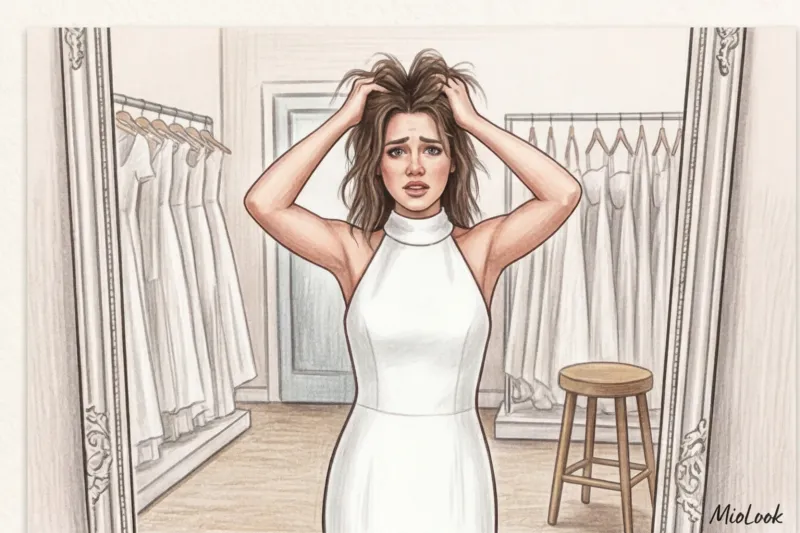

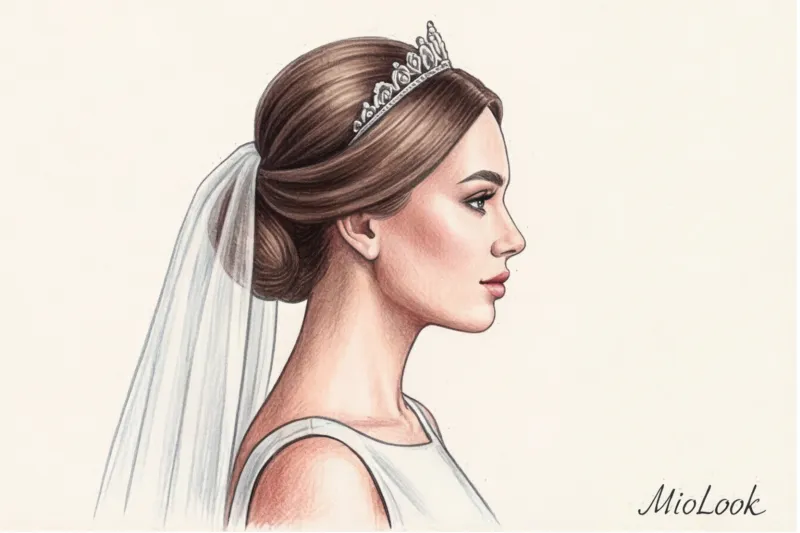
I remember a bride who tearfully pulled off her luxurious, three-meter-long veil exactly an hour into the reception. The reason? An unbearable, throbbing headache. The stylist simply stuck a heavy metal comb into her sleekly combed hair, securing it with a pair of ordinary bobby pins. Physics had taken its toll: nearly half a kilogram of embroidered lace tugged at her roots with every step and turn of her head.
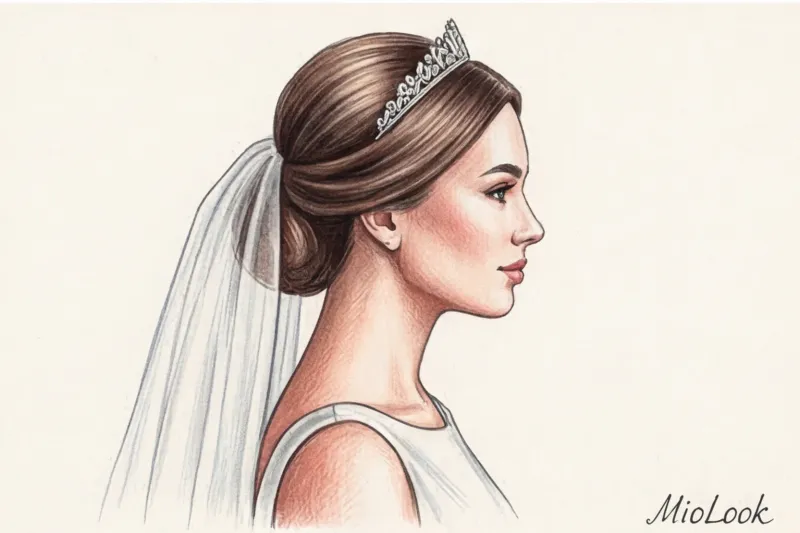
When we discuss wedding hairstyles with a veil Most glossy magazines focus exclusively on aesthetics and romance. But as a stylist with 12 years of experience, I can tell you straight: integrating voluminous accessories into hair is primarily a matter of engineering, weight distribution, and the architecture of the look. We've already discussed how to tie together silhouette lines in more detail in our a complete guide to choosing a hairstyle to match your wedding dress Today, we'll explore the mechanics: how to securely fasten heavy elements so you can enjoy the party instead of enduring pain.
Image architecture: why wedding hairstyles with veils and tiaras require an engineering approach
A bride's hair isn't an isolated flowerbed to be adorned with as many embellishments as possible. It's a logical extension of the lines defined by the dress. In my practice, I use the "inverted foundation" principle. If the dress has a complex, heavy cut with a crinoline, the hairstyle should visually balance this mass while still maintaining structure.
The main rule for volume balance: the more textured the outfit, the more minimalist the integration of accessories should be. A voluminous ballgown, a massive tiara, and a multi-tiered veil will transform you into a monumental figure. Texture also dictates its own rules. Smooth, heavy mikado silk demands a perfect shine in the hair—the tiara should sparkle with the crisp facets of its crystals. But loose, bohemian macramé lace forgives, even begs for, a touch of casualness, where the veil seems to flow out of nowhere.
Access to MioLook for €0.99 — one-time payment
A smart AI stylist will select the perfect look based on your proportions and hair texture.
Get access — €0.99 onceThe Hidden Threat: Accessories Weight, Hair Health, and Bride Comfort
Let's talk numbers. A cathedral veil 3-4 meters long, trimmed with corded Chantilly lace or embroidered with beads, can weigh between 300 and 400 grams. Does that seem like a lot? Try hanging half a kilo of sugar from a strand of your hair for 12 hours.
According to the International Society of Hair Restoration Surgery (ISHRS, 2023), prolonged root traction can trigger traction alopecia—localized hair loss due to mechanical damage to the follicles. This process is what causes that mid-party migraine.
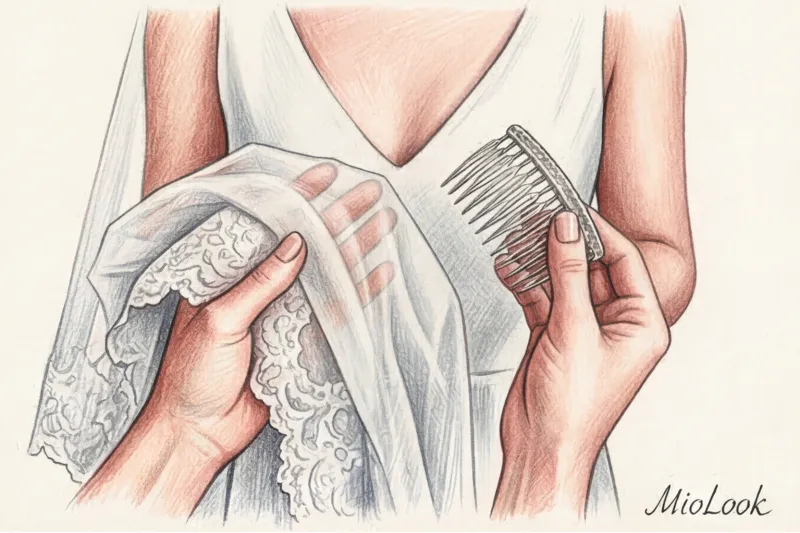
Weight depends on the fabric. The difference in weight between natural silk tulle (light, breathable, and flexible) and dense synthetic polyester tulle is about 30%. Silk tulle literally floats in the air without weighing down your hair. The same goes for tiaras. I always recommend investing in jewelry made from high-quality rhodium-plated jewelry alloys. Not only do they look elegant, but they also have the right center of gravity, unlike heavy tulle. fast fashion plastic that tends to slide down onto the forehead at the slightest tilt of the head.
Basic Rules for Attaching a Veil: From a Short Veil to a Cathedral Train
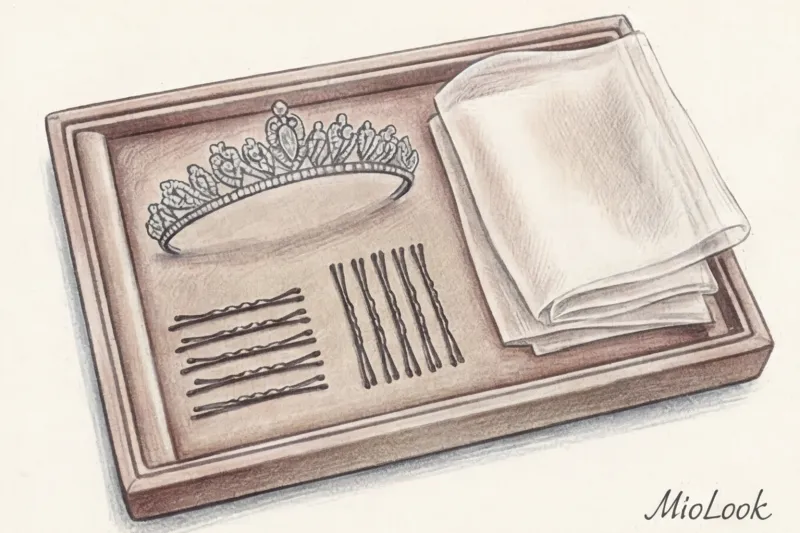
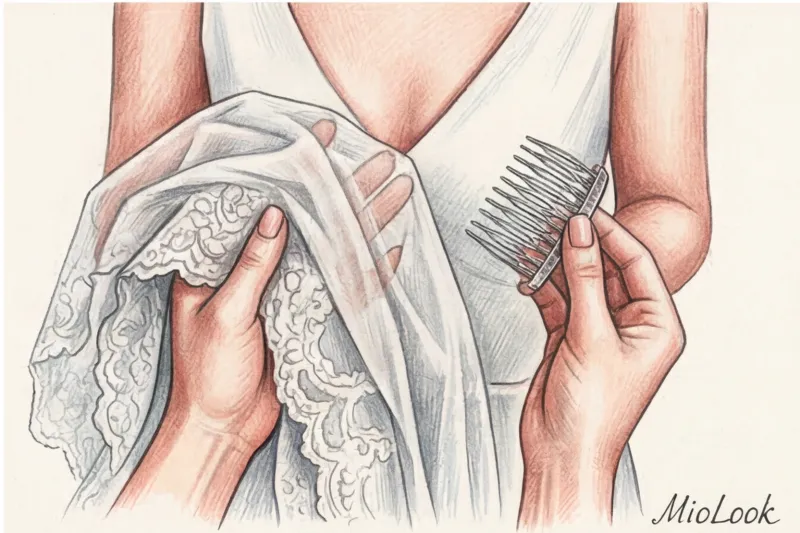
The biggest mistake I see backstage is trying to attach the veil comb to bare, simply combed hair. This will never work. The secret of celebrity stylists is to create a hidden frame. Before inserting the accessory, the stylist must prepare the platform—the anchor.
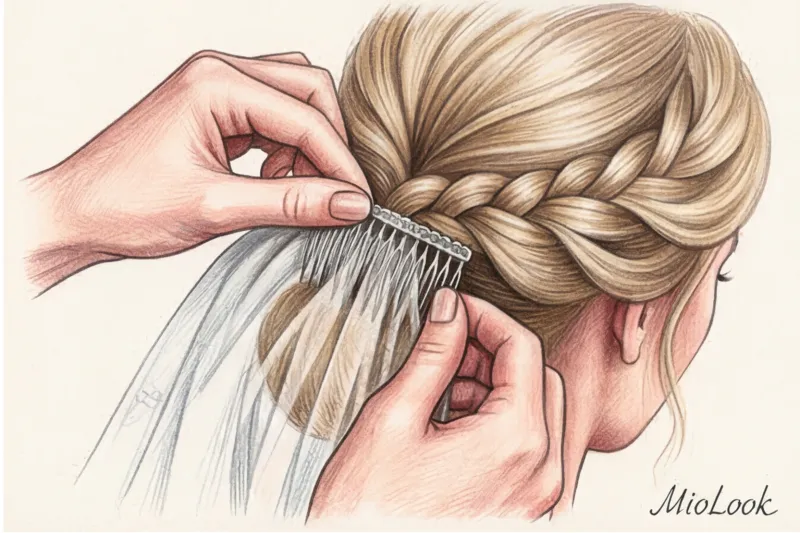
Typically, this is a micro-braid (cornrow) 2-3 centimeters long or a dense crisscross frame of ribbed bobby pins at the very roots, hidden under the top layer of hair. It is into this frame that the comb's teeth fit like a groove, transferring the load from individual hairs to the dense structure.
Engineering for heavy textures (multi-layered tulle and lace)
If your veil weighs more than 200 grams, a comb alone isn't enough. The center of gravity will pull the structure inexorably downwards. On my brides, I use additional insurance: I sew three or four small loops of strong shoe thread, perfectly matching the color of the hair, to the base of the veil.
These loops are distributed across the back of the head, and through them, the veil is further secured with long pins to the base frame of the hairstyle. The weight is distributed evenly, and the bride literally no longer feels the weight of the lace.
Light textures (Spanish mantilla and silk tulle)
The traditional Spanish mantilla has no comb at all. It falls on the head like a soft cloud. But the fine silk tulle is incredibly delicate—stiff metal bobby pins with frayed ends will tear it in a second.
Here I use special U-shaped pins that gently pass through the lace mesh without damaging the threads and catch on hidden micro elastics in the hair. No tension—just a soft hold.
Your perfect look starts here
Join thousands of users who look flawless every day with an AI assistant.
Get access — €0.99 onceTiara Integration: How to Avoid the "Tinfoil Crown" Effect
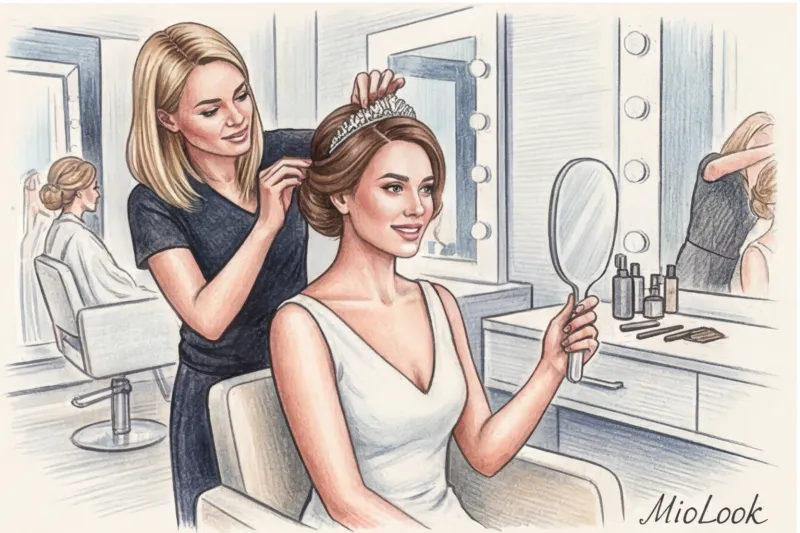
A tiara shouldn't sit on top of your head like a party hat. A proper fit means the piece "melts" into the texture of your hair. The front strands should slightly cover the base of the headband, creating the illusion that the crystals are literally woven into your hair.
The angle is critical. Ideally, the tiara should be positioned at a 45-degree angle to the hairline. If it's placed too flat, it will visually flatten the forehead. If it's positioned strictly vertically, it will create a doll-like crown effect, which cheapens the look. The cheap, glassy shine of chunky jewelry can instantly devalue a €3,000 dress.
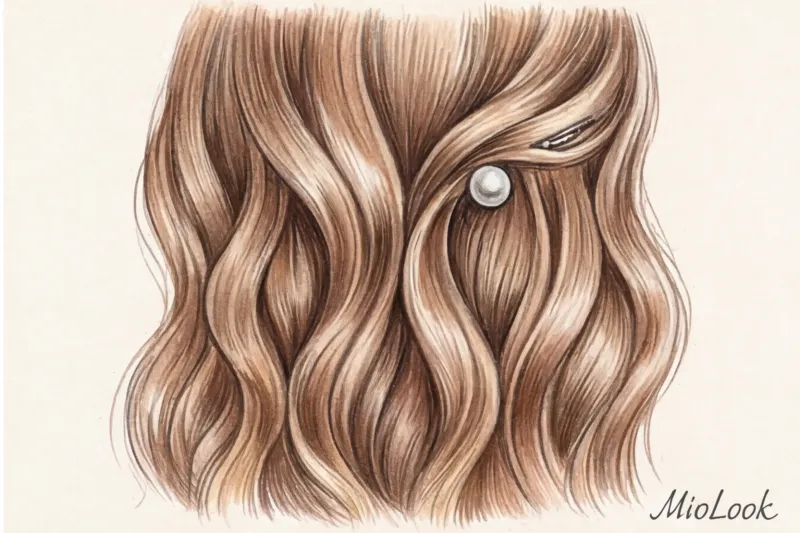
Pay attention to the temperature of the metals. If your dress hardware (zippers, buttons) or wedding ring are made of warm gold, a silver tiara with cool rhinestones will create a discordant tone. For brides with warm complexions (peach, olive) and ivory dresses, I always recommend accessories made of rose or yellow gold, brass, or warm-toned pearls.
Wedding hairstyles with veils: a styling compatibility checklist
Not every hairstyle can support a veil. Let's look at the most common scenarios:
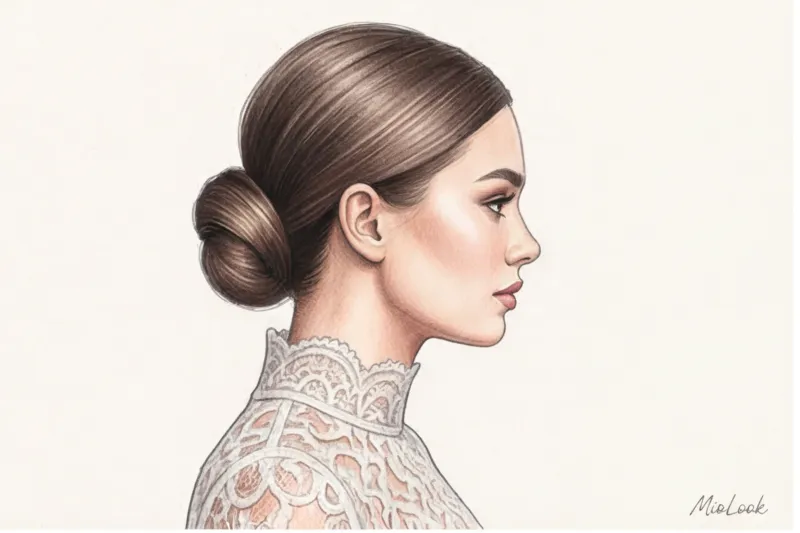
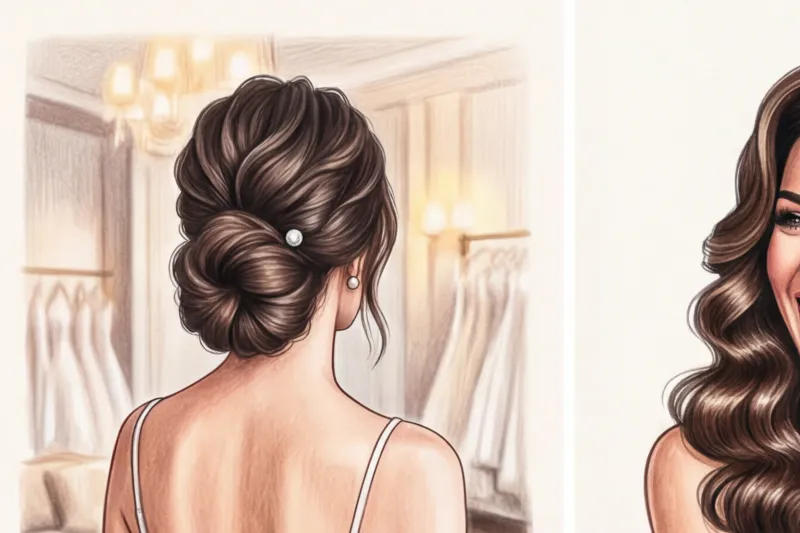
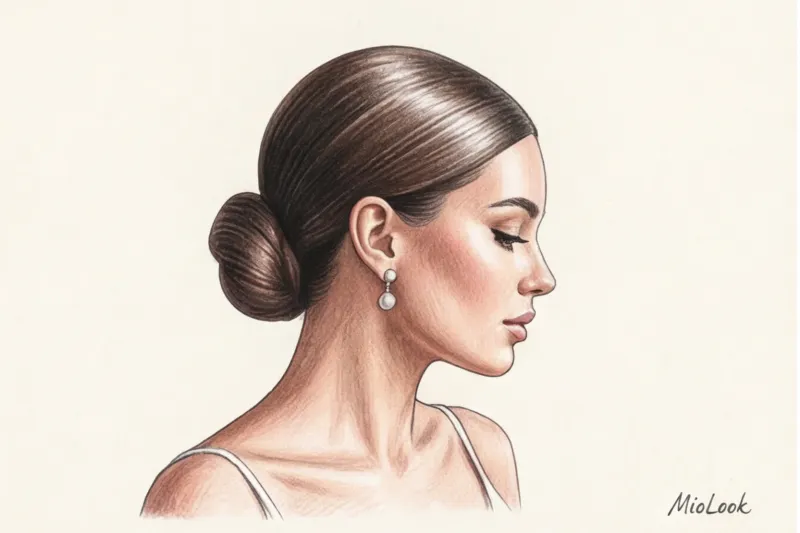
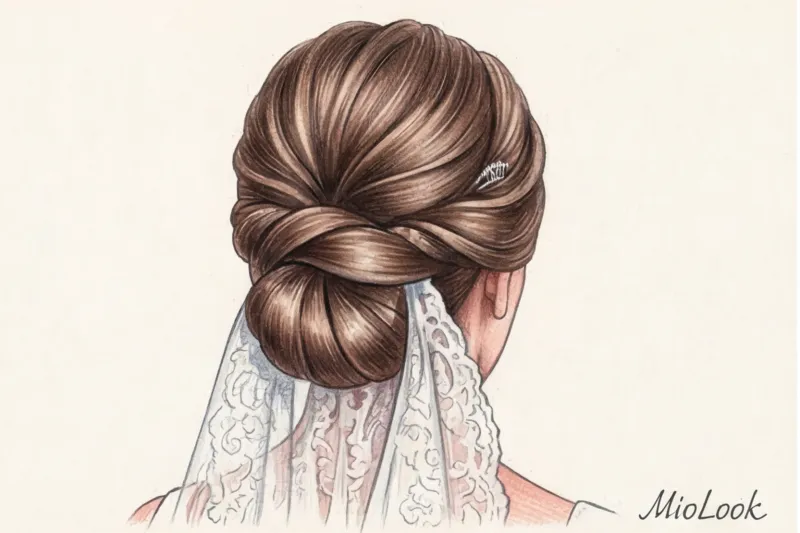
- Low sleek bun: This is an absolute favorite and the most reliable "foundation." Attaching the veil under A bun visually lengthens the neck and does not hide the complex architecture of the hairstyle. Fastening over A bun makes the look more traditional and romantic, but adds volume to the back of the head (be careful if you're short).
- Loose curls and Hollywood waves: The most challenging option for a stylist. There's no hair up—nothing to hook the comb onto. In this case, a hidden section is required on the crown, where a very thin braid is woven parallel to the parting. Without it, the veil will fall off after 15 minutes of dancing.
- High styling: If you're combining a high bun, a tiara, and a veil, place the veil directly underneath your updo. Otherwise, you risk overloading the top half of your head and making it appear half as large.
Fair Limit: This checklist doesn't work for everyone. If you have an ultra-short pixie cut or very fine, glassy hair lacking natural thickness, the physics of attaching heavy lace can be dangerous. In such cases, we replace the cathedral veil with a weightless veil or a stylish headband with micro-mesh.
The biggest myth of stylists: why liters of hairspray no longer work
Over the years, I've learned one counterintuitive thing that shocks many salon stylists: more hairspray doesn't mean stronger hair. Quite the opposite. A stiff strand of hair, coated in strong-hold hairspray, loses its elasticity. It becomes as brittle as glass.
A study on the properties of keratin published in Journal of Cosmetic Science (2022) , confirms: when styling polymers completely block hair movement, mechanical stress (such as a heavy comb) causes the hair shaft to immediately break rather than stretch elastically. Hair that's as smooth as cement has no texture—a metal pin simply glides over it.
Modern styling requires creating "grip." Instead of gallons of hairspray, I use salt texturizing sprays and root-volumizing powder. My hair stays alive and soft to the touch, but gains a matte grip. The bobby pin fits into this texture like a charm.
Action Plan: How to Conduct a Hairstyle Rehearsal Without Regrets
A wedding dress rehearsal isn't just a fitting; it's a crash test. I insist that my clients bring both the veil and the tiara. Trying them on separately is pointless—you won't understand how they compete for space on your head.
My personal tension test, which I conduct with every bride: we secure all the accessories, and I ask the bride to actively walk around the studio for 20 minutes, turn her head, bend over to pick up a dropped phone. If after 20 minutes there's a tug, a prick, or the urge to scratch her head, we redo everything. It's unbearable.
Last but not least: instructions for your bridesmaid. Brides typically want to remove their veils after the first dance or the official ceremony. Your bridesmaid should know exactly which pins to remove (they should be a different color from the main pins!) to avoid the veil from falling apart and the tiara from shifting.
Your hairstyle is a crown you wear on one of the most important days of your life. It should give you confidence, not make you count the minutes until you can take it all off.