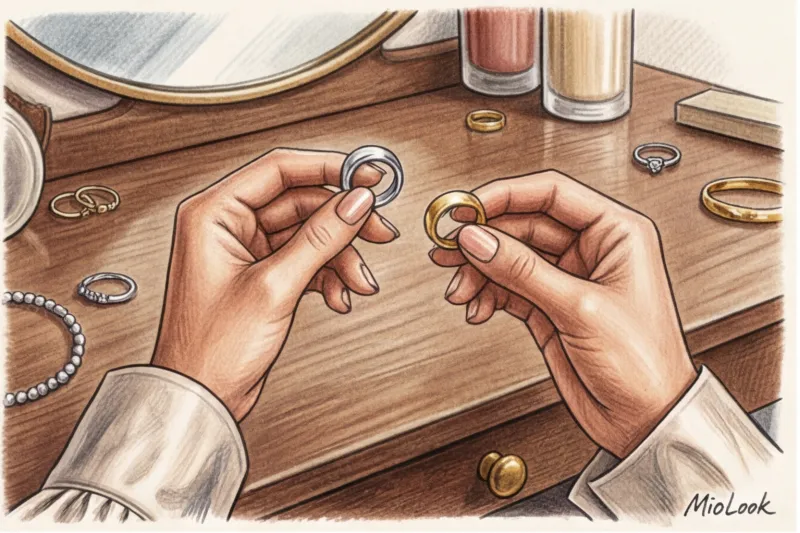
Let's be honest. If you ever hear the advice "look at the veins on your wrist: if they're green, wear gold; if they're blue, wear silver," I give you permission to roll your eyes. As a personal stylist, I've been watching for years how this rule from glossy magazines in the 2000s confuses smart, stylish women.
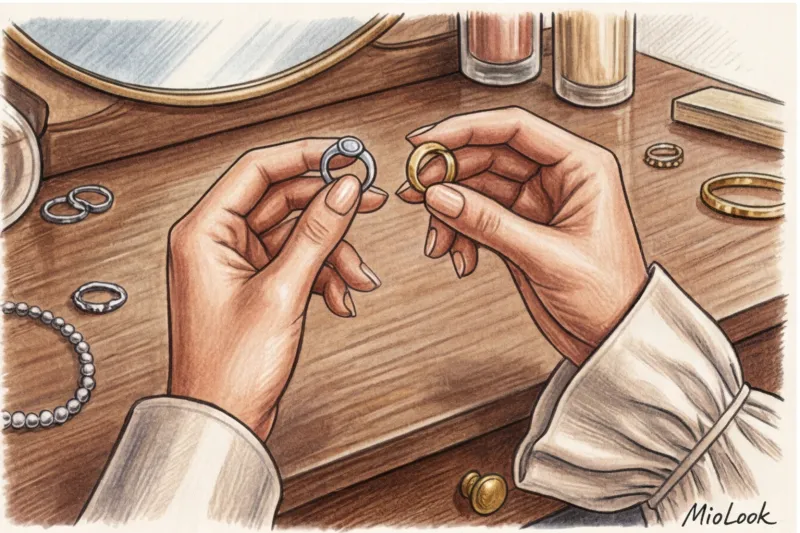
In reality How to choose the color of metal for jewelry It's not a question of vascular physiology, but of the architecture of your look. Color doesn't exist in a vacuum. It interacts with your skin, the contrast of your face, and, most importantly, the texture of your clothing. We've already discussed the architecture of accessories in more detail in our The complete guide to a basic jewelry wardrobe , where the anatomy of the ideal capsule was analyzed.
Today, we'll go further. We'll ditch the vein test and explore the advanced color techniques stylists use to make your jewelry look classy, whether it costs €50 at Massimo Dutti or €5,000 at a boutique on Place Vendôme.
The Green Vein Myth: Why Old Rules for Choosing Metal Color in Jewelry No Longer Work
According to fashion research agencies, approximately 70% of Slavic and European women have a combination or neutral skin tone. For them, the rigid "only gold" or "only silver" distinction simply doesn't work.
When you look at your wrist, you see the color of your veins through the optical filter of your skin. This filter changes depending on your tan, fatigue, the lighting in the fitting room, and even what you had for breakfast.
"Pure color types—strictly warm or strictly cool—are as rare in nature as a pair of perfectly fitting jeans without trying them on. Most of us fall somewhere on the spectrum."
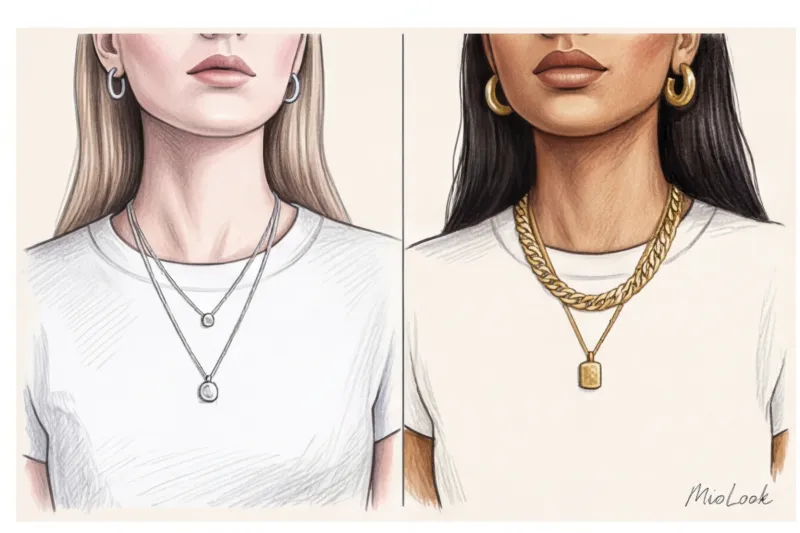
I had a revealing case in my practice. My client, Elena, came to see me—a classic "warm spring" with peachy skin and golden hair. By all the canons of the old school, she should have worn only yellow gold. But Elena had an incredibly high level of contrast in her appearance—dark, graphic eyebrows and piercing, icy-blue eyes. When we dressed her in bright, rhodium-plated (white) silver, her face literally burst with freshness. The gold made her look cozy and simple, and the cool shine of the silver created that perfect, bold chic effect.
Temperature and Contrast: A Modern Stylist's Method for Choosing Metal
Instead of palmistry, I use the principles in my work Munsell color system , developed in the early 20th century but still the gold standard for colorists, Munsell proved that color has three dimensions: hue (temperature), value, and purity (saturation).
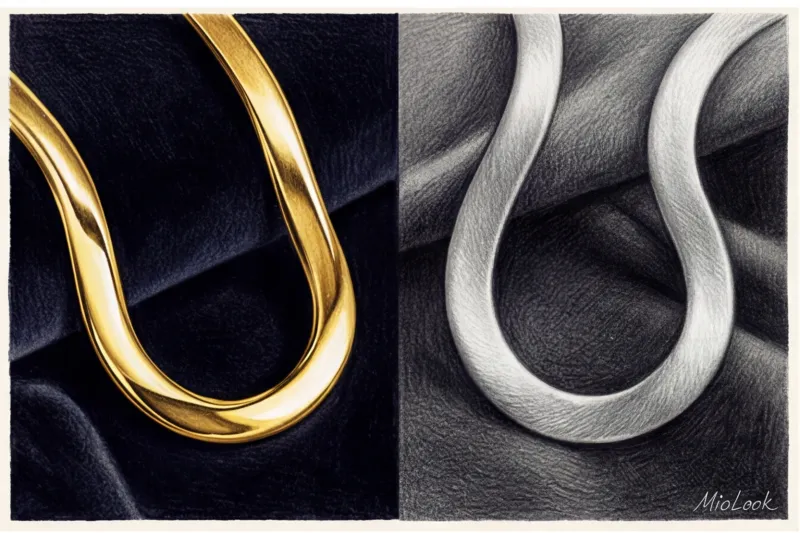
In relation to jewelry this means that How the metal shines, often more important than that, what It's a color. Glossy, mirror-polished silver and matte, slightly oxidized (blackened) silver are essentially two different metals for your face.
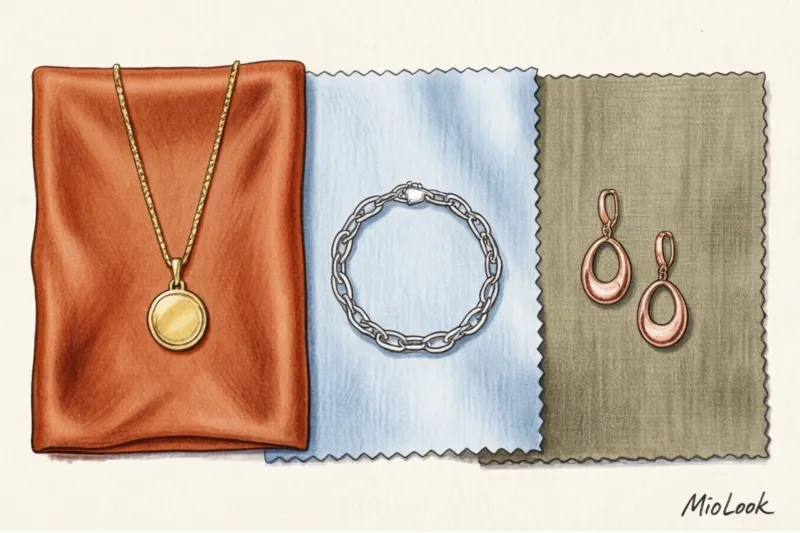
How do you check your temperature without veins? Take a piece of regular aluminum foil and a sheet of brass (or just glossy gold paper). Place them on your makeup-free face in daylight. Don't look at the paper, but at the shadows under your eyes and nasolabial folds. The wrong metal will instantly make them look deeper and grayer. The right metal will work as a good concealer.
Your perfect look starts here
Join thousands of users who look flawless every day with the smart AI stylist MioLook.
Get access — €0.99 onceWarm palette (Fall and Spring): yellow gold, bronze, brass
If the foil made your face look tired and the gold brightened it, your base is warm metals. Your skin has peachy, honey, or golden undertones.
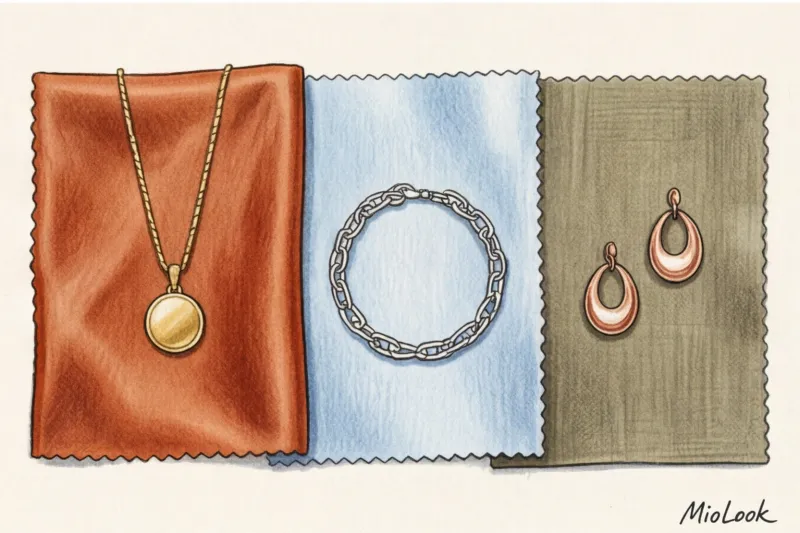
- Your best friends: classic yellow gold (18K gold looks especially rich), copper, bronze and rose gold.
- Texture: If you have soft features (muted autumn), choose satin, matte, or brushed gold. Leave the glossy finish to contrasting types.
- The main mistake: Wear cheap, overly bright "white" silver near your face. It draws the gray pigment out of your warm skin, making your face look sickly.
Cool palette (Winter and Summer): silver, platinum, white gold
If the gold test makes you look seasick, your profile is cold. This means porcelain, pinkish, or translucent skin.
- Your best friends: platinum, white gold, rhodium-plated silver, surgical steel.
- Texture: Winter (high contrast) calls for the dazzling, brilliant shine of polished metal. Summer (low contrast) looks stunning in vintage, slightly tarnished silver.
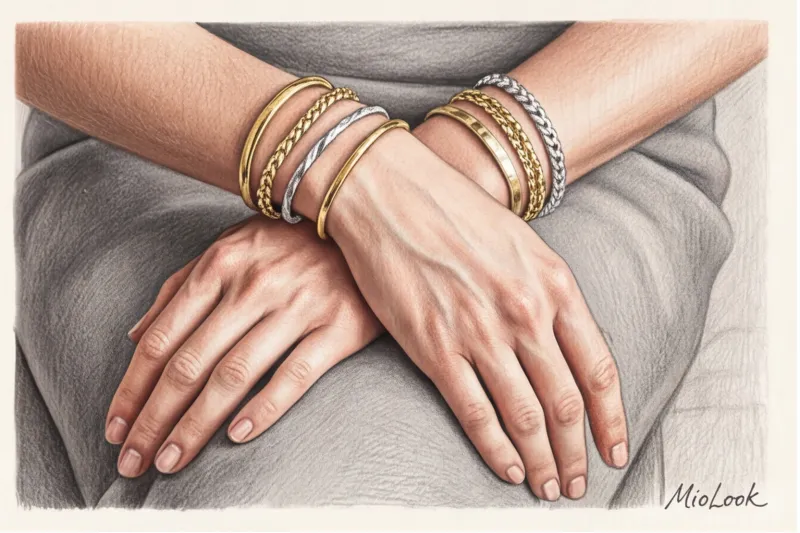
- Life hack: If you adore yellow gold but it doesn't suit you, wear it away from your face. Rings, layered bracelets, or a belt buckle won't affect your complexion, but they will satisfy your love of gold.
By the way, if you are unsure about which season you belong to, I recommend you study our material about the 12 color types of appearance.
Secret Mediterranean Shade: Metallics for a Complex Olive Undertone
Oh, olive skin! My favorite because it's the one that brings the most tears to my eyes in fitting rooms. The olive undertone (common in southern Europe, Latin America, and among many mixed-race brunettes) is a trap. The skin appears tanned and warm, but it's actually greenish-gray. cold nuance.
One day, a client, a top manager named Sofia, came to me. All her life, she'd been buying silver out of habit, as it literally blended with her olive skin, making her look pale and bland. Even classic 14kt yellow gold looked cheap and out of place on her.
The solution was champagne gold It's a pale yellow alloy (often 9 or 14 karat with added silver or palladium) that looks noble, understated, and incredibly expensive. It doesn't scream yellow, but it does impart that soft glow.
Ideal for olive skin:
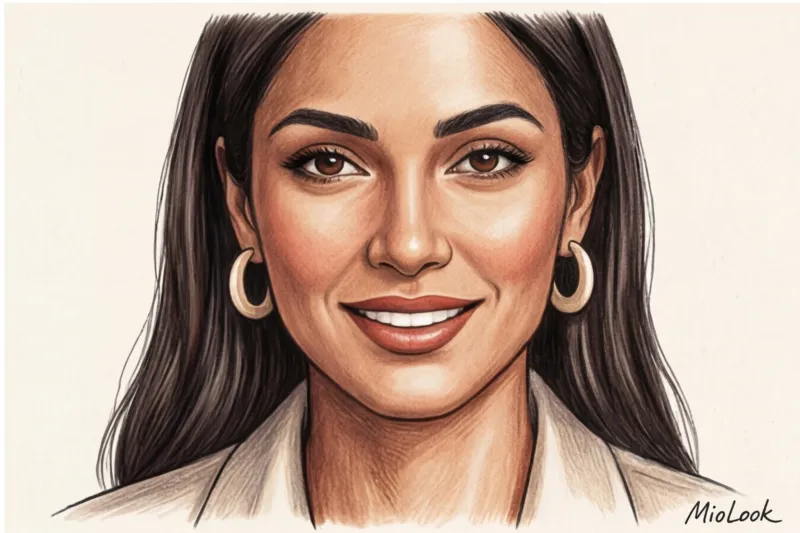
- Lemon and champagne gold (in the 100–300 € segment, such alloys are often found in niche European brands).
- Blackened silver in Balinese or vintage style.
- White gold with a slight warmth (not rhodium plated).
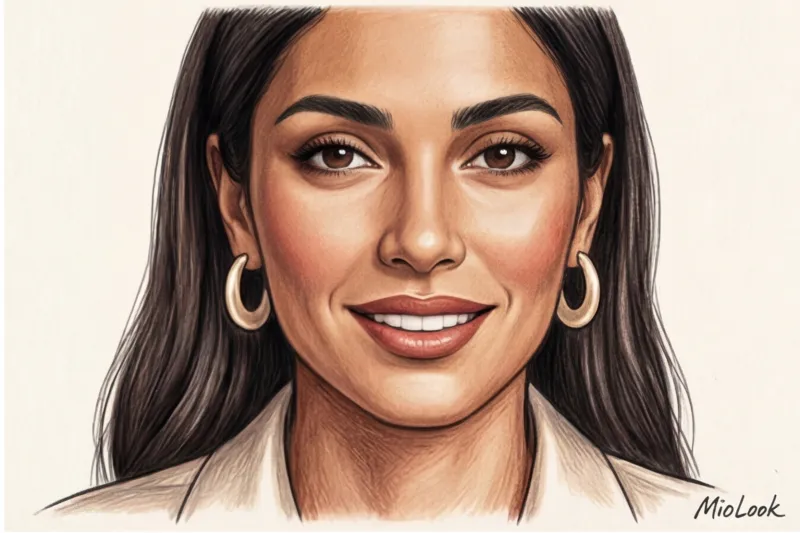
The formula of harmony: how the color of your clothes dictates how to choose the color of the metal of your jewelry
Jewelry doesn't exist separately from your wardrobe. Ever noticed how the same earrings look different with a white T-shirt and a burgundy sweater? This is the basic principles of Johannes Itten's color wheel in action.
Metal is also a color. Gold is yellow/orange. Silver is light gray/blue. And they should complement your clothes.
Here are my favorite styling formulas that work without fail:
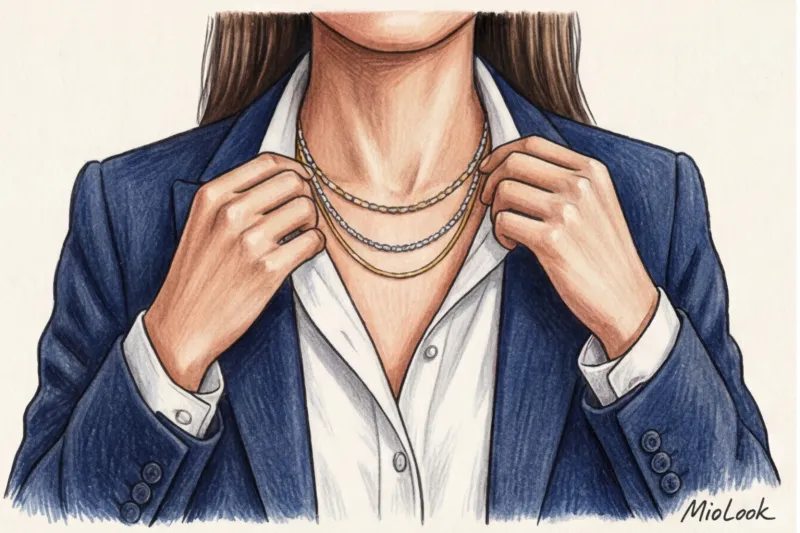
- Navy blue jacket + white shirt + smooth silver = strict, distancing status. Ideal for difficult negotiations.
- Navy blue jacket + white shirt + chunky yellow gold Relaxed Mediterranean chic. It looks like you just stepped off a yacht in Portofino.
- Emerald, burgundy, chocolate silk + yellow gold = maximum luxury, “old money” aesthetics.
- Powder pink, lavender, dusty blue + silver = purity, lightness, romance.
If you want to check how the shades of your clothes match with your jewelry base before leaving the house, use smart wardrobe feature in MioLook This saves at least 15 minutes of morning preparation.
Access to MioLook for €0.99 — one-time payment
A smart AI stylist will select the perfect look for you, taking into account your palette and wardrobe.
Get access — €0.99 onceThe Art of Mix & Match: How to Mix Gold and Silver Without Looking Tacky
If you ask me what betrays outdated taste most quickly, I'd answer: jewelry sets. Wearing a ring, earrings, and necklace from the same set with the same stone and metal is considered bad form these days. It's too much effort. Modern chic lies in a touch of casualness.
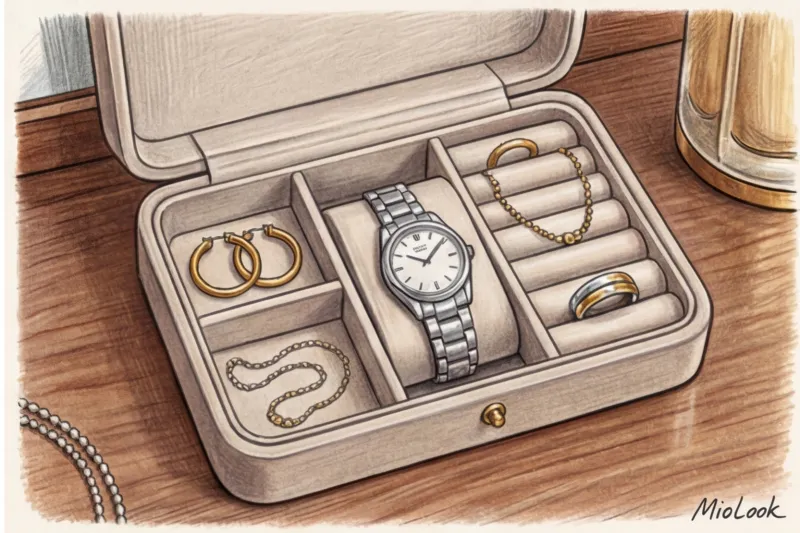
Mixing metals was long considered taboo. Today, it's a sign of sophisticated style. When creating capsule wardrobes for female executives, I always incorporate bicolor because it solves the biggest morning dilemma: "What watch should I wear if my bag has gold hardware and my earrings are silver?"
Three rules for a smart mix from a stylist:
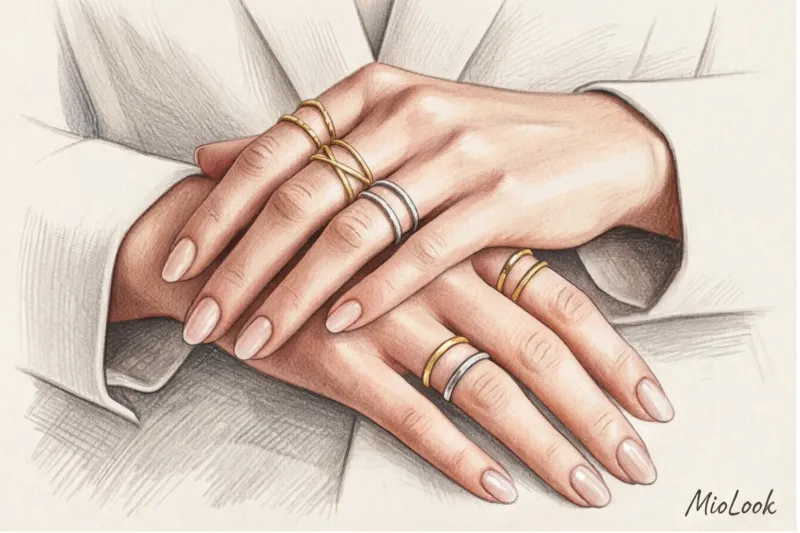
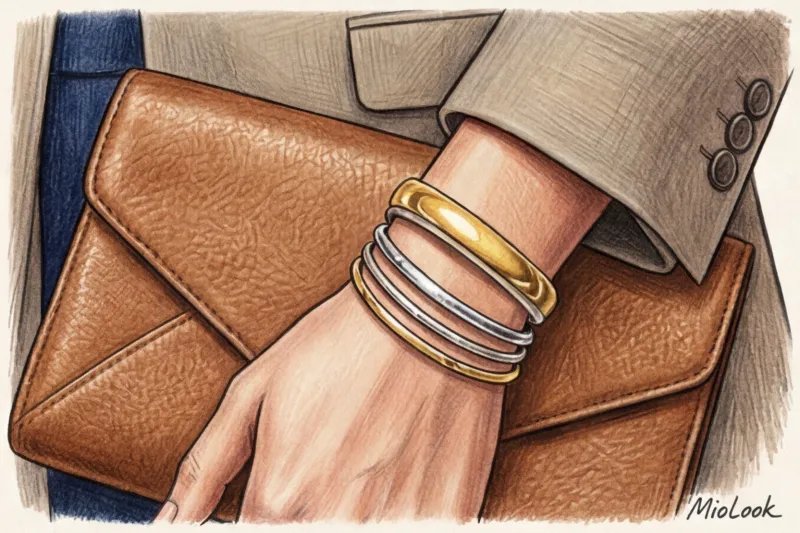
- The 80/20 ratio rule. Never mix metals 50/50—it looks random or a mistake. Choose a dominant metal (for example, 80% silver) and add an accent (20% gold—one chunky ring).
- Transitional element technique. For metals to blend, a bridge is needed. A bicolor watch (steel + gold PVD coating) or a dual-alloy ring is ideal. By wearing such a piece, you've legitimized the presence of both metals in your look.
- Unity of form or texture. If the metals are different, something should unite them. For example, mix a thin gold curb chain with an equally thin silver one.
Important: This rule does NOT apply if you're mixing ornate vintage silver with filigree and ultra-modern, minimalist gold. The styles must match!
Checklist: How to choose the metal color for your first capsule collection
To make sure your knowledge doesn't just remain theory, let's put together your first jewelry capsule right now. bridge-marks (from 70 to 250 €) you can find excellent basic items made of sterling silver or high-quality gold plated (vermeil).
- Analyze the clothing base. Open your closet: if it has more cool tones (gray, blue, black, fuchsia), choose silver or white gold as the dominant metal.
- Define your texture. Do you have contrasting facial features? Go for gloss. Soft, muted hair and eye colors? Look for satin metal.
- Buy the Holy Trinity base metal:
- Smooth hoop earrings (rings) of medium diameter.
- Minimalistic chain (anchor or snake) 40-45 cm long.
- A rigid bracelet or a simple watch.
- Add "negotiator". A single bicolor piece of jewelry—for example, a ring made of intertwined gold and silver threads—will tie your new capsule collection to any spontaneous purchases in the future.
Ready to get started?
Try the MioLook free plan—no commitments required. Upload your jewelry and let the AI create the perfect combinations.
Get access — €0.99 onceA jewelry wardrobe isn't about carat count or strict restrictions. It's about impression management. Once you stop looking for green veins on your wrist and start treating metal as an architectural element of your style, you'll notice something amazing: even basic jeans and a white T-shirt, paired with the right sparkle, will look like a million bucks.