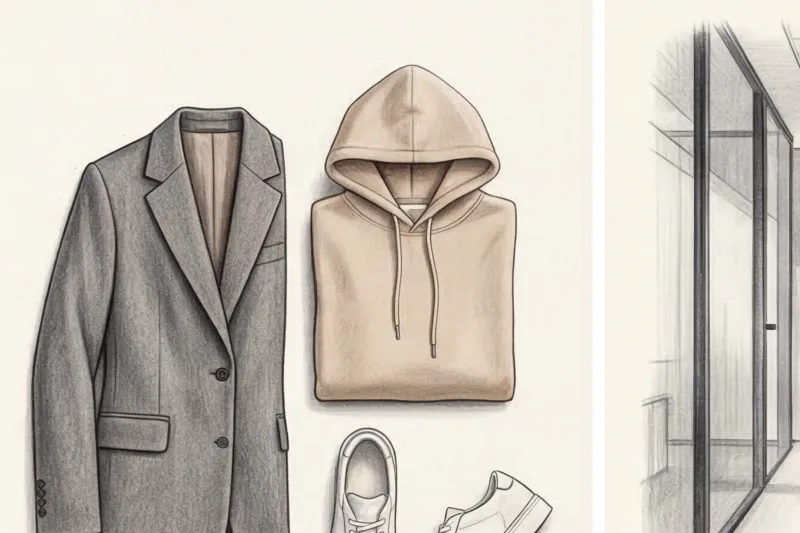
Anatomy of style: what is sport-casual style for women, really?
Over the 12 years I've worked as a personal stylist, I've seen the same scene time and time again: a woman decides to add some comfort to her workday by showing up to the office in an oversized hoodie, leggings, and chunky running shoes. She sincerely believes this is modern business fashion. But let's clarify this once and for all: Women's sporty casual style This isn't about adapting your Pilates gear to an open-plan space. It's a completely different, far more subtle and thoughtful aesthetic.
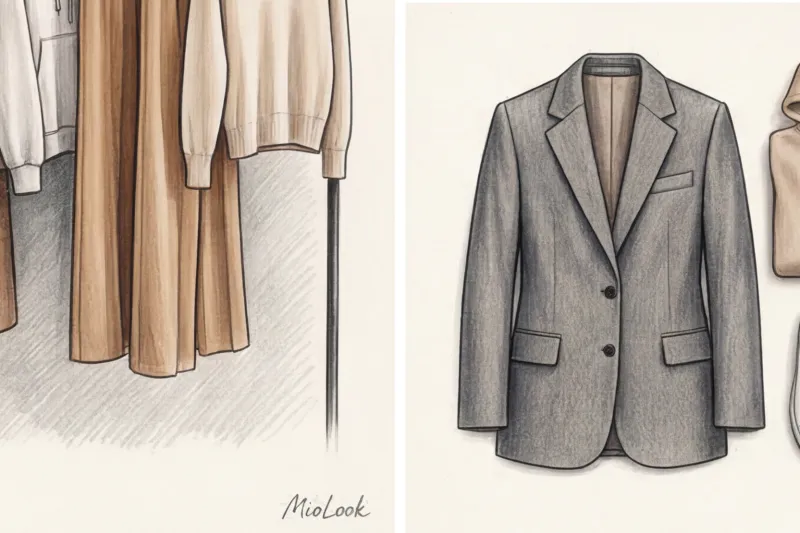
The post-pandemic world has forever rewritten the rules of corporate dress code. According to McKinsey's 2024 global report on the transformation of the retail and fashion industries, over 65% of companies worldwide have officially relaxed their employee attire requirements, abandoning rigid formality. I clearly see this shift in my own work. While before 2020, my clients would ask for a "formal capsule collection for the boardroom," today 9 out of 10 requests are worded differently: "Katarzyna, I need a look that's classy, but also one that I can comfortably wear for 10 hours, get behind the wheel, and go out to dinner in the evening.".
True sport-casual is always business attire with subtle elements of athletic comfort, not the other way around. To avoid costly stylistic mistakes, it's crucial to understand the differences between three related styles:
- Smart casual: This is a relaxed classic. A jacket, straight-leg jeans without fading, a silk blouse, and leather loafers. You can read more about this style in our guide about smart casual for women.
- Street style: This is the land of fleeting trends, hyperbole, and logos. Oversized down jackets, limited-edition sneakers, and tracksuits with bold prints. These are absolute no-nos for the office.
- Sports casual: This is a strict cut architecture, multiplied by utilitarian details and comfortable textures. The jacket's sharp shoulder line and the crisp crease on the trousers remain, but are complemented by dynamic elements.
"The secret to expensive athleisure is that athletic wear serves merely as a spice to the main course—a classic business wardrobe. Overdoing it with spices will ruin the whole thing."
The 80/20 Rule: The Gold Standard of Balance
A well-designed athleisure-casual wardrobe is based on strict mathematics. The main secret I reveal during the very first consultation: the ideal look is built according to the 80/20 rule. This means that 80% of your outfit should consist of structured, shape-resistant pieces, and only 20% should be sporty or relaxed pieces.
Why this particular ratio? As soon as you upset this balance and go 50/50 (for example, by wearing knit joggers and a hoodie with a classic double-breasted trench coat), the visual status of the look instantly collapses. Instead of a confident businesswoman, the mirror reveals a teenager on a skateboard who accidentally threw on his mother's coat.
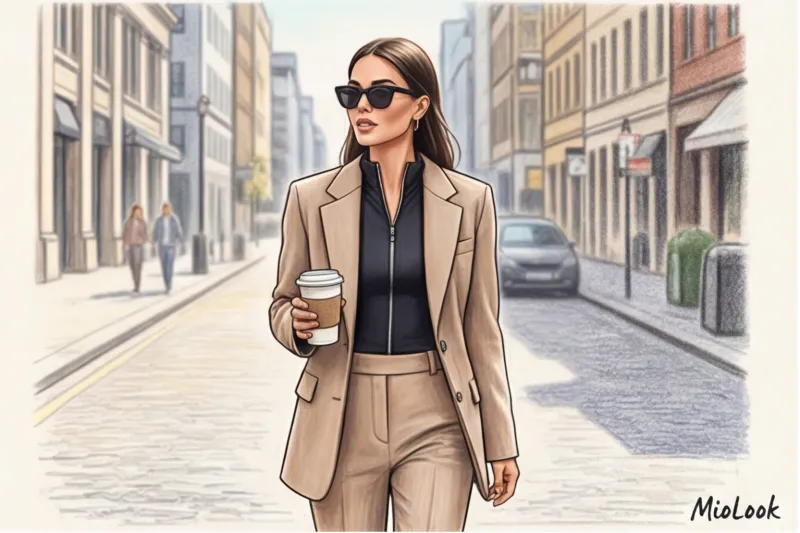
Let's look at a specific example. You take a well-fitting pantsuit made of high-quality wool blend (that's our 80% structure and formality). Then you tone down the formality: instead of a silk shirt, you wear a crisp basic T-shirt, and instead of pumps, you wear minimalist light-colored sneakers (that's the 20% of sport). The look is put together, expensive, but incredibly comfortable. If you need a little more formality for important meetings, consider business casual for women , where sporting inclusions are reduced to zero.
To avoid mentally calculating these percentages every morning while standing in front of your open closet, I strongly recommend digitizing your wardrobe. By uploading your items to the "smart wardrobe" feature in MioLook , you can visually assemble outfits right on your smartphone screen. You'll immediately see whether your "sporty" look is outweighing your business attire. This saves at least 15 minutes in the morning and guarantees you'll avoid any stylistic faux pas before heading to the office.
The Biggest Mistake: Why Sportswear Looks Cheap in the Office
Have you ever noticed how one girl in a hoodie and loose trousers looks like she stepped out of Vogue, while another in a similar outfit looks like she just hasn't had time to change out of her clothes after a spring cleaning? The difference stems from a fundamental misconception that I combat during almost every wardrobe review.
We're used to thinking that the most important thing in relaxed looks is comfort. I have to disappoint you: this is a dangerous myth. If you want to integrate Women's sporty casual style When incorporating comfort into your work routine, it should be just a basic setting, with texture always taking center stage. Leading trend agencies like WGSN regularly emphasize in their reports that the visual value of a garment depends 70% on how the fabric refracts light and holds its shape, and only 30% on its color or cut.
The most common style mistake I see on the streets of European capitals is a clash of densities. Imagine a typical situation: you wear a gorgeous, structured jacket made of heavy wool suiting (for example, a double-breasted model for €150), and underneath it, a thin, loosely knit long-sleeved shirt or a basic T-shirt. What happens dynamically? The heavy fabric of the jacket literally crushes the flimsy knit. The collar collapses under the lapels, the fabric begins to wrinkle, sag, and instantly cheapens the entire look. A sporty element in a business wardrobe must have structure; it must stand up to classic styles on equal terms.
To demonstrate this to my clients, I conducted a personal test drive last fall. I bought three black sports joggers from different price ranges: €20, €45, and €85, to test their performance during a typical eight-hour workday (meetings, working on a laptop, driving). The results were predictable, but very revealing.
A budget pair for €20 was made of 60% polyester, 35% cotton, and 5% elastane. By lunchtime, it had left me with catastrophically stretched knees. As soon as those characteristic bubbles appear on your pants, the status of the item plummets. Cheap elastane quickly stretches from body heat when sitting and doesn't return to its original shape. Meanwhile, an €85 pair made of 100% compact cotton maintained a straight knee line even by evening. The conclusion is simple: for the office, we avoid high-percentage elastane in sportswear.
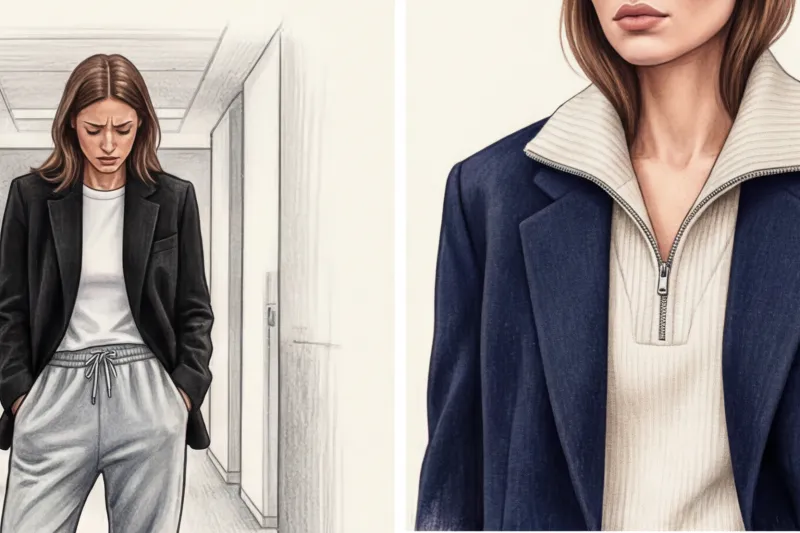
Fabric Decides Everything: Density vs. Looseness
How can you tell the difference between a sweatshirt you can confidently wear to a meeting and one you're better off watching TV on the couch in by touch? The rule I teach when I'm shopping is this: "office-appropriate" athleisure resists compression. If you take the fabric in your fist and it easily crumples into a thin, shapeless ball, save it for home.
The perfect choice for basic hoodies, joggers and sweatshirts is three-thread diagonal footer Preferably 100% cotton or with a minimal (up to 15%) addition of high-quality polyester solely for wear resistance on the smooth face. Why diagonal weave? The special diagonal weave of the loops on the back gives the fabric natural mechanical elasticity, eliminating the need for the manufacturer to add cheaper elastane. According to quality textile production standards, the density of such fabric should be at least 320–380 grams per square meter. This rugged, slightly dry texture creates a distinct shoulder line and doesn't cling to the body, but rather forms a complementary, form-fitting cocoon around it.
To avoid costly mistakes, I strongly recommend creating a "ban list" of materials. The following are absolutely not suitable for office athleisure:
- Fine ribbed viscose: It treacherously highlights the slightest unevenness of underwear, body contours and folds at the waist, completely depriving the image of the necessary business distance.
- Shiny polyester: Fabrics with a glossy sheen (like classic '90s tracksuits or running tights) are strongly associated with vigorous exercise. They create an unsightly glare in office artificial lighting.
- Loose melange knitwear: Especially the notorious "light gray melange" of low density. This is the absolute champion at creating a scruffy effect, which becomes covered in pilling after just the third wash due to the short fibers of the yarn.
Access to MioLook for €0.99 — one-time payment
A smart AI stylist will select the perfect look.
Get access — €0.99 onceBasic Sports-Casual Wardrobe: 5 Items Worth Investing In
There's a dangerous myth: we're willing to pay €200 for a perfectly tailored wool jacket without hesitation, but we genuinely don't understand why we'd pay more than €20 for a basic hoodie. The "smart investment" concept works just the opposite. Sportswear essentials integrated into a business wardrobe are subjected to tremendous stress—we wear them more often, wash them more aggressively, and demand the utmost from them in the office. Cheap, loose knitwear loses its shape after the third wash, instantly cheapening the entire look, no matter how expensive your jacket.
The secret to a high-status wardrobe lies in mathematics. Cost-per-wear analysis always proves that expensive sportswear ultimately costs less than mass-market items.
Last year I conducted a visual experiment with my wardrobe: I compared a premium minimalist hoodie from & Other Stories for 89 euros and its cheaper fast-fashion counterpart for 25 euros. The cheaper item became covered in pills and deformed along the hem after just a month of active wear (about 10 times, for a total of 2.5 euros per time). I've been wearing the &OtherStories hoodie for two years now, wearing it at least twice a week (over 100 times). The price per time has dropped below 80 cents, and the dense cotton still holds its architectural shape. To make women's sporty-casual style look expensive, you only need five smart investments.
- Hoodie without laces and kangaroo pockets. This is the perfect companion for a structured blazer or straight coat. The lack of unnecessary details (such as hanging ties over the face and a voluminous patch pocket on the stomach) ensures that untidy bulges don't form underneath the jacket. Choose models with a double hood—they're heavier, so they fall beautifully and symmetrically over the lapels.
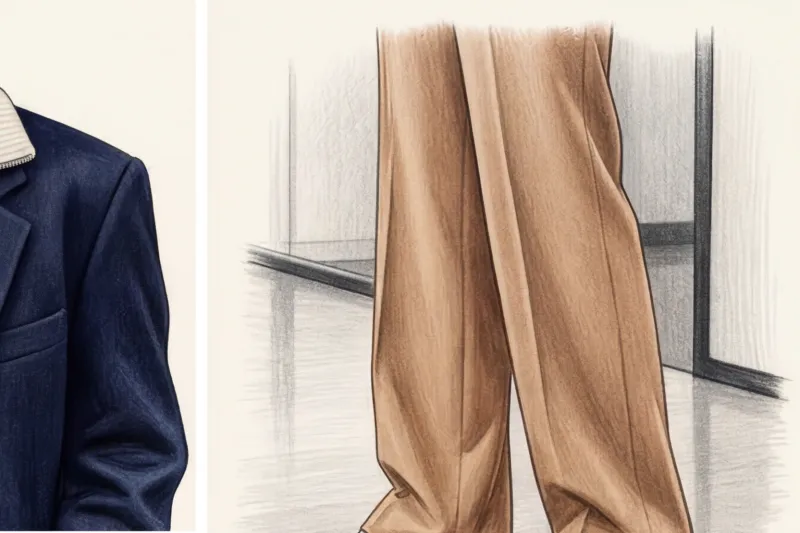
- Zip-knit polo neck sweater. The main trend of recent seasons, which successfully replaces the classic shirt and solves the problem of a "bare neck" in the cold season.
I recently worked with a senior executive at an IT company. She had a strict requirement: to appear authoritative in front of the board of directors, but not to appear "in a shell." We completely removed stiff, starched blouses from her capsule wardrobe, replacing them with cashmere and merino zip-knit sweaters. An open metal zipper creates a graphic V-neck, elongating the silhouette, and a thick collar frames the face just as well as a shirt collar. The result exceeded expectations: minus a degree of excessive formality, plus absolute comfort during long meetings.
- A T-shirt made of thick cotton that holds its shape. Forget about thin, flowy knits that reveal underwear. The right office T-shirt should have a weight of 200 to 250 g/m² (look for the label). heavyweight cotton ) and a reinforced, non-stretch collar. It doesn't cling to the body, but creates air between the fabric and the skin, working as a standalone, formal element within the look, like a blouse.
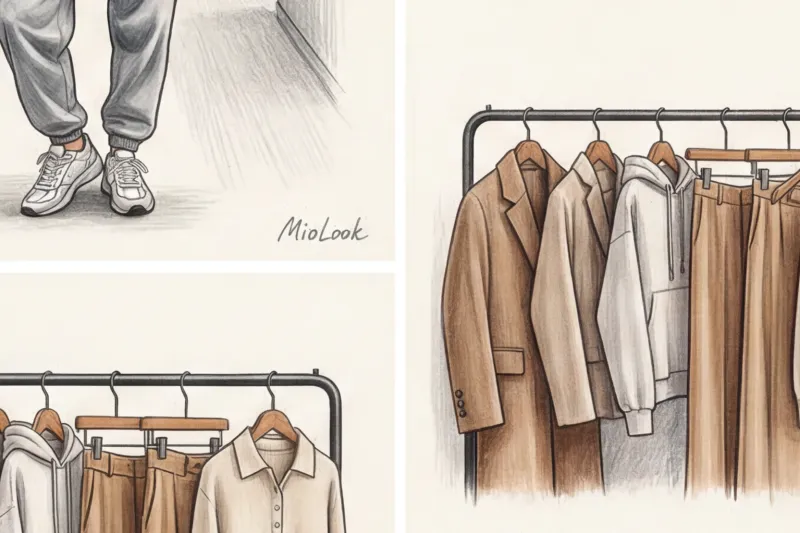
- Proper joggers with stitched creases. The elastic waistband and ankle cuffs maintain the sporty DNA, while the stitched front pintuck is a direct nod to classic tailoring. This vertical line not only visually lengthens the legs but also prevents the fabric from stretching at the knees.
- Cargo pants made of suiting fabric. A brilliant hybrid for those tired of classic palazzos. The cut remains relaxed and utilitarian, but the refined texture (Super 100s wool or a dense gabardine blend) instantly elevates the patch pockets from "country trip" to "office wear."
To properly plan your purchase of this basic item and avoid buying too much, I always recommend starting with an audit. Digitize your current closet: add your existing jackets and shoes to MioLook The app will clearly show you what you can wear with your new hoodie or cargo top and help you calculate the perfect price for an outing before you even go to the store.
Shoes: How to Choose Sneakers and Trainers for a Business Look
Corporate etiquette has a strict visual marker: footwear is noticed by the interviewer within the first three seconds of a meeting. This is where women's sport-casual style most often fails miserably. The main taboo I ruthlessly purge from my clients' wardrobes is the inclusion of running shoes in a work context. Mesh, neon inserts, massive heel cushioning, and reflective elements are designed exclusively for the treadmill. When paired with formal suit trousers, they don't make you look "modern and dynamic"; they create the persistent impression that you simply forgot to change your shoes after your morning workout.
The gold standard of office comfort is urban minimalist sneakers, or so-called court sneakers (Retro tennis silhouettes). The anatomy of the perfect pair is extremely simple: smooth matte leather, an almond-shaped (not too round) toe, no sporty perforations, a flat sole 2.5-3 cm high, and a monochrome look. Ideally, it's a crisp white, off-white, or deep black without contrasting inserts or flashy logos. As for specific brands, Common Projects (averaging around €350) traditionally sets the standard for minimalism. However, Axel Arigato, COS, and Massimo Dutti release ideal basic shoes with the right last geometry each season in the more affordable €100-150 range.
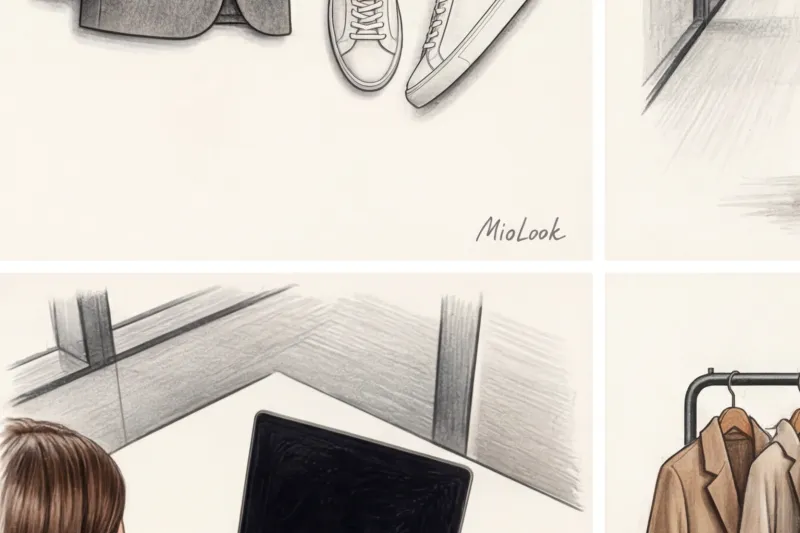
When choosing between leather and textile for everyday work, always go for the sturdy leather option. Textile options (even iconic sneakers) instantly dull your look, quickly lose their rigidity, and look too casual. Furthermore, in the business world, a strict "clean sole rule" applies. Smooth leather can be restored to perfect condition in a minute with a special cloth right before entering the office. My personal secret: to maintain the pristine whiteness of a rubber welt, use a regular melamine sponge—it removes dark streaks in seconds. Street dust, if it gets into the fabric, will ruin the prestige of even the most expensive wool jacket.
Access to MioLook for €0.99 — one-time payment
Start creating perfect looks with AI and organize your smart wardrobe in one click.
Get access — €0.99 onceBut what if your schedule demands a more formal look, but your feet absolutely refuse heels? Chunky loafers or classic leather derbies are excellent alternatives to sneakers. The chunky sole adds just the right amount of architectural ruggedness that perfectly grounds and balances oversized sweatshirts or hoodies. According to an analytical report from the Lyst platform last year, chunky loafers became the leading footwear in the transitional wardrobe category. Try styling them with thick ribbed cotton socks—this small stylistic trick instantly softens the conservative edge of formal footwear and fits seamlessly into the aesthetic of conscious comfort.
Style Formulas: How to Create a Sporty-Casual Women's Style for Every Day
Morning routines don't allow for improvisation. A 2023 study by the Fashion Psychology Institute found that the fear of looking out of place drives women to spend up to 15 minutes each morning mindlessly rummaging through hangers. Women's sporty casual style To make sure that your system works for you and doesn't become a daily puzzle, you need a system.
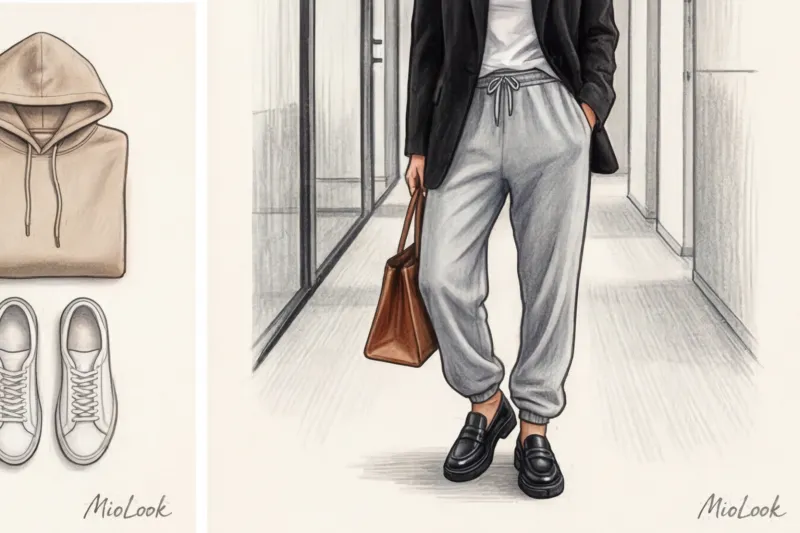
Ready-made patterns that work without much thought in front of the mirror are your stylistic lifeline. You simply take components with the right texture and combine them according to a proven pattern. When you have such formulas in your arsenal, getting ready takes exactly three minutes. By the way, to fully automate this process, I always recommend that clients digitize their successful capsule wardrobes: upload items to MioLook , and the smart wardrobe function will automatically put together an outfit according to these rules while you drink coffee.
Formula 1: Oversized jacket + hoodie + straight jeans + ankle boots
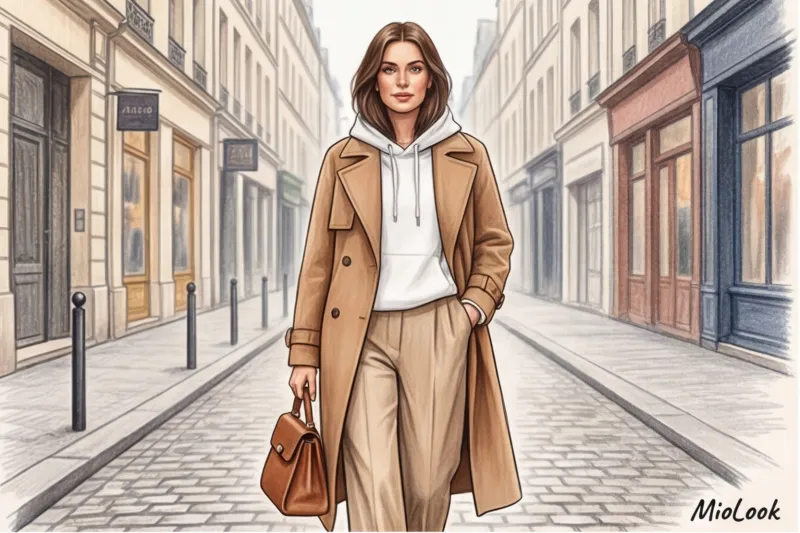
The secret to this combo is the strict architecture of the shoulder girdle. If you wear a voluminous hoodie under a soft knit jacket, the silhouette instantly transforms into a shapeless cloud. A crisp, structured men's jacket with pronounced shoulder pads is essential (excellent mid-priced options are regularly found at Arket or The Frankie Shop).
A hood, carefully draped over a collar, acts as an accent, softening the formality. Straight-leg jeans made of heavyweight denim (100% cotton, no elastane) and ankle boots with a pointed or square toe elongate the figure and bring the look together, making it perfectly appropriate for a creative agency or IT company.
Formula 2: Pleated midi skirt + oversized sweatshirt + loafers with socks
It's a classic play on contrasting textures: the flowing, feminine fabric of the skirt clashes with the utilitarian, dense cotton of the top. But this formula harbors its main danger: an oversized sweatshirt visually cuts the figure in half and adds volume around the waist.
Practical styling advice: Your key tool here is a proper "French tuck." Don't try to stuff the entire thick fleece into the waistband—you'll end up with an unsightly roll of fabric. Take exactly 3-4 centimeters of fabric from the center front, lightly twist it into a flat rope, and tuck it into the elastic or waistband of your skirt. Leave the sides to hang freely diagonally.
This mechanical touch delicately defines the waistline while maintaining the necessary relaxed silhouette. Chunky loafers with a lug sole and high, textured socks (ideally made of mercerized ribbed cotton) complete the look.
Formula 3: Classic pantsuit + T-shirt + basic leather sneakers
The safest entry point into the athleisure aesthetic. However, the devil, as always, is in the quality of the base layers. A flimsy, translucent tank top with a stretched-out collar will instantly cheapen even a €500 suit. You need a T-shirt made of heavy cotton (at least 200–220 g/m²) that holds its shape as reliably as a starched shirt.
The shoes in this formula must be impeccable. Follow three rules:
- Material: Only smooth, matte leather. No fabric or suede, which quickly lose their shine when paired with a suit.
- Form: Minimalistic court sneakers (urban tennis shoes in the style of Veja Campo or Massimo Dutti's basic lines). No running silhouettes.
- Trouser fit: The legs should fall slightly over the shoes, creating a single, soft crease at the front. Skinny pants that are too short and cling to the ankle, paired with sneakers, look hopelessly outdated today.
Brands and Budget: Where to Find the Right Styling (A Stylist's Guide)
The biggest paradox my clients face is trying to collect Women's sporty casual style When I go shopping at sporting goods stores, the logic seems ironclad—where else to buy sweatshirts and joggers if not Nike or Adidas? I'm categorically against this approach when it comes to office attire.
Clothing from pure sports giants is designed for training. Their cuts are designed for full range of motion, the fabrics (usually technical polyester or fleece) have a distinctive sheen, and large logos instantly kill any status symbol. Paired with a classic jacket, such a piece will always look like you simply forgot to change after a run.
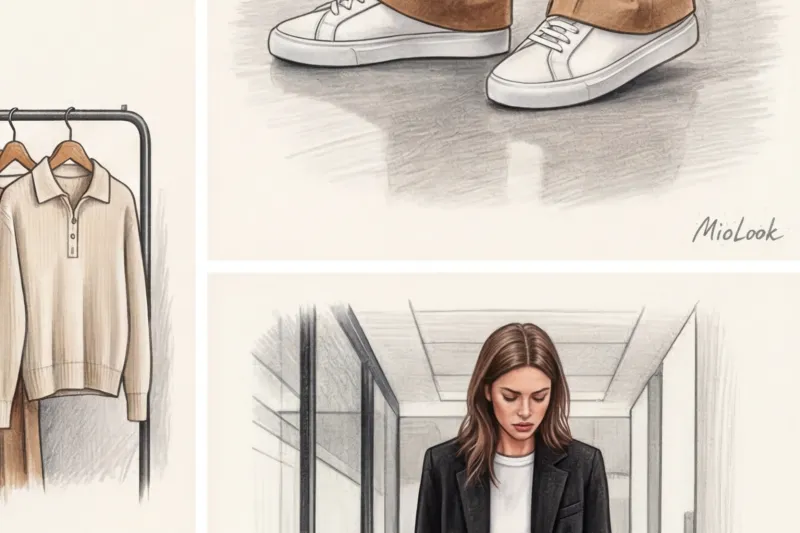
For the right architectural design, we turn to the European high street. It's here that sporty silhouettes are cut according to the strict rules of business attire.
- Arket: The Holy Grail for finding the perfect heavyweight cotton. Their hoodies and T-shirts are made from high-density material (from 300 g/m²) that retains its shape even after dozens of washes.
- COS: Go here for an architectural cut. This brand's sweatshirts often feature complex shoulder lines and hold their shape just as well as a classic blazer.
- Massimo Dutti: The best place to find wool blend suit joggers that look as smart as possible.
Insider tip: the fit of sweatpants varies dramatically depending on the brand's DNA. If you have a pronounced difference between your waist and hips, Massimo Dutti patterns will fit you perfectly—they create the right darts even in relaxed styles. Arket, on the other hand, designs for a straighter, typically Scandinavian figure, so their trousers can bulge at the waist.
Is it possible to find high-quality athleisure at mass-market stores like Zara and H&M? Yes, but it takes some practice. The main rule: ignore basic lines with fine knits. Your goal is the Premium Selection (at H&M) and Studio or Origins (at Zara) collections. In these capsule collections, brands use premium blended fabrics (cotton-cashmere, dense viscose), eschew flashy hardware, and pay much more attention to the finishing of internal seams.
Your ideal image
it begins Here
Join thousands of users who look flawless every day with MioLook.
Get access — €0.99 onceThe math of a smart wardrobe requires a clear budget. To avoid unnecessary overspending, I always recommend that clients divide their shopping list into two categories that are easy to track. MioLook to avoid spontaneous spending.
What you need to overpay for (your investments):
- Polo collar knit (zip-knit): Cheap yarn will pill after just a second wear under outerwear. Budget between €80 and €150 for styles with merino wool blends.
- Cargo pants and joggers: The fabric should flow, not be stiff. Good suiting viscose or wool is always more expensive than cotton.
What you can save on:
- Basic T-shirts: The perfect white T-shirt that holds its shape under a jacket can be found for 20-30 euros (for example, at Uniqlo in the U line).
- City sneakers: If you choose simple leather models without unnecessary details, a pair from a high-quality mass-market store for 60 euros will visually be in no way inferior to luxury analogues for 400 euros, the main thing is to regularly care for the soles.
Checklist: Is your sporty-casual look ready for the office?
There's exactly one minute left before you leave the house. You stand in front of the mirror, taking in your new, carefully put-together outfit. How do you know if you've crossed the line between appropriate casualness and outright sloppiness? My final step with any client is a rigorous audit of their finished look. I always leave them with a signature checklist, which serves as a fail-safe filter before heading to the office.
Go through these four points to ensure that your women's sport-casual style works for your reputation, not against it.
1. Testing for the "gym effect"
The fastest way to test an image is to ask yourself one question: "If I take off my jacket (or coat) now, will my colleagues think I've skipped out on a Pilates class?"
If a tailored blazer conceals a pair of knit joggers and a sports bra, the answer is yes. Office athleisure requires at least two classic wardrobe staples. If the bottoms are relaxed, a structured shirt is a must. If you've chosen a hoodie, pair it with pleated trousers and a crisp, geometric leather bag. Avoid duffel bags and backpacks with too many nylon straps—they instantly detract from the business-like vibe of the outfit.
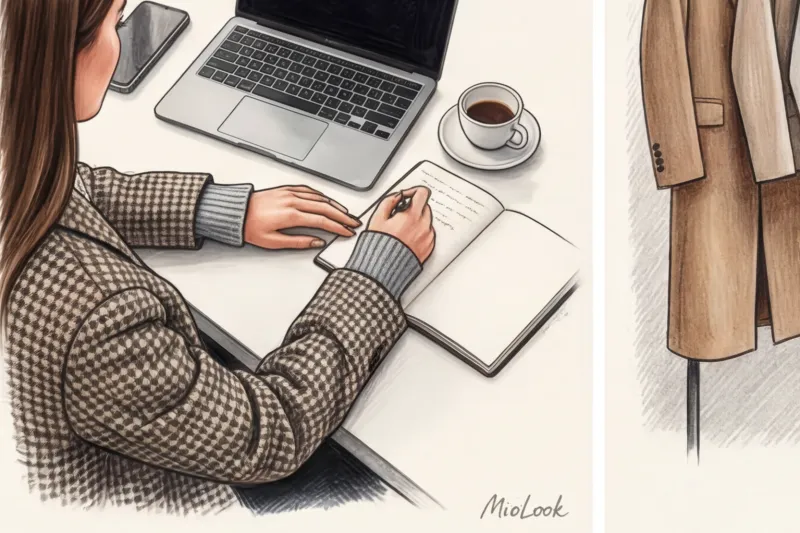
2. A ruthless audit of the state of things
Sportswear shows its age and wear three times faster than wool suits. What's acceptable on a Sunday stroll looks disrespectful to colleagues in an open-plan office. Before heading out, check three critical areas:
- Pills (peeling): Especially on the stomach and the inside sleeves of sweatshirts. Invest 15-20 euros in a high-quality knitting machine (such as Steamery) and run it over your garments every two weeks.
- Extended knees and elbows: If the fabric has become misshapen and won't return to its original shape after washing, it no longer belongs in the office closet. Relegate it to the loungewear category.
- Cleanliness of white sole: Gray, dusty rubber on sneakers ruins the magic of minimalism. If the sole isn't 90% white, the look looks cheap. Keep a melamine sponge or regular micellar water in the hallway—it takes exactly 30 seconds to clean the welt.
3. The "sudden meeting with the boss" test
Imagine the worst-case scenario: you arrive at the office on a "relaxed Friday," planning to quietly work on your computer, and suddenly you're called into an unscheduled meeting with a key client or company executive. Will you be able to confidently walk into the conference room?
"If the thought of an unexpected presentation in your current outfit makes you want to hide behind your computer or apologize for your appearance, you're dressed incorrectly. Swap your sneakers for loafers or add a smart blazer."
To avoid having to perform this stress test every morning in a panic in front of your open closet, I strongly recommend digitizing your successful decisions. Put together 5-7 flawless outfits on a weekend, take photos of them on yourself, and upload them to MioLook. The virtual wardrobe feature allows you to simply open your phone in the morning and choose a ready-made, tried-and-true look that will definitely pass any appropriateness test.
Bottom line: mindfulness versus laziness
Sporty-casual is deceptive. It promises a relaxed atmosphere, but in practice, it demands meticulousness. It's not a legitimate way to show up to work in the same clothes you wore to bed or walked the dog. On the contrary, integrating sporty elements into a business environment is the pinnacle of styling.
A perfectly ironed basic T-shirt, immaculately clean sneakers, and a well-balanced silhouette send a powerful message: you value your comfort while maintaining absolute control. Sporty casual is a conscious choice for a modern professional, not a matter of stylistic laziness. Use this tool wisely, and it will become your greatest career asset.
Guide Chapters
How to Combine Sporty and Business Style: Tips from an AI Stylist
The line between elegant casualness and sloppiness is a fine one. Learn the 70/30 formula to create the perfect mix of sporty and classic.
A bomber jacket for the office: a stylish alternative to a jacket
A well-tailored bomber jacket is the perfect replacement for an uncomfortable blazer. Learn how to maintain a professional look and feel comfortable all workday.
Sports casual for plus-size women: stylish office looks
How to look classy and feel comfortable in plus-size? We explore the rules of office athleisure that will make you look slimmer.
Women's Polo for the Office: From Tennis to Negotiations
A polo shirt is the perfect compromise between a formal blouse and a comfortable T-shirt. Learn how to incorporate this piece into an executive's business wardrobe.
A women's office backpack and smartwatch in a business style
Forget boring briefcases. Learn how to seamlessly integrate sports accessories into your business wardrobe without sacrificing your status.
Smart casual vs. sport casual: what to wear to the office
Is a hoodie and blazer stylish or a reprimand from HR? We explore the key differences between smart casual and sporty casual and the rules of modern office dress code.
Women's office sneakers: how to wear them with a suit
Sneakers in a business wardrobe aren't a sign of casualness, but a new status symbol. We'll explore how to pair sneakers with a suit and look professional.
The Perfect T-Shirt to Wear with a Women's Jacket: Style Secrets
We tested 40 brands to find the perfect basic office t-shirt. Learn how to avoid mistakes and create a high-end, athleisure-casual look.
Summer casual sportswear for women: office style for the hot weather
In the heat, it's not the lack of clothing that saves you, but the technology it uses. We'll explore how to adapt sports technology to a strict office dress code.
Women's Office Hoodies: How to Incorporate Them into a Strict Dress Code
Can you wear oversized knitwear to work and still look classy? We'll explore the rules for choosing the perfect office hoodie with a stylist.
Casual Winter Sports for Women: Warm Work Looks
Forget compromising between warmth and elegance. Learn how to incorporate down jackets and chunky shoes into your business wardrobe without sacrificing your style.
How to Wear Joggers to the Office: Stylist Tips
80% of a trousers' formality depends on the texture of the fabric, not the cut. We'll show you how to wear relaxed trousers to work and look your best.