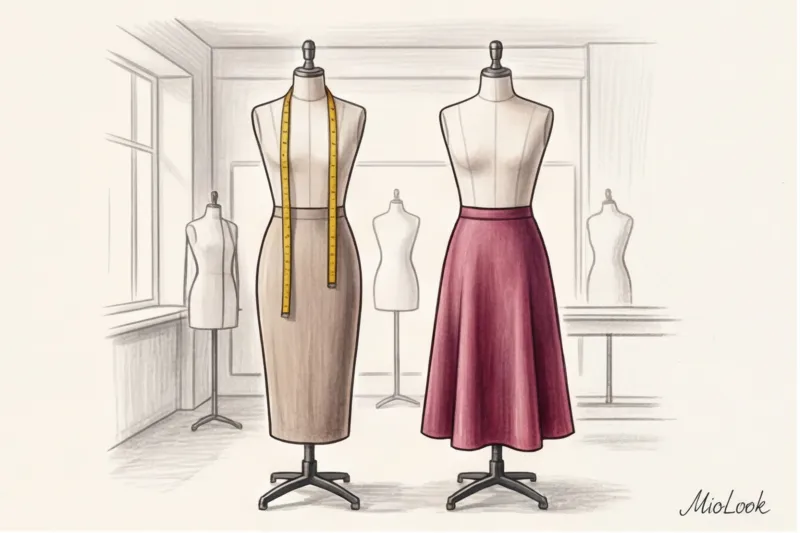
Do you know what reveals age faster than a lack of retinol in your evening skincare routine and gray hair? Those extra three centimeters of fabric at the hem of your skirt. In my stylist practice, dozens of women have come to me asking for a "wardrobe refresh," convinced that current trends simply don't suit them. We'd take their favorite Massimo Dutti skirt, pin the hem a couple of centimeters higher, revealing a narrow part of the ankle—and magic would happen. The client would instantly lose a visual 5 kilograms and look 10 years younger.
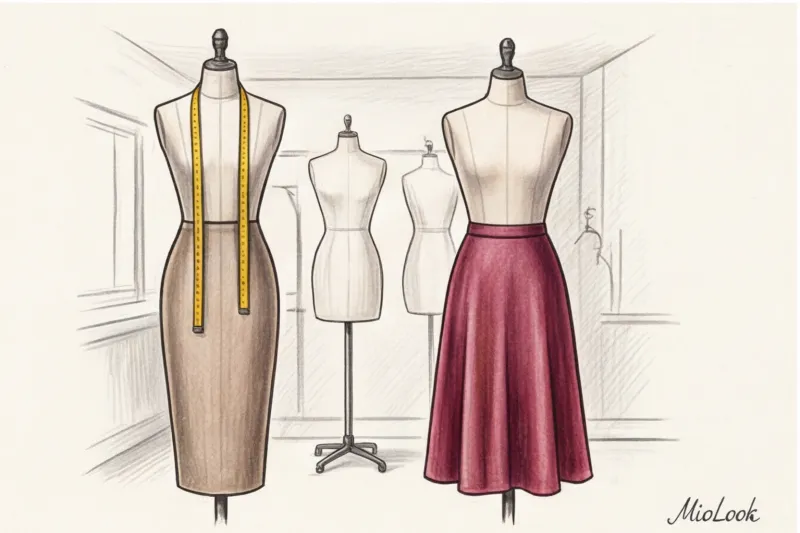
When people ask me what skirt length makes you look older, I always answer: one that ignores your anatomy. We're used to thinking about age in terms of wrinkles or pigmentation, but the human eye reads age primarily by your silhouette and gait. We've already discussed other less obvious markers in our A complete guide to style mistakes that make women look older A heavy, static, and mundane silhouette is instantly labeled by the brain as "aged." And today I'll show you how this merciless geometry works and how to use optical illusions to enhance your youthful appearance.
The Geometry of Age: Why We "Read" Silhouettes, Not Wrinkles
In fashion design, there's a concept called visual weight. It's not about the scale's reading in the bathroom, but rather how massive a figure appears in space. According to a large-scale study on proportion perception conducted by the analytical agency WGSN (2024), respondents associate silhouettes with a low center of gravity with fatigue, conservatism, and advanced age. Why is this?
It's all about the rule of horizontal lines. The hem of a skirt, shorts, or trousers creates a sharp horizontal line that cuts across your leg. Our gaze is always drawn to this line. If the horizontal line runs across the widest part of your body, this width is projected onto the entire silhouette. You can wear a size XS, but if your skirt ends midway through your powerful calf muscle, you'll appear heavy and bulky.
"Age isn't determined by your passport, but by how light and dynamic your silhouette appears when you move. The right hemline is like a good facelift, only without the scalpel and recovery."
What skirt length really makes you look older: debunking the "safe midi" myth
Glossy magazines of the 2000s hammered into our heads the toxic rule: "After 40, you should hide your knees." As a result, millions of women donned what I call "dead-midi" dresses—a length that mercilessly destroys proportions.
The paradox is that strict age restrictions don't work at all. Only your body's structure matters. The "safest" and most conservative length—right to mid-knee—ages the figure more than a revealing mini or a relaxed maxi. Let's examine the two main traps we fall into out of fear of looking "beyond our age."
The Mid-Calf Trap: Where is the Danger Zone?
Imagine a column. It's straight, monumental, and motionless. That's exactly the kind of column your legs become when the hem of your skirt ends at the fullest point of your calf. This length (often found in budget brands due to standardized cuts) visually blurs the contours of your legs. Your graceful ankle disappears, and your leg appears uniformly thick from top to bottom.
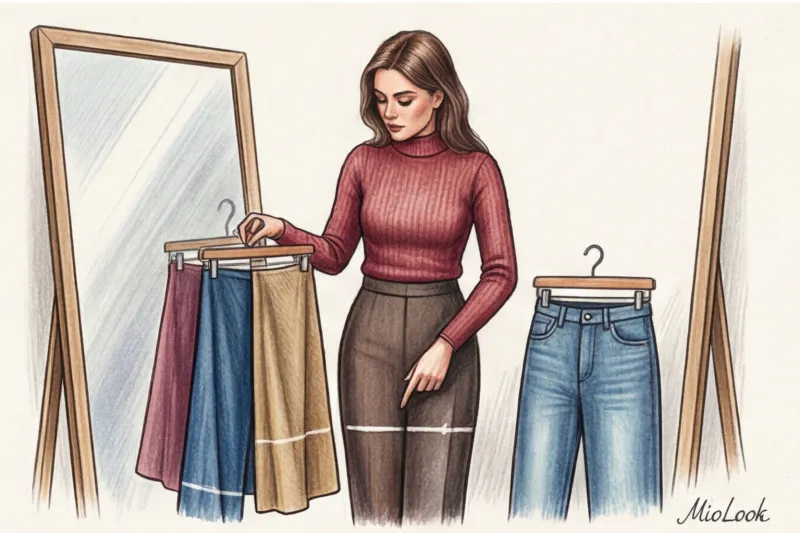
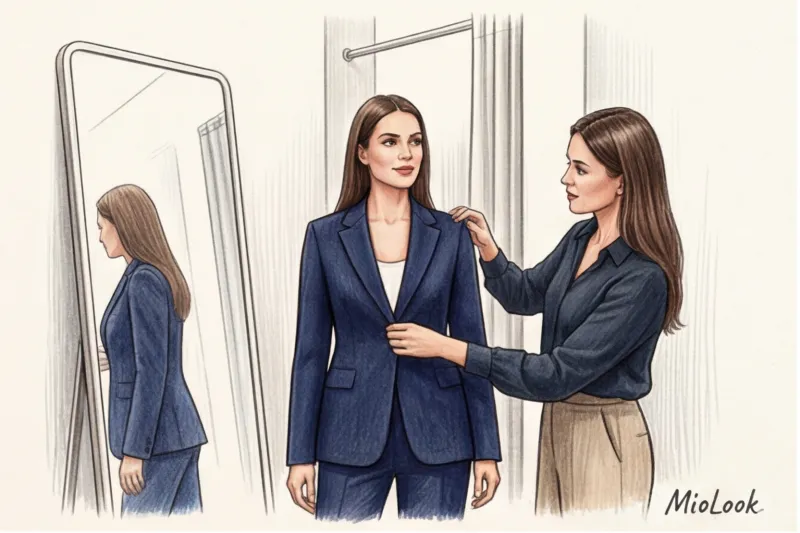
I recently sorted through a client's wardrobe who worked at an IT company. She bought a stunning silk COS skirt but complained that it made her feel "grandmotherly." We simply took the skirt to a tailor (the job only cost €15) and shortened it by 3 centimeters. The hemline rose to the exact point where the calf begins to taper toward the ankle. Her silhouette soared, and her gait became airy. Just 3 centimeters of fabric separate the "grandmother" look from the ultra-modern.
The "Half-Sliced" Body Effect: A Classic Knee-Length Skirt
And now for my favorite counterintuitive fact. A pencil skirt that ends right at the kneecap is the absolute leader in adding years. Why? Because it divides your figure into a deadly 1:1 ratio. A square torso equals square legs.
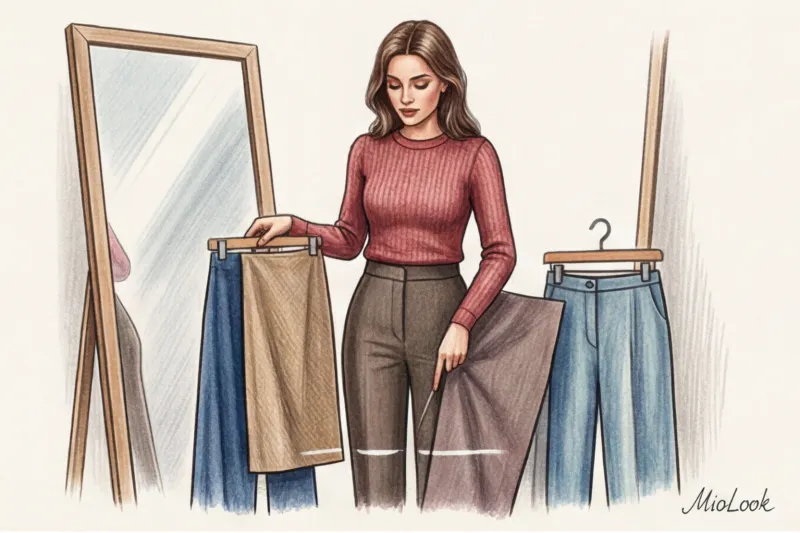
In art and architecture, perfect 1:1 symmetry is always perceived as static, frozen, and lifeless. Dynamism is youth. When you divide yourself in half, you convey extreme conservatism. If you have beautiful knees, expose them fully (a hand's breadth above the knee). If you want to cover them, cut the length into an elegant midaxi (to the narrowest point under the calf), but never cut the kneecap in half.
Access to MioLook for €0.99 — one-time payment
A smart AI stylist will analyze your proportions and create the perfect look in seconds.
Get access — €0.99 onceTrousers and jeans: how a few extra centimeters make your bottoms heavier
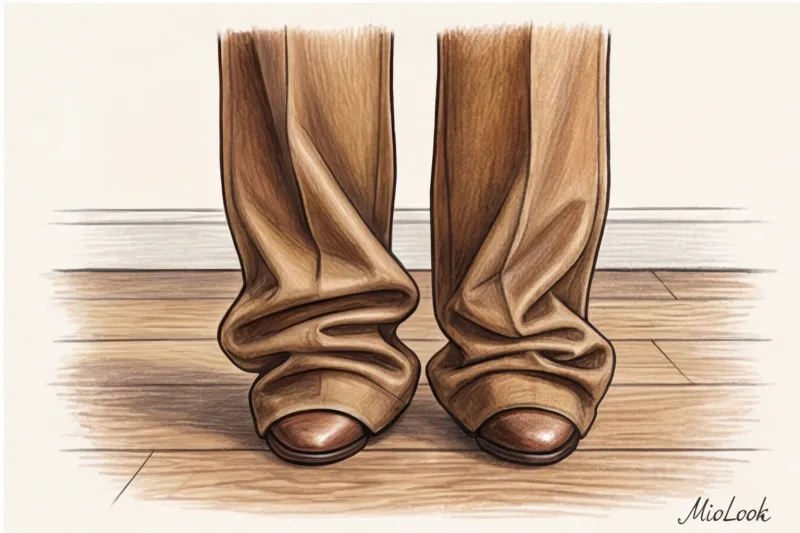
We've sorted out skirts, but the situation with trousers is no less dramatic. The main enemy of the modern silhouette is "tired" trousers that bunch up at the shoe. Many women buy full-length jeans and are too lazy to go to a tailor to have them adjusted to their height and usual heel height.
This is where the classic Müller-Lyer optical illusion comes into play. Remember the picture from your school physics textbook where two identical lines appear different because of the arrows at the ends (one pointing inward, the other outward)? The horizontal folds of fabric at your ankle act like inward-pointing arrows. They visually compress the length of your leg, stealing your height and shifting your center of gravity downward. This not only adds years to your appearance but also adds 3-5 virtual kilograms.
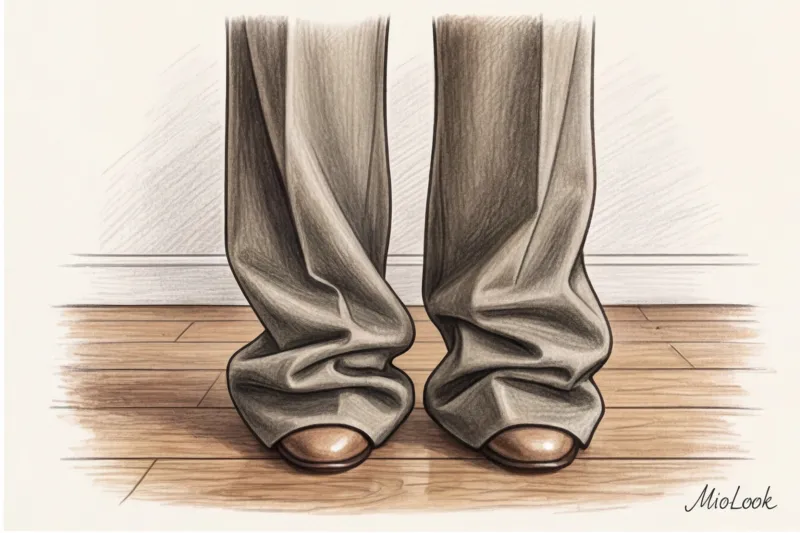
A particular stylist's pain point is cropped styles—capris, breeches, and culottes. While capris cut the leg in a completely random place, throwing off proportions, culottes can be incredibly stylish, but only under one condition: a perfect high-waisted fit. If culottes sit on the hips and end mid-calf, you turn into a boxy SpongeBob SquarePants. That doesn't work for anyone.
Shoes as an extension of the bottom: why proportions collapse without the right toe
Let's say you've found the perfect skirt length. It ends at the thinnest point, just below your calf. But you put on contrasting ankle boots that end just above your ankle bone. There's a 3-4 cm wide strip of skin between the boots and the skirt. Congratulations, you've just cut another horizontal line through your leg.
This contrasting strip of leather acts as a visual delimiter. To create a silhouette that appears endless, slender, and youthful, a continuous vertical line is essential. A technical tip I give to all my clients: the shaft of your boots or ankle boots should extend at least 2 centimeters UNDER the hem of your midi skirt. No gaps.
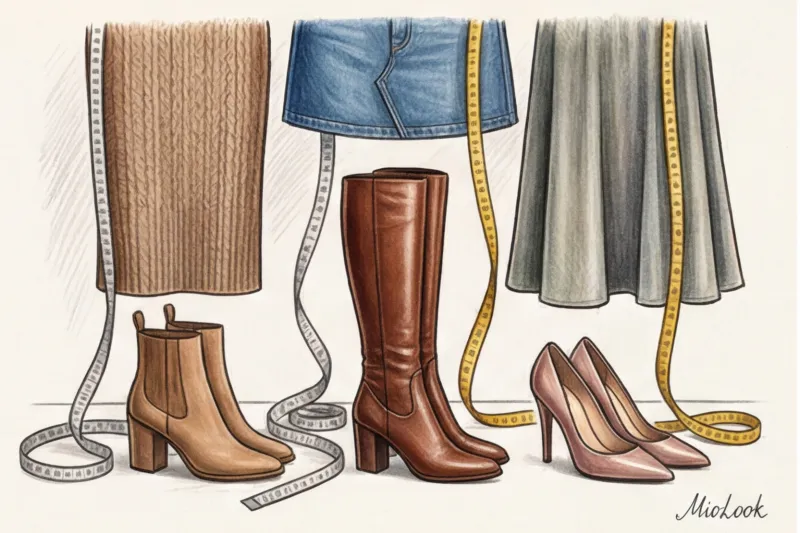
The shape of the toe is also critical. Imagine a chunky midi skirt made of thick wool and neat ballet flats with a round toe. This creates a "babyfoot" effect on a grown woman. A pointed or slightly elongated square toe always adds dynamism to the look, continuing the downward movement of the leg, while a round toe is distracting.
The Golden Ratio Formula: How to Find Your Ideal Length
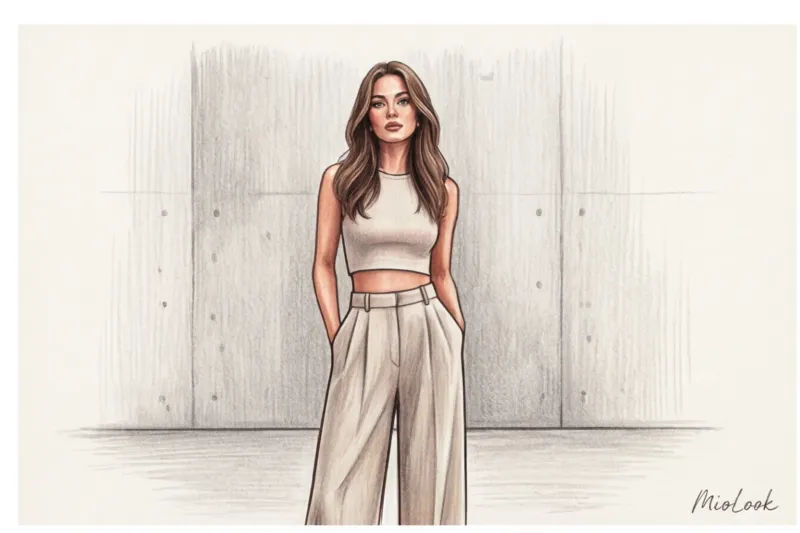
The secret of Italian designers lies in the Fibonacci sequence and the Golden Ratio. The human eye considers the most beautiful and harmonious proportion to be 1/3 to 2/3. In the context of clothing, this means that your torso (visually defined by your top) should take up 1/3 of the silhouette, and your legs (pants or skirt) 2/3.
How do you find that precise, millimeter-precise length? I suggest a simple home experiment—the "towel test":
- Stand in front of a large, full-length mirror in underwear or form-fitting clothing. Put on the shoes you wear most often.
- Take a large bath towel (preferably in a color that contrasts with your skin).
- Place it on your legs, covering them completely, like a maxi skirt.
- Slowly lift the towel upward. Stop and focus your gaze.
- You're looking for two points: the first is the narrowest point just below the knee (ideal for a midi-light length). The second is the narrowest point above the ankle bone (ideal for a midaxi).
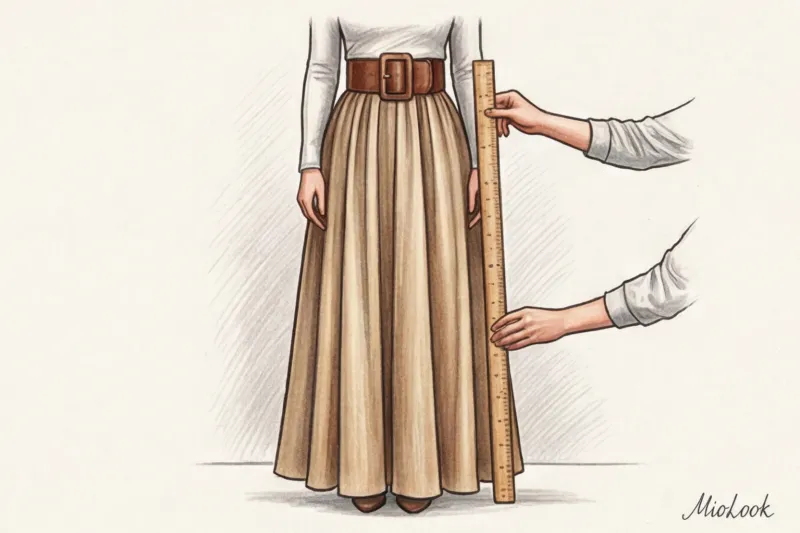
I must make an important disclaimer here: this method works for 90% of body shapes. However, it does NOT work if you have severe lipedema (abnormal distribution of fat tissue in the ankle area) or severe leg asymmetry. In such cases, we use flowing, maxi-length fabrics with high slits that create vertical lines without harsh horizontal cuts.
Your perfect look starts here
Join thousands of users who look flawless every day with MioLook. Digitize your wardrobe today.
Get access — €0.99 onceA stylist's checklist: Optimizing your wardrobe and eliminating age-appropriate items
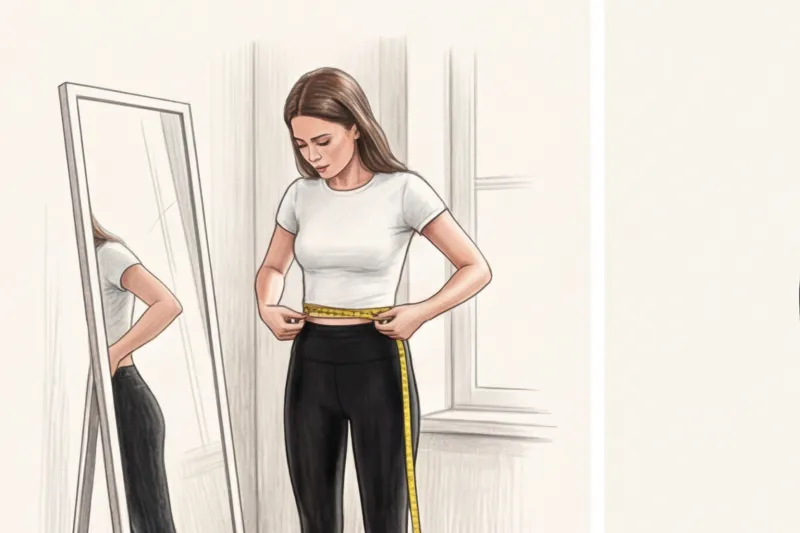
Our brain plays tricks on us when we look in the mirror. Perspective distortion (we look down on ourselves) alters proportions. To see the truth, you need the objective reality of the lens.
Smartphone cameras have a wide-angle lens (usually 26mm). If you photograph yourself from below or above, the proportions will be off. Position the phone at waist level, step back exactly 2 meters, and take a photo using the timer. This is how others see you.
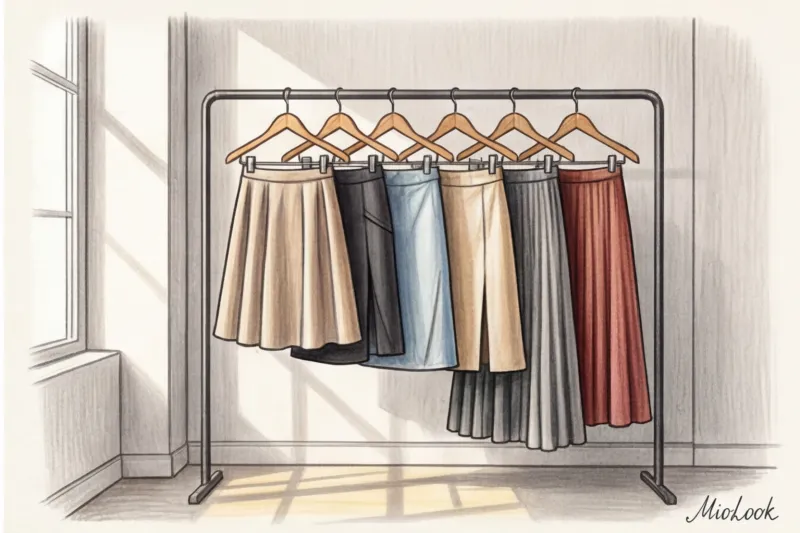
Look at the photo and draw bright red lines along the edges of your clothing right in your phone's editor. Do they cut across the widest part of your thigh? Do the hem of your jeans hit the middle of your calf?
The digital approach changes everything. I always recommend uploading photos of your outfits to wardrobe management apps. MioLook Allows you to step away from emotions ("It's my favorite skirt!") and see the hard facts: this length works for you, while this one adds seven years. Don't rush to throw out unsuccessful items. In 8 out of 10 cases, a visit to a tailor for €15–20 restores life and relevance to items.
Your ideal style isn't an innate gift or a luxury item. It's a subtle play with proportions. Find your sweet spots, learn to create a 1/3 to 2/3 ratio, and you'll notice how your wardrobe will start working for you, not against you.