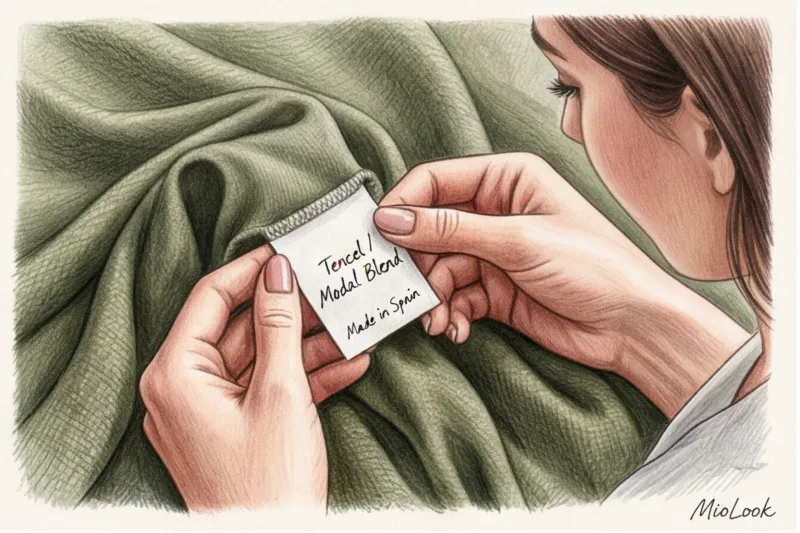
Just last week, my client Anya, during a wardrobe review, decisively tossed a stunning emerald blouse into the trash. "It's pure synthetic, look, it says 'man-made fiber,'" she declared categorically. I picked it up: its cool, flowing, heavy texture literally slid through my fingers. I read the label: 100% lyocell. Anya almost threw out the premium item simply because of the confusion in terminology.
I often receive the same question in my direct messages: What kind of fabric is Tencel? (aka lyocell), why does it cost as much as an airplane wing in the premium segment, and is it even worth overpaying for modal and cupro? We discussed the basic rules of reading labels in more detail in our a complete guide to choosing fabrics , but today I want to take a closer look at this "holy trinity" of the modern wardrobe. Spoiler: these materials are stylists' secret weapon for creating expensive capsule wardrobes that don't wrinkle, breathe, and look like a million bucks.
Artificial, but not synthetic: destroying the main illusion of the mass market
Let's draw a clear distinction between two concepts that consumers constantly confuse. Synthetics (polyester, acrylic, nylon) are, roughly speaking, plastic—a petroleum product that doesn't breathe and creates a sauna-like effect. Artificial fabrics (Tencel, cupro, modal, viscose) are natural cellulose (wood or cotton) that has simply been chemically processed into threads.
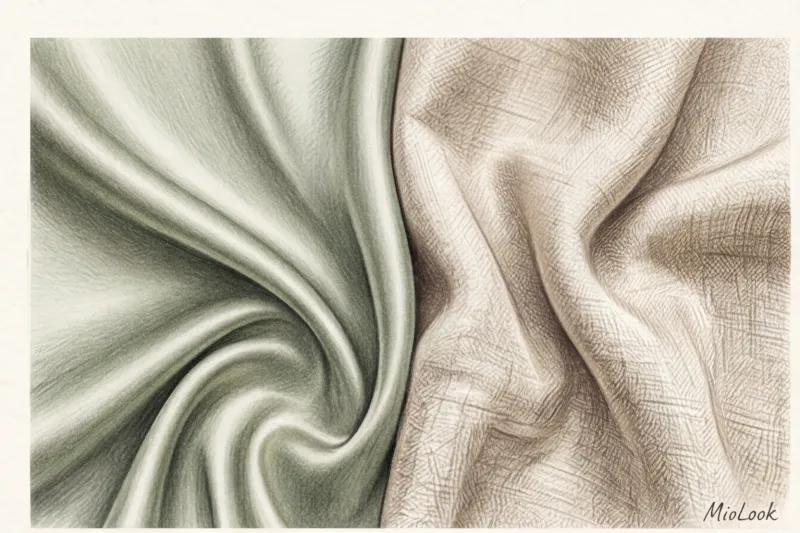
The word "faux" on a Russian label often evokes fear. Mass-market brands love to exploit this: they slap the proud word "silk" on the tag of a cheap polyester dress (referring to the texture, not the composition), and sell you a beautiful greenhouse. Real faux fabric offers the best of both worlds: it breathes like cotton, but flows and shines like silk.
What is Tencel fabric? Why is it the next generation of silk?
I answer the main search query directly: What kind of fabric is Tencel?? Essentially, this is the commercial, patented name for lyocell. It is produced from the wood of the Australian eucalyptus tree. If you see the word Lyocell on the label, that's the generic name for the fiber. If it's Tencel™, it's produced by the Austrian company Lenzing, which guarantees the highest quality standards.
"According to Lenzing, producing original Tencel requires 20 times less water than growing cotton. And the production cycle itself is closed: 99% of the organic solvent is recycled. This is an absolute jackpot for a conscious wardrobe."
But we love it for more than just its eco-friendliness. Tencel has an incredible cooling effect. In 30°C heat, a Tencel shirt feels like a sip of ice water on the skin. Eucalyptus also imparts its natural antibacterial properties to the fiber, meaning clothes stay fresher longer and don't absorb odors as quickly as regular cotton.

How Tencel Wears: Advantages and Hidden Nuances
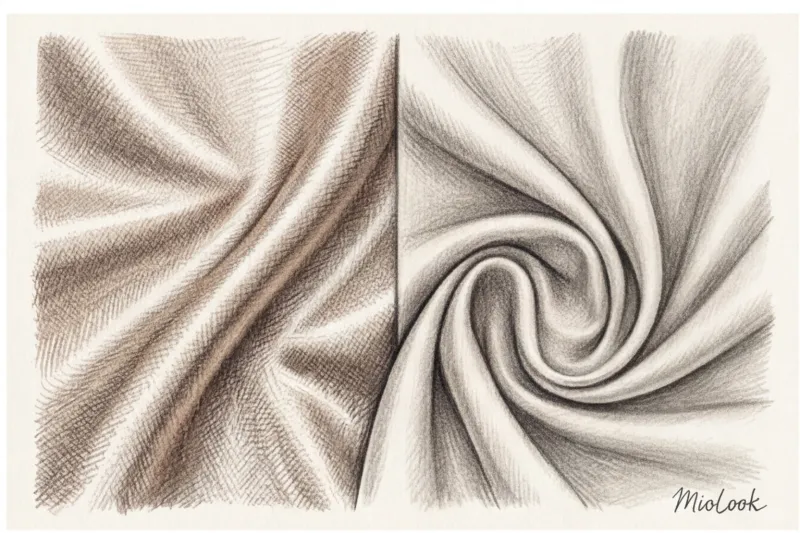
Tencel has unrivaled drape. If you want palazzo pants that will sway gracefully as you walk, concealing your figure rather than standing rigid, look for lyocell. It's heavy and flexible.
Does it wrinkle? Yes. But unlike fine cotton, which develops a fine, untidy network of wrinkles, Tencel develops large, elegant creases—much like fine linen. It looks effortlessly casual, not sloppy.
Honestly about the main disadvantage: When wet, Tencel loses up to 40% of its strength. That's why it's strictly forbidden to wring it out by hand when washing or to scrub it with a brush—this will simply tear the fibers.
Access to MioLook for €0.99 — one-time payment
A smart AI stylist will help you put together the perfect capsule wardrobe using the right fabrics to suit your lifestyle.
Get access — €0.99 onceModal: The Secret to Your Perfect Basic T-Shirts
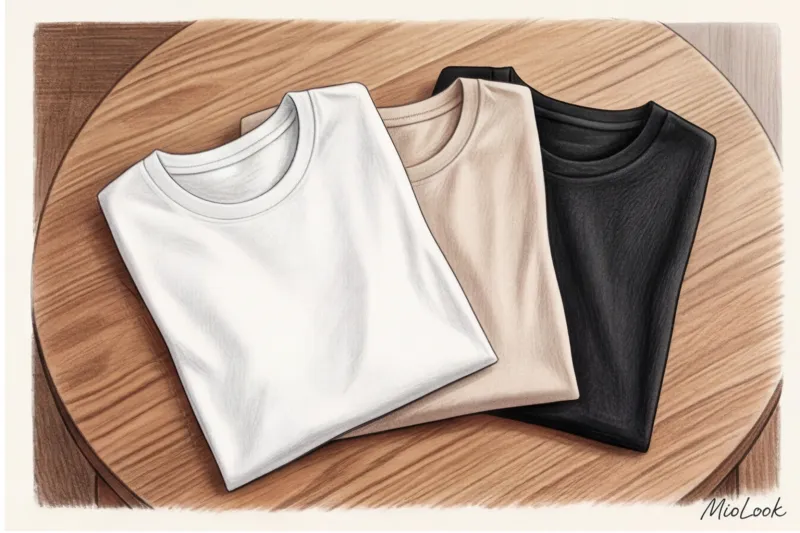
Modal is an advanced viscose made exclusively from beech wood. If you're tired of your basic T-shirts turning into dust rags after a month, modal is your savior.
I took the shirts for a test drive. I bought two basic black T-shirts: one made of 100% cotton (180 g/m²), the other a blend (50% cotton, 50% modal). After 20 washes at 30 degrees, the pure cotton had turned gray, felt stiff, and developed telltale pilling on the sides from the friction of the bag (short cotton fibers break easily). The modal T-shirt remained jet black, smooth, and silky.
Textile laboratory studies confirm that modal absorbs 50% more moisture than cotton. Moreover, its smooth surface doesn't retain minerals from hard tap water, so items don't stiffen after washing, even without fabric softener.
Cupro: "Vegan Silk" for Classy Looks Without the Cost
Of the three, cupro is the most expensive and aristocratic material. It is made from cotton linter—the fine, fluffy layer that envelops the cotton seeds. This fluff was once simply discarded, but today it is used to make a fabric that is visually indistinguishable from natural silk.

One of my clients is a top manager at an IT company. We were putting together a capsule collection for her to present at industry conferences. Natural silk under the hot stage lights is a risk (it treacherously shows even the slightest beads of sweat). Polyester is a guaranteed heatstroke. We chose blouses made of cupro. It has a deep, matte, luxurious sheen that doesn't glare like a cheap sheen on camera, is completely breathable, and has excellent temperature regulation.
Cupro items are 2-3 times cheaper than natural silk, but they are much more practical and comfortable for everyday wear.

Counterintuitive: Why 100% Natural Fabrics Aren't Always a Good Thing
Over 12 years of working as a stylist, I've realized one thing: blindly chasing the "100% natural" label often complicates life. The myth that pure linen, cotton, or wool are always the perfect choice is long outdated.
In today's fast-paced life, we need technology. Consider the synergy of blends:
- Flax + 30% Tencel: Pure linen wrinkles at the first glance and is often stiff. Add Tencel, and the suit will become soft, flowing, and free of stiff creases.
- Wool + modal: Adding modal to wool yarn eliminates prickliness. You can wear thin turtlenecks next to your bare skin without discomfort.
- Cotton + cupro: makes a regular cotton shirt flowy and gives it a light satin sheen.
It is this concept of a “smart wardrobe,” where things work for your comfort, that we laid at the foundation of the application. MioLook The program helps you digitize your closet and track which fabrics you wear most often, creating your personal comfort index.

A stylist's checklist: how to care for tencel, modal, and cupro so they last for years
Synthetic cellulose fibers require delicate care. If you wash them like regular jeans, they won't last a season.
- Temperature conditions: 30 degrees is the absolute maximum. Hot water destroys the fiber structure and causes severe shrinkage.
- Danger of wringing: High drum speeds (over 600) are fatal for these fabrics. This results in "split ends": the microfibers break, leaving a whitish fuzz on the surface of the fabric that cannot be removed with a washing machine.
- Ironing rules: Cupro should be ironed strictly from the inside out at the lowest temperature (otherwise, shiny patches will remain). Tencel, however, is best avoided with an iron altogether—use a steamer; it will instantly straighten the fibers under its own weight.
Professional pain: Recently, a client ruined a luxurious cupro slip dress by washing it with a trendy enzyme detergent. Remember: enzymes are designed to break down organic materials (food stains, blood). But cellulose is also organic! Enzymes literally "eat" the fabric, wearing it down to holes in just a couple of washes. Use only mild detergents for delicate fabrics.
Your perfect look starts here
Join thousands of users who look flawless every day with MioLook's smart algorithms.
Get access — €0.99 onceBottom Line: Are These Fabrics Worth the Money?
Let's do some cold-blooded math and calculate Cost Per Wear. A 3,000-ruble polyester blouse that makes you sweat, static, and is worn maybe five times a season costs you 600 € per wear. A basic, high-quality Tencel shirt that costs 8,000 € and that you wear 50 times a year in absolute comfort costs 160 € per wear.
Clothes shouldn't distract you from life. You shouldn't worry about your skirt sticking to your tights due to static electricity or how stuffy it is in the office. Investing in Tencel, Modal, and Cupro is an investment in your peace of mind and confidence.
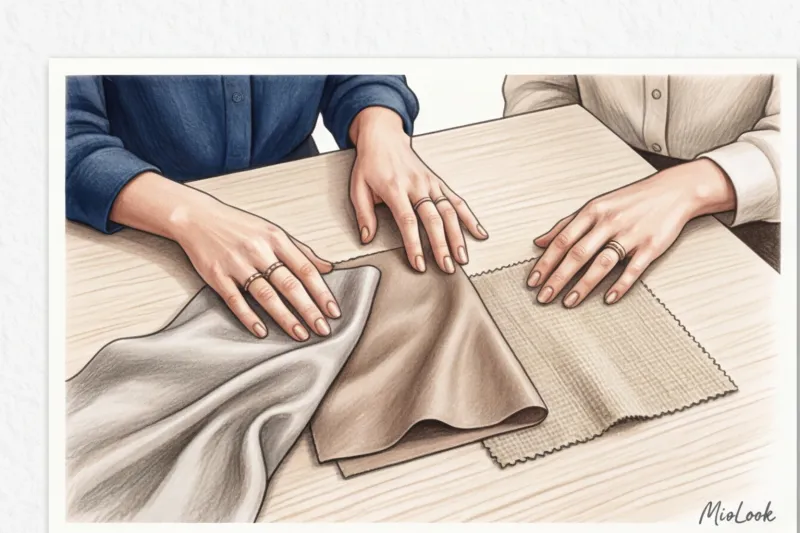
Next time you're shopping, try this simple experiment: close your eyes and touch an item on a hanger. If your hand glides over it like cool water, if the fabric feels pleasantly heavy, only then should you look at the composition. Chances are, you've just found your perfect lyocell.