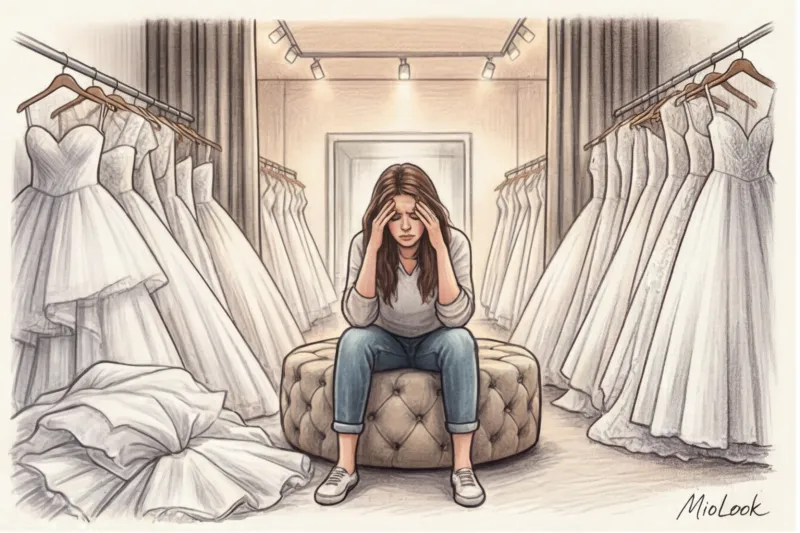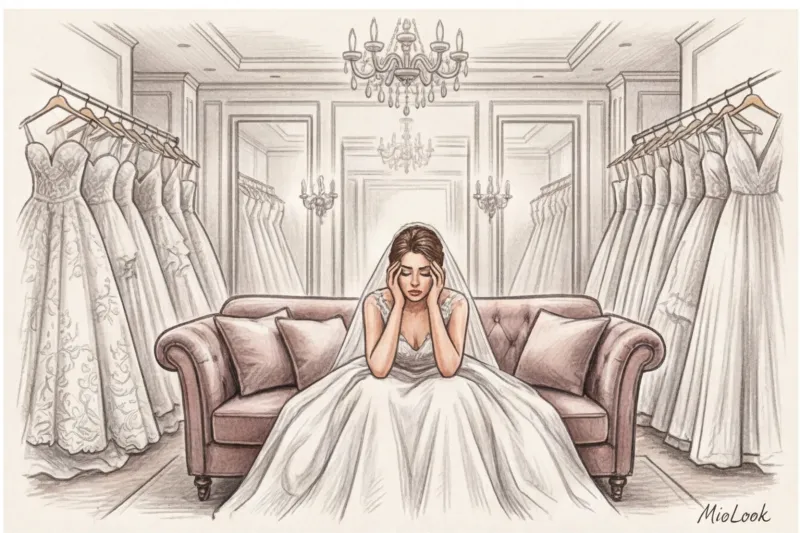
I still remember a client who burst into tears in the fitting room of an expensive salon. It was her fourteenth dress of the day. "They've all merged into one endless white blur; I no longer understand who I am or what I like," she said, peeling off yet more layers of tulle. This situation is not an exception, but a grim statistic in the wedding industry.
Wedding preparations often turn into a survival marathon. We've covered the basic rules and steps in more detail in our a complete guide to choosing a wedding dress , but today I want to talk about technology. As a digital stylist, I can assure you that trying on a wedding dress online isn't a replacement for going to a salon or a magic "buy without looking" button. It's a powerful project management tool that eliminates 80% of unsuitable options before you even leave the house.
Why Trying on Wedding Dresses Online Is the New Standard of Preparation
According to a large-scale study, The Knot Real Weddings Study (2023), the average bride spends about 40 hours searching for "the one" dress and tries on 10 to 15 options. It only sounds romantic in the movies. In reality, after the fifth heavy dress, the classic decision fatigue (decision fatigue).
Your brain is overloaded with sensory information: the pressure of the corset, the weight of the skirt, the bright spotlights, and, let's be honest, the comments of salespeople trying to meet sales quotas. In this state, it's easy to make an emotional purchase that you'll regret during the first fitting.
Virtual filtering is a game-changer. It reduces the number of physical fittings to three to five target silhouettes. You come to the salon not with an abstract "show me something beautiful," but with a clear request: "I need an A-line silhouette with a V-neckline because I already know it perfectly balances my proportions."
Access to MioLook for €0.99 — one-time payment
Start creating perfect looks with the help of artificial intelligence and save hours on fittings.
Get access — €0.99 onceHow neural networks work to select a wedding look
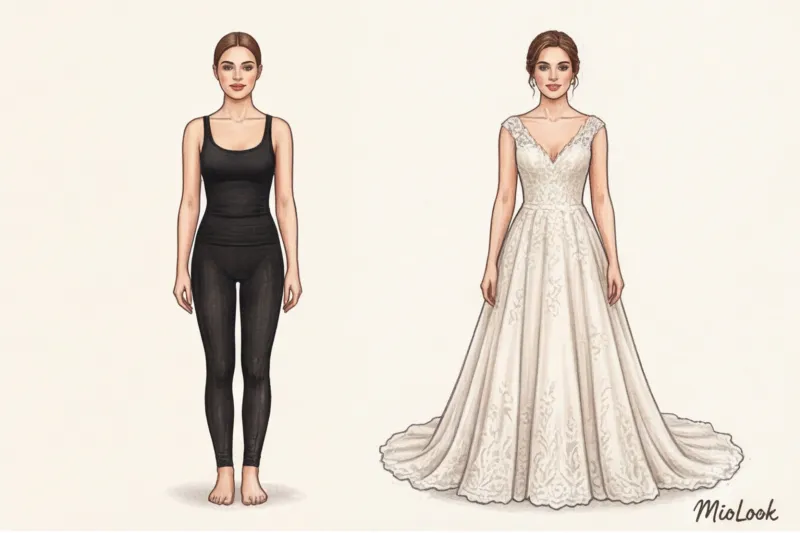
To get the most out of AI, you need to understand how it works. Cheap filter apps use basic computer vision—they simply take a 2D image of a dress (or mask) and stretch it over your photo. The result looks like a paper doll from the 90s.
Advanced styling apps are powered by generative AI. As I've already shown in the example virtual fitting of business clothes These algorithms analyze your body geometry. They re-render pixels, taking into account the lighting in your original photo, the circumference of your hips, the width of your shoulders, and even the way fabric should curve around your collarbones.
What AI can do well, and where it still makes mistakes
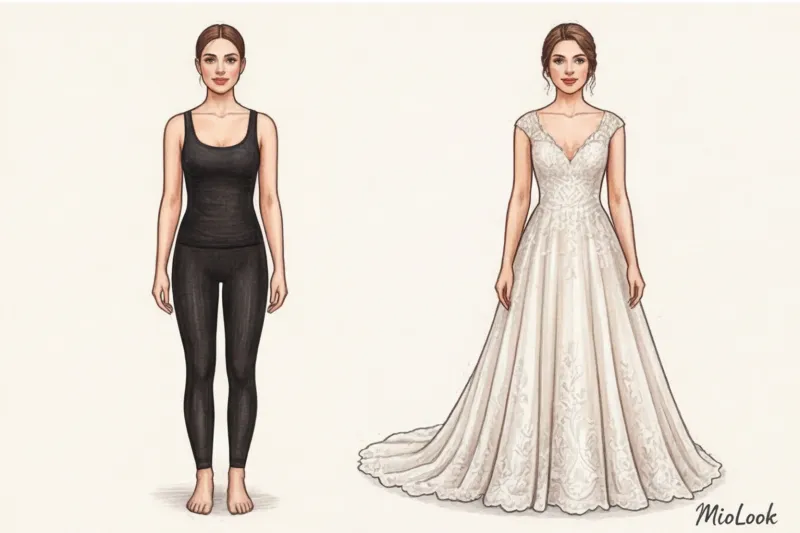
Let's be pragmatic. Today, the fit accuracy of high-quality neural networks reaches 90-94%. AI is flawless at selecting proportions. It will accurately determine whether you need a square neckline or a plunging neckline, whether you should bare your arms or opt for three-quarter sleeves.
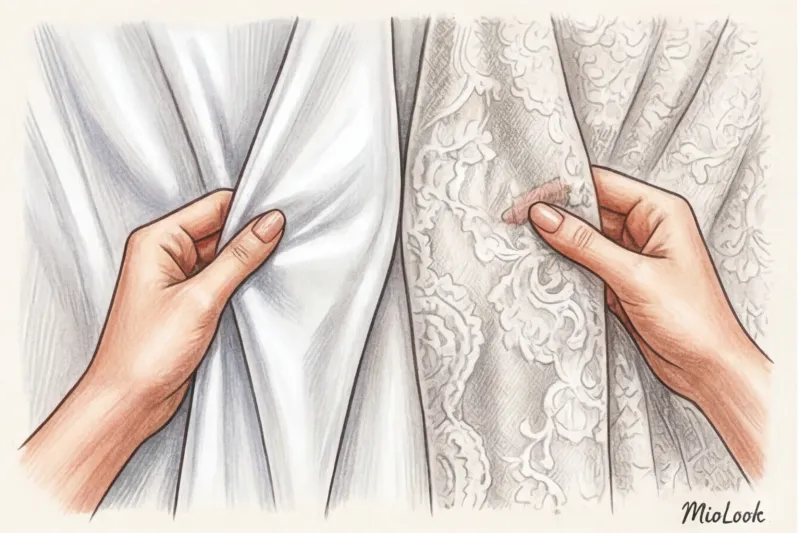
"The main blind spot of artificial intelligence is gravity and material physics. The accuracy of fabric weight (drapery) rendering is only about 60%."
What does this mean in practice? A neural network can't tell the difference between dense mikado silk and cheap, thin polyester—it will draw perfect, sculpted folds in both cases. The AI won't tell you that stiff corset lace will be stiff and chafe your armpits, unlike soft, flowing French Chantilly lace. That's why buying a dress solely based on a generated image is a huge risk.
Step-by-step guide: how to get the most out of trying on a wedding dress online
The first rule of successful digital fitting is to forget about Pinterest. Saving pictures of 6'1" models wearing XS when you're 5'4" and wearing M is a recipe for deep disappointment. Your goal is to focus on his own geometry.
For the algorithm to work correctly, you need the right "base" (the original photo). Here are the strict rules I give my clients:
- No top-down selfies. Distorted perspective will visually shorten your legs and enlarge your head. Use a tripod or have someone take the photo at chest level.
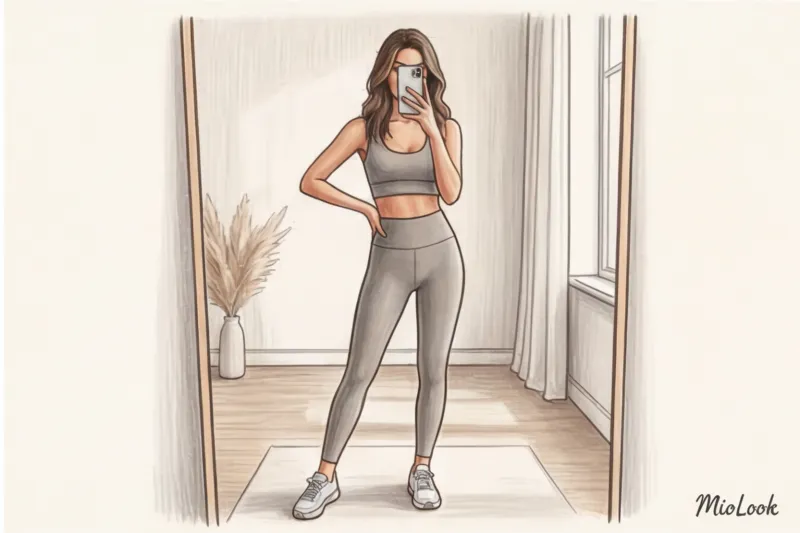
- Tight-fitting clothing. Wear basic leggings and a form-fitting tank top in a neutral color. The AI needs to see your body contours to properly fit the virtual dress.
- Even light. Stand facing the window. Harsh shadows from artificial overhead lighting will distort the volumetric rendering.
- Hair pulled back. Gather your hair into a sleek bun or ponytail to allow the neural network to correctly process the line of your neck and shoulders.
We're testing 4 basic silhouettes: from mermaid to A-line
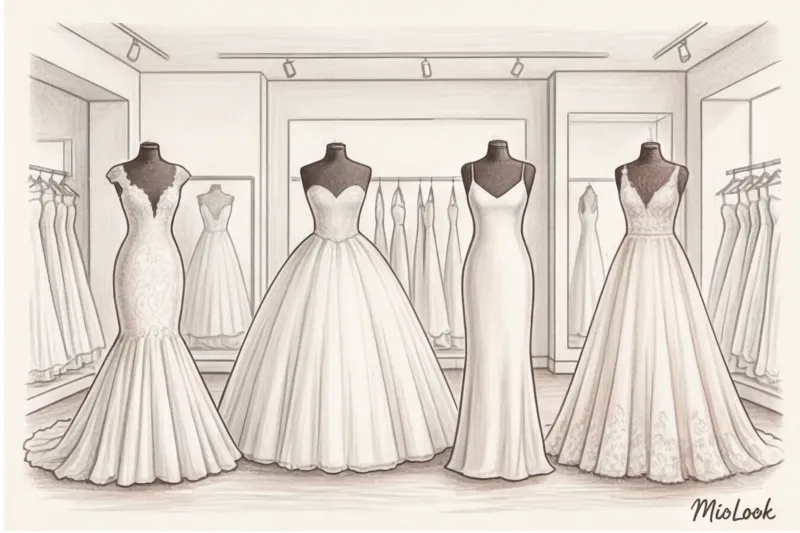
Once you've created your base, don't immediately try to find a dress with a specific lace pattern. Use contrasts. Ask the AI to generate contrasting styles. For example, compare a minimalist silk slip dress with a full ball gown. Then consider a mermaid silhouette and a classic A-line silhouette.
I had a telling case in my practice. A client was obsessed with the mermaid silhouette. We generated several looks, and visually, it looked stunning. But when we started discussing the concept of her active outdoor wedding, we realized: with a mermaid, the stride is reduced to 30 centimeters. You won't be able to dance or walk freely on the grass. A virtual fitting helped us solve this problem in 15 minutes, saving us three weeks of trips to salons.
Your perfect look starts here
Join thousands of users who look flawless every day with MioLook.
Get access — €0.99 onceThe main pitfall of virtual fittings: expectation vs. reality
The biggest mistake you can make is trying to find it offline. exactly the same A dress like the one on the phone screen. I've seen it dozens of times.
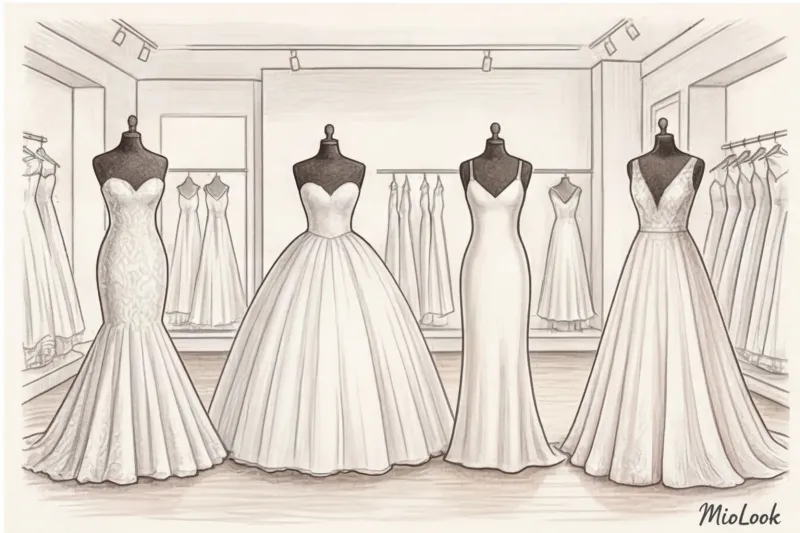
My client, Anna (name changed), brought me a generated photo. It was a masterpiece: a matte sheen, intricate architectural draping, and a perfect, wrinkle-free fit. The problem was that the neural network had created a dress that, in reality, would have required complex corsetry and cost at least 15,000 euros. Anna, however, was trying to find a similar dress among mass-market and budget bridal brands.
What she actually tried on for her budget was made of cheap synthetics that wrinkled mercilessly at the seams, didn't hold their shape, and looked flat. This is a classic trap of inflated expectations. Use AI not to search for a specific product, but to find a "style vector." You're looking for the answer to the question, "Does an open back suit me?" not, "Where can I buy this exact dress with the same beaded pattern?"
Integrating AI into Your Shopping Plan: A Bridal Checklist
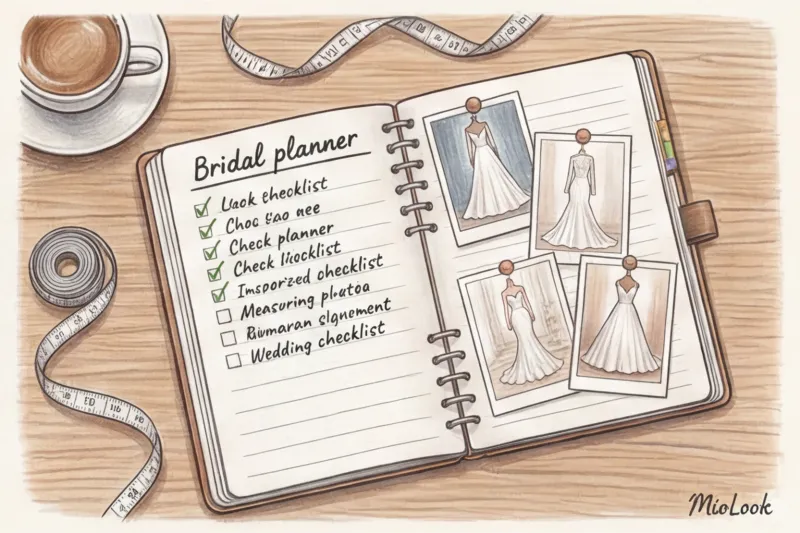
To make technology work for you, not against you, integrate it into a clear preparation process. Here's my tried-and-true checklist:
- Step 1: Generate silhouettes. Spend an evening working with an AI app. Choose 3-4 styles that objectively flatter your figure.
- Step 2: Create a mood board of realistic expectations. Collect the generated successful silhouettes into a single collage. This is your compass.
- Step 3: Spot calling. Don't book appointments at every salon. Call and ask, "Do you have A-line dresses in smooth fabric with a square neckline within a budget of X?" This saves you and the consultants time.
- Step 4: Offline tactile test. In the salon, forget about visuals (you've already checked them). Focus on the physical: sit in the dress, raise your arms (will you be able to hug the groom?), take a long step, and check if the fabric is itchy.
How MioLook technology saves your nerves and budget
In the article about AI wardrobe for managers I've already written about this fundamental thing: style should be an extension of your lifestyle. Weddings are no exception, despite the industry's persistent attempts to convince us otherwise.
Ask yourself: If you wear relaxed, oversized clothes, soft knitwear, and sneakers 364 days a year, why on day 365 do you want to tie yourself up in a tight, multi-layered corset that's hard to breathe in? MioLook solves exactly this problem. The "smart wardrobe" feature analyzes your everyday preferences and style DNA, helping you choose a wedding look that will make you feel like yourself, not like an actress in a period costume.
A virtual try-on is your personal armor against marketing gimmicks and stress. Delegate the routine of searching for silhouettes to algorithms, and reserve the most enjoyable part for yourself: choosing the best from the ideal and the anticipation of the holiday.