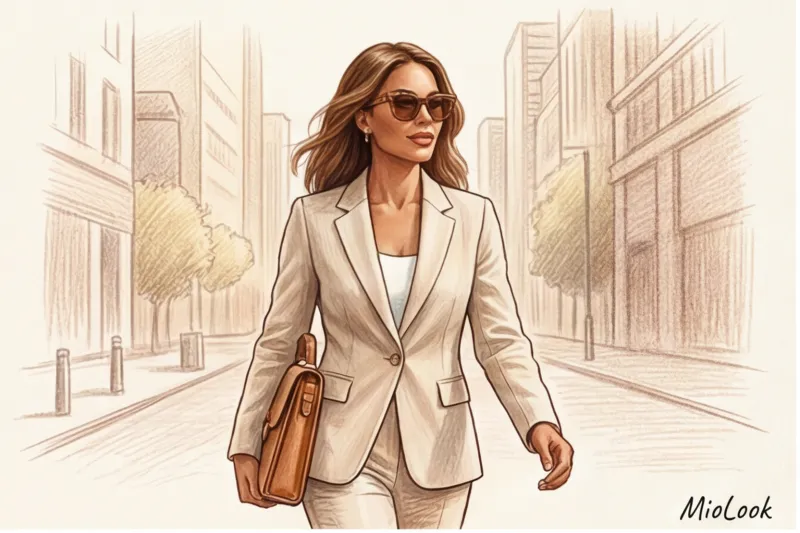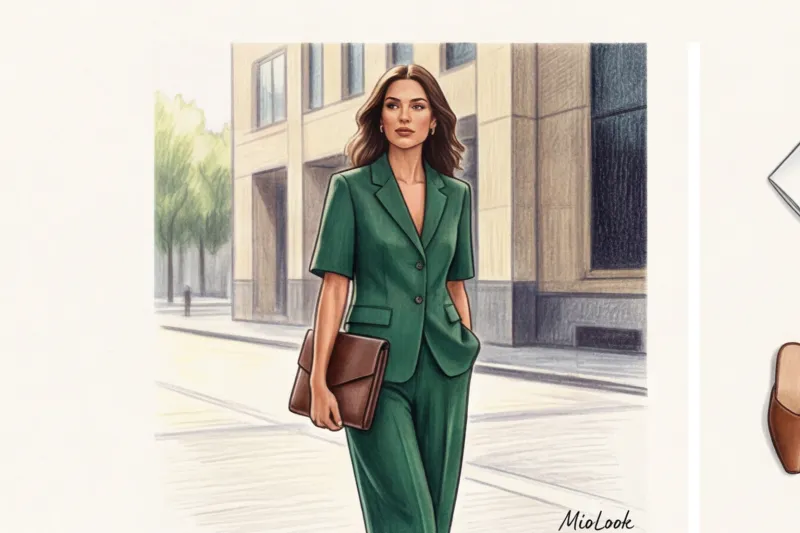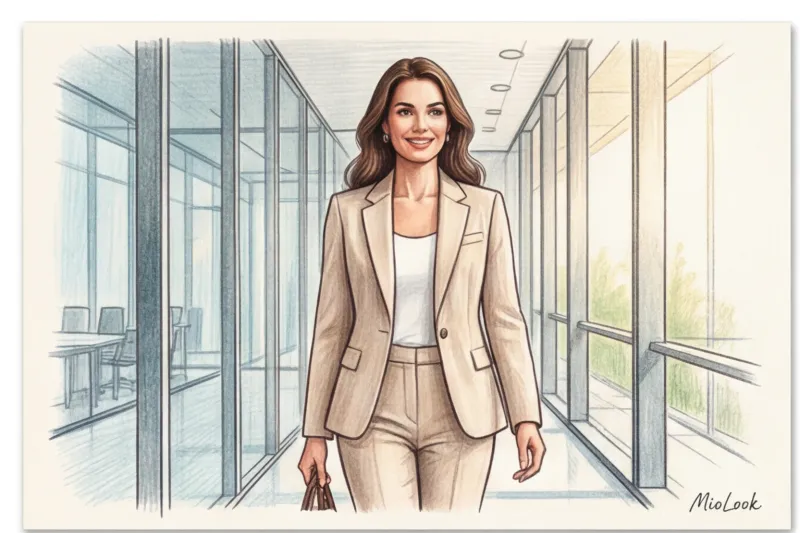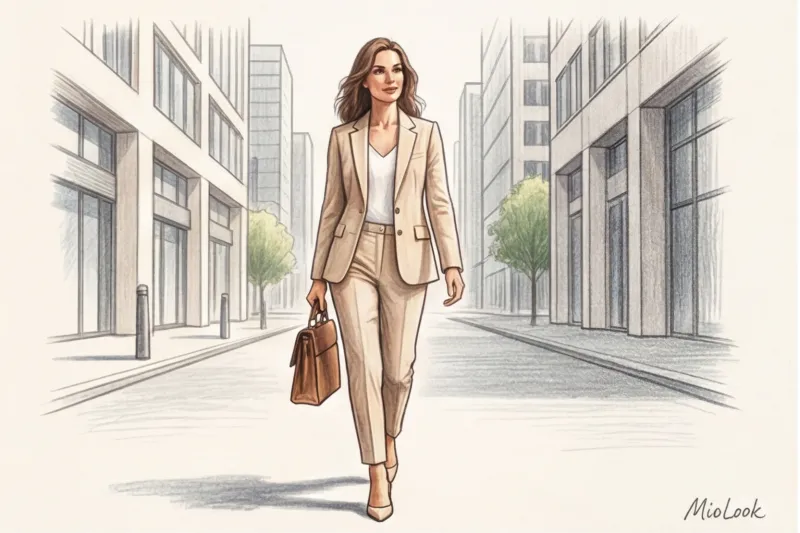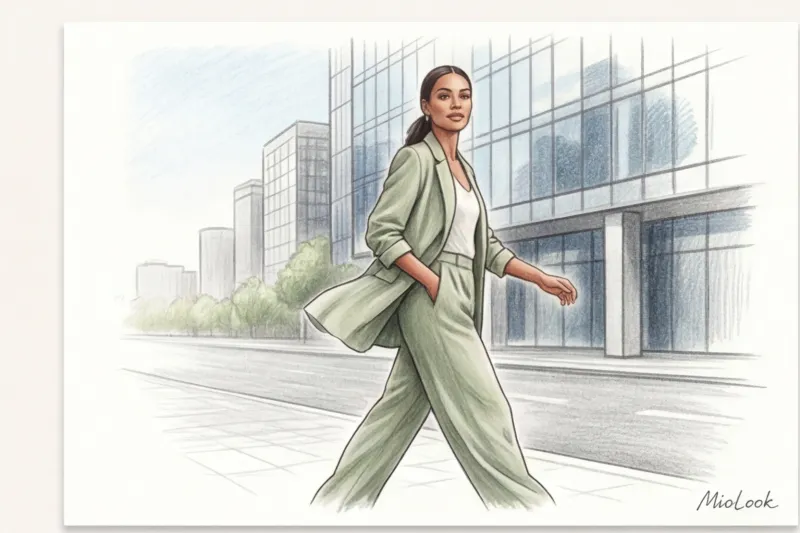
Have you ever caught yourself sweating more in an air-conditioned office than on a 90-degree day outside? I see it every summer. As soon as the thermometer hits 77°F (25°C), women flock to 100% linen, hoping for relief. The result is always the same: deep creases in your pants by 10 a.m., a feeling of unkemptness during an important meeting, and an unpleasant greenhouse effect under your arms due to tight armholes.
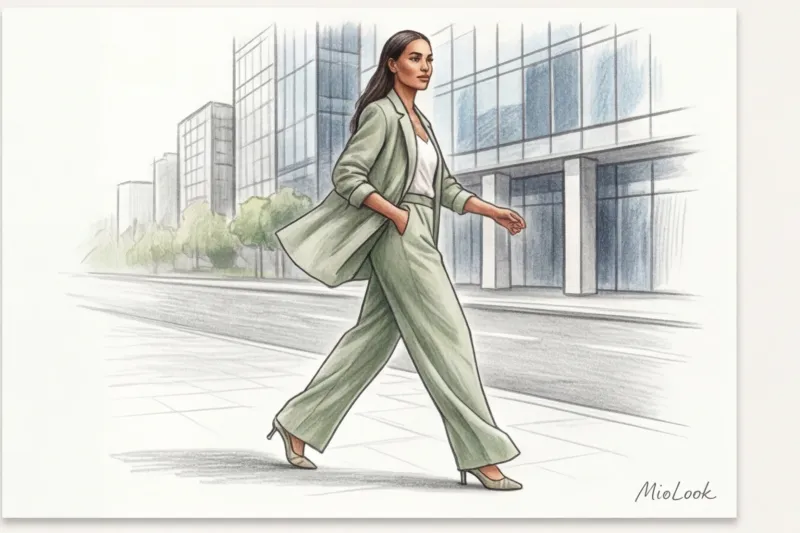
Spoiler alert: pure linen and heavy cotton are the worst choices for a strict summer dress code. Summer office wardrobe requires a fundamentally different approach. The solution lies in tailored cuts that create the right microclimate and high-tech semi-synthetic blends. We discussed the basic rules of protocol in more detail in our The Complete Guide to Business Wardrobe for Women , but today we will look at the strategy for surviving in summer extreme weather.
Summer Office Wardrobe: Why the Old Rules No Longer Work
The biggest mistake I've corrected in 12 years as a personal stylist is trying to adapt vacation attire for a business setting. A sundress with thin straps, even worn under a jacket, conveys the relaxed air of a lounge chair rather than the collectedness of a conference room.
According to WGSN's 2024 analytical report, the corporate world has finally embraced the concept of Soft Power. Rigid, restrictive tailoring has given way to fluid silhouettes. Just look at the latest shows from The Row or Jil Sander: the summer office no longer requires the sacrifice of stuffy sheath dresses. Designers have proven that comfort has become synonymous with professionalism.
It's time for a paradigm shift. Stop thinking in terms of "what to wear to stay cool." Start thinking like an architect: "How can I create a microclimate with clothing?"
Your perfect look starts here
Join thousands of users who look flawless every day with MioLook. Our smart AI stylist will help you choose looks based on the weather and dress code.
Get access — €0.99 onceTissue anatomy: what really saves you in 30-degree heat
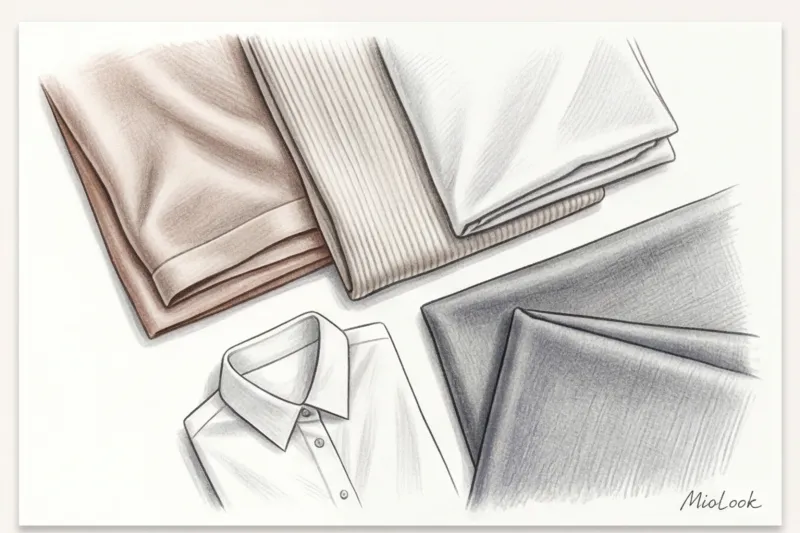
Let's look at the numbers. Our app's statistics MioLook reveals something astonishing: 78% of complaints from user-managers about their summer wardrobes are not related to the fact that they are hot, but rather that their clothes immediately lose their presentable appearance.
How does heat exchange work? When you put on a tight-fitting shirt made of the finest cotton cambric, the fabric immediately absorbs sweat, clings to your body, and blocks air circulation. You start sweating even more. At this point, the density of the fabric becomes more important than its naturalness: a structured, medium-weight material that holds its shape and doesn't touch your skin will cool you better than thin gauze.
The 100% Linen Myth and Technological Alternatives
Let's debunk the biggest myth: clean linen only looks classy for the first 15 minutes after ironing. In the office, where you sit at your computer, cross your legs, and buckle up in a taxi, it creates a totally unkempt effect.
Your real life-saving fabrics are modern technological cellulose fibers:
- Tencel (Lyocell): A fiber derived from eucalyptus wood, lyocell absorbs moisture 50% more effectively than cotton and releases it immediately.
- Cupro (Cupro): "Vegan silk" made from cotton fluff. Provides a luxurious matte sheen and a cool-touch effect.
- Modal: Ideal for knitwear, as it does not pill as quickly as viscose.
"Any CEO's secret weapon this summer is 'Cool Wool.' This ultra-fine wool, Super 120s or higher, open-weave, wicks away heat, breathes beautifully, and, most importantly, regains its shape overnight on the hanger. No creases for the morning boardroom."
Last year, we replaced one of my clients (a top IT manager)'s linen suits with two-piece summer wool trouser suits. The result? She stopped carrying a steamer on business trips.
The Architecture of Tailoring: Relaxed Tailoring as Built-In Air Conditioning
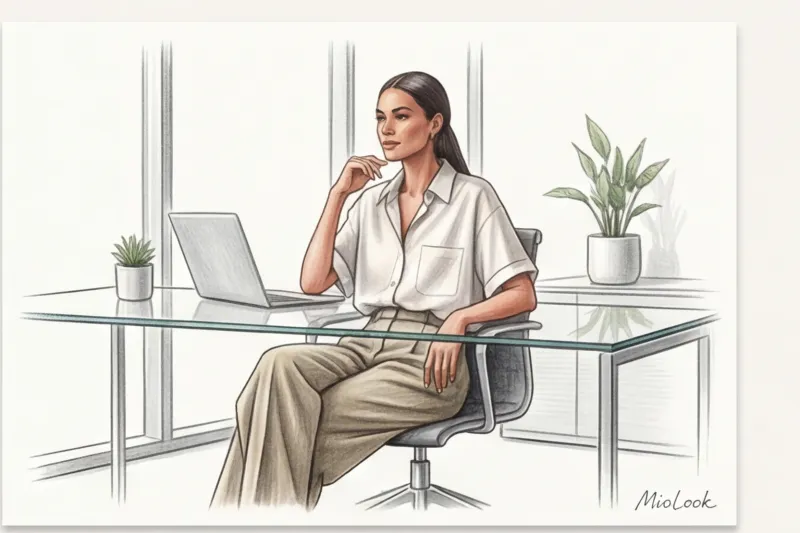
The key to surviving the heat is the "air gap" principle. Your clothing shouldn't touch your body 100%. This thin layer of air between your skin and the fabric acts as an insulator: outdoors, it prevents heat from reaching your body, and in the office, it protects you from the direct airflow of the air conditioner.
Swap skinny cigarette pants for wide palazzo pants with pleats at the waist. Pleats create extra volume at the hips, allowing air to circulate as you walk. As for the top, avoid set-in sleeves that fit tightly under the armpits.
In my experience, a properly cut armhole prevents sweat stains more effectively than the most powerful clinical deodorant. Choose blouses with cap sleeves, kimono sleeves, or jackets with dropped shoulders. They allow freedom of movement without sacrificing formality. By the way, we wrote more about how to avoid embarrassing moments during presentations in the article Fabrics that don't show sweat stains: A guide for speakers.
Ready to digitize your wardrobe?
Try MioLook's free plan. The app will automatically create outfits from your summer items—without the stress of mornings.
Get access — €0.99 onceFormal Dress Code Looks (Business Formal)
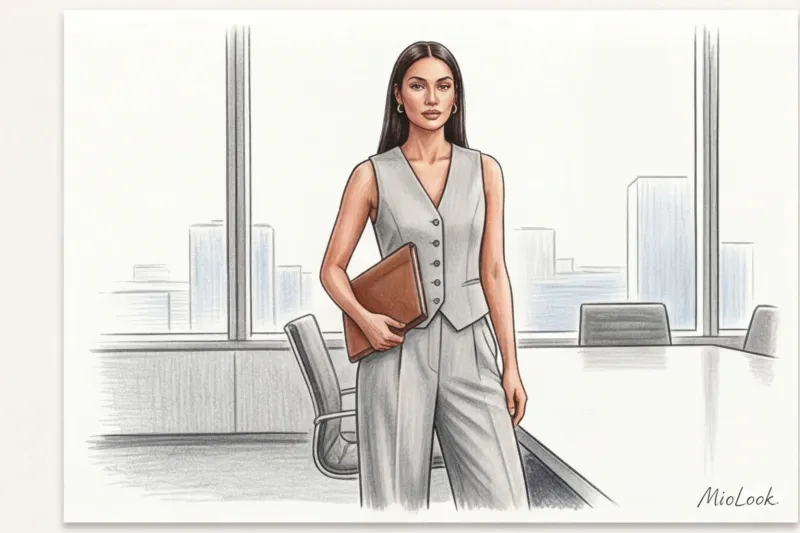
If your contract requires Business Formal compliance and shorts are prohibited at the corporate level, there's no reason to suffer. Recreate the classics.
Formula 1: A new take on the three-piece suit. Wear a heavy viscose-blend suit vest directly over bare skin as a standalone top. Pair it with wide-leg trousers for an ultra-professional look while leaving your arms and neck exposed.
Limitation: This technique doesn't work in courts, banks with outdated protocol, or government agencies. In such cases, shoulders should be covered—a thin silk blouse under a vest is the answer.
Formula 2: Architectural cut shirt dress. Forget thin cotton. Look for a dense silk or viscose blend with 5% elastane. Key details: a stiff collar that covers the collarbone, a midi length, and a hidden button placket.
Use a light palette as a status symbol. According to the Pantone Color Institute, complex light shades are subconsciously associated with luxury and purity. Replace traditional black and navy blue with ecru, pearl gray, and muted sage.
Smart Casual: When the Rules Relax
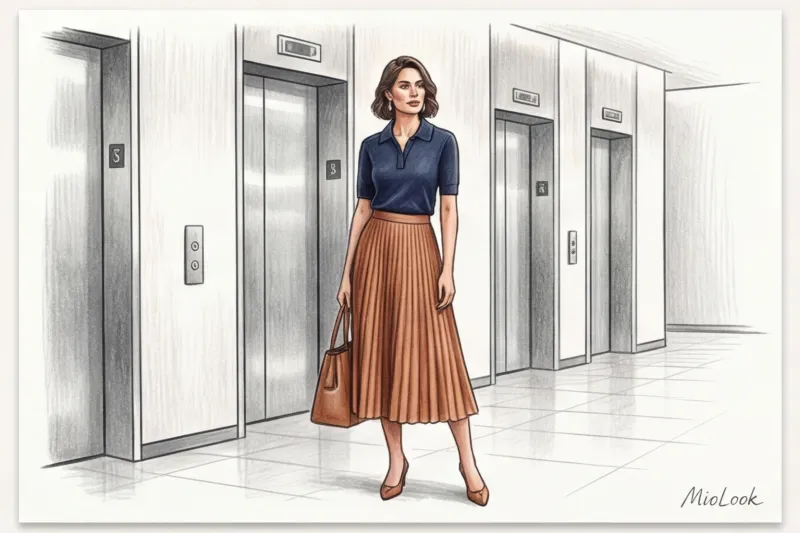
For Friday dress codes or offices with more flexible rules (for example, creative agencies or IT companies), there's plenty of room for maneuver. The key is to understand the fine line between relaxed and casual.
Bermuda shorts with creases are an absolute hit of recent seasons. But how can you tell the difference between suit Bermudas and beach shorts? The difference lies in the fabric thickness and the hardware. Proper office Bermudas have a suit belt with a hook-and-eye closure (no elastic!), crisply pressed creases, and a length that's a hand's breadth above the knee or just below the kneecap. Find more ideas for these looks in this article. Summer Business Style for Women: An Executive Wardrobe.
As for tops, knitwear is legit in summer if you choose the right fabric. A basic white T-shirt can often look too plain. Swap it for a thin polo shirt in smooth silk or mercerized cotton. A collar instantly elevates the formality factor.
Air Conditioning vs. Heat: A Strategy for Surviving Temperature Changes
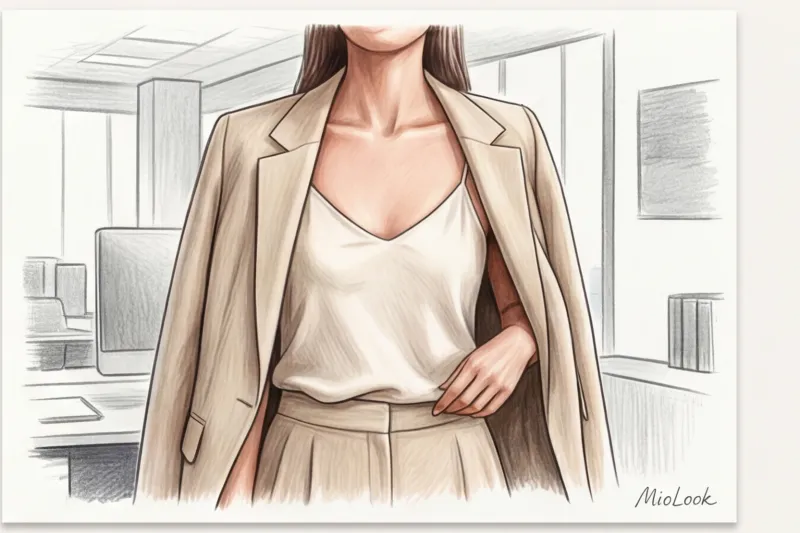
The main paradox of summer is the "ice cold office" problem. When it's 32°C outside, but the ventilation system settings in the office produce a harsh 19°C. A temperature difference of more than 10 degrees is a surefire way to catch a cold. This is where the "smart layer" principle comes into play.
I always recommend that my clients keep a "go-to" jacket at work. An unstructured or half-lined style on the shoulders and sleeves is ideal.
Have you ever noticed that unlined jackets in the premium segment are more expensive than classic ones? This isn't a pricing error. In such garments, all interior seams must be perfectly finished with bias binding, as they cannot be hidden under a layer of polyester. This is the pinnacle of tailoring. Such a jacket, in camel or cool gray, will complement 90% of your summer looks.
Shoes and Accessories: Summer Business Etiquette Made Easy
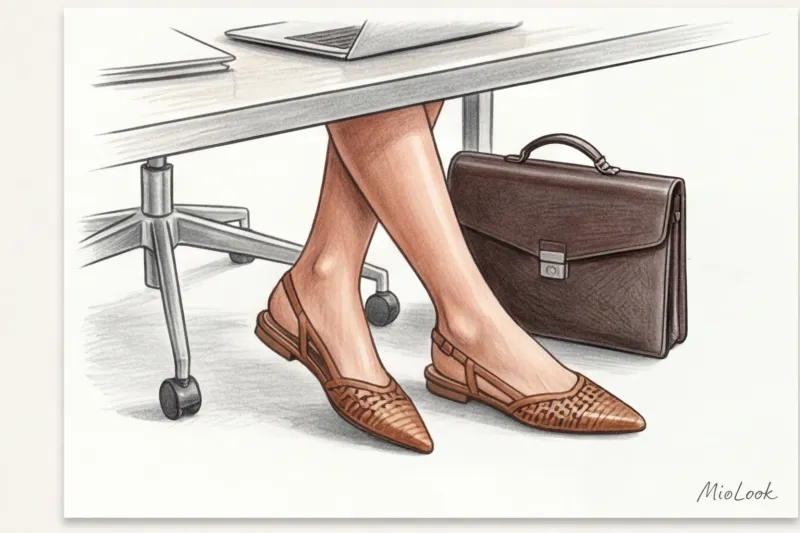
Business protocol is merciless when it comes to open-toe shoes. Sandals, clogs, and espadrilles are taboo in the business world. But slouching around in closed leather pumps in August is a dubious pleasure.
Your compromise is slingbacks (shoes with an open heel and strap) and elegant mules with a closed, pointed toe. Opt for shoes made of perforated suede or woven leather (intrecciato). They provide excellent air circulation while still keeping your toes hidden, thus adhering to the rules of etiquette.
What about tights? If the corporate dress code is strict (such as in protocol departments), look for ultra-thin opaque tights in 5-8 denier. They're practically invisible on the leg. No shine or tan effect—just a color that matches your skin tone as closely as possible. A smart-casual alternative is so-called "liquid tights" (body tinting sprays), which create a smooth skin effect. We discuss the nuances of choosing them in detail in this article. Business attire: style and status.
Access to MioLook for €0.99 — one-time payment
Save up to 20 minutes every morning. A smart AI stylist will select the perfect look from your closet.
Get access — €0.99 onceStylist Checklist: Putting Together the Perfect Summer Office Look in a Weekend
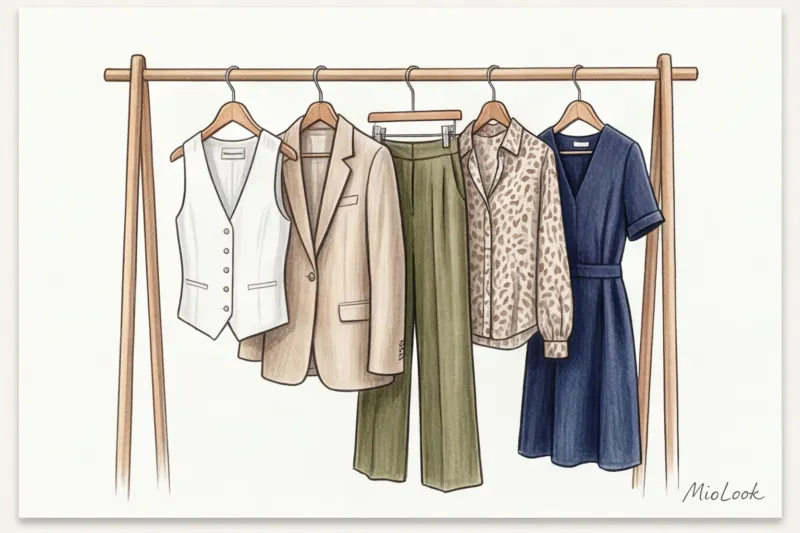
Theory without practice is dead. I suggest you set aside two hours this weekend to finalize your summer wardrobe before September. Start with a rigorous audit: remove all items made of 100% cheap polyester from the top shelves. This is plastic that will suffocate you.
Create a compact mini capsule collection with 12 looks. Here's a tried-and-true formula for the base (Middle segment: Massimo Dutti, COS, 12Storeez):
- 3 bottoms: Wide-leg Tencel trousers, light-coloured Bermuda shorts with creases, A-line midi skirt.
- 4 tops: Suit vest, silk polo shirt, blouse with short cap sleeves, thick basic T-shirt.
- 2 layers: Unlined jacket and cardigan made of thick textured cotton.
- 2 pairs of shoes: Kitten heel slingbacks and leather loafers.
The next step is digitization. Upload photos of these 11 items to the app. MioLook The algorithm will generate dozens of stylish combinations for you based on these items, taking into account your color type and the outside temperature. All you have to do is open your phone in the morning and put on the suggested outfit.
A well-crafted summer business wardrobe isn't a matter of huge budgets or exceptional taste. It's a matter of technology, understanding the properties of fabrics, and respecting your own comfort. Remember: your office attire should enhance your credibility, not test your endurance in 30-degree heat.