
According to eye-tracking research conducted by the Nielsen Norman Group (2023), during business negotiations, the other person spends 70% of their time looking at the "bridge of the nose" area. You can be dressed in an impeccable Jil Sander suit and holding a Hermès bag, but if your face is covered in cheap plastic, the magic is ruined within the first second of eye contact.

Over 12 years of working as a stylist, I've learned a hard and fast rule: glasses are the "supporting structure" of a portrait's appearance. They are instantly perceived by the person you're talking to, even before they evaluate your shoes or watch. That's why properly chosen status frames for women's glasses It's more than just a medical device or a fashion accessory. It's an impression management tool, an indicator of your intellectual capital and financial well-being.
We have provided more details on how the database of expensive parts is formed in our A complete guide to status accessories for women: bags, shoes, and watches And today I propose taking a closer look at optics: from the sound of a frame falling on a table to architecture that will make the board of directors listen to you more attentively.
The Psychology of the Gaze: Why Status-Inspired Eyeglass Frames Are More Important Than a Birkin Bag
Let's be honest. You leave your bag on your chair or in the conference room. Your shoes are hidden under the table. And your glasses are in the very center of the "communication triangle" (eyes-lips-eyes). They frame your gaze—your primary tool of persuasion.
One of my clients, a brilliant financial analyst, couldn't understand for a long time why her numbers were treated with mild skepticism during strategy presentations. The problem lay in the "residual principle." She invested in expensive jackets but wore flimsy, scratched frames she'd bought on the run five years earlier. An expensive suit paired with cheap lenses always looks fake. The other person's brain detects the dissonance and subconsciously loses trust.
We replaced her "invisible" metal frame with a statement tortoiseshell frame made of thick acetate. The result? A month later, she laughingly told me that her colleagues no longer interrupted her in meetings. The glasses added structure to her face and added weight to her look.
Access to MioLook for €0.99 — one-time payment
A smart AI stylist will create the perfect look based on your new accessories.
Get access — €0.99 onceThe Anatomy of Expensive Optics: Materials That Become an Expert
Did you know that stylists and opticians can determine the quality of glasses with their eyes closed? My favorite professional test is the "frame sound." When you place mass-market glasses (molded plastic) on a wooden table, they make a resonant, hollow, rattling sound. Expensive, milled frames land with a dull, heavy, and refined thud. This is the sound of density.
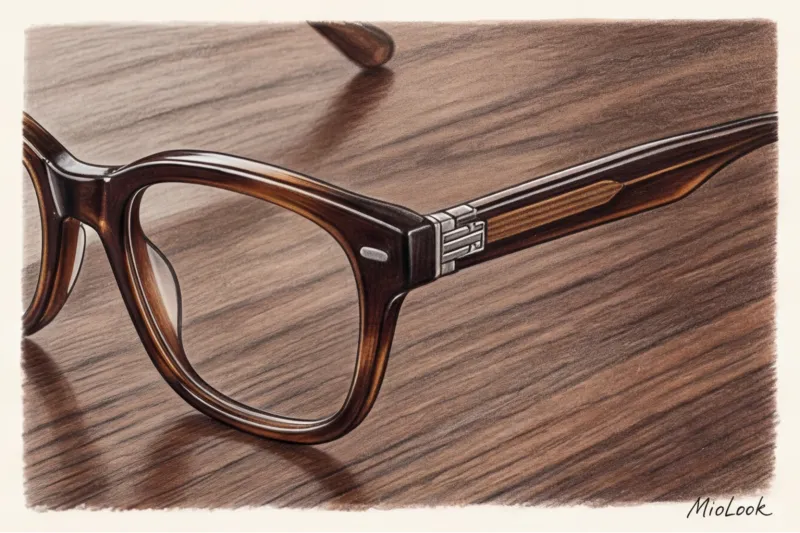
Cellulose acetate vs. injection molded plastic
Most inexpensive glasses are made from injection-molded plastic: a hot mass is poured into a mold. These glasses last 1-1.5 years, quickly lose their shine, become covered in micro-scratches, and their color always looks flat. If they're made from imitation tortoiseshell, the stains will look like a cheap print.
The premium segment works with cellulose acetate The industry gold standard is the Italian manufacturer Mazzucchelli 1849. Their acetate is created in layers, like puff pastry, and then the frame is milled from a single piece. What's the difference for you?
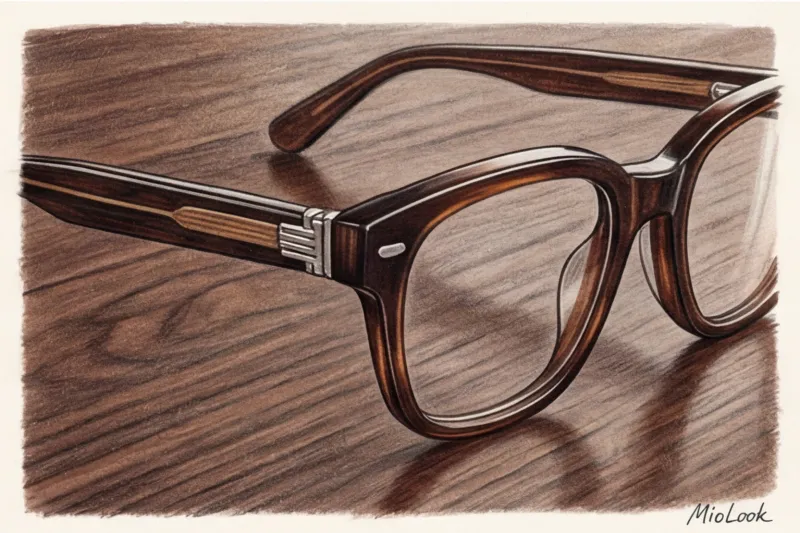
- Color depth: The tortoiseshell coloring in Mazzucchelli acetate appears three-dimensional, with light playing within the material.
- Tactility: Acetate is warm to the touch and is hand polished to a smooth stone finish.
- Landing: Unlike cheap plastic, acetate is malleable when heated. An optician can perfectly fit the temples to the contours of your skull.
Japanese titanium and natural horn for the upper echelon
If your dress code demands maximum formality and conservatism, plastic may be too relaxed a choice. This is where titanium comes in.
The world's finest optical titanium is produced in Sabae, Japan's Fukui Prefecture. It's completely hypoallergenic, weightless, and virtually eternal. Japanese titanium frames exude exquisite precision. They're the choice of top executives, investment bankers, and lawyers seeking "quiet luxury" without unnecessary details.
And for those seeking absolute exclusivity, there's genuine buffalo horn. Each frame features a unique natural pattern that's impossible to replicate. It's an accessory that whispers status, but is heard by all who care.
Your perfect look starts here
Join thousands of users who look flawless every day with MioLook, matching their outfits to their signature accessories.
Get access — €0.99 onceThe Face Shape Myth: Key Posture Rules for a Status Look
Forget those magazine charts from the 2000s that categorically declared, "A round face should wear square glasses, and a square face should wear round glasses." This is a horribly outdated rule that distorts proportions. It's not the abstract shape of your face that influences the status and harmony of your look, but the specific architecture of your features.
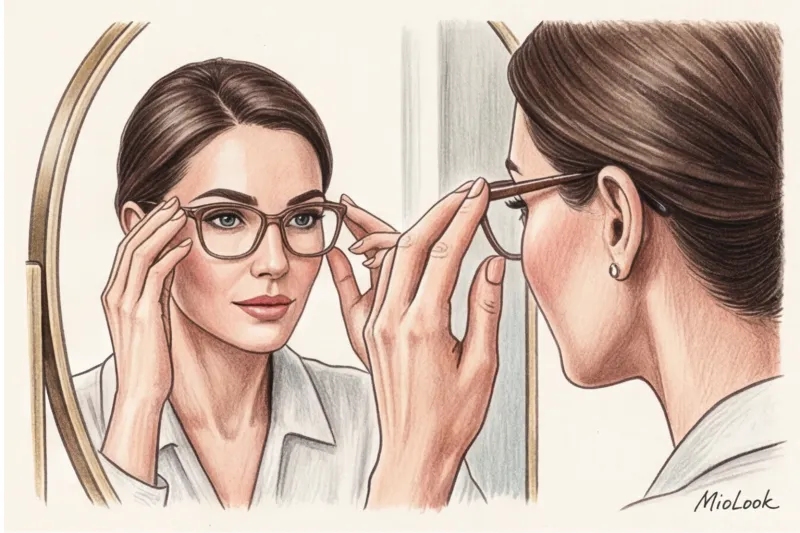
Here are three planting rules that actually work:
- Eyebrow line rule. The top edge of the frame should follow the curve of your eyebrow or run parallel to it. Glasses shouldn't completely cover your eyebrows (this will hinder your expression) or cross them at an odd angle (this will create the effect of a perpetually surprised or frowning face).
- Bridge fit. Nothing kills your credibility more than glasses that constantly slip down to the tip of your nose, forcing you to adjust them with your index finger. For a narrow bridge, look for a keyhole bridge; for a wide one, look for a classic saddle bridge.
- Pupil centering. Your eye should be exactly centered horizontally across the lens. If your eyes are drawn toward the bridge of your nose, the frames are too big. If they're pressed toward the outer edges, they're too small.
"A common mistake I see beginners make is trying on glasses when the face is relaxed. But as soon as the woman smiles, her cheeks lift and the glasses bounce, resting on her cheekbones. This throws the lenses off center and looks comical. Always smile when trying on frames!" Julia Rossi
The Architecture of Authority: Which Status-Changing Women's Eyeglass Frames Convey the Right Message
The geometry of your frame changes the perception of your character. Glasses can make you appear tougher, softer, more creative, or more conservative. Choose the shape that best suits the task you're tackling today.
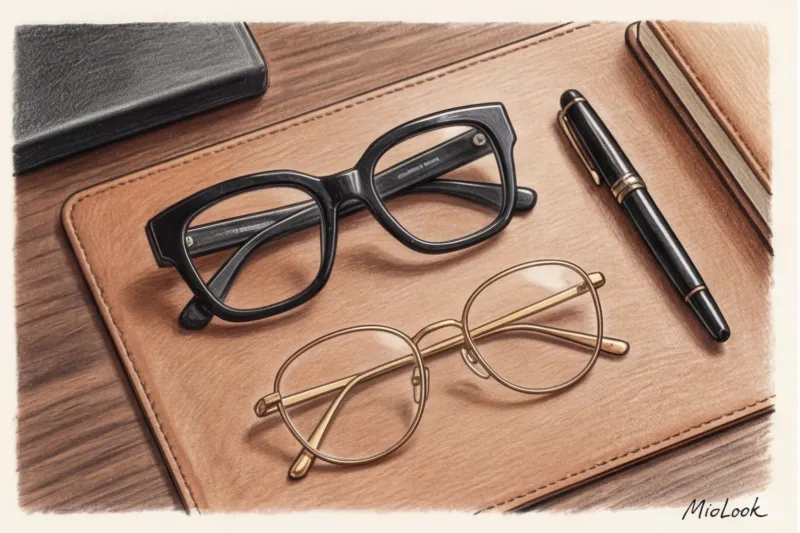
Thick frames
Wide, thick acetate frames are a statement. These glasses convey boldness, vision, and self-confidence. They're the perfect choice for creative directors, marketers, strategists, and architects. When you wear these glasses, you don't need to raise your voice—you'll be noticed.
But there is a fair limitation here (when it DOESN'T work): Bulky black frames are contraindicated for women with very small, delicate facial features and light, low-contrast eyebrows. The glasses will simply "swallow" your face, and the person you're talking to will be talking to the frames, not you.

Thin metal and rimless models
Thin titanium is a scalpel. It conveys meticulousness, an analytical mind, and a love of order and rules. Rimless models (where the temples are attached directly to the lens) create the effect of maximum openness and intelligence. These are classics for financiers, IT architects, and auditors.
Cat-eye
The most insidious shape. The classic rounded cat-eye from the 1950s often looks overly playful, retrograde, or frivolous. If you're aiming for status and expertise, opt for a modern interpretation: angular, sharp lines sweeping upward. They create a face-lifting effect and add dynamism and daring to the look.
I had a revealing case in my practice. My client, Marina, worked as a psychologist but decided to transition into executive coaching for top managers. Her old round glasses with thin gold frames made her look too cozy and soft. We replaced them with a strict, slightly angular geometric frame made of dark green acetate. The frame acted as a kind of "shield," adding the necessary distance and status. For more information on how to manage impressions through clothing, read the article. Expert Image: A Wardrobe for Your Personal Brand.
Ready to start your transformation?
Try the MioLook plan for free—no commitments required. Our AI will help you integrate your new glasses into your everyday wardrobe.
Get access — €0.99 onceWhat to Avoid: 5 Signs of Cheap Optics
According to the WGSN (2024) report, the trend toward "quiet luxury" has firmly established itself in business dress codes. This means that some details that were once considered prestigious now work against you.
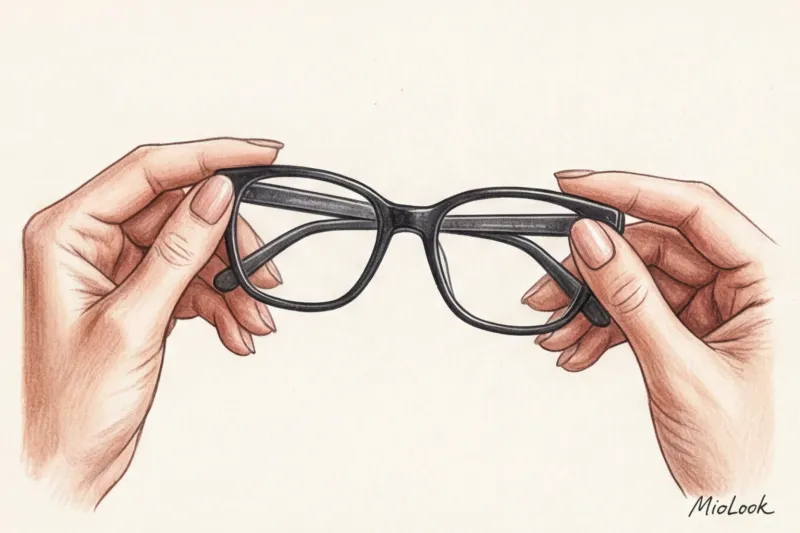
- Huge gold logos on the temples. In the business world, this is an anti-status sign. A flashy logo is perceived as a sign of insecurity and an attempt to prove one's worth. An expensive frame is recognized by its silhouette and the quality of its polish, not by the letters on the temple.
- Flimsy hinges. Open and close the temples. Cheap glasses have a single hinge that wobbles. Premium glasses have a five- or seven-piece hinge (the hinges interlock like fingers). The temples should move tightly and smoothly.
- Cheap anti-glare coating. Advice from videography experts: cheap lenses produce a bright green or purple tint in photos and during Zoom calls. This instantly cheapens the look. Invest in premium multi-coatings that provide a subtle, residual sea-green reflection or are completely clear.
- Rhinestones and excessive decor. Lace-like metal temples, stone inlays, and intricate decoration are a relic of the past that adds age and detracts from the dynamic look.
- Yellowed silicone nose pads. Even the most expensive frames look unkempt if the silicone on the bridge has oxidized from makeup and sebum. Have them replaced at the optician's every six months—it costs a few pennies, but it saves your reputation.
Optical Wardrobe: A Checklist Before Investing in Frames
For the modern professional woman, one pair of glasses for all occasions isn't enough. You wouldn't wear the same shoes to a board meeting, a date, and Sunday brunch, would you? A basic eyewear wardrobe should include at least two items: a formal, architectural pair for important meetings and a more relaxed, perhaps slightly brighter frame for networking, casual Fridays, and creative gatherings.
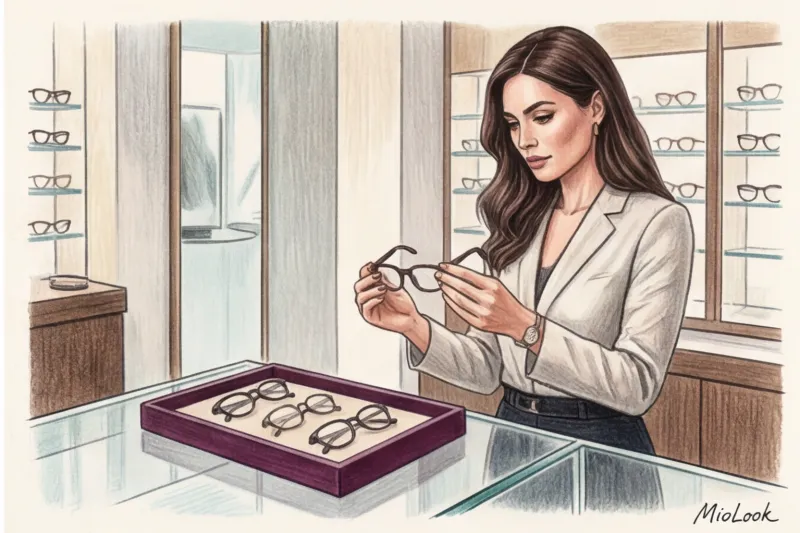
Before you take your frame to the checkout, do a quick check:
- Twist test: Gently rotate the frame in your hands. It shouldn't creak.
- Assessment of cuts: Run your finger along the edges of the frame. Expensive acetate has perfectly sanded edges, with no sharp, scratchy seams.
- Weight balance: The frame shouldn't lean forward, otherwise it will put pressure on the bridge of your nose. Good glasses are balanced by metal rods inside the temples.
And finally. When my clients are hesitant to shell out a hefty sum for quality eyewear, I suggest they calculate the cost-per-wear (CPOW). You wear your glasses in a highly visible place, 365 days a year, for 10-12 hours a day. If a quality pair of frames costs €500 and lasts at least three years, then one day of a flawless look costs you 0.45 cents.
This is the most profitable investment in your credibility you can imagine. No bag will give you such a return on investment. And to learn how to masterfully incorporate your new glasses into your everyday looks, study our A guide to finding personal style for women.