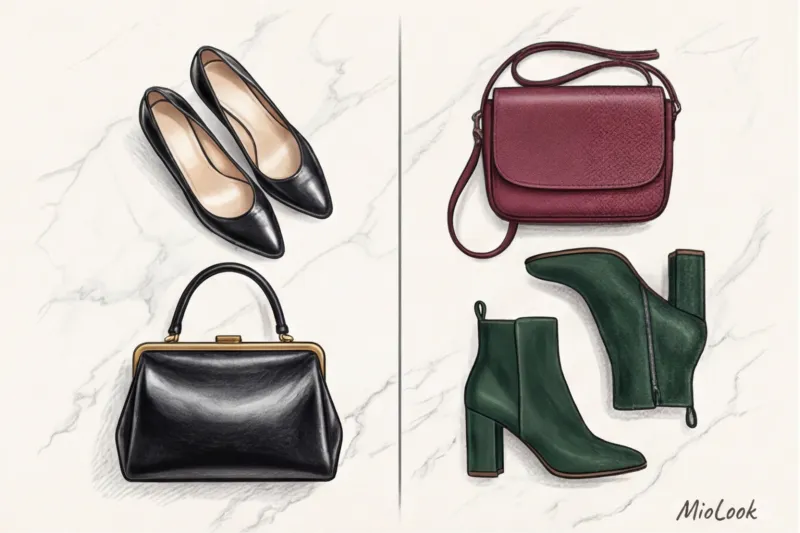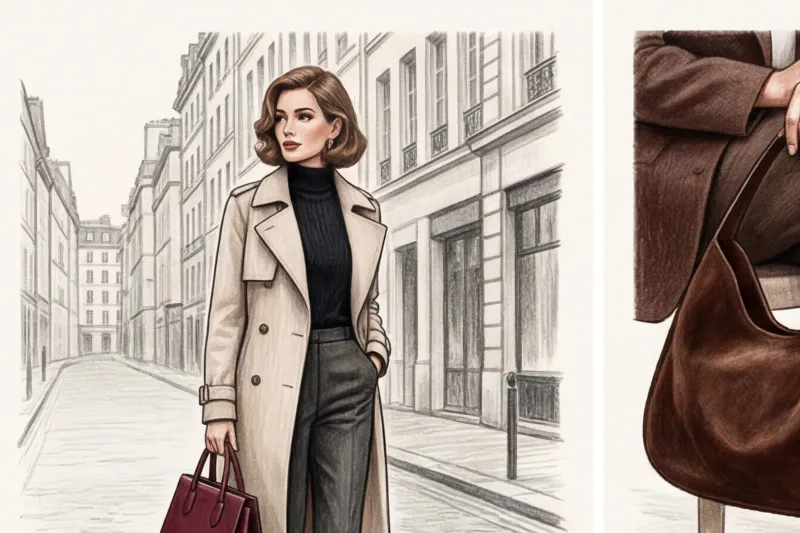
Recently, a client came to me for a wardrobe review. Three perfectly coordinated outfits lay on her bed: a black leather bag with black pumps, a beige bag with beige ballet flats, and a burgundy bag with burgundy ankle boots. These rigid ensembles consumed the lion's share of her budget (around €850). And you know what the problem was? She had absolutely nothing to wear with jeans, oversized sweaters, and relaxed trench coats.
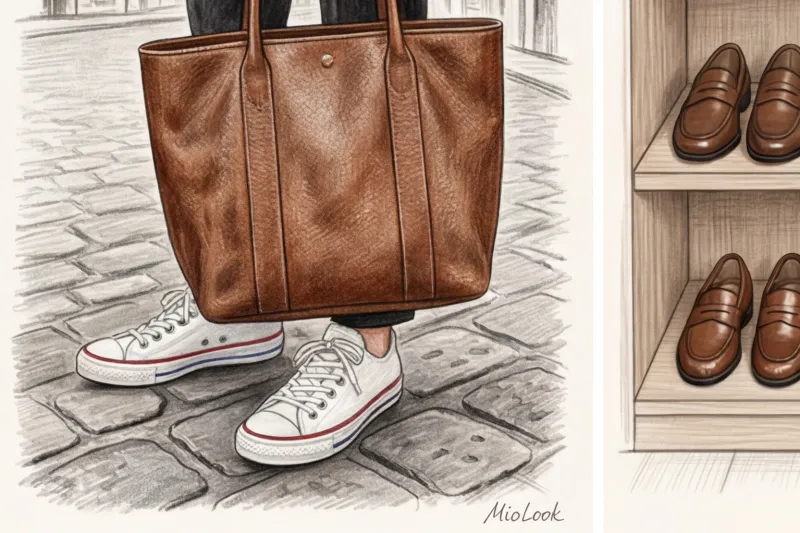
The main question she asked me that day was: Should a bag match your shoes? in a modern wardrobe, or is this an outdated rule that only gets in the way? In my 12 years as a stylist and fabric expert, I've seen hundreds of such "orphaned" wardrobes. We've covered the evolution of these pieces and why they're no longer bought in pairs in our A complete guide to how fashion accessories transform your look and set trends..
Instead of the banal "wear whatever you want," I suggest looking at accessory selection differently. It's not a matter of personal taste, but a precise mathematical tool for managing visual weight and an eco-friendly approach to creating an independent capsule wardrobe.
Historical context: should a bag match shoes in today's reality?
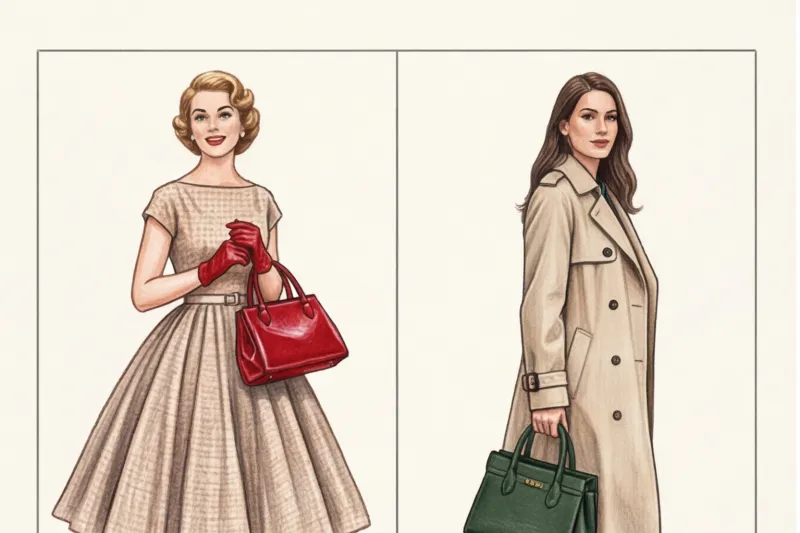
The rule of perfectly matching shades originated in ill-fated circumstances, and then paradoxically became a symbol of luxury. After World War II, the standardization of production and the bourgeois style of the 1950s dictated strict rules: an elegant woman was obliged to demonstrate "put-togetherness." A bag, shoes, and gloves made from the same material screamed status.
Why do rigid sets often seem like a sign of a lack of imagination today? The fast fashion era changed everything. When mass-market brands started churning out identical polyurethane sets for €30, a perfect match ceased to be a marker of exclusivity.
Report Business of Fashion: State of Fashion 2024 This confirms a global shift: consumers are reallocating their budgets. Instead of buying mediocre ensembles, they're investing in standalone accessories. Accessories are no longer just accessories—they're the main driving element of an outfit. So the short answer is no, a bag doesn't have to match your shoes. But this rule can and should be used as a conscious stylistic approach.
When a Perfect Match Is Status (And Why It Works Again)
Almost every stylist has been insisting for the past five years that matching your bag to your shoes is anti-trend and bad form. I'm willing to argue. The perfect match is making a comeback on the wave of "Corpcore" and "Quiet Luxury" aesthetics, but only under one strict condition.
This is the rule of "texture discontinuity." A smooth burgundy calfskin bag paired with smooth burgundy pumps is boring and flat. The light bounces off them equally, turning you into a mannequin from a 2000s shop window.
But try pairing a burgundy bag in soft, light-absorbing suede with smooth, shimmering leather shoes of the same shade. It creates architectural depth. The color symmetry in this case acts as a strong anchor for complex, layered, or avant-garde outfits.
Access to MioLook for €0.99 — one-time payment
A smart AI stylist will select the perfect look based on your wardrobe and suggest the best texture combinations.
Get access — €0.99 onceThe Mathematics of Visual Weight in Accessories
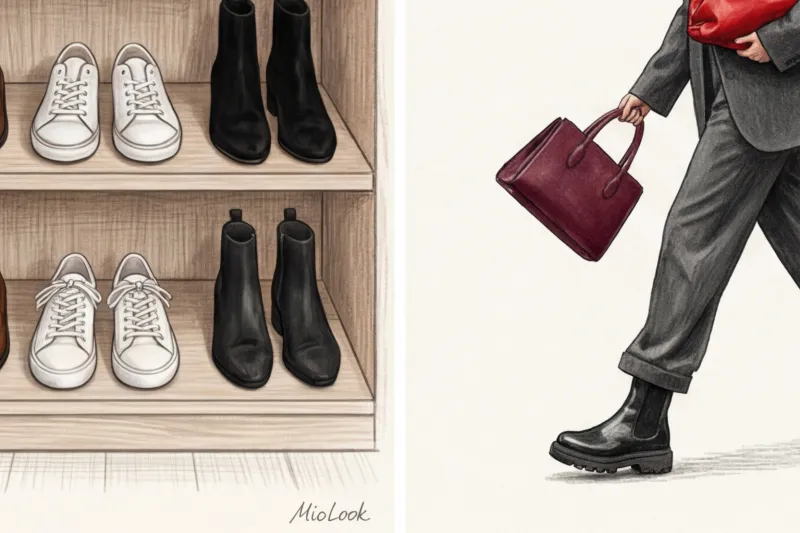
The color and volume of your accessories directly influence how others perceive your proportions. Dark, chunky shoes (such as chunky loafers or heavy boots) visually ground your silhouette. Adding an oversized black shopper bag to such shoes can make your look appear heavy and elongated.
How does balance work? A light or brightly colored medium-sized bag in the portrait area (such as a crossbody) instantly lightens the silhouette, drawing attention away from the heavy bottom. Chunky shoes require architectural support at the top, but not necessarily massive ones. A framed, rigid bag will be enough to balance chunky boots.
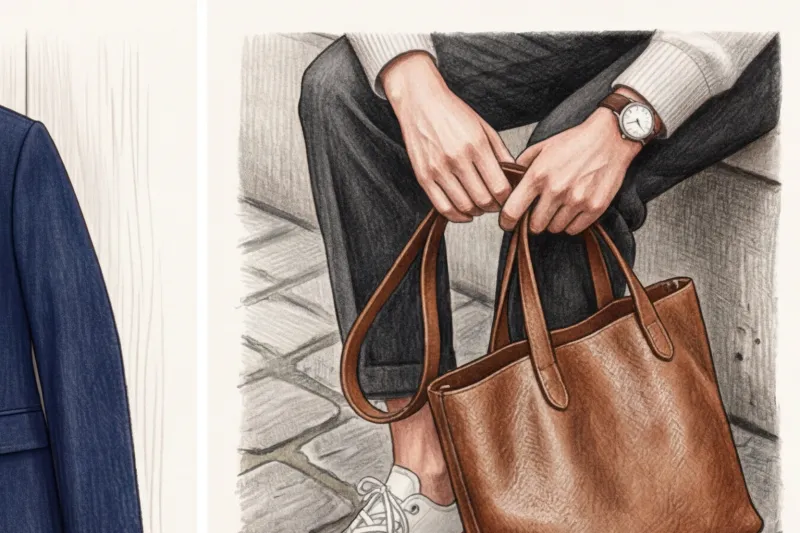
The "Connecting Thread" Rule: How to Pair Shoes and Bags of Different Colors
If we avoid pairing items, how can we prevent the look from falling apart into random pieces? I use an adaptation of Johannes Itten's color theory when working with clients. Accessories can be combined based on contrast, analogy, or temperature balance.
- Temperature balance: Why does the warm chocolate hue of the bag work so well with the cool graphite color of the shoes? Because they have the same depth (saturation) and are linked through the clothing—for example, the gray coat with horn-colored brown buttons.
- Echo Method: My favorite styling trick: We repeat the color of bright shoes not in the bag, but in completely unexpected places: in the print of a silk scarf, in the watch strap, in the glasses frames, or even in makeup (burgundy shoes and matching lipstick). The bag, however, remains neutral.
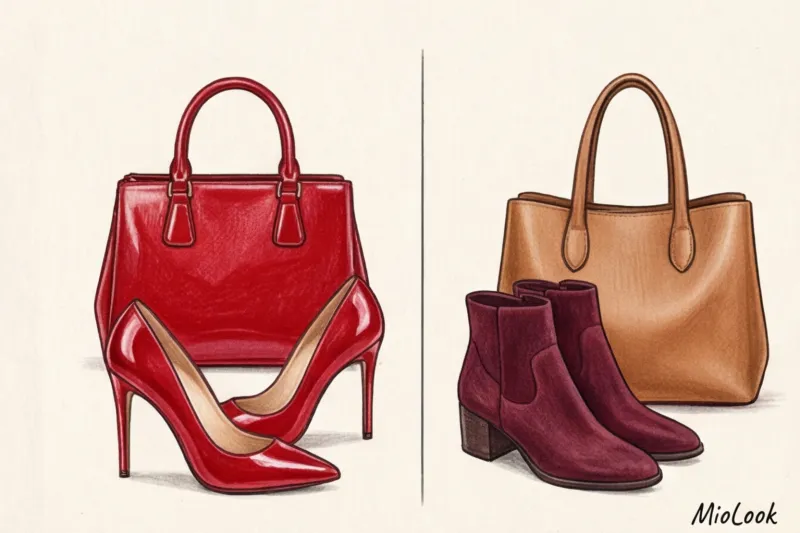
- Complementary contrast: A dark green emerald bag and deep wine-colored shoes. They sit opposite each other on the color wheel, creating a dynamic look that looks far more expensive than a boring black ensemble.
Textile Intelligence: Why Material Quality is More Important than Color Matching
When I first went to inspect tanneries in Tuscany, I realized one important thing: cheap artificial leather, even if it is selected perfect matching color will cheapen your look faster than a high-quality vintage bag that doesn't match anything else in color.
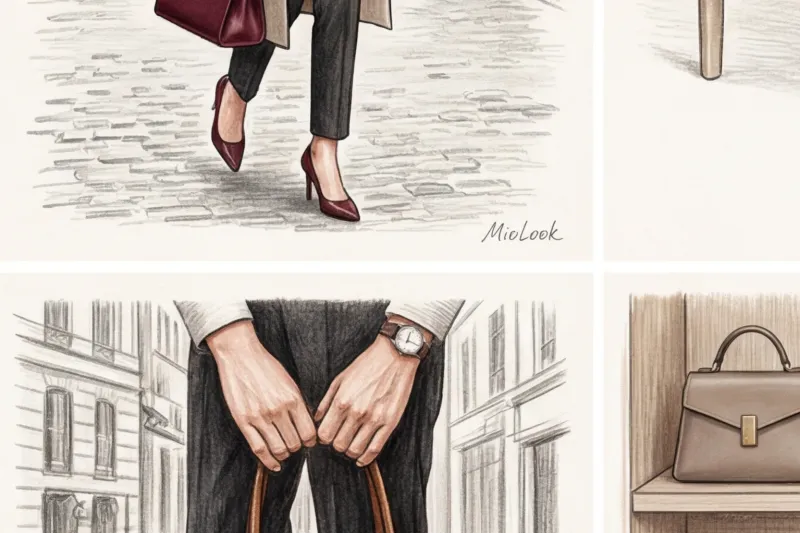
One of the pitfalls of mass-market fashion is selling faux leather sets. But let's apply the math of sustainable fashion. Shoes come into contact with asphalt, chemicals, dirt, and the weight of your body. A bag comes into contact only with your hands and the air. Shoes wear out on average 3 times faster than bags.
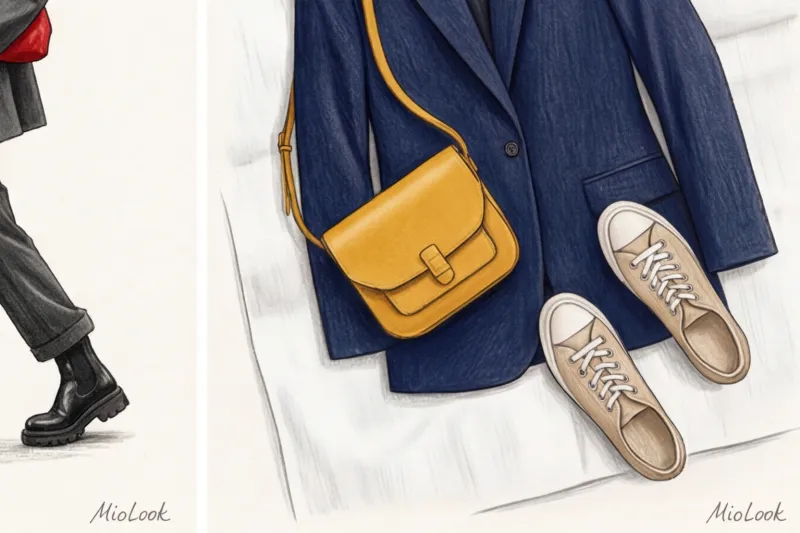
If you buy a set for €200, the shoes will look bad after a season. You'll throw them away, and you'll be left with an orphaned bag in a specific shade that you can't wear with anything because you bought it. only for those shoes.
"The Cost-per-wear concept proves that independent, stand-alone accessories pay for themselves 40% faster than pieces from rigid outfits, as you can incorporate them into dozens of different looks."
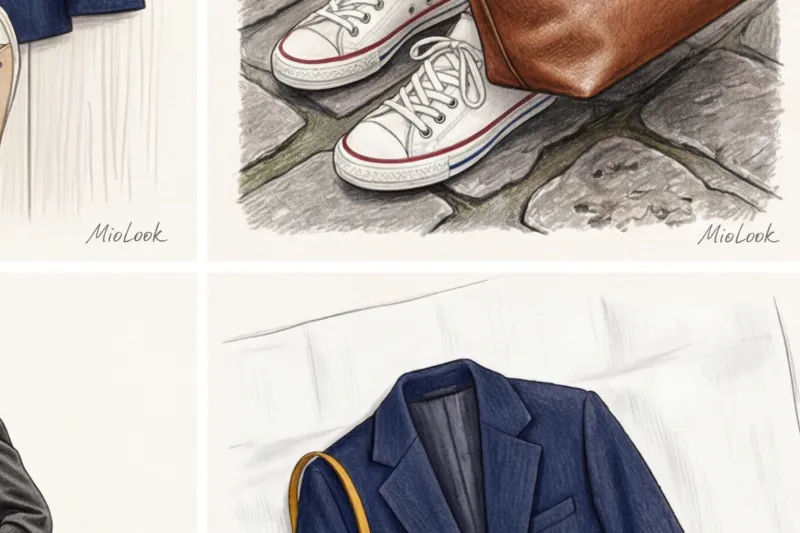
Creating a capsule collection of independent pieces isn't just about style, it's also about eco-friendly consumption. It's better to invest €300 in a single high-quality full-grain leather bag, which will develop a refined patina over time, and wear it with basic canvas sneakers, than to buy five seasonal sets.
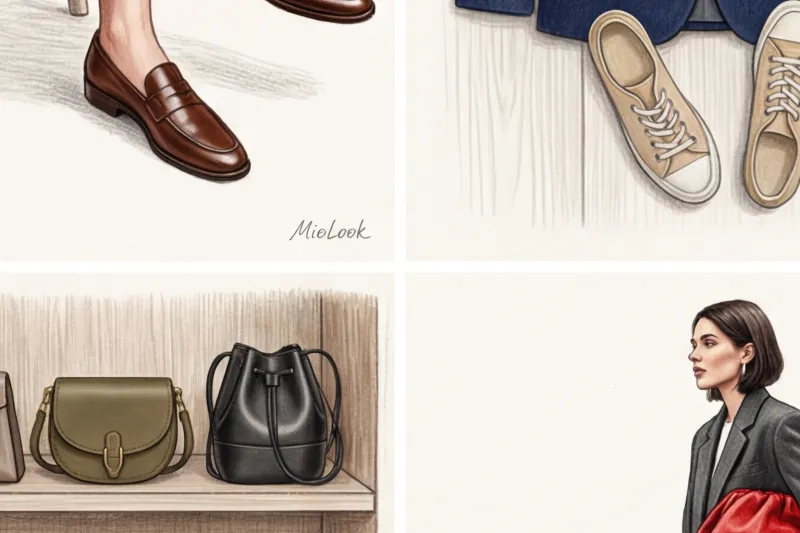
Your perfect look starts here
Join thousands of users who look flawless every day by creating smart capsules with MioLook.
Get access — €0.99 onceStylist's Cheat Sheet: 5 Modern Bag and Shoe Pairing Formulas
Getting ready in the morning should take 15 minutes, not an hour spent agonizing over your makeup in front of the mirror. Save these 5 effective formulas that work flawlessly in modern fashion:
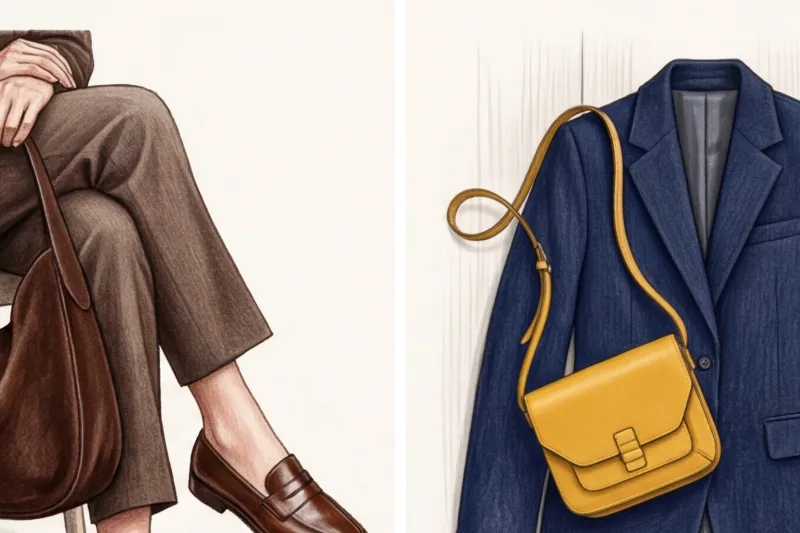
- Neutral base + Color flash. You put on a gray suit, basic black or beige shoes, and pick up a bag in neon green, deep red, or cobalt. The bag functions as an art object in its own right.
- Total monochrome with a play of textures. As we discussed above: black suede ankle boots, a black patent leather bag, a black wool coat. Same color, but different reflections of light.
- Metallic binding. The colors can be anything (for example, blue shoes and a brown bag), but they are united by the hardware. The silver buckle on the loafers perfectly complements the chunky silver chain on the bag.
- Sporty Chic + Structure. A contrast of styles. You wear relaxed, light-colored, retro-style sneakers, but instead of the expected backpack, you carry a tough, formal tote bag, as if you're heading to a board meeting.
- Print + Plain. If you're wearing leopard print shoes, your bag shouldn't be leopard print (otherwise you'll look like a character from a 2000s sitcom). The bag should match one of the shades print - for example, caramel or black.
Mistakes that cheapen your image: what should you avoid forever?
Although fashion has become incredibly democratic, there are still stylistic pitfalls that are instantly perceived as outdated. In my experience, eight out of ten clients have made at least one of these.
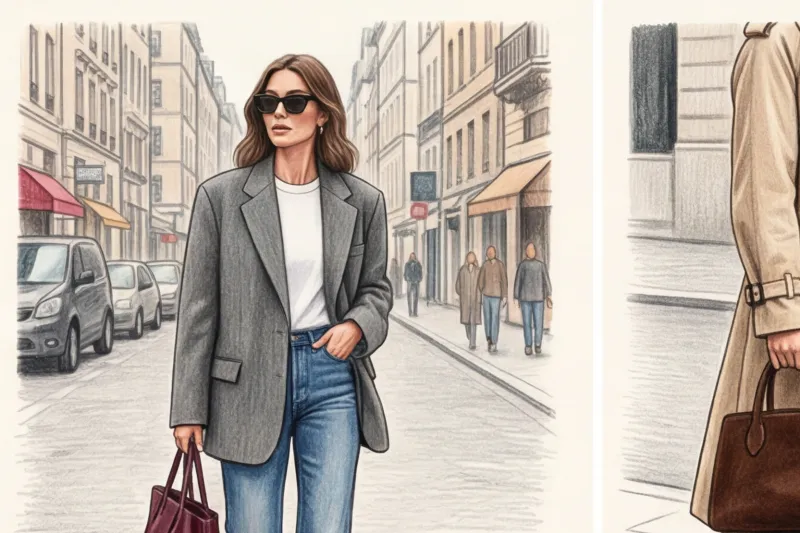
Fear of experiments (total black syndrome). Always wear only black shoes with a black bag "to be absolutely sure." Black is a very contrasting and demanding color. In everyday daytime looks with blue jeans and pastel sweaters, black accessories look harsh. Swap them for dark chocolate, graphite, or deep burgundy—your style will instantly soar.
Ignoring context. When color-coordination rules are taken to the extreme, ignoring the purpose of items. For example, pairing powder-colored office pumps with a rhinestone evening clutch of the same powdery shade at 10 a.m. Color-coordination doesn't negate the rule of appropriateness: evening textures (satin, rhinestones, feathers) don't work in the daylight of an office.
Buying "sets" in mass markets. I've mentioned this before, but I'll repeat it: if you see a bag and shoes in a store that are sewn from the same roll of faux leather, walk on by. They strip the look of its individuality and make it look flat.
Style isn't about following rigid rules, but rather understanding how to break them gracefully. Stop searching for the perfect pair to match your shoes. Let your bag be the standalone hero of your wardrobe, and you'll see how your looks become lighter, more modern, and more interesting.