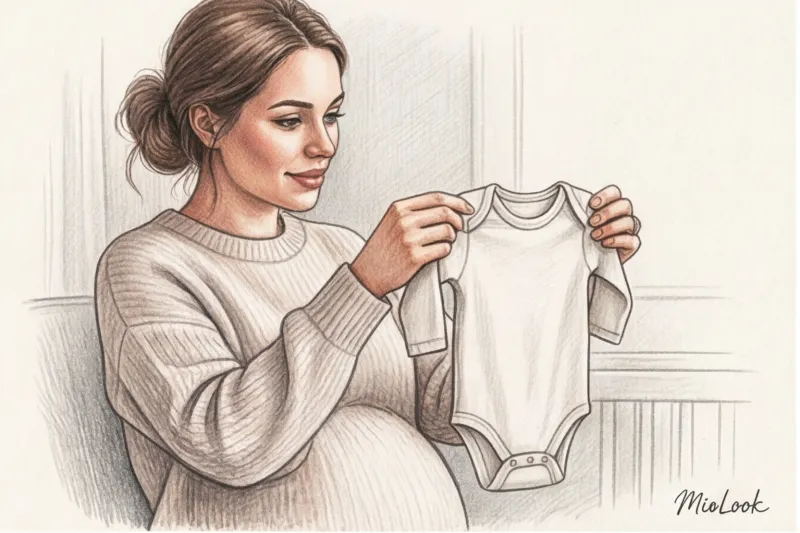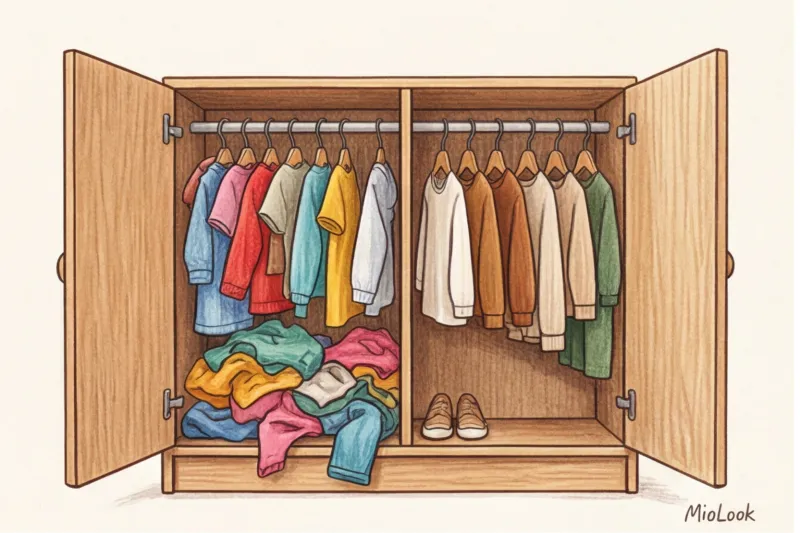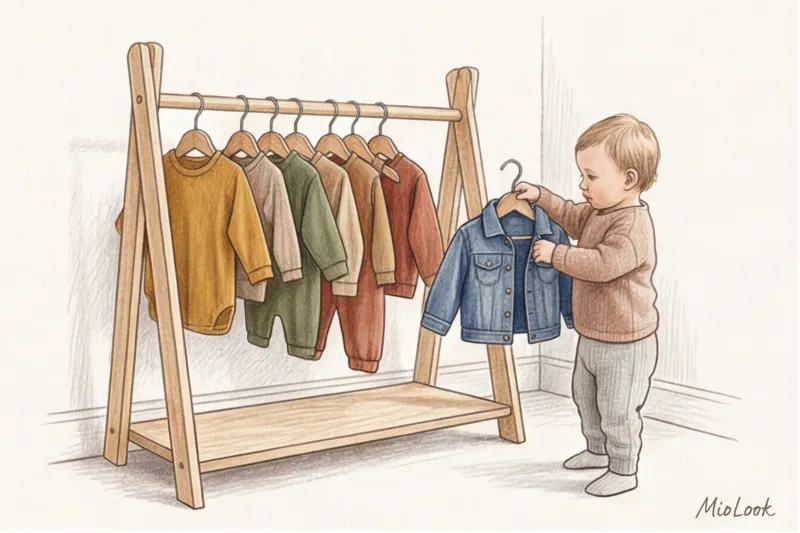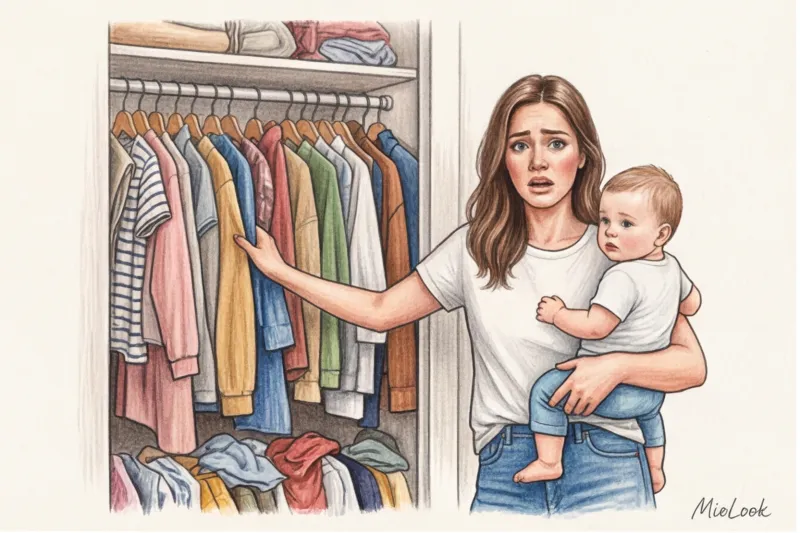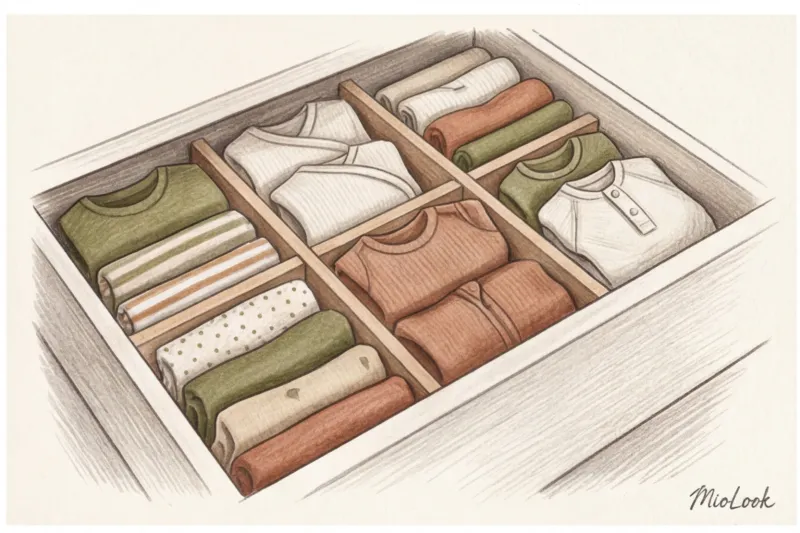
I distinctly remember one of my clients—let's call her Anna. A month before her due date, succumbing to the magic of nesting, she bought twenty adorable size 50 bodysuits. Guess what happened next? Her baby outgrew them exactly two weeks later. Over two hundred euros were spent on items the baby wore only a couple of times. As a stylist, I've been helping women put together flawless work capsule wardrobes for years, but when it comes to babies, emotional shopping often trumps common sense.
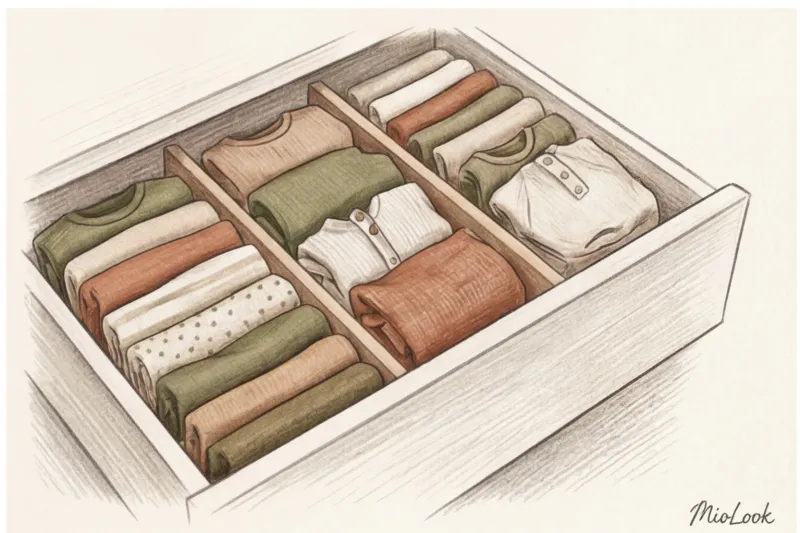
Let's face it: Basic wardrobe for a newborn This isn't about lacy bonnets or buying things "just for a nice photo on social media." It's about saving a mother's sanity at three in the morning, when you need to change a diaper in the dark, using one hand. Today, we'll apply the rigorous, pragmatic methodology of the adult capsule to baby items.
A Basic Wardrobe for a Newborn: Why a Capsule Wardrobe Saves Moms
When we talk about a systematic approach to children's things, many are surprised: why does a baby need an "adult" concept? We discussed the philosophy of this method in more detail in our A complete guide to creating a capsule wardrobe for your child , where we discussed in detail how the structure saves time. But for a newborn, the capsule does even more—it eliminates decision fatigue.
During the first months of life, your brain is overloaded. You don't need to stand in front of an open dresser trying to remember what to wear with that bright green onesie your mother-in-law gave you. A baby capsule is a compact, 100% interchangeable collection of items, where any top goes perfectly with any bottom.
In my practice, I often draw on the Mediterranean aesthetic: a focus on quality over quantity, natural textures, earthy tones, and relaxed elegance. This approach translates perfectly to babies. A well-curated base can save up to 40% of the budget typically spent on impractical "cute" items and visually calm the nursery space.
Debunking the myths: what you definitely shouldn't buy for a baby
Let's be honest: the popular "maternity bag" lists that have been floating around the internet since the 2010s are hopelessly outdated. They force expectant mothers to buy things that only complicate their lives.
- Myth 1: You need a lot of clothes in sizes 50–56.
Reality: According to pediatric data, babies grow an average of 1–1.5 cm per week during the first month. Size 50–56 (newborn) will become too small after 2–3 weeks. Buy at least this size, and focus your budget on size 62 (0–3 months). - Myth 2: Separate anti-scratch mittens are essential.
Reality: They fall off exactly three seconds after you put them on. Instead, look for onesies and bodysuits with built-in cuffs. - Myth 3: Dressing like grown-ups is stylish.
Reality: Stiff denim, hoodies, and tulle dresses are a tactile nightmare for someone who spends 20 hours a day lying on their back. Save these outfits for toddlers. - Myth 4: Back fastenings are convenient for changing clothes.
Reality: Any snaps, buttons, or zippers on the back create pressure points on the baby's delicate spine while lying down. All hardware should be located at the front or side.
The formula for the ideal first capsule (sizes 56 and 62)
My favorite styling formula for newborns, which I call the "three-layer rule," is:
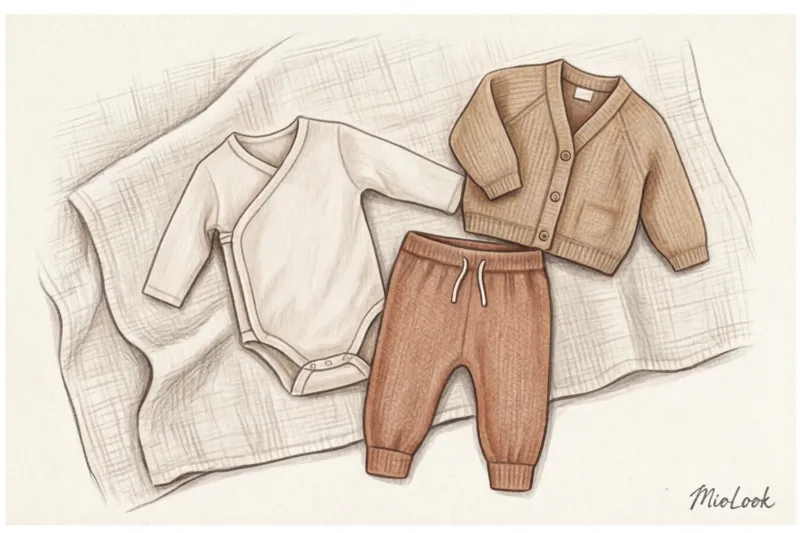
A kimono bodysuit + loose-fitting romper + a cardigan = the perfect layered look.
Why a kimono bodysuit (with a wrap)? Regular bodysuits, which need to be pulled over the head, are a real stress for inexperienced parents and the baby themselves, as the neck muscles are not yet strong. A wrap-around design with snaps allows you to simply place the baby on the unbuttoned garment and fasten it around them.
Loungewear and Sleepwear: Focus on Comfort
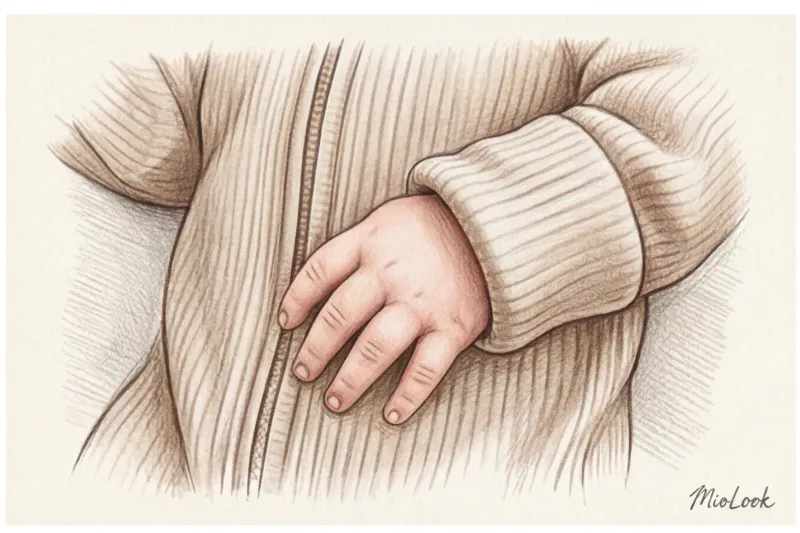
The foundation of a home wardrobe is slips (overalls). In my practice, I've established a strict rule for my clients: If you can't unfasten the sleepsuit with one hand in the dark, it won't fit into the capsule. Look for models with a two-way (reversible) zipper. This allows you to open the jumpsuit from the bottom up only at the diaper area, without exposing your baby's chest.
As for the legs: onesies with closed feet are more comfortable (no need for socks that are always getting lost), but onesies without feet (with cuffs) will last a month longer, since they do not restrict the growth of the legs.
Walking clothes: the principle of layering
Pediatric thermoregulation guidelines (2023) remind us that infants lose heat faster than adults, but they also overheat just as quickly. The adult outdoor rule applies: a base layer (cotton), a midlayer (fleece or merino wool), and an outer layer (a sleeping bag or a jumpsuit, depending on the weather).
Stylist's advice: Never check your baby's cold by checking their nose or hands—babies have poor peripheral circulation. Feel the back of their neck. If it's hot and clammy, you've applied too many layers.
Organize your kids' wardrobe smartly
Upload photos of baby clothes to MioLook to plan combinations in advance and avoid impulse purchases.
Get access — €0.99 onceFabrics, Accessories, and Color: Secrets from a Stylist and a Mom
One of my favorite insider tricks is Ribbed fabric life hack (Noodle fabric). For some reason, experienced mothers know this, but gift set manufacturers don't. Cotton noodle fabric has a remarkable property: it stretches horizontally as the baby gains weight, providing a snug fit without being too tight. A smooth cotton onesie will last you a month, while the same onesie made of ribbed fabric will last almost two and a half.
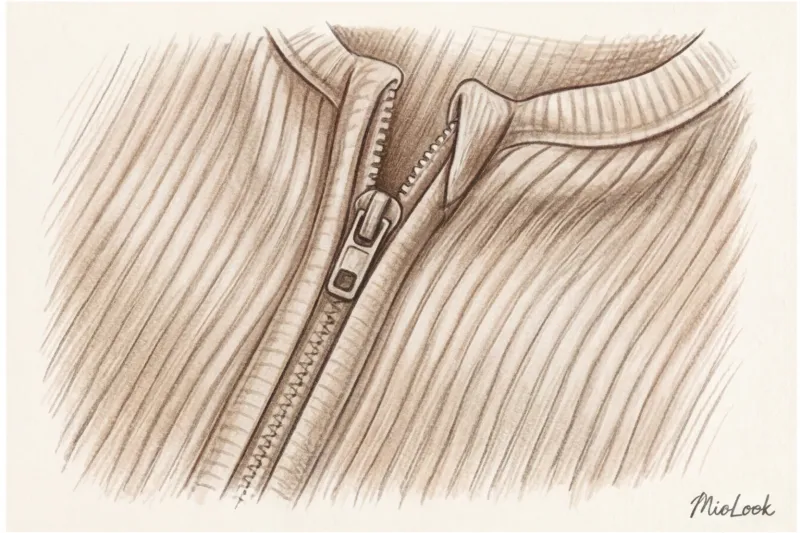
The second critical point is the safety of the materials. Look for certification on the labels. Oeko-Tex Standard 100 This is an international standard that guarantees the absence of harmful dyes and phthalates, which can cause dermatitis on infants' delicate skin. All hardware must be concealed: zippers must have a fabric pull tab under the chin, and tags must be printed directly on the fabric (or easily removed).
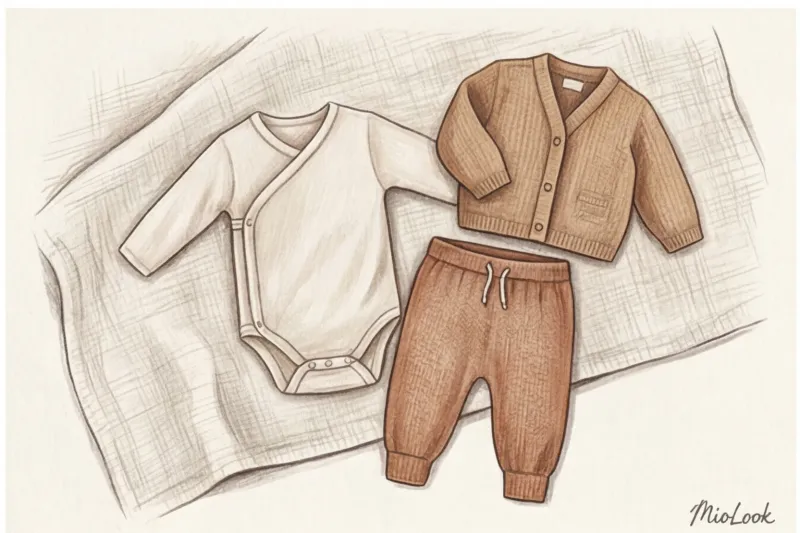
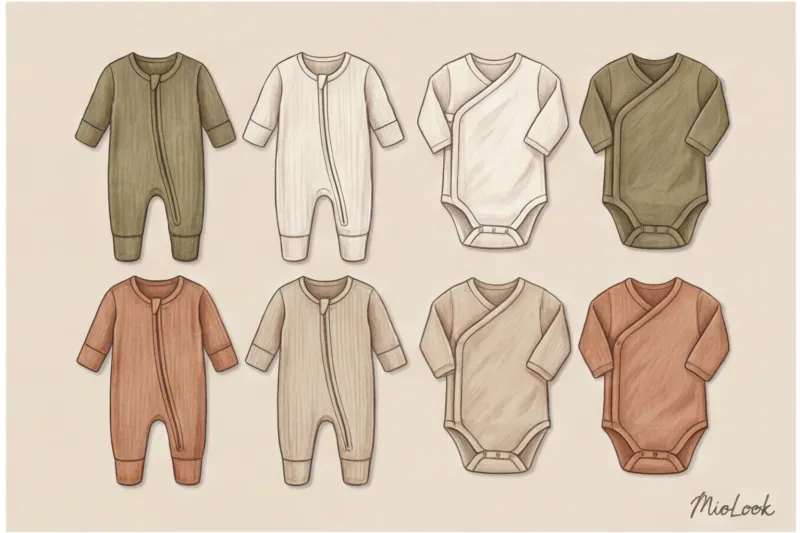
When it comes to color, forget the stereotypical divisions between "pig pink" and "poison blue." We're building a Mediterranean palette: olive, deep terracotta, cream, mustard, and dusty gray. Firstly, it looks expensive and elegant. Secondly, such deep, natural shades are gender-neutral. Thirdly, if your baby burps in an olive bodysuit, you can simply swap it for a terracotta one, and the look will still remain stylish and harmonious.
Checklist: Basic Wardrobe for a Newborn in the First Month
I won't give you abstract advice like "buy several bodysuits." Babies spit up. Diapers leak. On average, you'll go through 3 to 5 changes of clothes per day. Assuming a reasonable routine for a mom, washing every 2-3 days, here are the exact numbers for the first capsule (preferably in size 62):
- 5–7 slips (overalls for sleep and home). Exclusively with a two-way zipper. In the mass-market segment, a good cotton sleepsuit costs between €15 and €30.
- 5 wrap kimono bodysuits Preferably made of ribbed fabric.
- 3-4 pairs of soft rompers or joggers The elastic band should be wide and elastic so as not to put pressure on the healing navel.
- 2 cardigans or sweaters Ideal composition: dense cotton or soft merino wool (it repels moisture and regulates temperature).
- Accessories: 2 soft hats without ties (knots under the chin are dangerous) and 3-4 pairs of socks that actually stay on the foot.
Your perfect look starts here
Join thousands of users who look flawless and organize their closets every day with MioLook.
Get access — €0.99 onceHow to use MioLook to organize baby items and gifts
One of the most common requests from pregnant clients: "How do I tell my relatives not to give us those awful synthetic bunny costumes that we'll never wear?".
This is where wardrobe digitalization comes into play. Upload your purchased basics to the app. MioLook Firstly, you'll clearly see your palette and understand what's missing (for example, you have three bottoms but only one warm top). Secondly, the app will help you track sizes—babies grow in spurts, and mothers often forget that in the far corner of the dresser there's a pair of size 68 rompers, never worn.
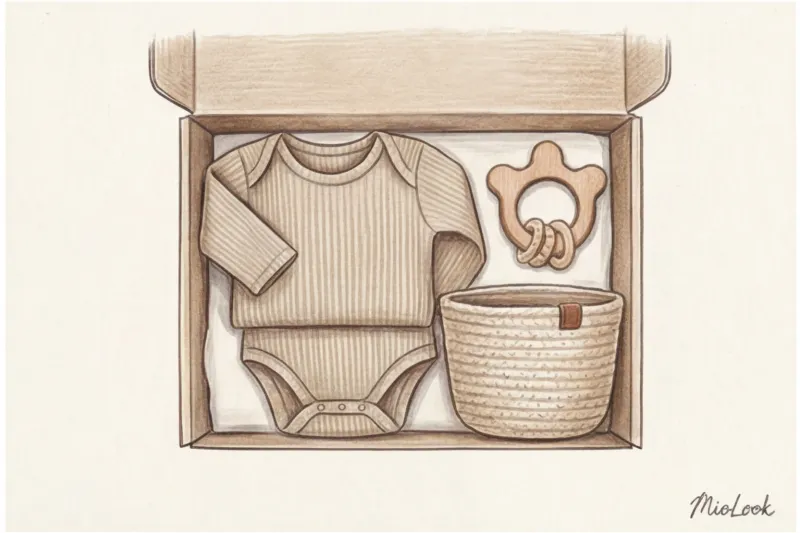
But most importantly, you can use your completed capsule collection as a visual reference for your loved ones. By sending them a selection from the app, you're gently setting the tone: "Look, we're putting together a wardrobe in these natural shades." This is the most eco-friendly form of wish list: you don't demand a specific brand, but you do specify the style and color scheme. Your family is happy to participate, and you're protected from those plush leopard-print overalls.
Building a newborn's wardrobe shouldn't be a race to the bottom. Allow yourself some space for calm. Fewer items are acceptable, but each one is easy to put on, will withstand dozens of washes, and is pleasing to the eye. Ultimately, an aesthetically pleasing and functional wardrobe in the first months of motherhood is needed not so much by the baby as by the mother herself.