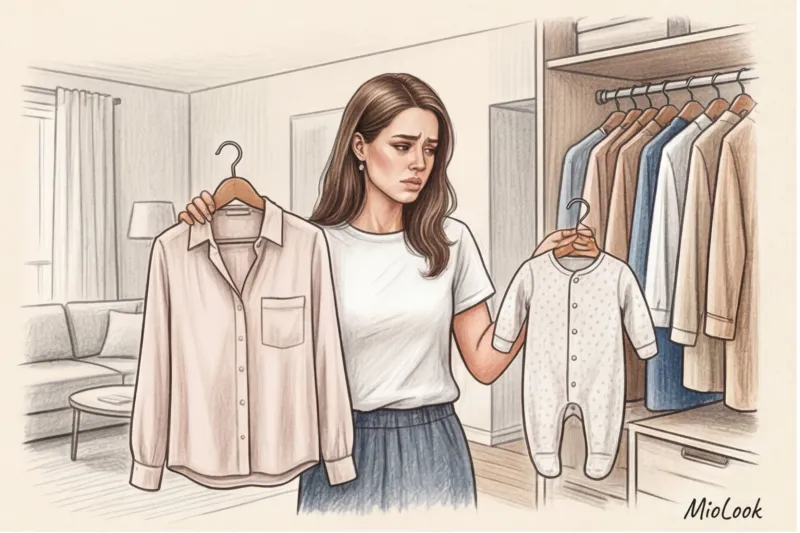

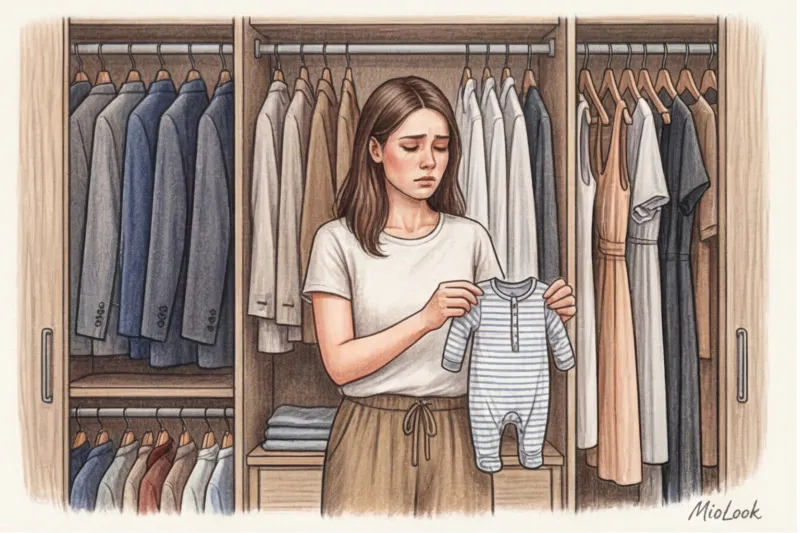
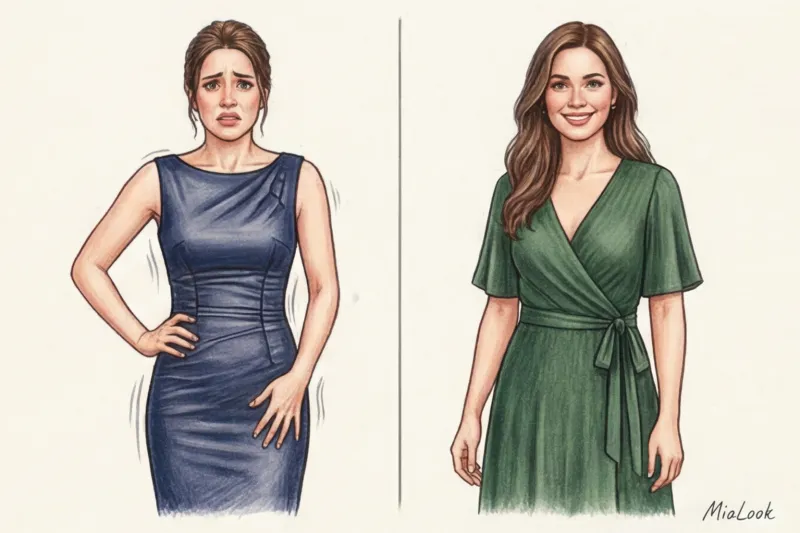
One of my clients literally burst into tears in front of her open closet in her third month of maternity leave. She had on perfect velvet hangers a selection of tailored wool jackets and silk blouses, and clutched a tiny bodysuit with spit-up stains in her hands. "I have a full wardrobe, but I wear my husband's old hoodie to the playground because I feel sorry for my own clothes and have nothing else to wear," she confessed. That same day, we vacuum-sealed 90% of her office wardrobe and hid them on the back shelves. Guess what happened? Her daily morning stress level dropped by half.
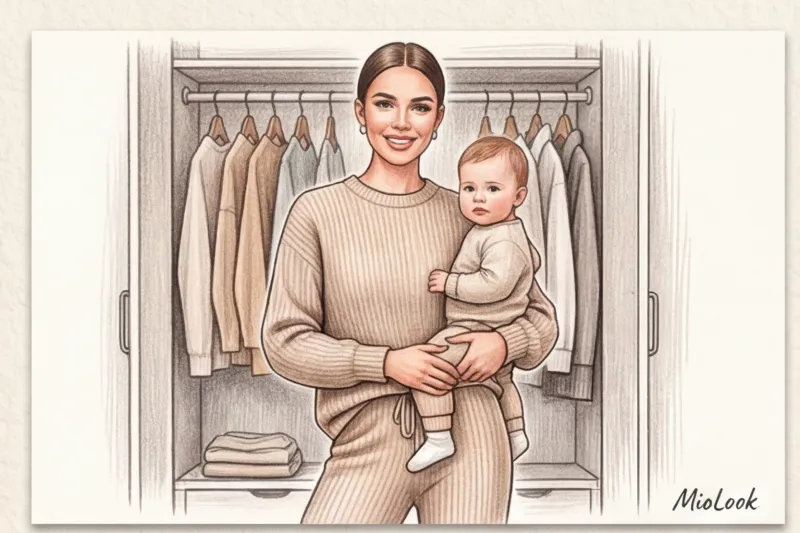
Instead of the banal advice to wear shapeless tracksuits, I offer you the concept of "structured comfort." Properly assembled capsule collection of clothes for maternity leave — it's a wardrobe that feels like your favorite pajamas, but looks like street style from Fashion Week. And most importantly: it evolves with your child. I discussed the basic principles of this type of space organization in more detail in our The Complete Guide to Creating a Capsule Wardrobe , but motherhood requires very special, almost engineering-like settings.
The "Loungewear" Trap: Why We Need a Maternity Clothing Capsule
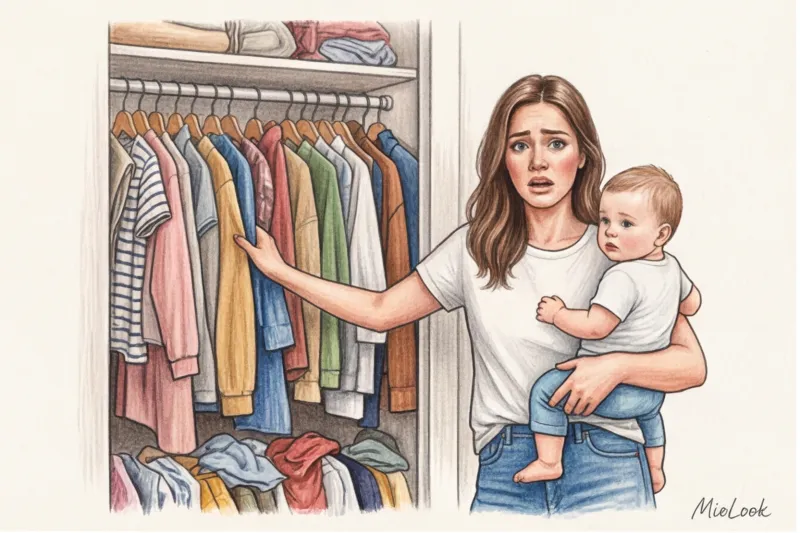
Every morning, opening your closet and seeing your pre-pregnancy office clothes is a microscopic but painful emotional blow. These things remind you of your life, which is now on hold. The paradox of maternity leave arises: your closet is bursting with clothes, but you have nothing to wear to buy bread or run to the doctor's office.
This is where the psychology of style comes into play. Researchers from Northwestern University (Adam and Galinsky, 2012) coined the term "enclothed cognition." They demonstrated that clothing directly influences our cognitive processes and energy levels. A stretched-out, pilling sweatshirt communicates to the brain, "we're sick" or "we're too tired." A neat, well-fitting knit suit sends the signal, "we're focused and ready for action."
"Wearing old T-shirts that you don't mind getting rid of is a surefire way to lose your sense of self-worth while on maternity leave. Comfort and neatness should be synonymous."
I once asked a client to track her wardrobe using an app. The data was brutal: 90% of the time, she wore just three items with permanent mashed potato stains, simply because she "didn't mind ruining them." A true maternity wardrobe capsule solves this problem mathematically. Statistically, a mother has, on average, only two to three minutes to get ready before going out. The math of style dictates that 15 well-chosen functional items replace 40 emotional purchases and save up to 30% of your clothing budget.
The Anatomy of the Ideal Maternity Capsule: 3 Ironclad Rules for Moms
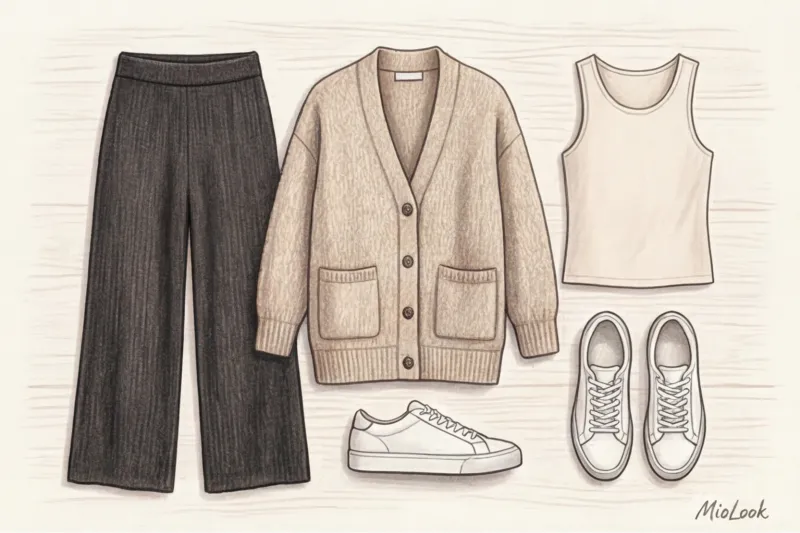
Forget about filtering things solely by the "pretty/not pretty" principle. We're moving to a technical approach to wardrobe analysis. The concept is structured comfort This means we choose fabrics that stretch 360 degrees but still have structure: they hold the shape of the shoulders, don't stretch out at the knees, and don't hang baggy.
The second rule is the layering principle. Life as a mother is a constant cycle of temperature fluctuations. You might be freezing in the wind while pushing the stroller, and five minutes later, sweating in a stuffy mall or clinic. Your look should be easily transformed by removing one layer with one hand.
The 3-Minute Rule: Dressing Blindly
You don't have time to stand in front of the mirror and pick out shades. Therefore, every bottom in your capsule collection must perfectly match at least three tops. If you buy trousers that only go with one specific blouse, it's not a capsule collection; it's a headache.
Pay special attention to your shoes. Look for styles that allow you to jump into them hands-free while balancing the car seat in one hand and your bag in the other. Chelsea boots with wide elastic bands, slip-ons, loafers, or sneakers with elastic laces (like Salomon or elastic ones for basic sneakers) will save you hundreds of nerves. Important limitation: This advice about shoes without ankle support doesn't work if you have orthopedic problems or joint hypermobility after childbirth—in this case, choose models with Velcro.
Touch safety and vandal-resistant fabrics
Your baby constantly rubs their face against your shoulder or chest. Rough sequins, stiff wool, and scratchy lurex are a thing of the past. I've personally tested dozens of materials for their "vandal-proof" qualities—their ability to withstand burps, fruit purees, and sandboxes.
Follow dermatologist standards. Ideally, items should be Oeko-Tex Standard 100 certified (meaning the fabric is safe for close contact with baby's skin). Avoid anything that requires dry cleaning, hand washing, or long ironing. Your best bet is dense mercerized cotton, viscose blends (up to 30%), and modern modal. They are easy to wash at 40 degrees and do not fade.
Ready to get started?
Try the MioLook plan for free—no commitments required. Digitize your wardrobe and start creating stylish looks in seconds.
Get access — €0.99 onceA Basic Maternity Clothing Capsule: A 15-Piece Formula
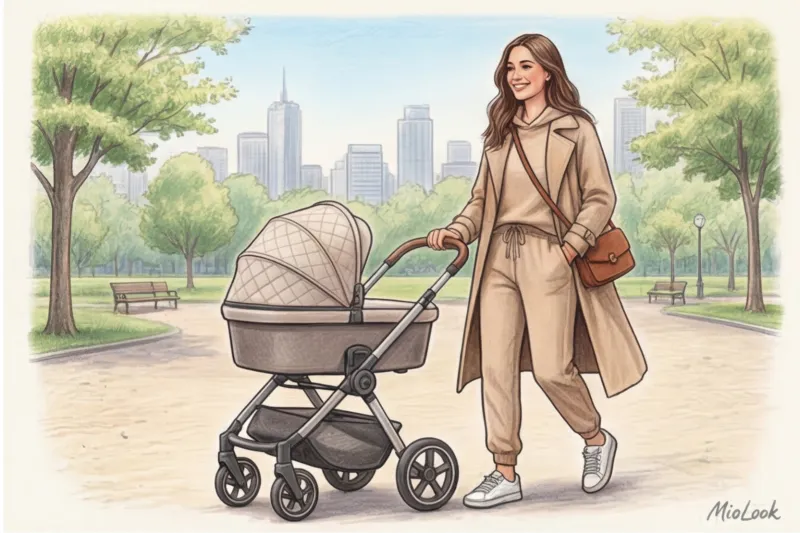
I like specifics. Here's a proven formula that, according to my calculations, yields up to 45 different combinations. That's enough to ensure no repetitions over a month and a half of daily walks.
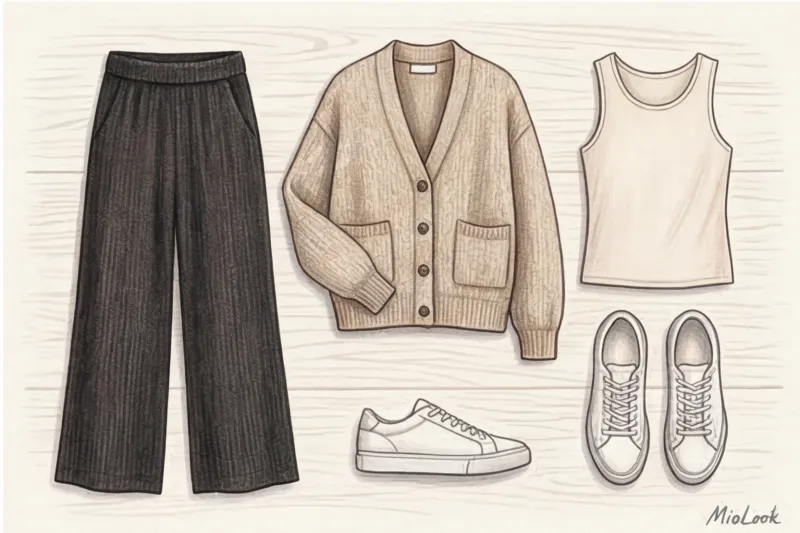
- 3 bottom options: The right pair of sweatshirt joggers (loop-fit, not brushed—to keep you cool indoors), straight-leg jeans with a mid- or high waist (choose styles with 2-3% elastane), and flowy jersey palazzo pants with a soft elastic waistband.
- 5 top options: 2 basic tightly knit t-shirts (at least 180 g/m², so that nursing underwear doesn't show through), a high-quality cotton long sleeve top, a loose-fitting shirt (perfect for layering), and an oversized sweatshirt.
- 2 dresses or one-piece suits: A knitted midi dress (the noodle fabric perfectly conceals figure nuances and is stretchy) and a versatile footer suit.
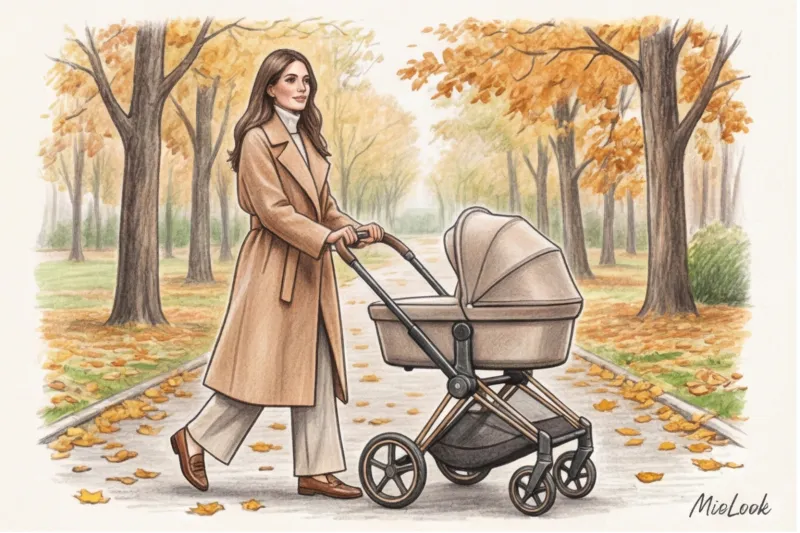
- 3 top layers: A long, chunky knit cardigan (will replace a coat in dry weather), a denim jacket or a thick overshot shirt, and a voluminous windproof trench coat or a light quilted down jacket.
- 2 pairs of shoes: white basic leather sneakers (leather is easy to wipe clean with a damp cloth, unlike fabric) and comfortable Chelsea boots or loafers.
These 15 elements are the canvas. You can add seasonal pieces (a winter parka or summer shorts), but this core will work for you 80% of the year in most climates.
Wardrobe Evolution: How Your Capsule Changes with Your Child
Many brands sell maternity clothing as a monolithic package. But the unique insight is that maternity leave isn't a single phase. It's three completely different lifestyles, each requiring a different outfit. What worked perfectly in the first month will be completely dysfunctional by the first birthday.
0-6 months: Focus on breastfeeding and recovery
During this period, you spend a lot of time at home, with a stroller in the park, or at the clinic. The main technical requirements of clothing are quick access for feeding and gentle adaptation to changing body sizes.
Look for items with hidden zippers in the seams, wrap tops, and button-down shirts (buttons take too long to undo with one hand). Silhouettes should be loose around the midriff. Soft fabrics are paramount here. Choose softened linen, viscose, and heavy cotton. Avoid stiff waistbands and tight necklines.
6-18 months: Active walks and sandboxes
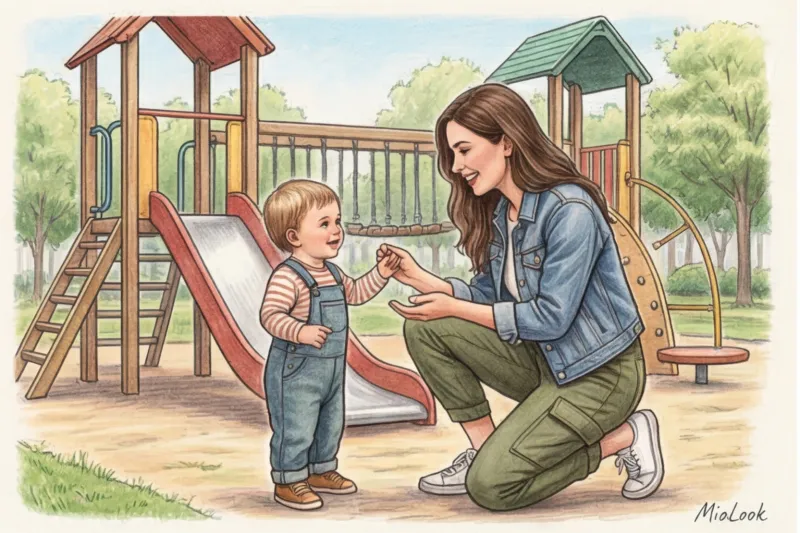
The baby crawled, then ran. Your needs change dramatically. Whereas before you gracefully pushed the stroller, now you squat 50 times during a walk, catch the toddler from a slide, and brush sand off your knees.
The priority shifts to durability. Trousers must withstand abrasion, and shoulder seams must withstand sharp tugs. It's at this stage that crossbody bags and stylish urban backpacks (such as nylon or faux leather) are integrated, completely freeing up your hands.
Try MioLook
A smart AI stylist will create the perfect look for you. Simply upload your items and receive ready-made combinations every day.
Get access — €0.99 onceThe main mistakes when packing a maternity wardrobe (and how to avoid them)
The first and most damaging mistake is leaving office or dressy clothes "on display." We've already discussed this: the visual clutter of clothes you can't wear right now causes guilt and frustration.
The second trap is buying ultra-cheap, one-time wear items, thinking, "I'm only going out with the baby." Cheap knitwear loses its shape after the first wash, becomes covered in pilling, and makes you look tired. It's better to buy one thick, mid-priced T-shirt (for example, from COS or high-quality local brands) than five thin, mass-market pieces.
The third mistake is completely ignoring accessories. Accessories are what turn a basic T-shirt and sweatpants into stylish street style. Pair joggers with chunky sunglasses, a simple watch, and a structured crossbody bag—and you're no longer a "worn-out mom" but a Pinterest cover girl.
"The most harmful myth about a mother's wardrobe is the belief that black is the most practical color."
And now the main refutation of popular advice. Black is the worst color for maternity leave. Everything shows on black: dried milk stains, drool, playground dust, cookie crumbs, and pet hair. Your best bet is a colorful melange (a fabric made from fibers of different shades), beige, taupe, khaki, and small prints. On a light melange sweatshirt, a small milk stain will be practically invisible, whereas on a black one, it will light up like a neon sign.
Checklist: Assembling Your Capsule Over the Weekend
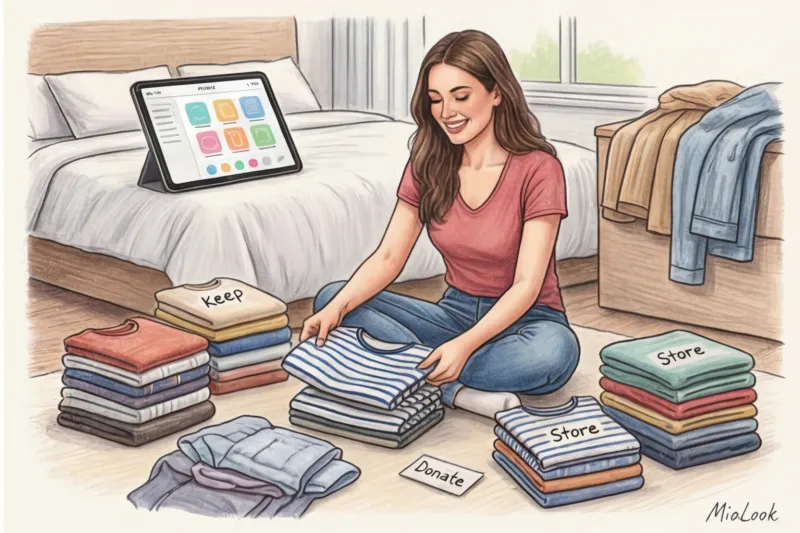
Style thrives on system. You can assemble your capsule wardrobe in just two days if you follow a consistent approach.
- Step 1: Inventory and ruthless sorting. Take everything out of the closet. Vacuum-seal any items that are tight, require careful ironing, are itchy, or are marked "dry clean only." What's left is your work material.
- Step 2: Identifying "holes" and digitizing. Look at your remaining items. What's missing to complete the bundle? Do you have three great bottoms but only one comfortable t-shirt? Write it down. To make the process easier, take photos of your items and upload them to MioLook app Its AI features will help you see your actual wardrobe at a glance and automatically suggest outfit formulas based on what you already own.
- Step 3: Trying out the finished formulas. Plan your outfits in advance. Put them on, look in the mirror, and take photos of your favorite looks on your phone. Save these photos in a separate album called "What to Wear." Tomorrow morning, when the baby is crying and you need to get out quickly, this morning cheat sheet will save you.
Conclusion: Reclaiming Ourselves Through Style
Clothes are just a tool. They should serve you, support you, and make your life easier, not make you feel guilty or restrict your movement. When you find balance in your clothes, you regain control of your life, even if right now that control is limited to the playground.
A capsule wardrobe while on maternity leave is the best investment in your peace of mind, self-confidence, and personal comfort. And if you want to transform your mornings tomorrow, take one simple step today: open your closet and remove from sight exactly one shelf of clothes you haven't worn in the last three months.