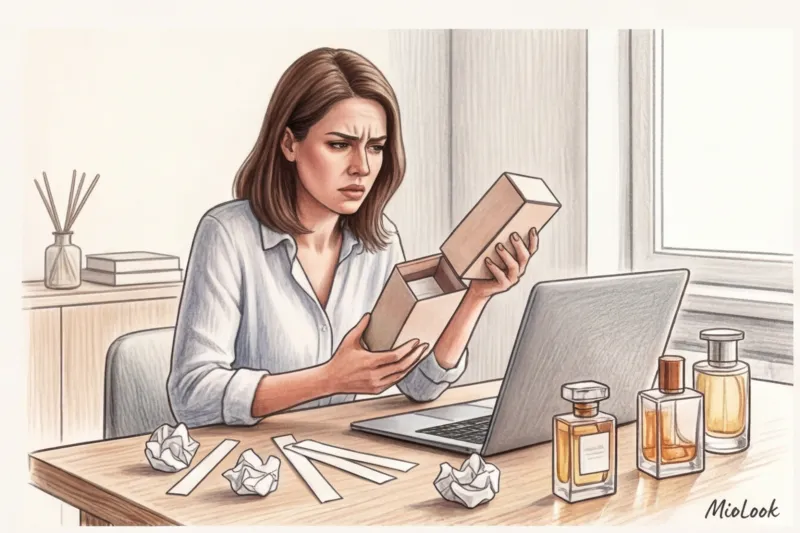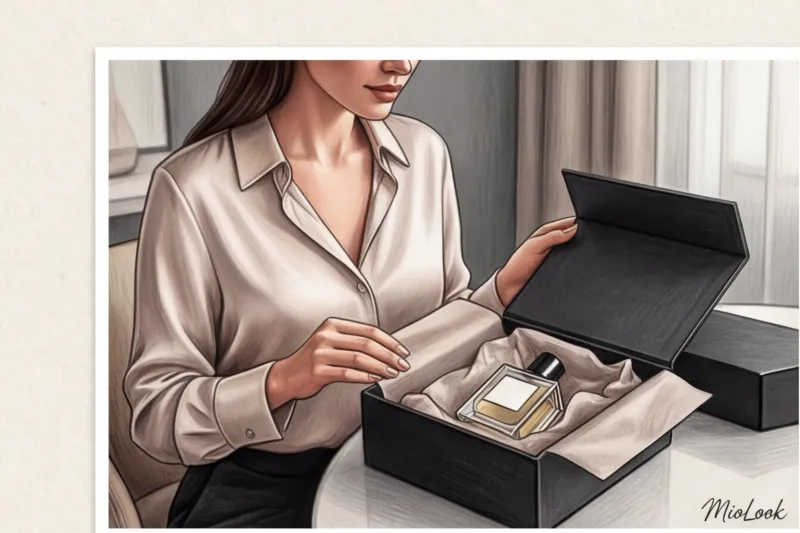
Have you ever noticed how perfume descriptions in online stores often resemble a Michelin-starred dessert recipe? "Sparkling Calabrian bergamot intertwines with velvety Madagascar vanilla on a bed of rare oud." It sounds hypnotic. You click "Add to cart," wait for delivery, spray the fragrance on your wrist, and... smell like an old powder compact and hospital bandages.
As a stylist working with the premium segment, I constantly hear this question from my clients: How to choose perfume without testing it and not turn the purchase into an expensive lottery? Especially when it comes to niche perfumes, which are often simply not available in offline boutiques outside of major cities. We've already covered the basic principles of selection in more detail in our the complete guide to niche perfumery.
The truth is, buying a fragrance online isn't a gamble. It's a smart investment in your personal brand. And to make it pay off, you need to learn to read olfactory pyramids the same way a professional tailor reads fabric composition.
Why We Buy Perfume Blindly (And When It's Worth the Risk)
Let's be honest: niche perfume isn't cheap. A bottle can cost 200, 300, or even 500 euros. Why not just go to a chain store and buy a well-known luxury brand?
Because fragrance is your invisible accessory, your olfactory wardrobe. One of my clients, a top manager from a small town, has amassed an incredible collection of rare, select fragrances exclusively through online orders. No one else in her circle has such signature scents. This gives her a tremendous advantage in positioning.
If you break down the cost of buying a niche fragrance into numbers, the math will surprise you. A 100 ml bottle for €250 equates to approximately 1,000–1,200 sprays. With daily use (3 sprays), one day of this luxurious scent costs about €0.60. That's cheaper than a cup of espresso. Investing in perfume is often more cost-effective than buying another handbag (the cost-per-wear is simply phenomenal).
But there is one strict limitation: Never buy a fragrance blindly if you need it for a specific event tomorrow. A wedding, an important speech, a board meeting—for such occasions, you need a proven "anchor" that you're 100% confident in. A blind purchase requires time to get to know the product: anticipation, unpacking, and the intimate process of testing it out in private, without the pressure of consultants and their blotters.
Access to MioLook for €0.99 — one-time payment
A smart AI stylist will create the perfect look based on your new perfume wardrobe.
Get access — €0.99 onceThe Pyramid Illusion: How to Choose a Perfume Without Testing and Avoid Marketers' Fools
Now I'm going to reveal the biggest secret of the industry that will change your understanding of perfumery. The notes stated on the website are not the composition in the bottle. This is pure marketing fantasy, an illusion designed to evoke the desired associations in you.
When you see "morning rose" in a description, the bottle likely doesn't contain a drop of rose oil. It's a masterfully crafted combination of essential oils—geraniol and citronellol. And that's okay! Synthetics in niche perfumery are a sign of high-quality, modern perfumery, not cheapness. Natural absolutes often smell dirty, unstable, and can cause allergies. It's the molecules that give a fragrance its mile-long sillage and diffusion.
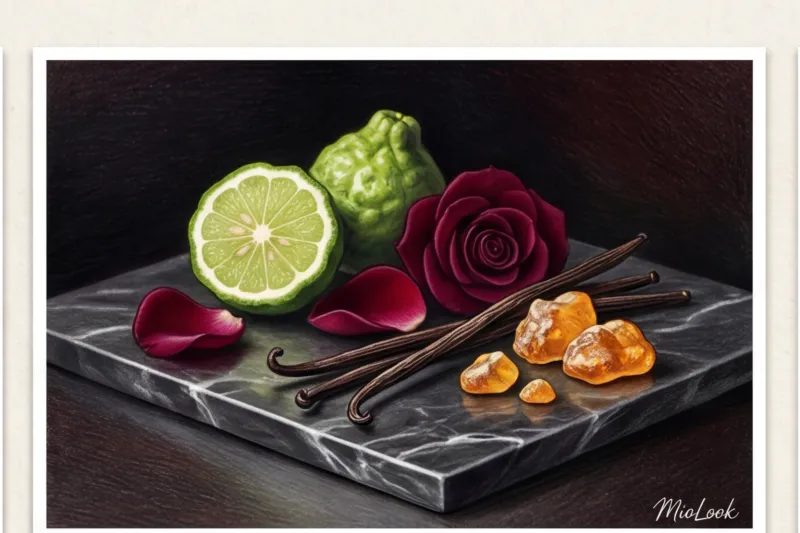
Instead of poring over a list of notes, focus on olfactory families. Back in 1992, perfume expert Michael Edwards created his famous "Fragrance Wheel," dividing all fragrances into floral, oriental, woody, and fresh. Knowing your favorite family will protect you from mistakes better than any ingredient list.
Also remember the rule of fragrance evolution: 15 minutes / 2 hours / 8 hours. What you read in the top notes (citrus, greenery) will disappear after 15 minutes. Choosing a perfume by its top notes is like buying a coat by only looking at the button design. Look at the base notes—woods, musks, resins. These are the notes you'll spend the entire day with.
A Dictionary of Niche Perfumery: Translating from Poetic to Russian
To read reviews between the lines, you need to understand the slang. Marketers use fancy words that, in reality, can mean completely unexpected smells.
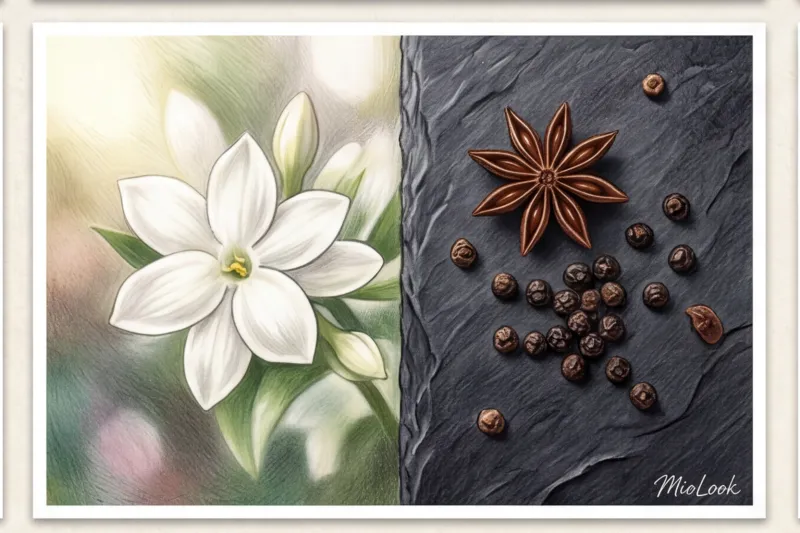
- Indolic / Animalic: In theory, it's luxurious white flowers (jasmine, tuberose). In practice, indole can produce animalic, fleshy, and sometimes downright fecal nuances. I had a case in my practice: an executive client blind-bought a top-rated "white floral" fragrance for the office. On her hot skin, it unfolded with such an indolic and predatory scent that wearing it to a boardroom meeting would have been downright inappropriate.
- Powdery / Cosmetic: It doesn't smell like baby powder. More often than not, it's the scent of expensive vintage lipstick, a theater dressing room, orris root, and violet. It sounds prestigious, but it can add years to one's appearance.
- Gourmet: Don't confuse it with confectionery! In the luxury segment, gourmand is praline and cotton candy. In the "adult" niche, gourmand is unsweetened vanilla bean with tobacco, rum, burnt wood, and dark chocolate.
- Mineral / Urban: The smell of hot asphalt after rain, wet concrete, printing ink, salt, and iodine. Perfect for minimalists and lovers of architectural design.
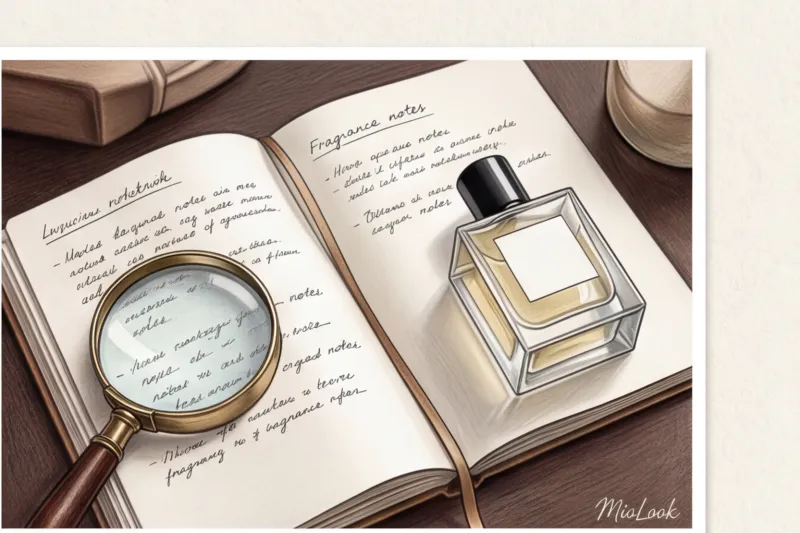
Investing Strategy: 4 Steps to Successful Online Fragrance Buying
Over 12 years of working with wardrobes, I've developed a clear algorithm. Before offering a client a new signature fragrance for their personal brand, we go through these four steps.
Step 1: Audit your current wardrobe. Pull out every bottle you've used to the last drop over the past five years. Look them up on perfume encyclopedias (like Fragrantica) and see what family they belong to. You might think you love fresh scents, but empty bottles will reveal you're a secret fan of woody chypres. By the way, organizing your personal styles for different fragrances is a great way to do it. Smart wardrobe at MioLook.
Step 2: Study the perfumer's signature. Choosing a perfume by brand is a mistake. Brands employ different "noses." Look for fragrances by creator. For example, Francis Kurkdjian creates ringing, ethereal compositions with incredible sillage. Dominique Ropion is a master of dense, thick, dramatic florals. I found my personal signature scent exactly like this: I simply blind ordered a fragrance from a little-known brand because I saw the name of my favorite perfumer on the box.
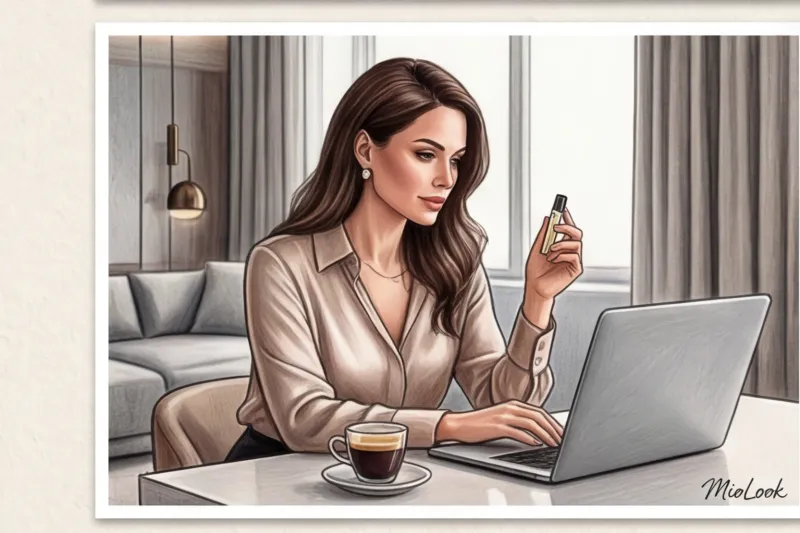
Step 3: Decoding reviews. When reading forums, filter out sentimental comments like "a fragrance for a goddess," "smells like a grandmother," and look for technical data. You're interested in two parameters: longevity and sillage. If 80% of users say a fragrance sits close to the skin (intimate sillage), don't expect it to fill a conference room.
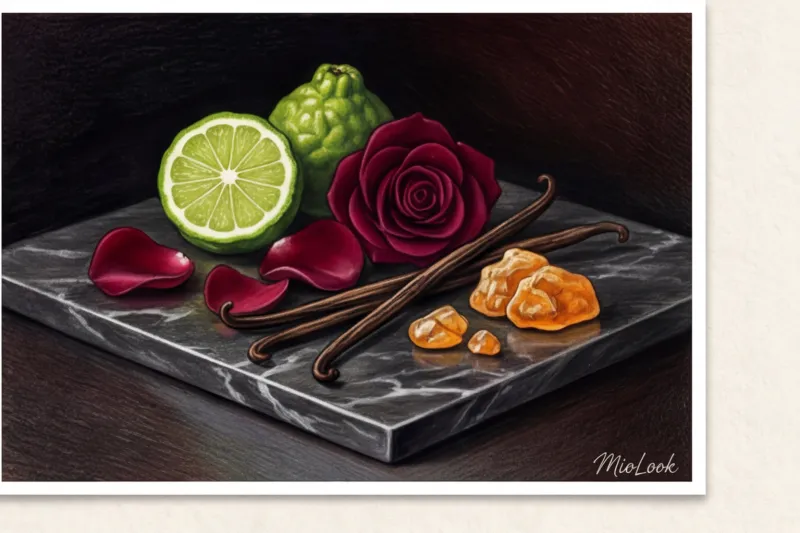
Step 4: Finding anchors. This is the most important thing. Use the search function on the reviews page. If you see words like "medical," "dentistry," "bandages," "iodine" (hello, Baccarat-like fragrances with evernil), "brine" (sandalwood is a common culprit), or "church" (frankincense and myrrh), stop. These are indicators of complex components. If you're not a fan of the avant-garde, it's best to hold off on such a blind purchase.
Your perfect look starts here
Join thousands of users who look flawless every day with MioLook. Sync your style and fragrance.
Get access — €0.99 onceCommon mistakes when ordering a selective (and how to avoid wasting your budget)
Even experienced perfumers fall into traps. Here are the main mistakes I constantly see.
Reading reviews of vintage items when buying a new one. You read a rave review from 2012 about a classic chypre, order a bottle in 2024, and receive something vague. Why? Because of IFRA (International Fragrance Association) regulations. This organization regularly bans or restricts the use of allergenic ingredients (such as oakmoss). Formulas are remixed. Always read reviews only of modern releases.
Ignoring skin chemistry. What smells amazing on your friend with "cool" skin (where scents develop slowly and boldly) may turn into a sticky mess on your "hot" skin (which immediately swallows up the top notes and reveals the base). Spices and heavy oriental resins love hot skin, while subtle musks and white florals often smell more beautiful on cool skin.
Expecting eternal resilience from a niche. This is the most pernicious myth. Longevity depends not on price or the "niche" label, but on physics—the volatility of molecules. Citrus notes (lemon, bergamot) have light molecules and evaporate in an hour or two, even in €500 perfumes. Woody notes and musks are heavy—they last for days. Want longevity? Choose woody-oriental bases, not citrusy colognes.
Purchase of a 100 ml "bucket". If you're buying blind, look for travel-size (10-15 ml) or the brand's discovery sets. 15 ml will last for several months, during which time you'll know for sure whether you need the full size.
Plan B: What to do if you bought a fragrance blind and it didn't work
The package arrived, you applied the fragrance, and realized it was a flop. Don't rush to put the bottle up for sale. We have a rescue plan.
Firstly, the art of defending Perfume experiences olfactory shock after being buffeted by transport and experiencing temperature fluctuations in logistics centers. Place the bottle in a dark cabinet at room temperature for at least two weeks. You'll be surprised how the composition develops and matures after a rest.
Secondly, perfume layering This is a favorite trick of stylists. An overly sweet, suffocating gourmand scent can be salvaged by layering it with a crisp, dry vetiver or cedar. And an overly harsh, masculine oud can easily be softened with molecular perfumes (based on Iso E Super or ambroxan), which will add air and fluffiness.
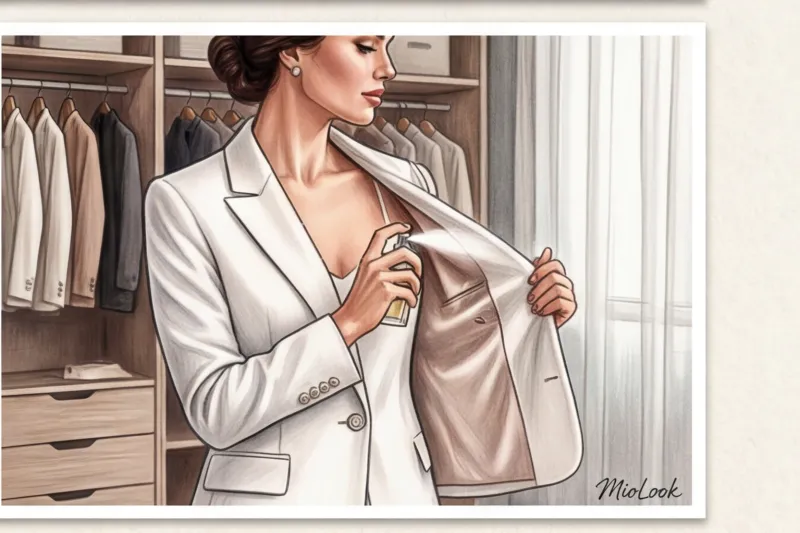
Thirdly, change the application point If a scent lingers on your neck, apply it under your knees—the trail will rise like a soft cloud. And for office work, I often recommend that clients apply complex perfumes to the silk lining of their jacket. On natural fabrics (wool, silk), fragrances last longer and are more even, without the unexpected changes that skin chemistry can cause.
Checklist: 5 Questions Before Hitting the Pay Button
The perfect perfume is the finishing touch to your look. Learn how to create a visual statement in this article. How to Look Expensive: Secrets of a Status Wardrobe Before buying perfume, ask yourself these 5 questions:
- Does the scent match my archetype? (If you're building an image of a strict expert, frivolous strawberry gum will ruin that positioning.)
- Do I understand which olfactory family it belongs to? (And do I have any successful experience with this family in my wardrobe?)
- Have I researched reviews from people with similar tastes? (Did I look for marker words like "bandages" or "indole").
- Am I prepared for the scent to sound extravagant? (A niche doesn't have to be liked by everyone - it has to evoke emotions.)
- Have I checked the possibility of ordering a branded sample? (If there is even the slightest doubt, start with 2 ml).
Buying perfume online isn't about blindly believing in beautiful text. It requires analyzing data, understanding your preferences, and understanding the laws of fragrance physics. Treat it as a fascinating exploration, and your perfume shelf will become your crowning glory.