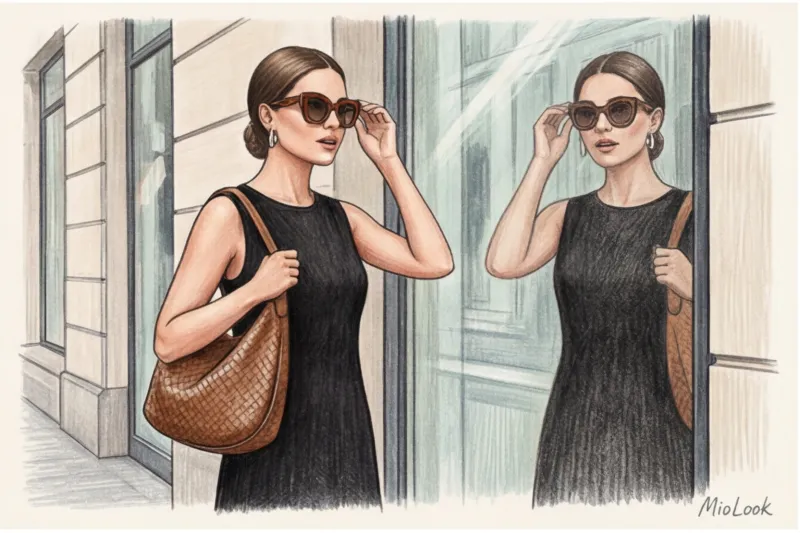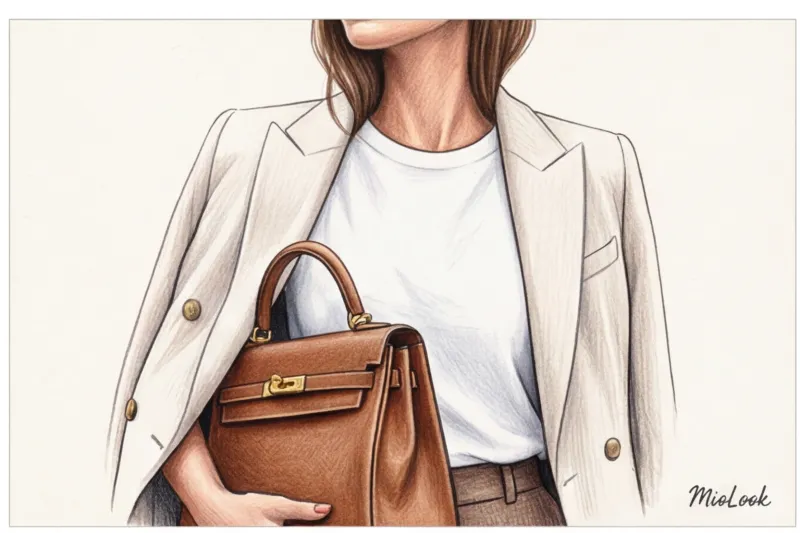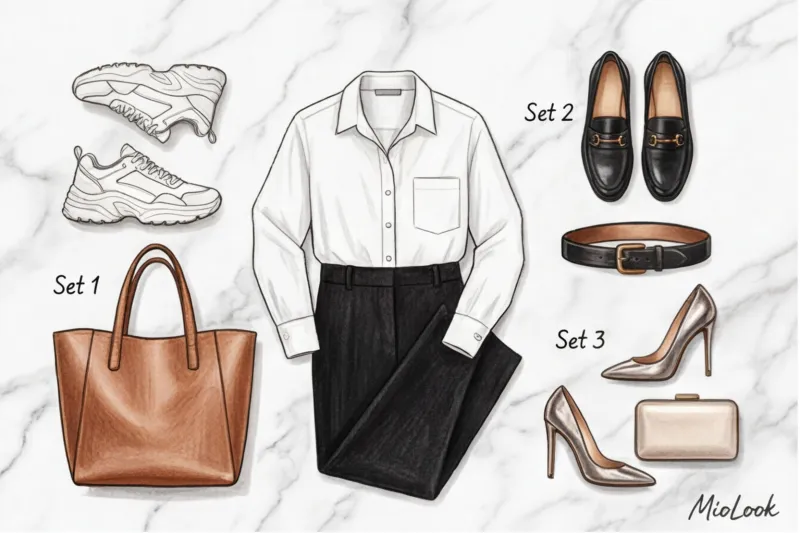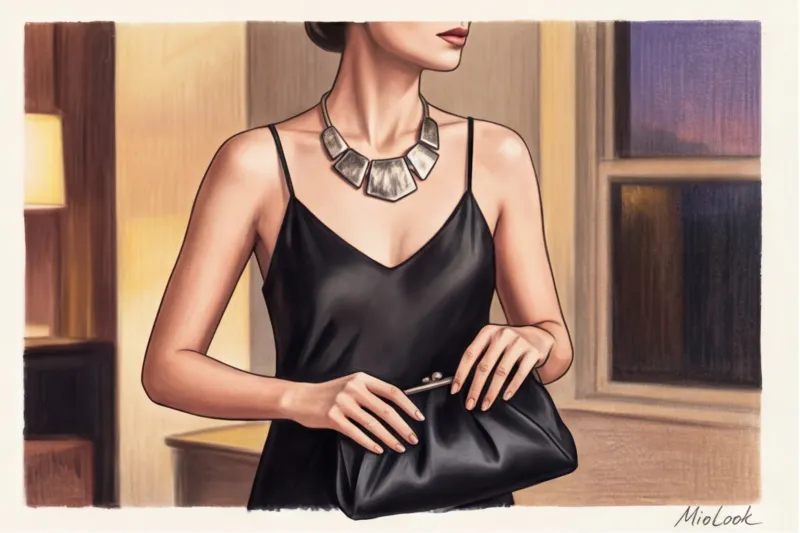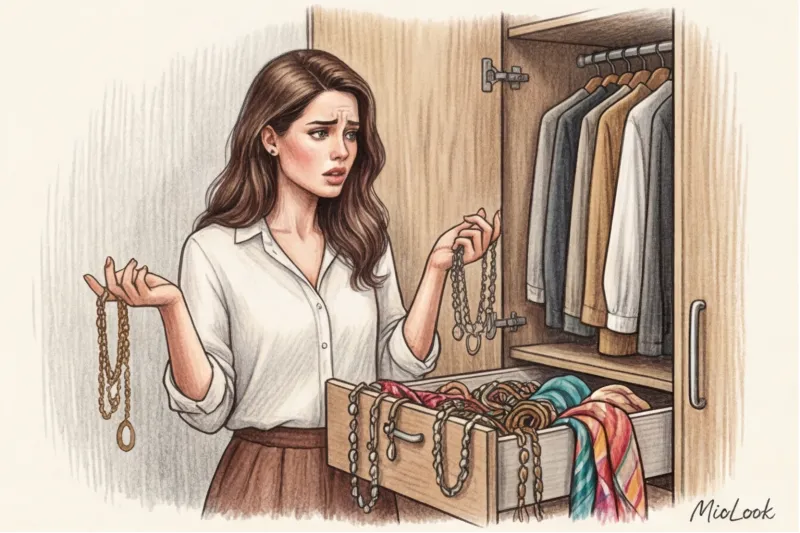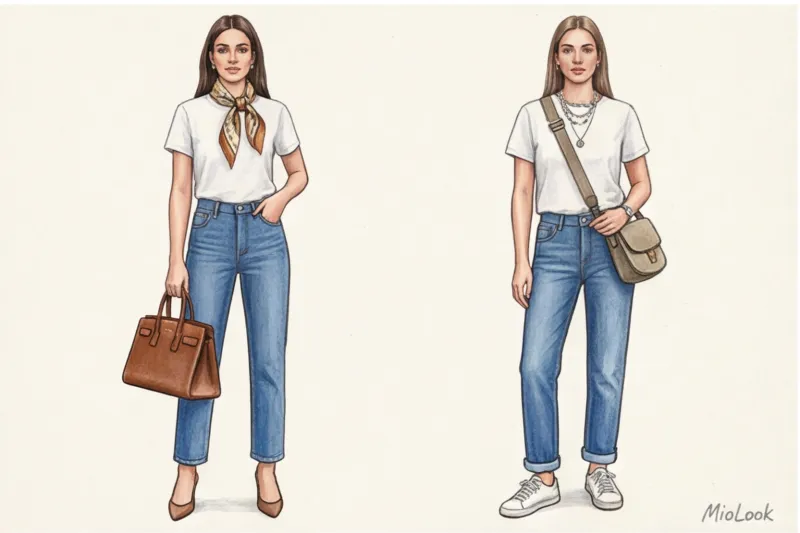
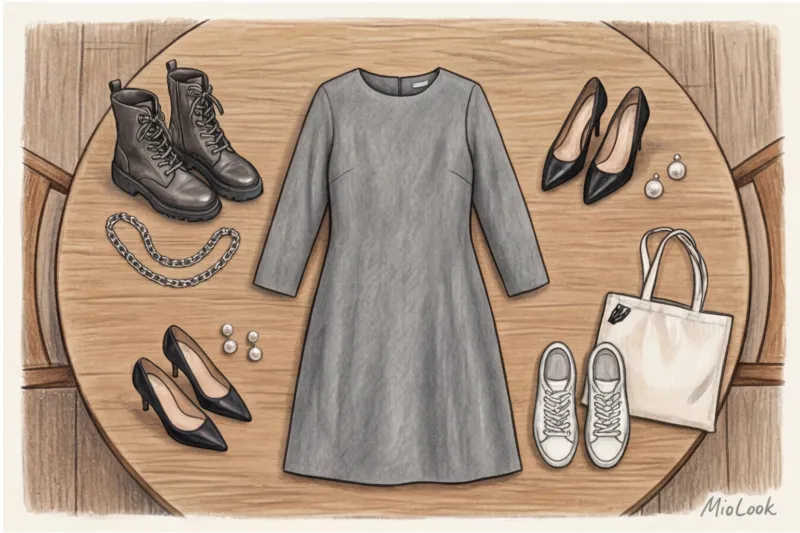
Last Friday, my client Anna texted me from a taxi: "Sofia, this is some kind of magic! I've been wearing the same gray dress all day, but I feel like I've changed into three outfits." The secret was simple. That morning, at a board meeting, her thick merino wool dress was paired with a crisp leather tote and simple silver studs. That evening, on a date, she accessorized with a soft suede clutch and a tiered necklace draped across the neckline. And on Sunday, at brunch, the same dress looked stunning with a canvas tote bag and chunky sneakers.
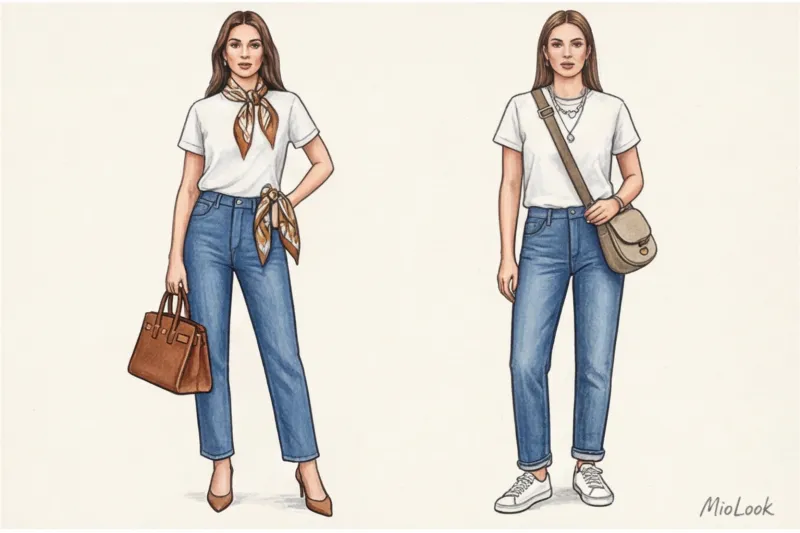
The foundation hasn't changed. What has changed is the architecture of the look. Understanding how to accessorize an outfit isn't an innate gift, but rather the pure physics of texture and the mathematics of proportion. I wrote more about the evolution of these techniques in our complete guide to How fashion accessories change your look: trends Today, we'll explore the mechanics: how details make basic pieces look expensive and why you don't need a huge closet to look different every day.
The 80/20 Formula: Why It's Beneficial to Know How to Accessorize Your Look
The era of fast fashion is rapidly fading, according to a report The Business of Fashion: State of Fashion (2024) , the most thoughtful consumers are radically changing their spending patterns. They're cutting back on "disposable" trendy dresses and redirecting up to 35% of the saved money toward quality bags, belts, and jewelry.
Why does this happen? The answer lies in your wardrobe's ROI (Return on Investment) and Cost Per Wear (CPW). Let's do the math. Let's say you bought a trendy blouse at a high-street store for €50. You wore it three times, after which it lost its shape after washing or simply went out of style. Your CPW is approximately €16.60 per wear.
Now, let's take a high-quality leather belt in a basic shade for €120. You wear it with jeans, over jackets, with dresses, and trench coats at least 100 times a year. The cost per outfit is only €1.20. A quality accessory not only pays for itself, it reduces the cost of your basic outfit, making a single cashmere sweater or classic trousers work in ten different ways.
Investing in Detail: The Mathematics of Conscious Style
The difference between "spending" and "investing" in styling is colossal. Spending is buying another printed T-shirt that will become boring within a month. Investing is buying an architectural cuff made of heavy metal (in the €150-€250 range), which will make a basic white T-shirt from COS or Uniqlo look three times more expensive.
Access to MioLook for €0.99 — one-time payment
A smart AI stylist will select the perfect look.
Get access — €0.99 onceThe Texture Rule: How to Make Basics Look Expensive
As a textile specialist, I always look at clothing through the lens of how it interacts with light. It's pure physics. Matte fabrics—heavy cotton, denim, heavy wool—absorb light. If your entire look consists solely of absorbing textures, it will appear flat, heavy, and dull.
For a base to really pop, it needs contrast. Fabrics need metal, smooth leather, or silk, which will act as reflectors. That's why simple blue jeans and a gray cotton sweatshirt are transformed by adding a glossy bag or a pair of statement gold rings.
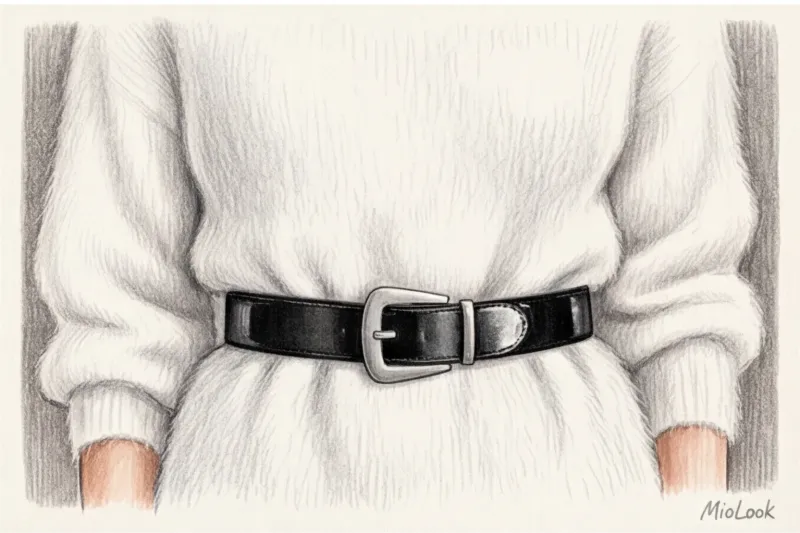
In my experience, the "warm-cool" (or "fluffy-smooth") rule works reliably. Wearing a chunky mohair or alpaca sweater? Add a smooth polished leather belt. This contrast in surface creates visual depth.
Also, consider visual weight. A chunky chain on the collarbone or a large ring will make adjacent areas of the body (neck, wrists) appear more fragile. Conversely, jewelry that is too small and gets lost against a dense fabric will emphasize the bulk of the silhouette.
The Illusion of Proportions: Belts, Bags, and Visual Figure Correction
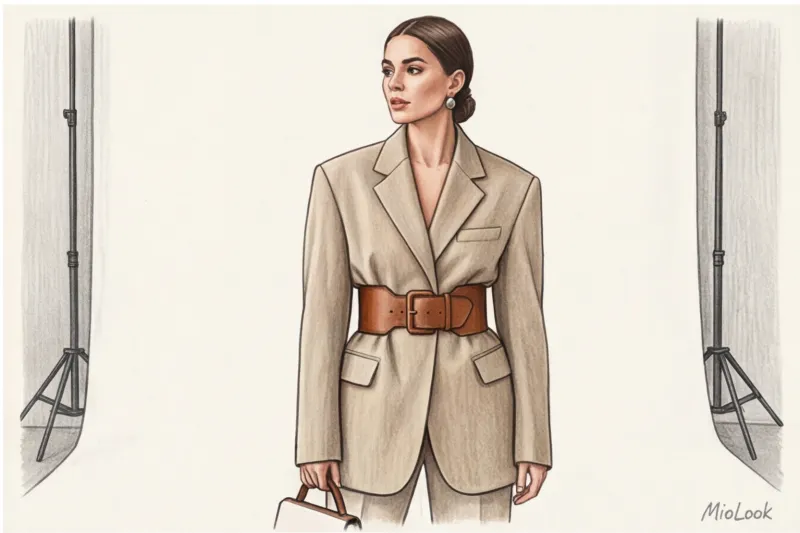
One of the main secrets I share with my clients: a belt isn't there to keep pants from falling down. If your pants aren't staying up, they need to be taken to a tailor. A belt is a tool for silhouette design.
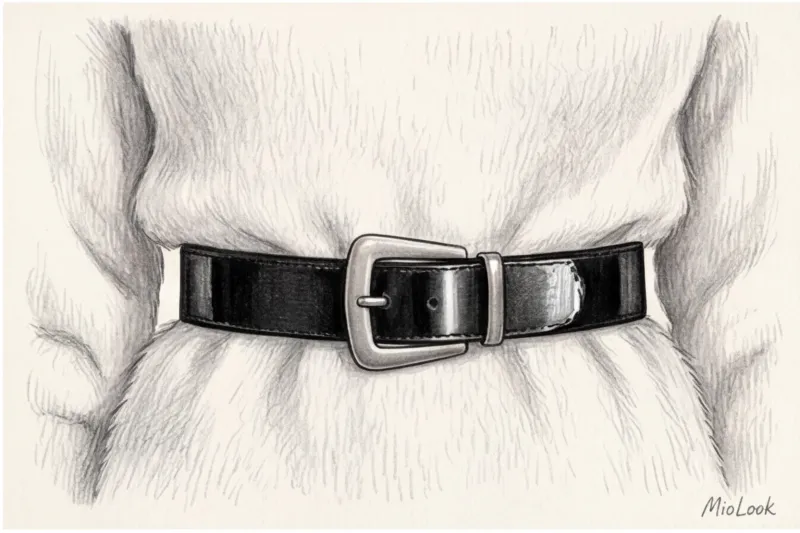
Use a micro-tuck (French tuck)—tuck in just the front of your shirt or sweater and accentuate it with a statement belt buckle. This instantly lengthens your legs and defines your waist, even in relaxed, oversized silhouettes.
Bag size also critically impacts the perception of height and volume (body mapping). A tiny micro bag on a woman of size EU 46+ will play a nasty trick: the contrast with the small object will make her appear larger. A petite woman of 155 cm tall will be visually crushed by a huge, shapeless tote.
"An accessory is a focal point. You place it exactly where you want the other person's gaze to be. Want to draw attention away from your hips? Wear a statement brooch or statement earrings in the portrait area."
When it does NOT work: Wide, contrasting belts are strictly contraindicated for figures with a shortened torso (especially the apple shape). The sharp horizontal line will cut into the silhouette at its widest point. In such cases, I recommend choosing a belt that matches the pants or dress to maintain vertical continuity.
The Biggest Myth: Why You No Longer Need to Match Your Bag to Your Shoes
Perhaps the most damaging rule that still ruins the looks of newbies is the belief that a bag and shoes must perfectly match in color and texture. Historically, this trend originated in the 1950s. Back then, ordering a bag and shoes from the same piece of leather in the same shade was a sign of high status and custom tailoring.
Today, a perfect "match" looks like you've tried too hard. It makes the look flat, predictable, and downright old-fashioned. Contemporary luxury is built on the concept of "controlled dissonance."
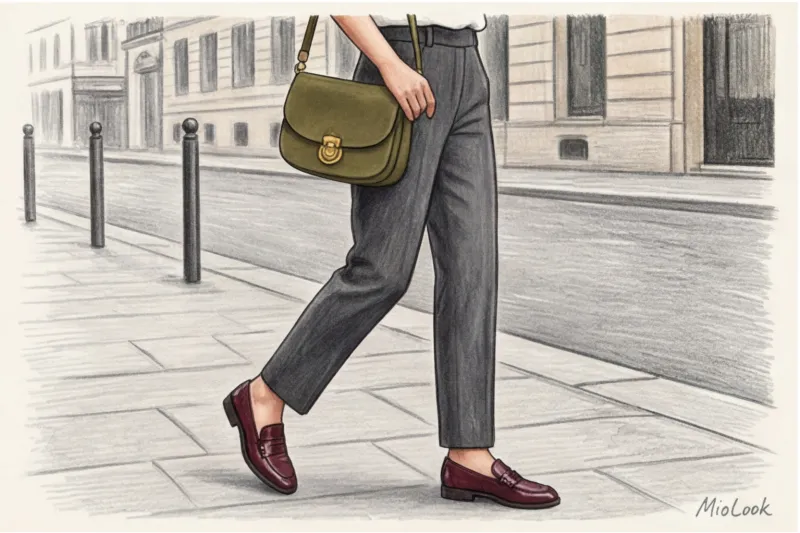
How do you do this beautifully? Combine textures and complex shades. Try wearing burgundy loafers made of smooth polished leather and carrying an olive bag made of soft suede. Instead of directly copying, use the "color echo" technique: let the bag's hue subtly echo the print on your scarf or the pinstripes on your jacket, but don't duplicate the shoes.
Your perfect look starts here
Join thousands of users who look flawless every day with MioLook.
Get access — €0.99 onceThe Third Layer Method: Transforming a Flat Image into a Multidimensional One
Stylists often talk about the third layer rule (T-shirt + jeans + jacket = complete look). But what about summer? Or an office with a very strict but stifling dress code, where wearing a jacket is out of the question? Accessories take on the role of the third layer.
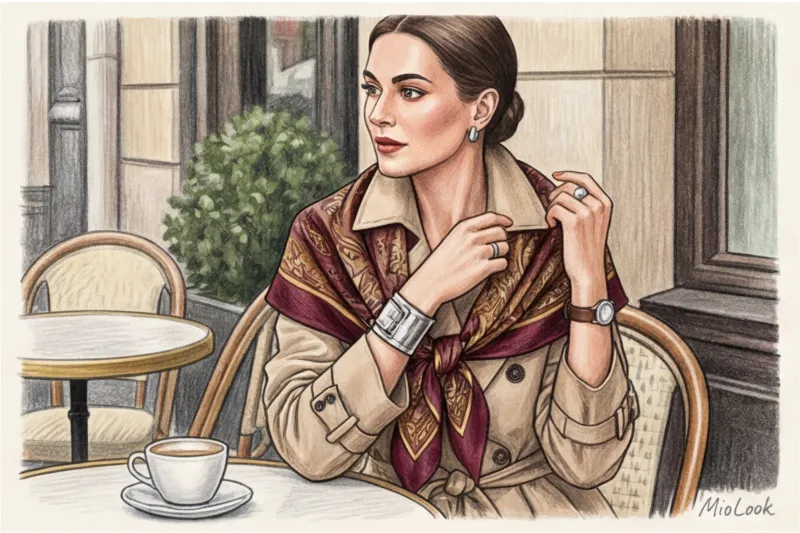
One of my clients, a top manager at an IT company, travels frequently on business. We adapted her basic dark blue Massimo Dutti suit for three situations. During the day at the office, the "third layer" was a classic men's watch on a leather strap and a thin leather belt. In the evening, for a trip to the theater, we added a large silk bodice, casually draped over one shoulder and secured with a belt (a technique inspired by the Hermès runway shows). For dinner with partners, the suit was complemented with a statement choker made of crushed metal.
Quality indicators: what indicates a high-quality part
Over the years of testing the durability of hardware on bags across various price ranges (from budget bags for €30 to premium bags for €500+), I've identified several clear indicators of quality. First, the weight of the metal. Cheap zinc alloy is light and makes a loud clanking sound. Expensive brass hardware has a pleasant heft and a dull sound when the parts collide.
Secondly, pay attention to the edge paint on the leather. On cheap belts and bags, the paint on the edges begins to crack and peel after just two months of use. A high-end item has a perfectly smooth, almost fused edge.
Stylist Checklist: 5 Steps to Transforming a Boring Outfit
If you stand in front of a mirror and realize that your image is "missing something," follow this algorithm:
- Base Assessment (Blank Canvas): Make sure your clothes fit well, are ironed, and have no pilling. No necklace will save a stretched-out T-shirt neckline.
- Selecting a focal point: Decide where you want to draw attention. Want to highlight your face? Wear large earrings. Want to accentuate your waist? Use a belt. Don't try to highlight everything at once.
- Adding textural contrast: For a matte dress, choose glossy shoes or a bag. For smooth silk, choose matte suede.
- Checking proportions: Is the bag proportionate to your height? Does the contrasting strap cut into your figure in the wrong place?
- Redundancy Test (Chanel Rule 2.0): Coco Chanel advised removing the last piece of jewelry you put on. I've adapted this rule for 2024: remove the most predictable Detail: If you're looking for a matching pearl necklace to go with your pearl earrings, remove it and replace it with a chunky chain.
Summary: From Theory to Your New Style
Accessories are the language your clothes speak. Jeans and a white shirt say nothing about you until you add a vintage grandfather clock, a silk scarf with an abstract print, or Cossack boots. Before you go shopping for a new dress, take stock of your jewelry boxes and bags.
Smart algorithms are great for visualizing new combinations and understanding how to accessorize your look without having to rummage through your entire closet. MioLook You can digitize your basic items and details, and the AI stylist will suggest dozens of fresh combinations of textures and colors that you may not have even thought of.