I remember my first attempt at an online wardrobe review vividly. I spent six hours collecting 52 links to items from Zara, COS, and Massimo Dutti, carefully copying them into a client's WhatsApp. I thought I'd done a tremendous job. The next morning, I received a message: "Julia, half the sizes are already sold out, and I have absolutely no idea how those wide-leg trousers go with that jacket." That day, I learned a hard lesson: How can a stylist work online? , has nothing to do with the ability to quickly google things.

We talked about the technical side of the issue in more detail in our The complete guide to the best apps for stylists , but today I want to talk about a fundamental shift in thinking. This article debunks the myth that online styling is simply exchanging links in a messenger. We'll discuss "premium digital architecture," where the focus shifts from finding one-off items to creating a flawless, technologically advanced customer experience.
The Digital Shopping Illusion: Why Shifting Your Offline Habits Is Ruining Your Business
The biggest mistake new online stylists make is trying to replicate the shopping mall experience through a computer screen. Offline, your value is obvious: you physically pick up items, bring them to the fitting room, evaluate the fit, and touch the fabric. When you simply send links via messenger, clients see you not as an expert, but as a free search engine.
The hidden threats of working through instant messengers are much more serious than they seem at first glance:
- Link burnout: According to statistics from major marketplaces, up to 30% of popular items (especially in sizes M and L) sell out within 48 hours of the start of sales or the release of new drops. Your hard work literally goes to waste while the client sleeps or is in a meeting.
- Loss of visual context: It's impossible to judge proportions in a chat. The client sees disparate images rather than a unified system. It's like a centipede trying to decide which foot to start with and then falling over—the client gets confused and abandons the purchase.
- Check devaluation: Why pay a high price if the final product looks like an endless chat with back-and-forth messages?
Online support via links isn't expensive. If the process isn't structured, the client experiences stress instead of pleasure and never returns for repeat service.
How a Stylist Can Work Online: A Fundamental Process Overhaul
To make money online, you'll have to change your role. You're no longer a "shopper" running from store to store. You're a "style architect." You design a visual system that works without your physical involvement.
The online format requires a more rigorous capsule logic. In a fitting room, you can randomly throw a scarf on a client, and the look will be complete. Online, randomness is unacceptable. Each item must fit mathematically precisely into capsule wardrobe , covering at least 3-4 images.
How can you justify a high bill without physical meetings? Through the concept of "ROI (return on investment) for the client." At the first online meeting, I always say, "We're not buying you clothes. We're buying you 15 minutes of free time every morning and confidence before important negotiations." You're selling a ready-made system that eliminates headaches, not hours spent monitoring websites.
"A premium online service means the customer doesn't have to make any unnecessary movements. They open their phone and know exactly what to wear today, tomorrow, and next week."
The Technical Side of Color: White Balance Pitfalls
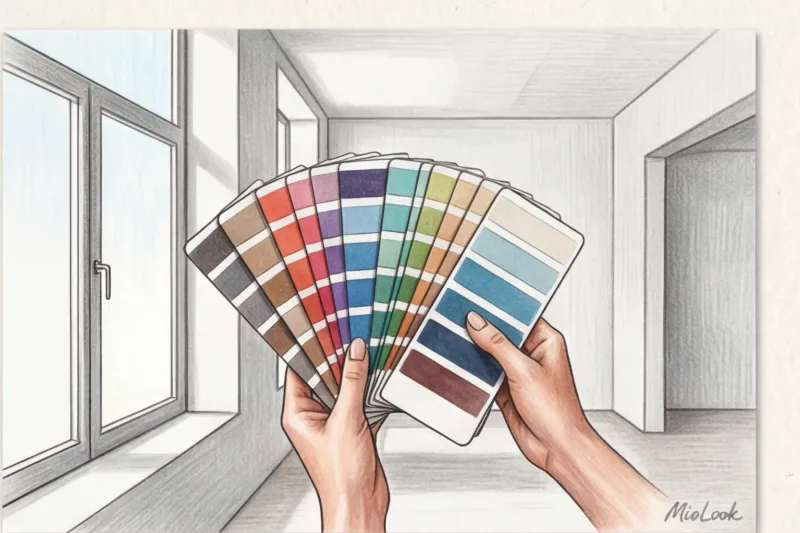
The biggest fear when working remotely is color mismatch. Modern device displays, nighttime lighting, and software filters mercilessly distort reality. Technical specifications of color profiles (for example, the difference between standard sRGB and the extended Display P3 on Apple displays) mean that you and your client literally see different shades of red on your screens.
I once almost made a serious mistake: a client sent me a photo that I labeled as "warm autumn." It turned out she'd taken the selfie under incandescent light (around 2700K) with the iPhone's True Tone feature enabled, which adds a yellow tint to the screen for eye comfort. In reality, hers had a cool, contrasting color scheme.
Since then, I have had an ironclad rule for requesting photographs from a client:
- The photo is taken strictly during the day, facing the window (diffused natural light).
- In the frame, right next to the face, the client should hold a reference object - a regular white sheet of A4 paper.
- All camera filters and enhancers must be disabled.
A white sheet of paper serves as a reference. If the sheet has a yellow or blue tint in a photo, I know how to adjust the white balance in the editor to see the true skin and hair tones.
Premium Service Packaging: Remote, Yet Luxurious
Luxury isn't about heavy bags from boutiques. According to a 2024 study by Bain & Company, the key indicator of luxury in today's premium segment is a frictionless experience. How can this feeling be conveyed through a screen?
The answer lies in the "one-stop shop" concept. Clients shouldn't have to switch between instant messaging, an Excel spreadsheet with dimensions, and a Google Drive folder. The entire process, from the brief to the final lookbook, should be packaged within a unified, aesthetically pleasing digital environment with precise typography and a minimalist design.
However, I want to make an important digression. This approach It doesn't work With older, kinesthetic customers, for whom the shopping process is a ritual of touching fabrics (silk, cashmere) and personal interaction over a cup of coffee. If you see that tactile contact is crucial for the customer before making a purchase, honestly admit that the online format won't suit them.
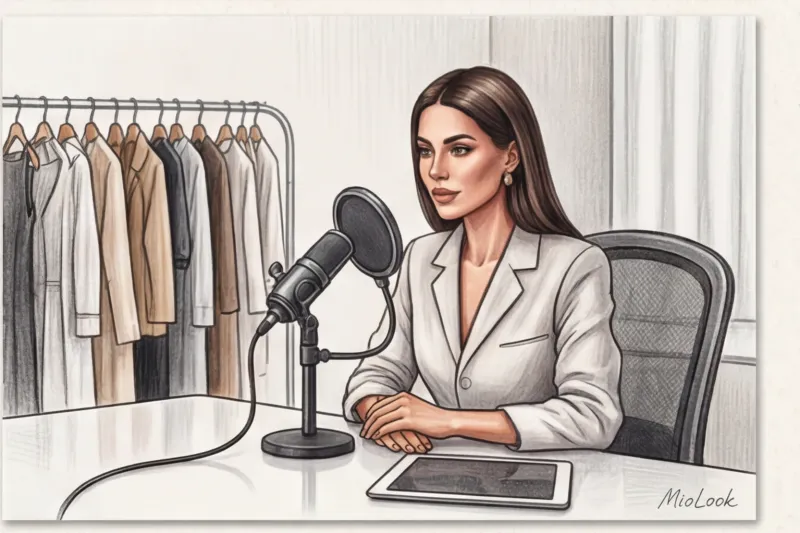
For everyone else, a preliminary Zoom session (with ideal lighting and background on your end) is essential. You're selling aesthetics, so how you and your workspace appear on camera sets the bar for trust.
Style Architect Tools: From Routine to Smart Apps
Making collages in basic editors, manually cutting out the background of each bag, is so last century. Over 12 years of work, I've come to the conclusion that using specialized platforms saves up to 40% of a stylist's time.
This is where professional tools come into play. Instead of chaotic mood boards, I translate the client's wardrobe into a digital environment. For example, you can use MioLook to create a smart virtual wardrobe. You upload your client's items, add new items from stores, and create ready-made capsule wardrobes.
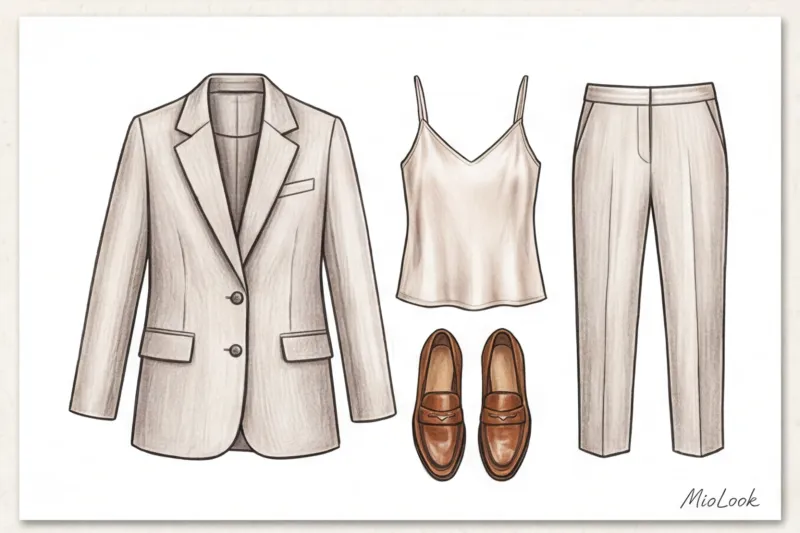
What does this mean? You track your client's wardrobe in real time. If the client buys new stylish travel bag , you enter it into the app and immediately show which five looks from your current wardrobe it pairs with. This dramatically increases your LTV (Lifetime Value)—your client stays with you for years because you manage their style like an investment portfolio.
Step-by-step guide: stress-free remote wardrobe review
After conducting over a hundred online analyses, I have developed a strict checklist that eliminates misunderstandings.
Stage 1: Correct technical specifications for the client. A common mistake beginners make is asking to photograph every item. You end up with a photo of a wrinkled blouse hanging on a hanger against a window. The backlight kills the texture, and you can't tell if it's thick cotton or thin viscose. My rule: items are only photographed laid out on the floor or bed, with daylight from above. No hangers against the light.
Step 2: Sorting and categorizing. The resulting photos are uploaded to a cloud storage or app. I immediately delete duplicates and items with obvious defects (pilling, stretched knees) that the client tried to "save."
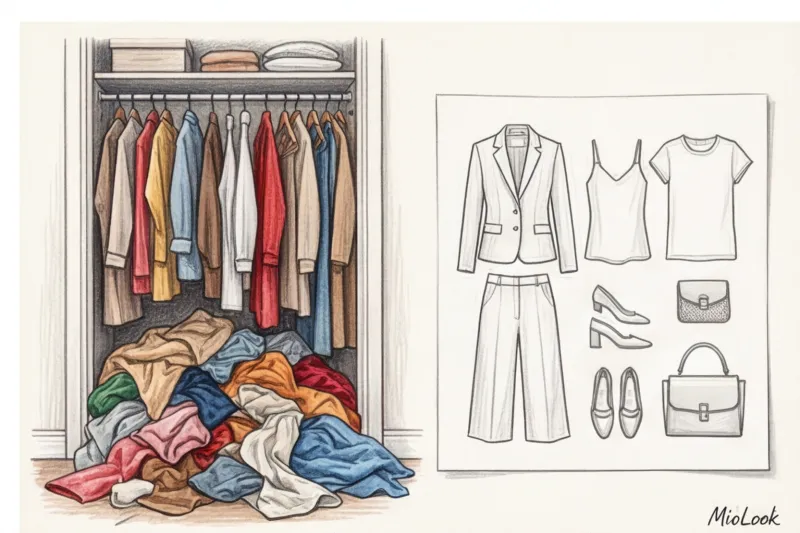
Step 3: Finding wardrobe holes. I create a wardrobe matrix and look for missing links. For example, I have great jackets and trousers, but there is no quality basic office shoes This is how a smart shopping list is born.
Stage 4: Final virtual fitting. I create a PDF lookbook or interactive presentation where each new item from the client's shopping list is already paired with three or four old items. The client isn't just buying a skirt; they're buying a complete look for Tuesday.
Coping with Decision Fatigue
There's a pernicious myth that the more options you offer a customer, the better the service. In fact, it works just the opposite. According to UX design principles and Hick's Law, the time and effort spent on making a decision increases logarithmically with the number of options.
Sending a client five options for a single white shirt to choose from is a shift of responsibility. You're forcing the client to work as a stylist at their own expense. Online, the ideal choice should be limited to one or two carefully considered options. A curated approach—"I've looked at 50 shirts, and here's the only one perfect for your body type, made of 180 g/m² cotton—instantly elevates your expertise in the client's eyes and relieves decision fatigue.
Scaling Your Business: How Digitalization Increases Revenue
The main benefit of understanding how to work online as a stylist is that income is decoupled from geography and time. You stop trading in the hours you spend at the mall.
Firstly, you gain access to expats and the international market. Your clients may live in Dubai, London, or Bali. You work with international platforms (Farfetch, Net-a-Porter) or global brands (Massimo Dutti, Uniqlo), creating versatile wardrobes.
Secondly, digitalization allows you to launch a style subscription. This is a recurring payment model: the client pays a fixed amount each month, and you assemble a weekly capsule collection from their virtual closet, adding one or two new trendy items seasonally. Thirdly, you build a database of ideal basics (those perfect white T-shirts or the perfect pair of jeans), which reduces the time it takes to prepare each subsequent project.
Your ideal image
it begins Here
Join thousands of users who look flawless every day with MioLook.
Get access — €0.99 onceA successful online stylist today is part aesthete, part systems analyst. Stop sending clients endless lists of links that only cause headaches. Digitalize their wardrobe, take responsibility for the final selection of one or two ideal items, and you'll see your clients happily paying for a premium service that truly makes their lives easier.