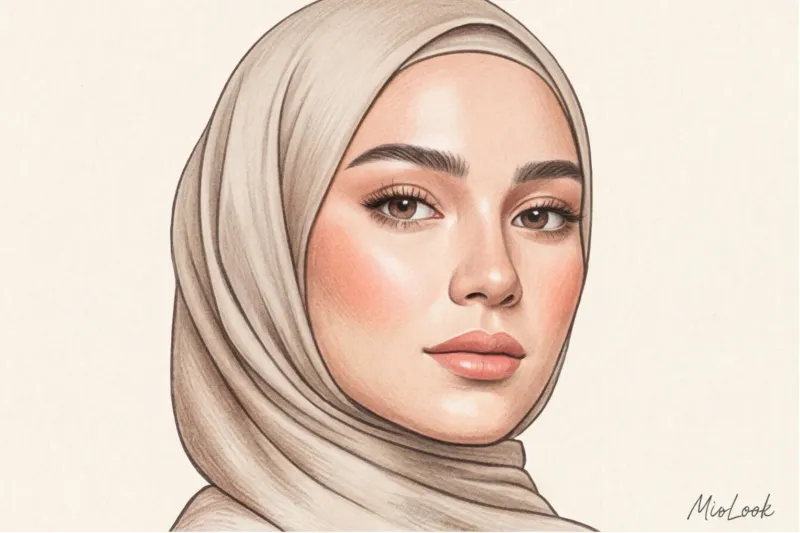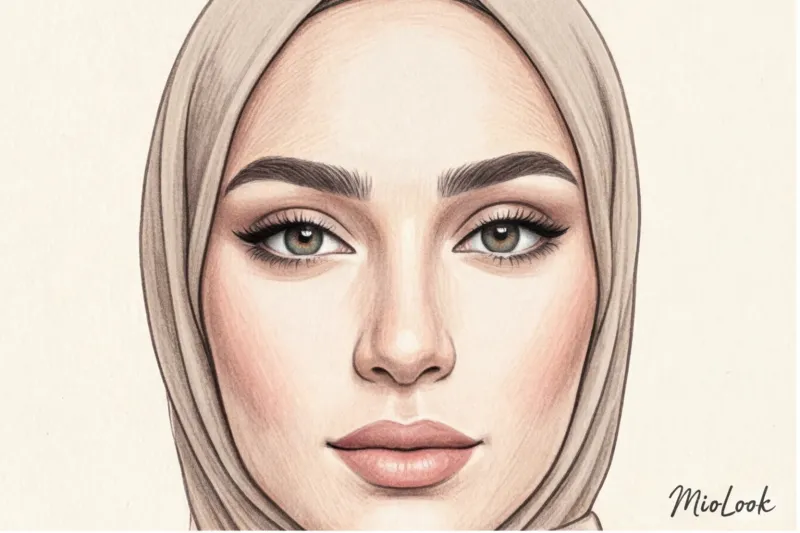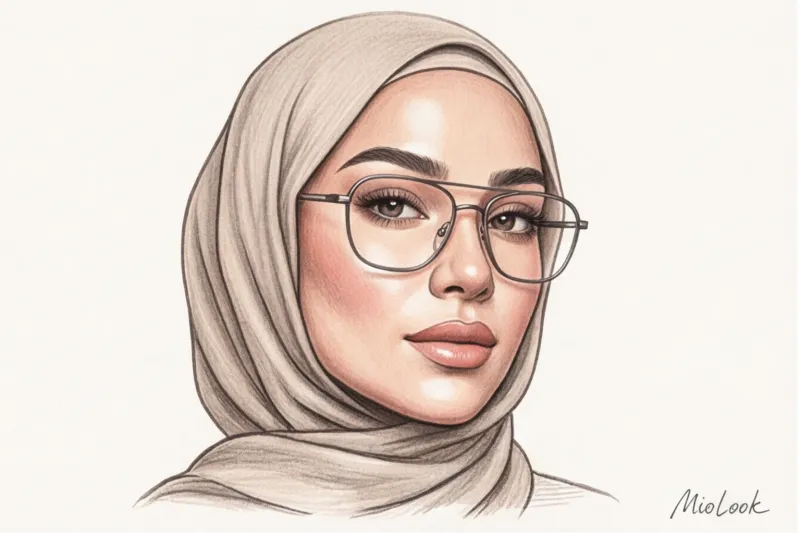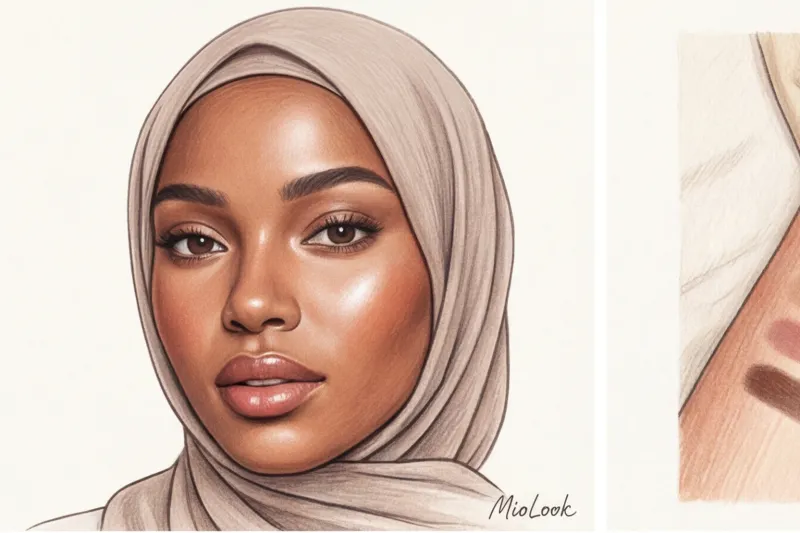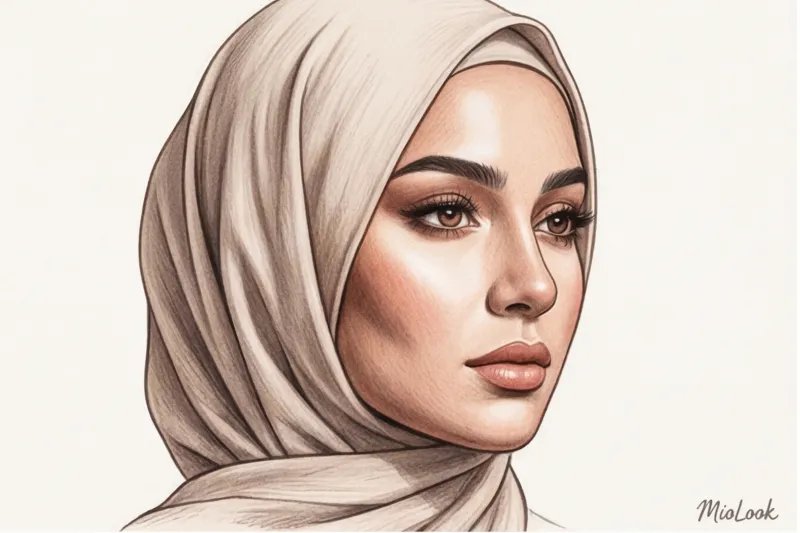
Dubai Modest Fashion Week 2022. Backstage before the show. I'm standing there, watching a celebrity makeup artist, slightly panicked, try to wipe away brown streaks with wet wipes from the flawless €300 silk hijab the model has just been given. Why did this happen? Because he'd done her a classic makeup look. I've seen this scene dozens of times: using standard techniques is a recipe for disaster, because the right one face contouring in a hijab operates according to completely different laws of physics and geometry.
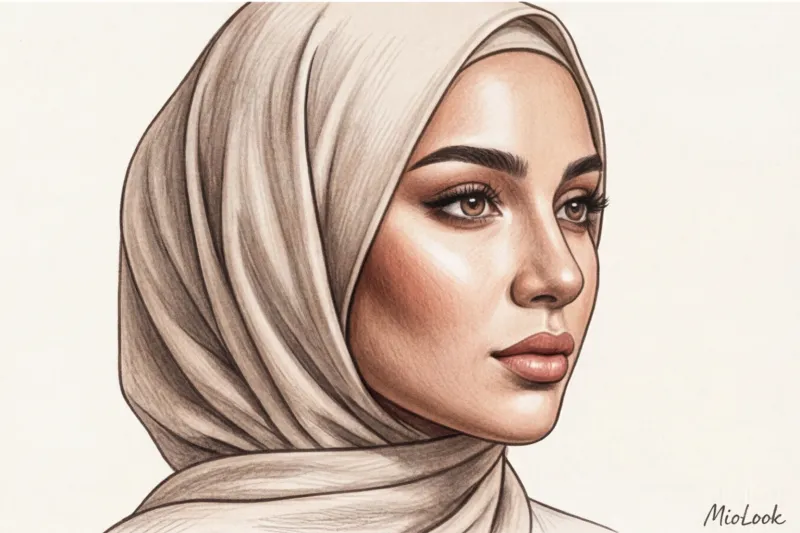
We have already discussed in more detail the architecture of the image with closed hair in our The complete guide to hijab makeup But today I want to delve into the most problematic area—sculpting. Over 12 years of working as a stylist, I've learned the most important thing: a scarf isn't just a piece of fabric. It's a fully-fledged optical filter that completely changes the light and shadow patterns on your face.
Shadow Architecture: How a Scarf Changes the Geometry of the Face
When you cover your hair, neck and ears, your face becomes the absolute center of attention. Research Nielsen Norman Group Eye-tracking (adapted for the 2023 fashion industry) showed astonishing figures: when the body is covered, about 80% of the viewer's visual weight and focus falls exclusively on the area from the eyebrows to the chin.
There is a concept in painting chiaroscuro — the play of light and shadow. A hijab, especially one with a voluminous drape (for example, made of thick chiffon or jersey), physically casts a real shadow on your cheekbones and neck. When you try to add artificial shadows there with makeup, you're defying the very physics of light. That's why your usual makeup, which looks perfect with loose hair, suddenly appears heavy, overdone, and aged when paired with a headscarf.
"In modest fashion, we work only with the 'inner perimeter' of the face. Everything within one centimeter of the edge of the fabric should remain crystal clear," is a rule I always share with my clients.
Complex face contouring in a hijab: rejecting classic schemes
Forget the "rule of three" (darkening the forehead, cheekbones, and jawline in one stroke). This is the biggest counterintuitive discovery for many women: the classic perimeter contouring technique absolutely doesn't work with the hijab.
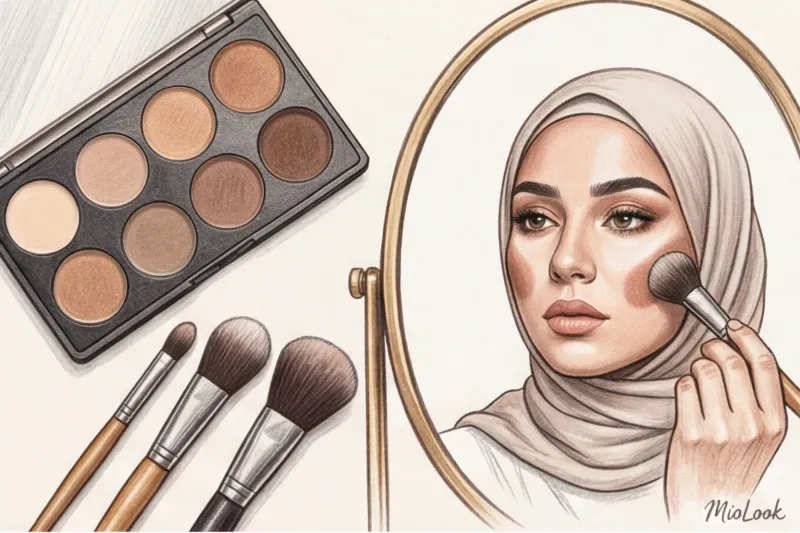
If you wear a tight-fitting turban, the accent shifts to the center. If it's a loose cape, you'll have to contend with excess shadows in the lower third of your face. Your main tool now is not darkening the periphery, but highlighting the center.
Forehead area: the "clean edge" rule
An absolute no-no when wearing makeup under a hijab is applying highlighter or bronzer along the hairline. Firstly, you're guaranteed to stain the bonnet (under-hat) or the edge of the scarf itself. Secondly, the fabric already creates a distinct, graphic border on the forehead. An additional dark line underneath it looks like a dirty stain.
What to do instead: Apply a soft, translucent bronzer exclusively to the temples, leaving at least 2 centimeters from the edge of the fabric. Use light brush strokes, as if you were simply brushing away dust.
Cheekbones and lower jaw: conflict with tissue
One of my London clients, Aisha, constantly complained that her face looked haggard and tired in her hijab, despite sleeping eight hours a night. The problem lay in her "double shadow." She'd drawn a strong line along her cheekbone, and then the shadow from her thick stole fell on top.
Important limitation: Jawline contouring is absolutely NOT effective if your fabric is tight against your face. Not only will it stain your scarf, but it will also create the effect of a masculine, heavy jaw. Put the contouring tool aside—the fabric will contour your face naturally.
Your perfect look starts here
Join thousands of users who look flawless every day with MioLook. Its smart algorithm will help you match your makeup to the shade of your scarf.
Get access — €0.99 onceTextures and Fabric Physics: Creamy vs. Dry
Backstage at fashion shows, where models have to change 5-6 full-length outfits in an hour, we use only creamy textures. And this isn't a whim, but a strict necessity.
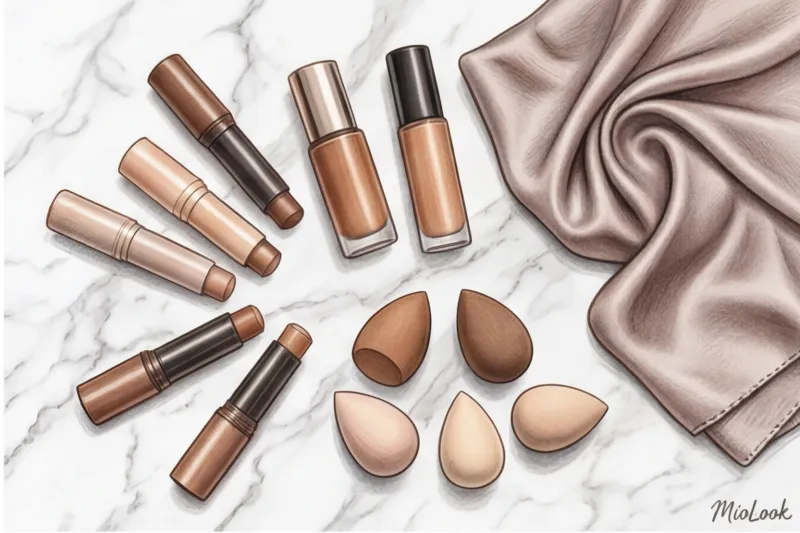
Dry sculpting powder (even the most expensive) is essentially colored dust. No matter how well you blend it, if you constantly rub it against the fabric, it will inevitably crumble onto light silk. Cream sticks (for example, premium Westman Atelier for 50 € or an excellent basic KIKO Milano Sculpting Touch for 15 €) are fused into the skin.
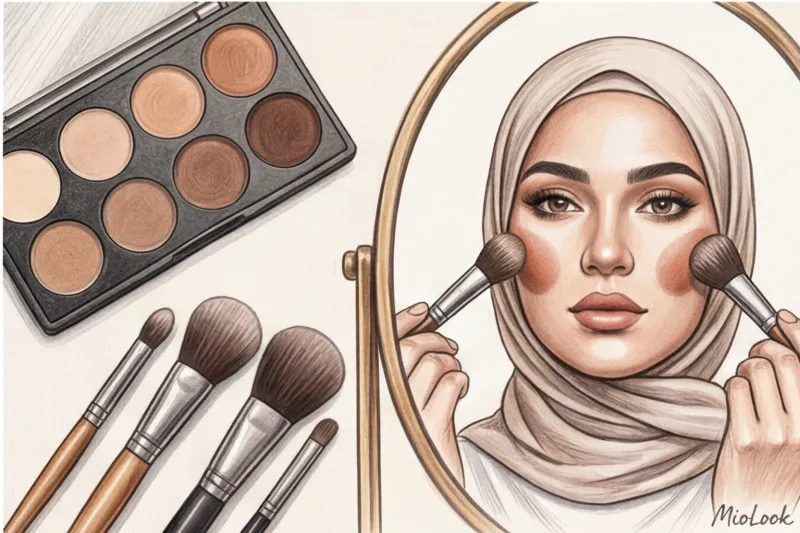
My proven algorithm for resilience:
- Apply the creamy product to a well-moisturized base (primer is essential on the cheekbones where the fabric touches the face).
- Blend the product with a damp sponge, not a brush. The sponge absorbs excess product that could transfer to the hijab.
- Fix the result not with a powder sculptor, but with the lightest transparent powder and fixing spray.
And one more thing: avoid shimmery, shimmery bronzers on the lower third of your face. Under a scarf, they look like an oily, sweaty sheen rather than a healthy glow.
The "Dirty Face" Effect: 4 Major Mistakes in Contouring Your Face While Wearing a Hijab
When you see a girl in a hijab whose makeup looks heavy and unkempt, chances are she has made one of these four fundamental mistakes.
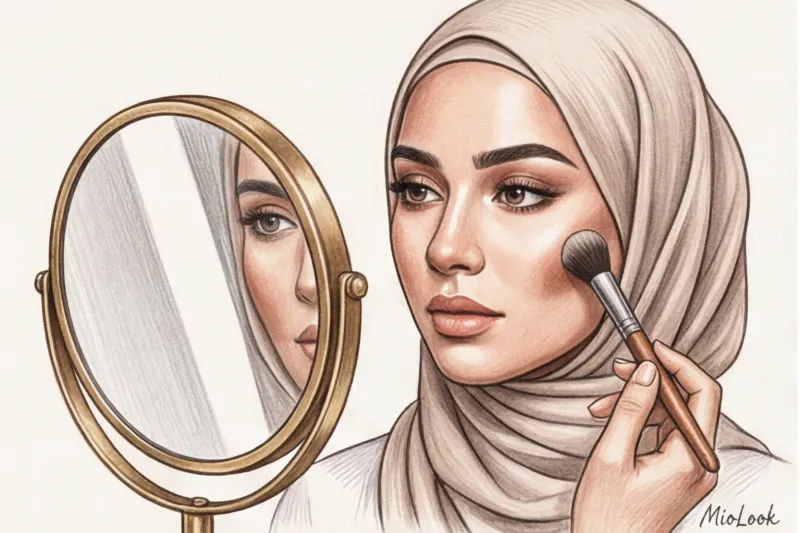
- The sculptor's undertone is too cold. Gray (taupe) sculpted shades are great for studio photography. However, in real life, when layered with the natural shadow of the fabric, they create the illusion of a bruise. Choose neutral or slightly warm shades.
- Downward shading. In classic makeup, we blend the contour under the cheekbone downwards to draw it into the neck. In a hijab, the neck is covered! Blending downwards visually "lowers" the face. Blend strictly upwards, toward the temples and the apples of the cheeks.
- Hard graphic lines. Modest fashion dictates smoothness. If your contour doesn't flow smoothly into your blush, your face will look cut into geometric blocks.
- Ignoring the undertone of the hijab itself. This is such a common problem that it deserves a separate, in-depth analysis.
Access to MioLook for €0.99 — one-time payment
Unsure about which shade to choose? Upload a selfie to the app, and the AI stylist will analyze the color combination of your makeup and hijab.
Choose an imageColor Reflex: How the Shade of a Hijab Dictates the Sculptor's Color
A year ago, I conducted an experiment with students in a style course. We used the same cool contouring technique and applied different colored scarves to our faces. According to the Color Institute PANTONE (2024) Regarding the reflective properties of fabrics, the color closest to the face casts its own undertone onto the skin. In portrait photography, this is called "color reflex."
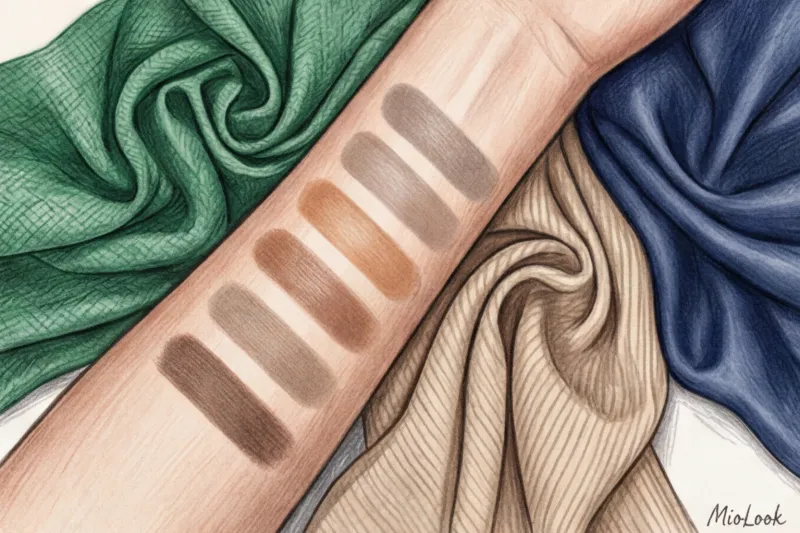
- White, milky and pastel scarves: They act as a reflector, brightening the face. Here, you'll need the softest, warmest shades of the sculptor to avoid looking washed-out.
- Black and dark blue fabrics: Dark colors can dull the intensity of your makeup. With a black hijab, you can opt for a richer, neutral brown hue.
- Bright shades (emerald, fuchsia, mustard): This is where things get tricky. If you wear emerald silk and contour with taupe, your face will look sallow, green, and unhealthy. In cases like this, I completely replace the contouring product with a warm, peach-toned bronzer.
Checklist: The Perfect Hijab Face Contouring Scheme
To never have to wash stains out of silk again and always look fresh, I developed a scheme that I use for shooting closed-loop looks. It's based on the technique reverse contouring (reverse contouring).
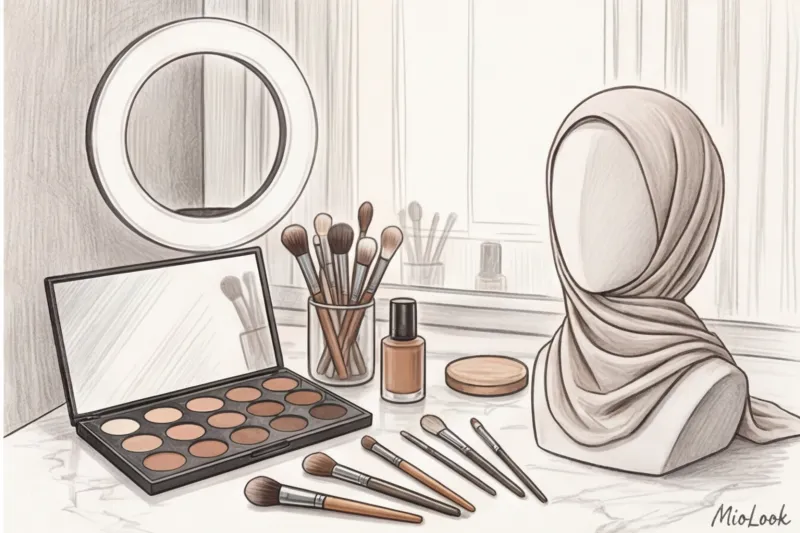
Step by step plan:
- Create a "buffer zone". Leave at least 1.5–2 cm from the edge of the hijab (both at the forehead and jawline). This area should only have a light skin-colored tint.
- Lighten, don't darken. Take a concealer 1-2 shades lighter than your skin tone. Apply it under your eyes, to the center of your forehead, the bridge of your nose, and—most importantly—in a thin line. under your natural cheekbone hollow. Blend. This will create volume without a single drop of dark pigment.
- Point shadow. If you still want to highlight your cheekbones, apply a drop of cream contour a little higher natural hollow. Literally on the bone. Blend strictly upward.
- Blush as the main sculptor. In modest fashion, blush is more important than brown sticks. Apply it high on the cheekbones (in a lifting makeup style), smoothly blending into the temples. This enlivens the face and balances any voluminous turban.
When it does NOT work: Reverse contouring, using concealer to highlight the lower cheekbones, will highlight imperfections if you have a pronounced skin texture (acne or deep post-acne marks) on the lower third of your face. In this case, avoid highlighting the cheekbones and opt for an even, matte finish.
Makeup as an Accessory: The Art of Balance
Face contouring in a hijab isn't about adding new features or trying to fit Instagram standards. It's about restoring the face's natural volume, temporarily obscured by thick fabric.
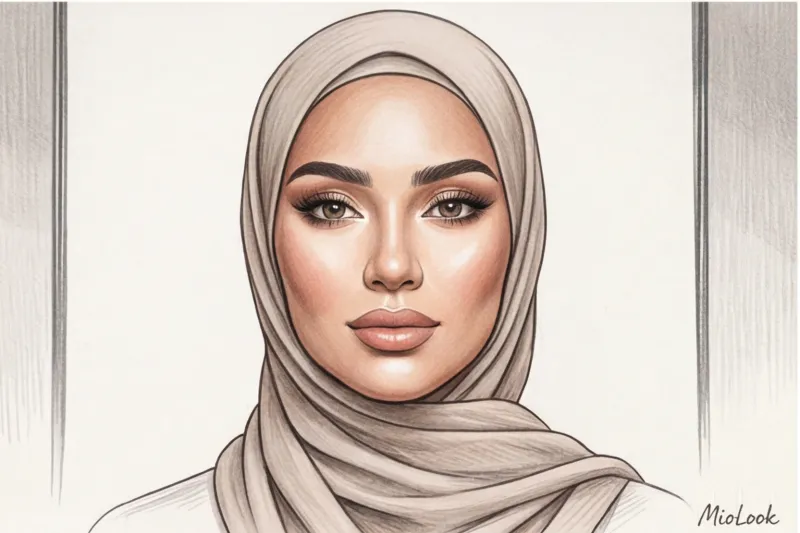
The key principle you should understand is that groomed, soft lines always trump graphic styles in modest fashion. Sharp, ruler-like cheekbones, paired with the soft drapes of chiffon, create visual dissonance.
Adapt these rules to your lifestyle. Whether you're heading to a business meeting in a formal suit and a simple scarf, or getting ready for dinner in a silk stole, always remember the 2-centimeter buffer zone and the magic of creamy textures. You can experiment with shades and makeup schemes in MioLook app to see how the fabric color interacts with your skin in advance. Leave harsh contouring in the past decade—let highlights and soft shadows do the work for you.