Over 12 years as a stylist, I've learned one hard and fast rule: even the most brilliant wardrobe will be ruined by poorly chosen underwear. Every time I start a wardrobe review with a new client, we inevitably end up with the same scenario. The woman complains about slouching, shoulder pain, and how "cashmere sweaters feel cheap." And then it turns out that, while she's actually a size 65E, she stubbornly wears a 75B.
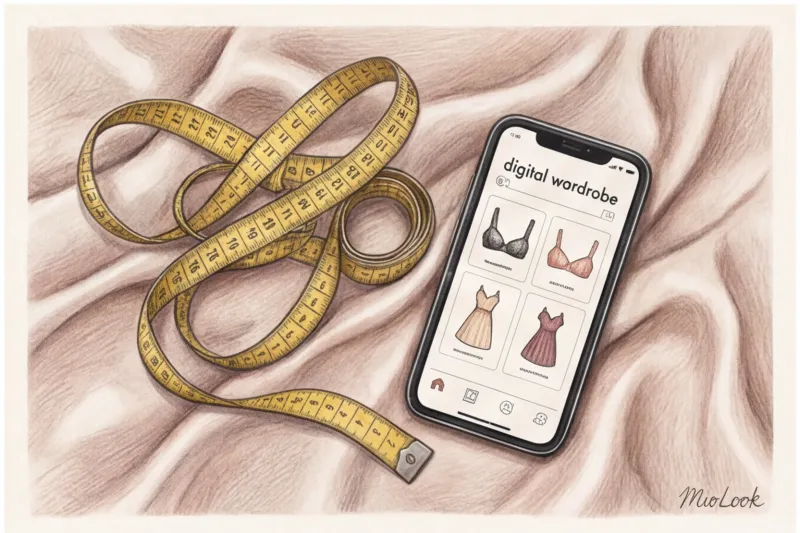
If you've ever googled, How to determine your bra size at home You've probably come across classic online charts: measure your underbust, add a few centimeters, then measure your bust and calculate the difference. The problem is, this math is hopelessly outdated. We've covered the evolution of these algorithms and how technology is changing our approach to shopping in our A complete guide to smart online lingerie selection using AI.
This guide isn't just another rehash of old formulas. As an expert in fabrics and clothing architecture, I'll tell you what mass-market brands don't tell you: how waistband elasticity, underwire shape, and your anatomy influence fit more than the numbers on a measuring tape.
The End of the Tape Measure: Why Old Tables Are Wrong
The statistics are stark: according to a global study by WGSN (2024), 80% of women worldwide wear the wrong bra size. And the main reason is the so-called "+4 inch rule" (or adding 10 cm to the underbust measurement).
This myth originated in the 1930s. Back then, lingerie was made from stiff, non-stretchy fabrics like heavy cotton or silk. To allow women to breathe, manufacturers included a huge allowance for ease of fit. Today, when bras are always made with elastane or spandex (often 15% to 30%), this allowance renders a bra useless.
"The physics of breast support are uncompromising: 90% of the weight should be supported by the tight band, and only 10% by the straps. If there are red indentations on your shoulders, your band is too wide and isn't working."
A common myth is that a looser band is essential for comfort. This is fundamentally wrong! The larger and heavier your breasts, the tighter and narrower the band should be under your breasts. Otherwise, the back of the bra will slide up toward your shoulder blades, and all the weight will fall on your shoulders, causing chronic cervical spasms.
Ready to get started?
Try the free plan—no commitments required. Start creating perfect looks with AI.
Get access — €0.99 onceHow to determine your bra size at home: the correct algorithm
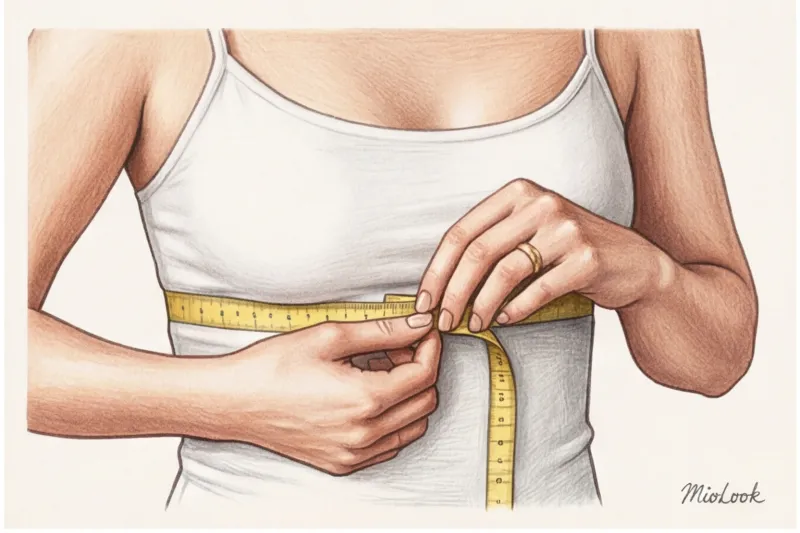
For the algorithm to work, we need to prepare. Taking measurements on a bare chest is only appropriate in one case: if the breast tissue is very dense and the breasts are naturally erect. In all other cases (after childbirth, weight loss, or simply due to natural ptosis), measurements are taken in a thin, soft top or an old bra without push-up support. We need to simulate the shape the breasts take when they are gathered.
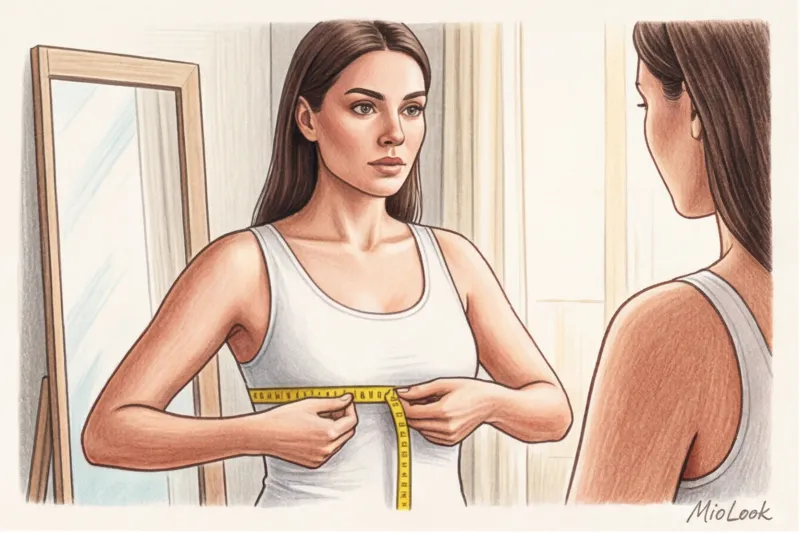
Stand in front of a mirror. Your main goal is to ensure that the measuring tape on your back is always strictly parallel to the floor. A tape tilted up or down will result in an error of 2-4 centimeters, which is equal to one full measurement.
Step 1: Measure your underbust: the base of your support
Wrap the band around your ribcage, just below the base of your breastbone. Now, exhale completely and pull the band as tight as possible. Yes, the band should literally dig into your skin.
Why is this so? Elastic materials stretch with wear. A snug fit indicates the minimum amount of support the belt will provide. If your snug fit is 73 cm, you need a 70 cm belt, not 75 cm. It's always a good idea to round up when choosing a belt. downwards.
Step 2. Measuring your bust: finding the true projection
Now we measure the circumference at the most prominent points (usually the nipples). Here, the tape should not be too tight.
Fitting room insight: If your breasts are soft and have lost volume on top, a standing measurement will show you're a B cup, even though you need a D cup. To find the "true projection" (the full volume of your breast tissue), lean forward 90 degrees so your back is parallel to the floor and measure your breasts in that position. Trust me, the difference in numbers will amaze you.
But there is an important limitation here: This tilting hack does NOT work for women with very dense, fibrous breast tissue or implants—in their case, tilting will not change the volume, but will only distort the fit of the band.
More than centimeters: breast shape, density, and root
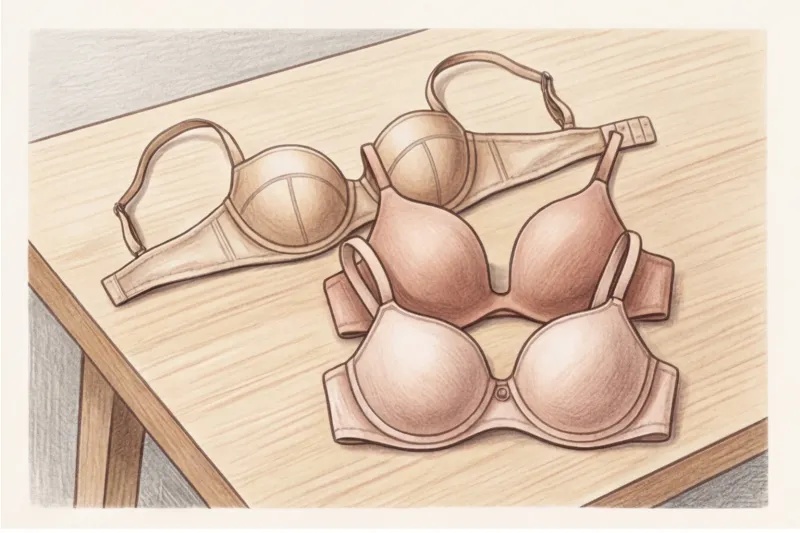
If everything depended only on numbers, How to determine your bra size at home , would be a trivial task. But in my experience, two clients with absolutely identical measurements (for example, a 75D) leave shopping with completely different models.
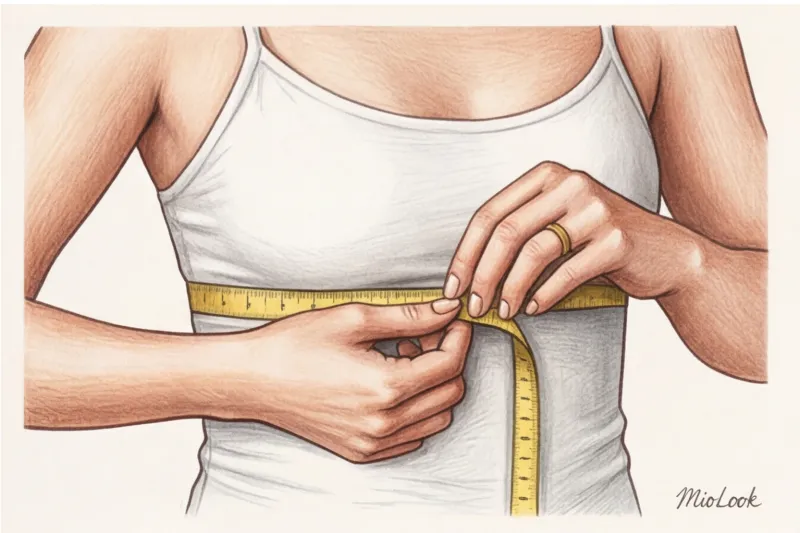
It's all about body architecture. Key terms used by professional bra fitters:
- Breast Root. This is the area on the chest wall where the breast gland attaches. The root can be narrow or wide. If you have a wide root and buy a bra with narrow underwire (Italian brands are often guilty of this), the underwire will painfully dig into the fabric at the sides. Women with wide root can often mistake breast tissue for "armpit fat."
- Projection. Breasts can be "shallow" (distributed over a large area of the chest, with little forward projection) or "deep" (narrow at the base, with a strong forward projection). Deep projection requires sewn cups made of 3-4 pieces, while molded smooth sphere cups will leave a hollow space at the top.
- Fabric density. Soft breasts will conform to any cup shape, like water conforms to the shape of its container. Firm breasts will "fight" a bra: if the shape doesn't match your anatomy, the breasts will simply push the bra down.
Your perfect look starts here
Join thousands of users who look flawless every day with MioLook. A smart assistant for your wardrobe.
Get access — €0.99 onceOnline Shopping Secrets: How to Read Size Charts for Different Brands
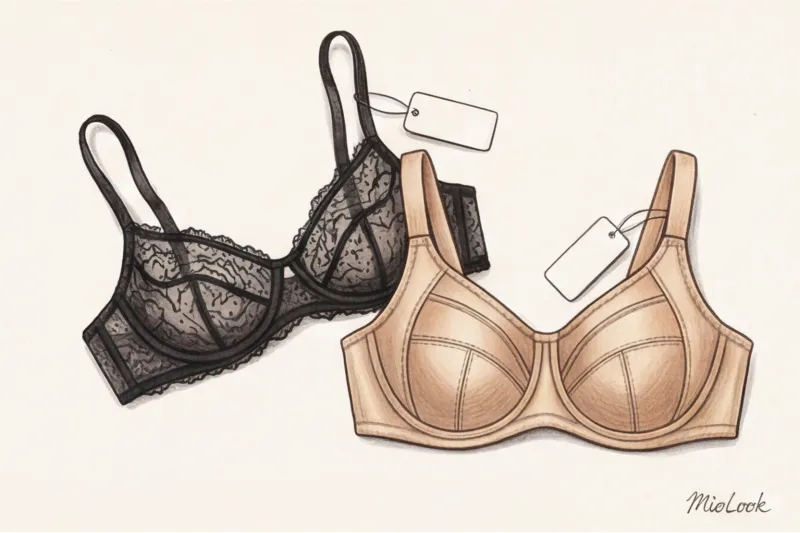
Underwear is an engineered product. Different countries use different construction standards (Fit Models). If you're ordering underwear online, it's crucial to understand this difference.
British school (eg Panache, Freya, Elomi).
This is the global gold standard for breasts of a D cup and up. Prices typically range from €50 to €80. British bras use very tight bands made of dense mesh (powernet) and deep, stitched cups. If you buy a "British bra," get your exact band size under your bust; it won't stretch out after a month.
French school (Chantelle, Simone Pérèle, Maison Close).
The average bill here is higher (€80–€130), and the aesthetics are more refined. French brands tailor their designs to women with narrower rib cages and smaller bust projections. The materials (often delicate calé lace) are more stretchy. French lingerie often runs small in the cup, so when ordering online, order a cup size larger than usual.
Sister Sizing Rule.
Cup size is relative. A D cup on a 70 band and a D cup on an 85 band are completely different measurements. If the band is too big but the cup fits perfectly, you should reduce the band size but INCREASE the cup size.
Example: 80C = 75D = 70E. The cup volume (capacity) is the same, only the band length changes.
Smart Fit: How AI Solves Size Mismatches
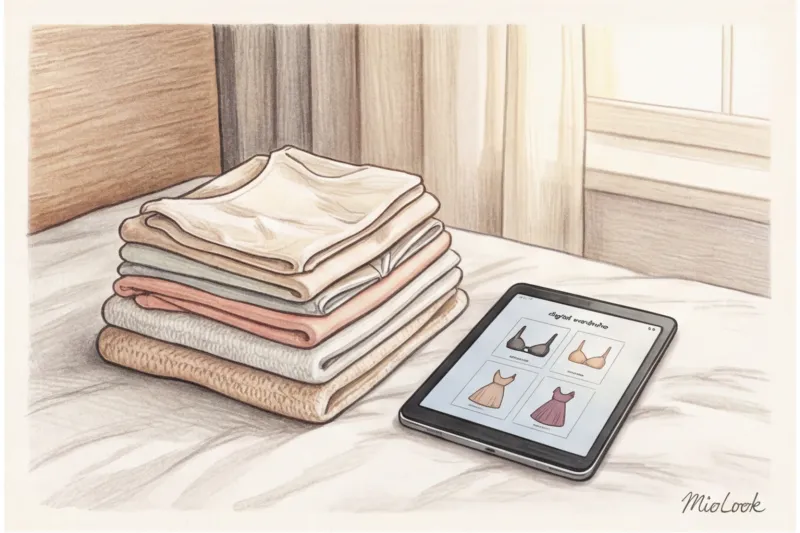
Today, manually sorting through all these stretchability coefficients is no longer necessary. Size charts are outdated precisely because H&M uses elastane with a 30% stretch coefficient, while COS uses 15%, even though the size on the tag will be the same.
This is where technology comes to the rescue. In the app MioLook Artificial intelligence algorithms work more than just a ruler. Neural networks not only analyze your measurements but also compare them with actual patterns from specific brands, taking into account the fabric density and fit.
By creating a digital profile once, you avoid the endless cycle of returning parcels. The AI understands that if you need a 75C at Zara, you'll need a 70D at a premium British brand. This completely changes your approach to wardrobe management: you invest only in items that fit perfectly from the first try-on.
Checklist: How to tell if the bra you received doesn't fit
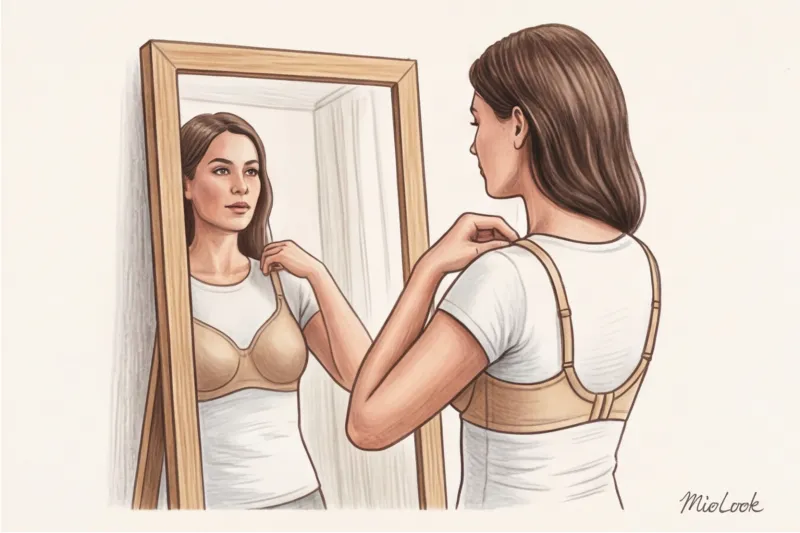
Let's say you've received an order. Trying on a garment at home should be no less rigorous than in a boutique. Here's my signature fit checklist, where a cut at any stage means returning the item to the store.
- Extreme hook test. You put on a new bra and fasten it... Which hook? If the tightest one, return it. A new bra should be fastened ONLY on the loosest (outer) hook. You'll need inner bra straps in six months to a year, when the elastane in the fabric begins to break down from washing. If you fasten it too tightly right away, the band will be hopelessly too big for you in three months.
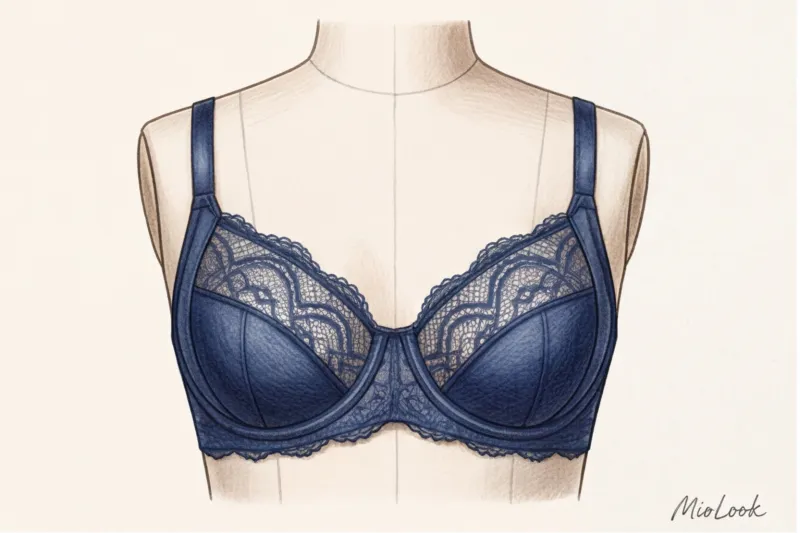
- Gore test. The center piece between the cups should lie completely flat on your sternum (sternum bone). If you can fit a finger there, the cup is too small and your breasts are pushing the bra away from your body. (The exception is the anatomical depression of the rib cage.)
- Bone test. Press your finger on the end of the underwire. It should rest against the rib. If it rests against the soft tissue of the breast, the underwire is too narrow, which will lead to lymph congestion over time.
- Raised hands test. Stand sideways to the mirror and quickly raise your arms up. If the band on your back is moving up or your breasts are slipping out from underneath, the band is too wide. Go down a size immediately!
Access to MioLook for €0.99 — one-time payment
A smart AI stylist will choose the perfect look for you and help you organize your wardrobe without stress.
Get access — €0.99 onceConclusion: Your comfort is not a luxury
Finding the perfect lingerie isn't a whim, but a basic hygiene routine for your wardrobe and health. Even the most expensive €300 silk slip dress will look untidy if the contours of your back are constricted by a narrow, digging bra band.
Forget the myths of the last century. Trust your senses, your anatomy, and modern technology. Remember the most important thing: you shouldn't feel the right bra throughout the day, but you should immediately notice its effect in your straightened posture.