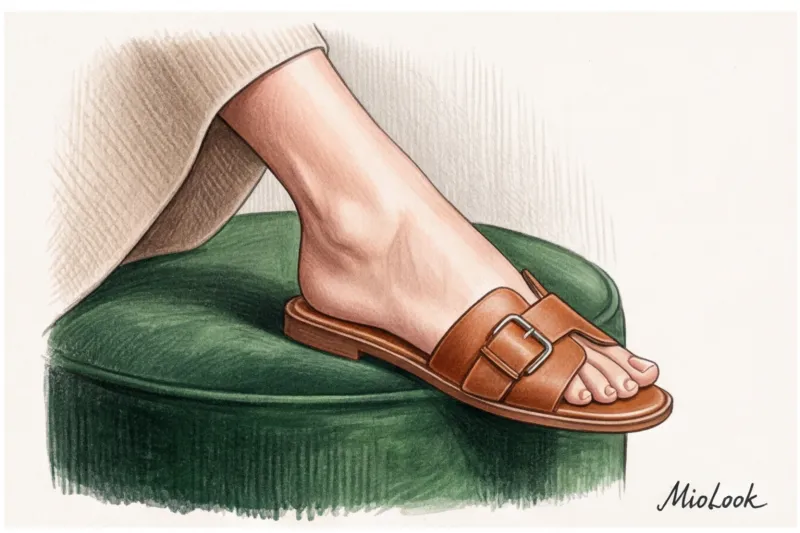
I remember my sixth month of pregnancy: I was getting ready for an important meeting and, out of habit, tried to put on my favorite leather pumps. After ten minutes of struggling, I realized my foot simply wouldn't fit into the shoe, which had fit perfectly just a month earlier. Sound familiar? Choosing shoes during this period often becomes a torture, and compromising between "pretty" and "not painful" seems impossible. But as a stylist and colorist, I'm absolutely certain: comfortable shoes for pregnant women should not look like orthopedic equipment from a pharmacy.
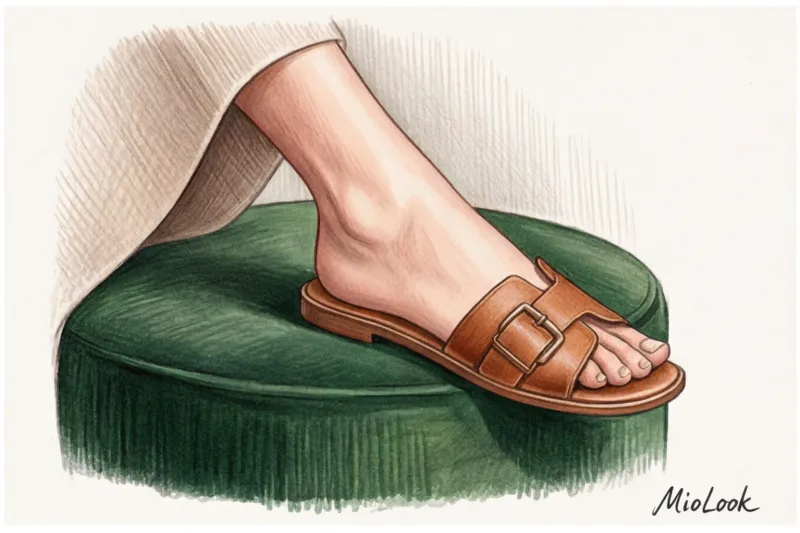
Instead of buying shapeless sneakers two sizes too big, we'll apply the rules of a smart wardrobe. We discussed this approach to building a wardrobe in more detail in our The Complete Guide to Stylish Maternity Clothes: The Best Looks Today, we'll be looking specifically at footwear: how to use styling techniques, the right textures, and the Cost Per Wear formula to help you survive swelling gracefully and painlessly.
The Anatomy of Style with Swelling: Why Your Favorite Shoes Have Become Your Enemy
To understand what kind of shoes to look for, you need to understand what's happening to your feet. It's not just "fluid accumulation," as is commonly believed. During pregnancy, the body actively produces the hormone relaxin, which relaxes the pelvic ligaments in preparation for childbirth.
But relaxin doesn't act selectively. It relaxes ligaments throughout the body, including the feet. Under the pressure of increasing weight, the arch of the foot simply collapses and flattens. A landmark study from the University of Iowa (2013) showed that 60–70% of women experience an increase in foot length and width during pregnancy, and for many, this increase (0.5–1 cm) remains permanent.
"The biggest mistake I see pregnant clients make is trying to break in old, stiff shoes or buying the same style but in a size 40 instead of a size 38. This doesn't work because it changes not only the size but also the width and instep height."
Additionally, your center of gravity shifts. Your stomach pulls forward, and your shoulders lean back. If you wear shoes with the wrong last, your lower back will bear a tremendous load, which will cause a nagging pain by evening.
Orthopedic Myth: Comfortable Shoes for Pregnant Women Can Be a Status Value
Many brands still believe that if a woman is expecting a child, aesthetics automatically cease to be important. We're offered wide, downright unflattering Velcro boots that ruin any well-thought-out look.
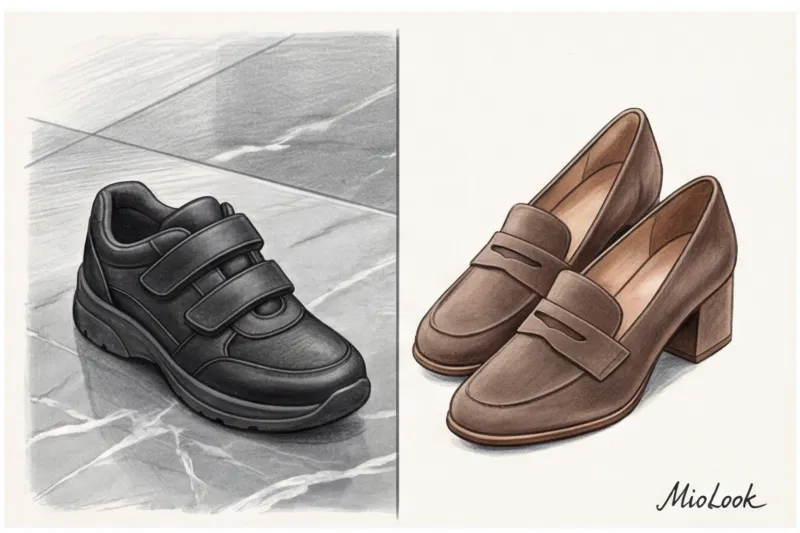
Herein lies the most dangerous, counterintuitive paradox, in my opinion. When your feet swell, your hand automatically reaches for completely flat shoes: ballet flats, soft Uggs, thin-soled sneakers, or beach flip-flops. These are the worst possible choices.
The American College of Obstetricians and Gynecologists (ACOG) warns that completely flat shoes provide no support for a collapsing arch. According to biomechanical calculations, flat soles without cushioning increase the load on the spine and joints by approximately 25%. Ballet flats literally provoke the development of acquired flatfoot.
Medical Fact vs. Fashion Habit: The 3-Centimeter Rule
Ideal shoes for swollen feet should have a micro heel, wedge, or thick sole of 2 to 4 centimeters.
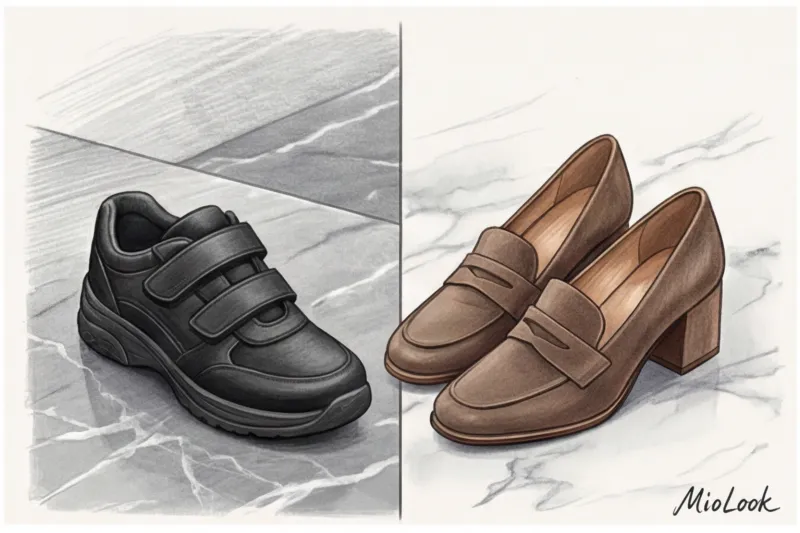
- Unloading: This height difference slightly elevates the heel, relieving tension on the Achilles tendon and calf muscles.
- Depreciation: A thick (from 1.5 cm), but necessarily flexible sole works as a buffer between your foot and the hard asphalt.
Access to MioLook for €0.99 — one-time payment
A smart AI stylist will find the perfect look with your new comfortable shoes.
Get access — €0.99 onceA stylist's checklist: how to choose shoes that will accommodate swelling
I often explain to my clients the difference between inexpensive pressed leather and high-quality nappa. While stiff, mass-market loafers might simply cause blisters in everyday life, they can impair circulation during pregnancy. Here's what we look for when buying:
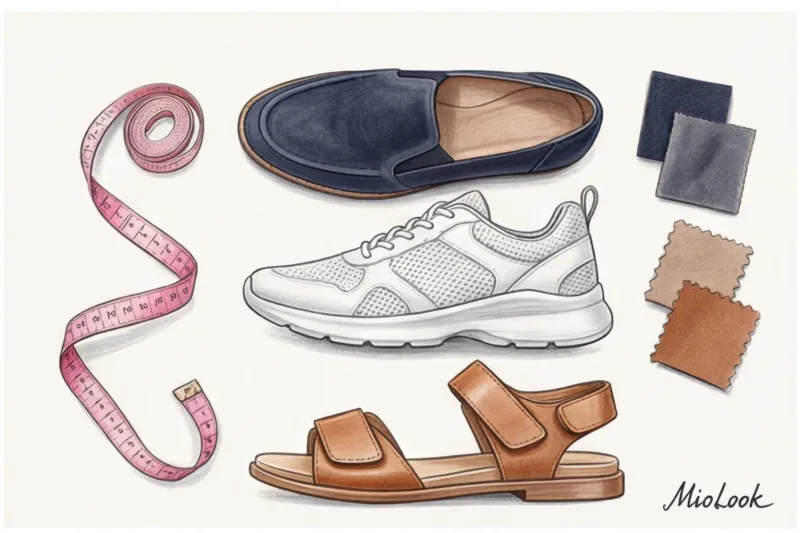
- Materials: A firm no to patent leather and stiff polyurethane faux leather. Genuine suede, ultra-soft nappa leather, and breathable, technical mesh (like those found in running shoes) are your best friends.
- Upper construction: Look for shoes with built-in adaptability. These include hidden elastic inserts on the sides, elegant Velcro straps (modern brands make them very stylish), or bungee laces.
- Completeness: Pay attention to the width markings. European manufacturers use letters: you need a last of H (wide) or K (extra wide). A wider width allows for more room for your foot without having to buy a ridiculous size 41 when you're a 38.
- The "evening fitting" rule: Never buy shoes in the morning. Arrive in the store or order delivery and try them on strictly after 5:00 PM, when your feet reach their maximum volume for the day.
Top 5 Stylish Alternatives for Pregnant Women with Swollen Legs
Theory is great, but let's move on to practice. Recently, a client, the IT director of a large company, contacted me. She was eight months pregnant, had a strict but modern business-casual work style, and suffered from severe swelling by midday. We put together a capsule for her based on the following pairs, which I highly recommend to everyone.
- Mules and clogs with a micro heel (Kitten heel or block heel 3 cm). An ideal choice for the office. They have no back, so they don't put pressure on your heel, and you can put them on without bending over—just slip your foot in. Choose models with a closed almond toe.
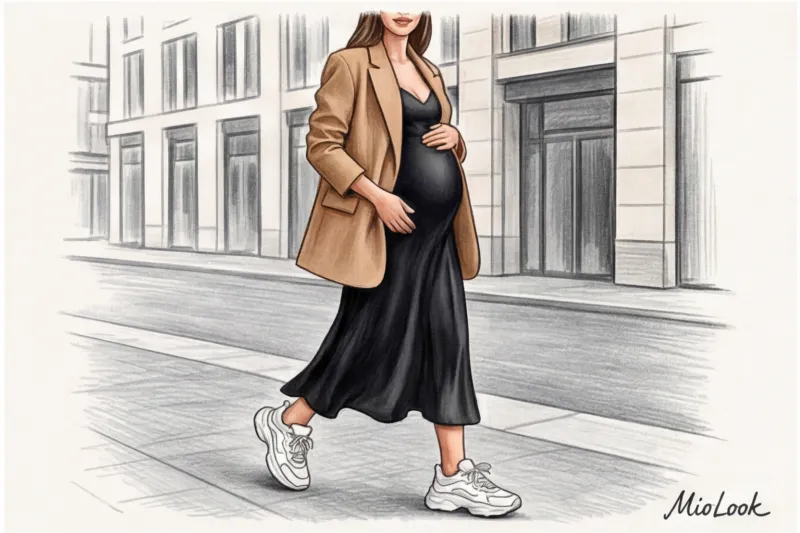
- Chunky sneakers (Dad sneakers). Tech sneakers from brands like New Balance, HOKA, or ASICS. Their thick soles provide luxurious cushioning, and their generous volume visually balances out a growing belly (unlike thin sneakers that make you look like a lollipop).
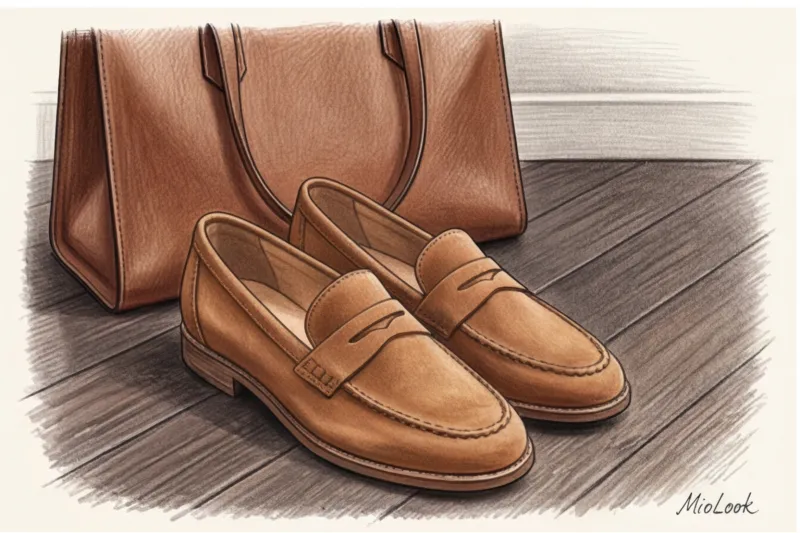
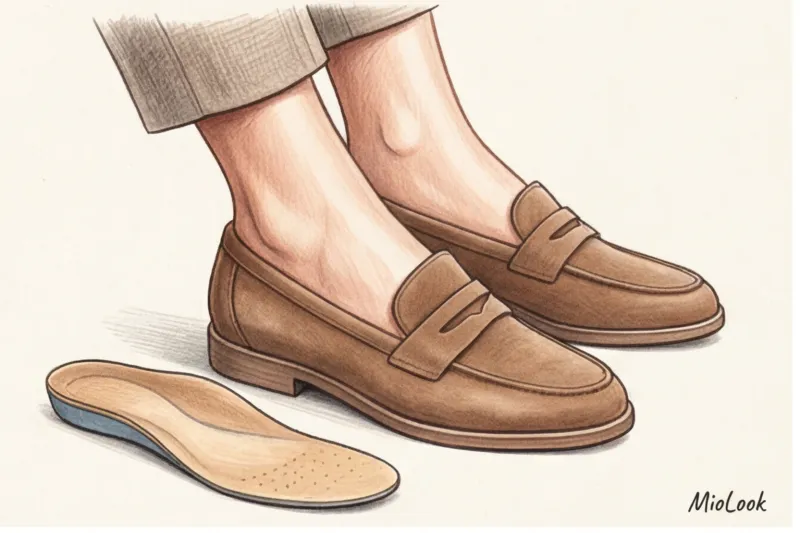
- Suede loafers with a folding heel counter. What a brilliant invention! In the morning, you put them on like classic loafers. If your feet are swollen by 4:00 PM, you simply step on the soft heel counter (designed specifically for this purpose) and transform the loafers into mules.
- Birkenstocks and trekking sandals. A lifesaver for the warm season. The anatomical cork insole supports the arch of the foot, and the straps can be loosened up to three times a day.
- Chelsea boots with wide elastic bands. For cool autumn and winter weather. Elastic side panels (gussets) allow the boot to stretch to accommodate ankle swelling.
Fair Limit: Of course, dad sneakers won't work if you have a strict formal dress code (like at a bank), and suede shoes are a definite no-no in autumn puddles. Adapt this list to your climate and circumstances.
Access to MioLook for €0.99 — one-time payment
Start creating perfect looks with AI and save them in the app
Get access — €0.99 onceCost Per Wear Rule: Invest in shoes you'll wear later
Buying special "maternity" shoes of dubious quality for 2-3 months is a waste of money. I'm a proponent of the Cost Per Wear approach.
Let's do the math: you can buy cheap, generic orthopedic shoes for €40, wear them 20 times, and throw them away (costing €2). Or you can invest €150–200 in a high-end pair of premium suede loafers or cool technical sneakers. You'll wear them every day until you give birth, and then on long, mile-long walks with the stroller for at least a year.
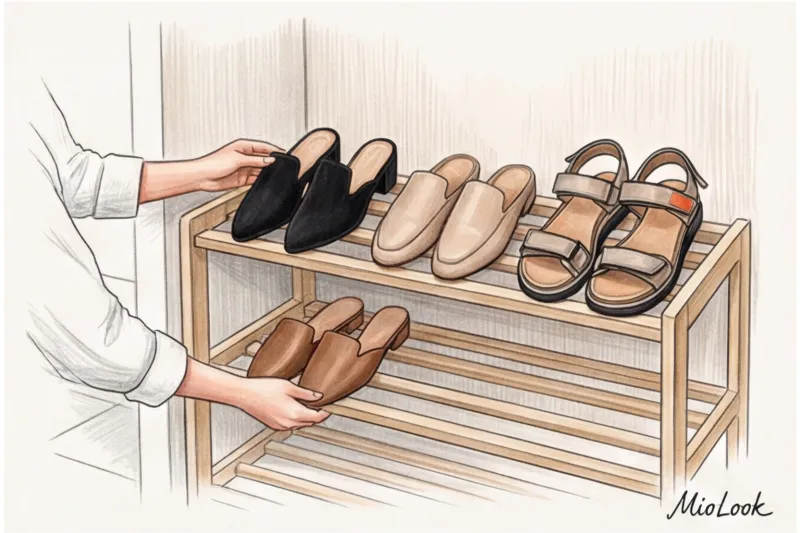
Investing in shoes that can be integrated into your basic capsule wardrobe is well worth the investment. Neutral colors (caramel, taupe, dark chocolate, graphite) will easily fit into 90% of your everyday looks, both now and after the baby arrives.
Life hacks from a stylist: how to visually correct ankle fullness
As a colorist and visual image maker, I often use optical illusions. If a leg is swollen and has lost its graceful arch, we can conceal it.
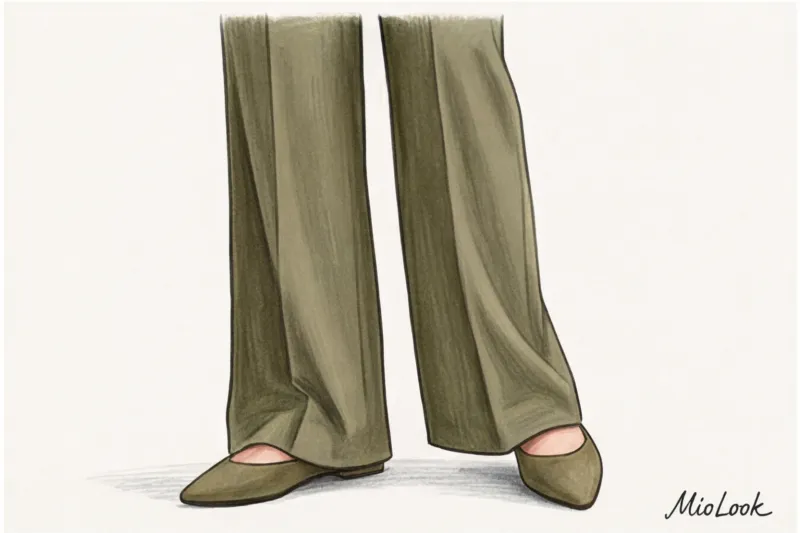
- Low contrast rule. The most powerful trick! Match your shoes to your trousers or tights. Black trousers + black loafers, beige joggers + beige sneakers. This creates a single vertical line of color, lengthens the leg, and blurs the line where the ankle appears wide.
- The shape of the cape matters. Avoid round, wide toes—they make your feet look like hooves. Opt for an elongated almond-shaped or soft square toe. These will visually slim your feet.
- Length and width of trousers. If swelling is severe, there's no point in exposing your ankle with cropped 7/8-length pants (the hem of the leg can also draw attention to the problem area). Instead, wear full-length, wide-leg palazzo pants or straight-leg jeans that cover your shoes almost to the toe.
- The focal point is the face. Draw attention away from your legs. Wear statement earrings, bright lipstick, a silk scarf, or a statement shirt collar. Viewers will always look where there's more contrast.
Combination mistakes that accentuate swelling
What you definitely shouldn't do? Avoid shoes with thin ankle straps (Mary Janes or Roman sandals). When your foot swells, the strap can dig into the skin, creating a tight, over-stretched appearance, which is not only unsightly but also painful.
A contrasting horizontal cut at the widest point of a shoe is also dangerous. For example, black ankle boots that end exactly halfway up a swollen shin, paired with nude tights, will visually "cut" the leg in half.
Smart Wardrobe: How MioLook Helps Integrate Comfortable Shoes
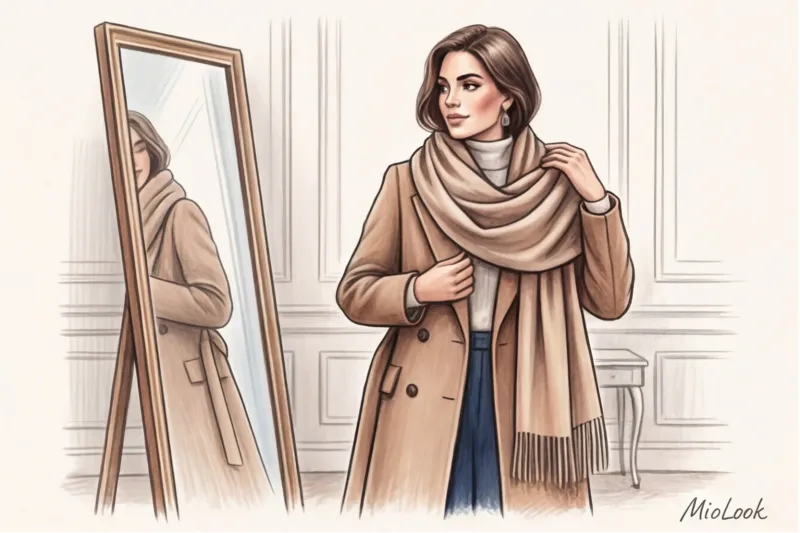
When you buy new, roomy or athletic shoes for comfort, you often get confused: what to wear with them from your old wardrobe? Standing in front of the mirror and changing clothes ten times in the final stages of pregnancy is physically taxing.
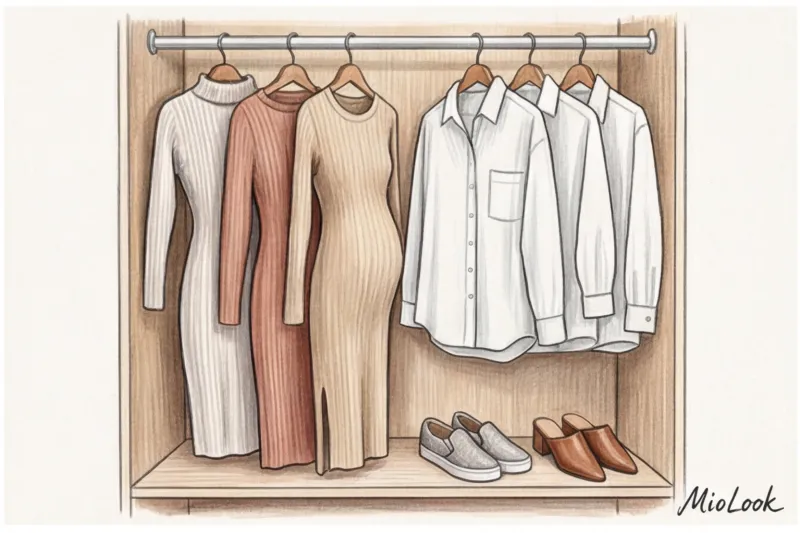
This is where the digitization function comes to the rescue. MioLook Take a photo of your new chunky sneakers or mules, add them to your virtual wardrobe, and the AI stylist will suggest combinations with your pre-pregnancy items: for example, pair the sneakers with your favorite stretchy knit dress and layer it with a voluminous jacket or your husband's shirt for balance.
Pregnancy is an incredible time when your body is going through incredible work. Don't make it harder with uncomfortable shoes. Invest wisely in comfort, choose high-tech materials, use the power of color to create a visual impact—and remember, self-care will always be the top trend of any season.