


Did you know that regularly renting an ordinary everyday sweater via a subscription service can be more harmful to the environment than buying it from a mass-market store? It sounds counterintuitive, as the sharing economy has always been touted as the pinnacle of conscious consumption. But if you look at the hidden logistics and chemical processes involved in caring for rental items, a completely different, paradoxical picture emerges.

As a stylist and textile specialist, Sophie Müller often sees clients going from one extreme to another: either buying fast fashion by the ton or trying to rent everything, making their lives more difficult. We've already discussed the basic principles of a sustainable wardrobe in more detail in our comprehensive guide: Conscious Fashion: How to Build an Eco-Friendly Wardrobe And today I propose to analyze with mathematical precision Pros and cons of clothing rentals to understand once and for all: when sharing really saves your budget and the planet, and when it only creates the illusion of savings.
Clothing Rentals: The Pros and Cons of the New Conscious Consumer Trend
The Airbnb and car-sharing model has naturally reached our closets. According to a report by the Ellen MacArthur Foundation, today we wear purchased clothes on average 36% less often than fifteen years ago. Closets are overflowing, and, as usual, there's nothing to wear. Modern rental services have responded to this pain by offering online showcases of thousands of dresses, delivered directly to your door by courier.
Unconditional advantages: from savings to freedom of style
Let's start with the obvious. The main advantage of renting is the radical reduction in the cost of making a mistake. You gain access to luxury brands, sophisticated cuts, and premium fabrics for just 10-15% of the retail price.
- Zero visual noise: You get rid of the one-time-only items (sequin dresses, neon jackets) that hang in your closet for years after one party, causing you to feel guilty.
- Style experiments: Have you been wanting to try Maison Margiela's asymmetrical cut or fuchsia, but were afraid the color wouldn't suit you? Renting allows you to test out micro-trends without a long-term investment.
- Freeing up space: Your personal wardrobe remains “clean” and functional, with only those items that you truly love and wear every day allowed to breathe.
Hidden disadvantages: the ecological paradox and the fear of spoilage
Now, about what rental services prefer to keep quiet about. A study published in a reputable scientific journal Environmental Research Letters (2021) found that renting everyday clothes is more harmful to the environment than buying them.
Why does this happen? The constant back-and-forth courier delivery of each T-shirt, the endless disposable packaging, and—most importantly—the toxic solvents used in mandatory industrial dry cleaning after each customer generate a colossal carbon footprint. What's good for an evening dress (which you'd probably dry clean anyway) is detrimental to a basic wardrobe.
"Renting everyday essentials is greenwashing. You're not saving the planet by renting a basic cotton long sleeve; you're simply subsidizing courier services and chemical factories." I always emphasize this principle at the first consultation.
Don't forget the psychological barrier: at a corporate event, you might spend the entire evening thinking not about dancing but about avoiding spilling wine on your hem, which carries a hefty fine. Furthermore, you can't take a rented garment to a tailor for a precise fit, which is critical for complex suits.
Access to MioLook for €0.99 — one-time payment
Start creating perfect looks with AI and integrate rented items into your capsule collections.
Get access — €0.99 onceBuying vs. Sharing: Wardrobe Math and the CPW Formula
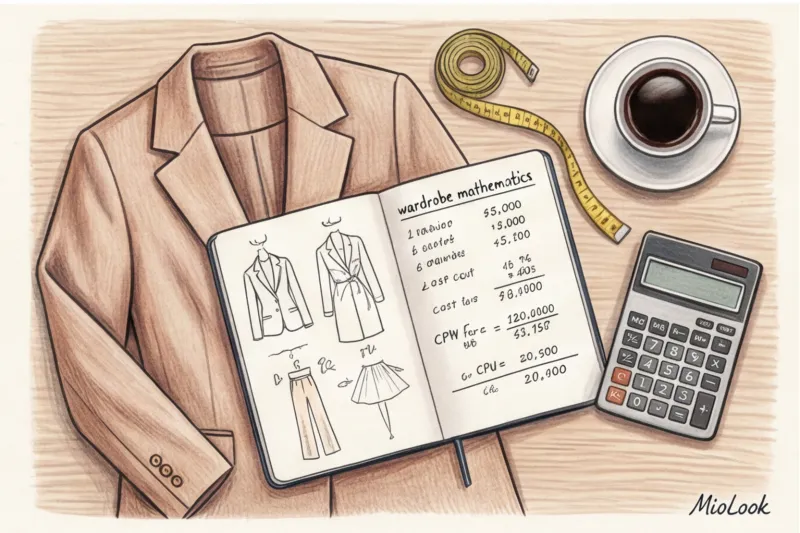
How do you know if it's worth renting or buying? Professional stylists don't rely on the absolute price tag. We use a formula. Cost Per Wear (CPW) — the cost of one exit. It is calculated as follows: (Price of item + care costs) / Number of wears.

Let's use real-world examples to calculate this. Let's say you need a flawless, basic wool-blend jacket for work.
- Scenario A (Purchase of a base): A quality jacket costs 30,000 €. You'll wear it at least 100 times over two years. CPW = 300 € per outing. If you rent it for 3 days for 4,000 € and do it regularly, you'll go broke. You need to buy the basics.
- Scenario B (Evening dress for going out): A luxurious dress costs 45,000 €. You'll wear it exactly once, to a friend's wedding (you wouldn't wear it to work, after all, and you'll want to wear something new at the next event). CPW = 45,000 €. Renting this dress would cost 5,000 €. The savings are obvious—renting is 9 times cheaper!
To quickly calculate your CPW and see which items from your closet you don't wear, it's convenient to use digital tools. After uploading your database to MioLook , you'll clearly see statistics: which items are worth their price, and which would be cheaper to use sharing instead.
When is clothing rental most profitable: 4 ideal scenarios
In my experience, sharing works flawlessly when used selectively. Here are four scenarios where renting is completely worth it.

Scenario 1: Black-tie, weddings and corporate events
This is a classic. I have a client, a top manager, who saved over $1,500 last year just by stopping buying outfits for social events. One- or two-night outfits, where status and wow-factor are crucial, are made for rental. If this topic is relevant to you, I recommend checking out this article. What to Wear to a Corporate Party: Style and Business Etiquette.

Scenario 2: Pregnancy and temporary changes in figure
There's nothing more pointless than investing tens of thousands in clothes that will be too big or too small in three months. High-quality maternity denim or warm convertible jackets are expensive, and you can only resell them for pennies later. A rental subscription is your salvation here.
Scenario 3: Thematic photo sessions and public speaking
A stage image dictates its own rules: color, volume, and texture are essential on camera, but repetition is unavoidable on video. One of my clients is a business coach. She has an extremely minimalist personal wardrobe, but for each performance, she rents vibrant, intricately cut suits. This allows her to always look fresh and maintain her status (read more about this in the article). Dressing for Public Speaking: How to Look Classy ).
Scenario 4: Test drive expensive fabrics before buying
This is my favorite insider tip that few people know about. When I first considered buying a 100% cashmere Max Mara coat (a serious investment), I rented a similar one for the weekend. I wanted to understand how the fabric would react to a bag strap. Would it pill a lot when rubbed against a car seat? For 5,000 €, I conducted a full crash test of the fabric in real-world conditions before shelling out 200,000 € for the item.
Your perfect look starts here
Join thousands of users who look flawless every day with MioLook. Digitize your wardrobe in just a few clicks.
Get access — €0.99 oncePitfalls: How to check the quality of items at rental services
But every coin has a flip side. As a textile expert, I can tell at a glance if a garment has survived 15 industrial dry cleaning cycles.
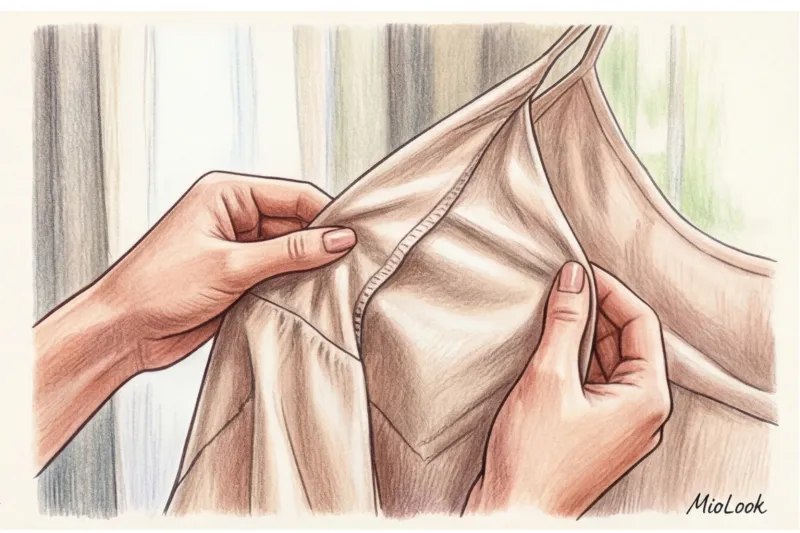
The problem is that perchloroethylene (a popular dry cleaner's solvent) is harsh on protein fibers. It literally leaches the natural oils (sericin) from natural silk. As a result, a silk slip dress loses its signature oily sheen and becomes dry and brittle. Frequent chemical treatment and steaming of wool causes persistent pilling, and the fibers lose their elasticity.
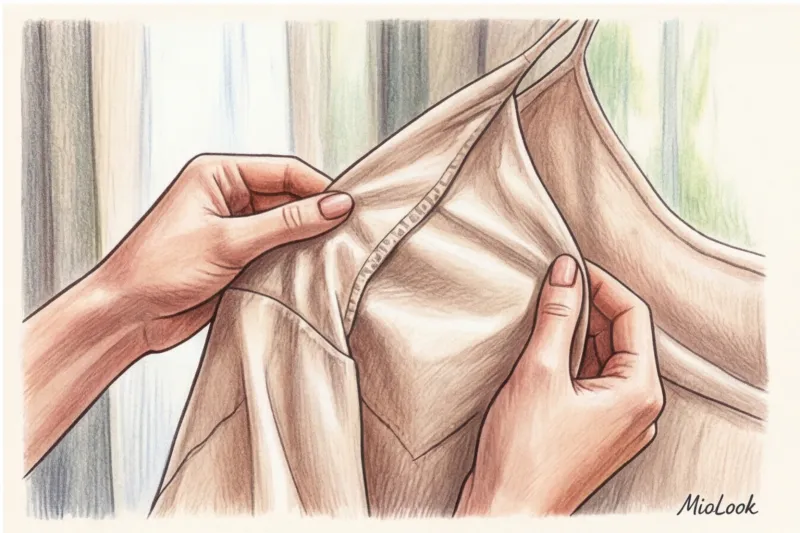
Stylist's checklist when accepting an item from a courier:
- Seams and fittings: Carefully inspect the armpit and waist area (where the fabric stretches). Are there any loose threads? Zip and unzip the zipper twice—it shouldn't snag.
- Smell: The item shouldn't smell of harsh chemicals or, conversely, someone else's perfume. A strong chemical smell indicates that the service is skimping on proper airing after treatment.
- Terms of the agreement: Before signing the contract, find out whether the basic insurance (if any) covers minor snags on the hem or food stains. A white wine stain is often covered, while a heel snag on a silk dress is fully compensated.
The 80/20 Rule: How to Integrate Sharing into a Capsule Wardrobe
The ideal modern wardrobe isn't 100% purchased or 100% rented. The secret lies in the Pareto golden rule: 80/20.
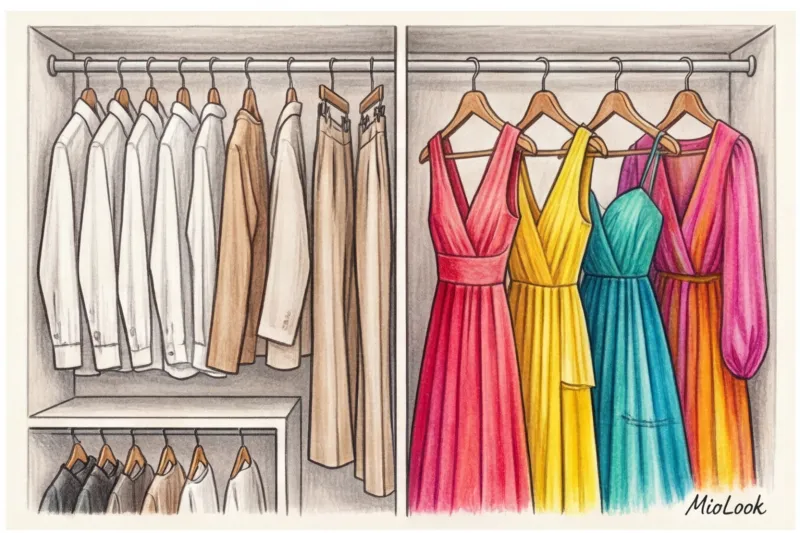
80% is your personal base. Perfectly fitting jeans, high-quality cashmere sweaters, basic shoes, and white shirts made of heavy cotton (at least 180 g/m²). These are low-cost-per-wear items that you wear constantly. You're investing in their quality and tailoring them to your body. (For more information on how to build such a foundation, read our article.) Capsule Wardrobe: A Complete Guide to Creating One ).
20% are rented accents. Extreme seasonal trends (like leopard-print coats or jackets with exaggerated shoulders), evening wear, and sophisticated accessories for photo shoots. These 20% are constantly changing, refreshing your base without taking up too much space on the hangers.
Ready to get started?
Try the MioLook free plan—no commitments required. Build your ideal 80% database right in the app.
Get access — €0.99 onceRenting clothes isn't a magic pill for the "nothing to wear" problem. It's a financial and stylistic tool. If you try to cover your basic needs with rentals, you'll overpay logistics companies and harm the environment. But if you learn to buy the perfect basics and rent only the most exciting moments for a single evening, your style will reach a whole new level of awareness and visual luxury.