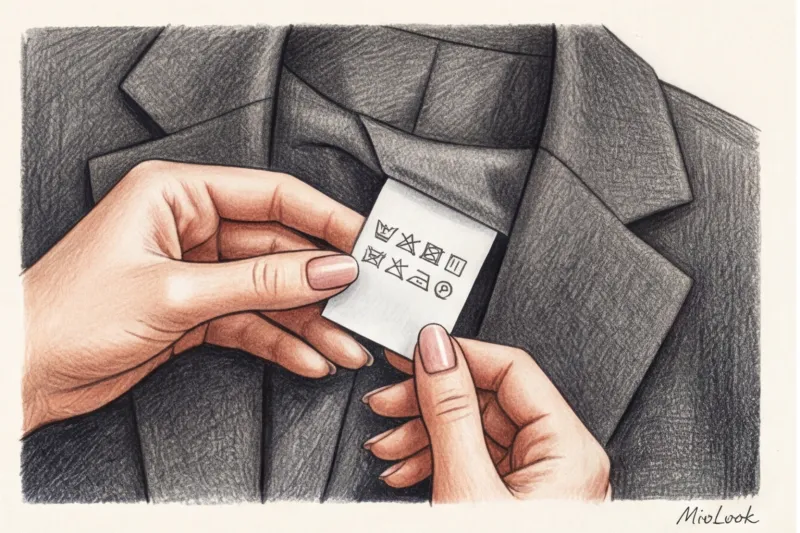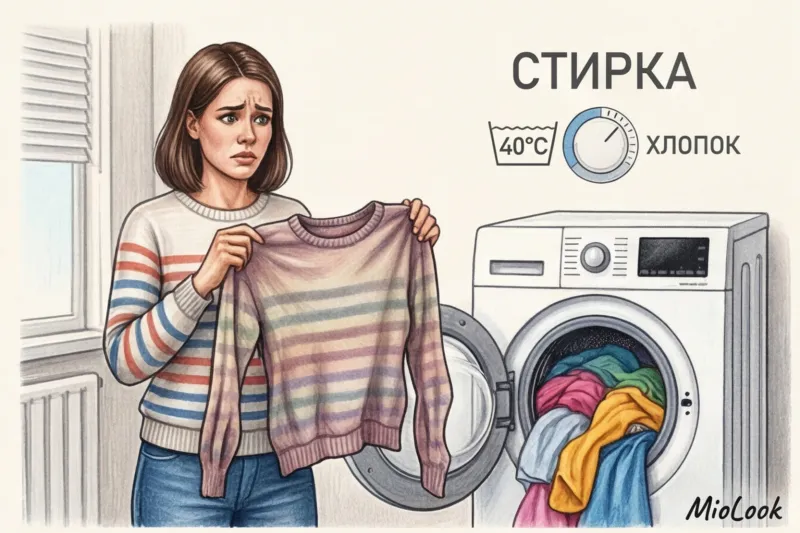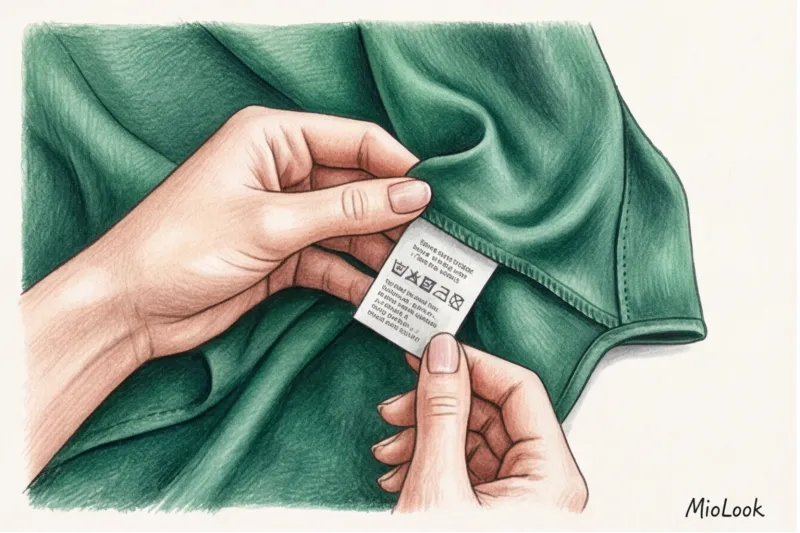
One day, a client of mine brought in a $500 silk blouse from a premium brand for a wardrobe review in tears. It had been worn only once, but now it looked like a piece of stiff, wrinkled paper and had shrunk exactly two sizes. The reason? She'd thrown it in the washing machine on the delicate cycle, ignoring the single symbol on the tag—a crossed-out basin of water. It was then that I realized once again: icons on clothing labels explanation which many ignore - this is not the manufacturers' tediousness, but a literal instruction on how to save your investments.
We have already discussed in more detail the integrated approach to forming a durable base in our The complete clothing care guide: how to extend the life of your favorite items.
Instead of memorizing dozens of strange symbols, I suggest you understand the physics and chemistry of fabric care. Once you understand what exactly happens to elastane in hot water or cashmere in the dryer, you'll no longer need cheat sheets.
Badges on clothing labels: decoding as an investment in your wardrobe
Over 12 years of working as a stylist, I've developed a strict rule: a well-maintained mass-market item (for example, a basic jumper from Uniqlo or COS), washed properly, always looks many times more expensive than a "tired" luxury item with pilling and protruding elbows. The magic of status lies in preserving the garment's original texture, density, and geometry.
Let's do the math. There's a golden metric in styling: Cost Per Wear. Let's say you bought a great pair of wool-blend trousers for $300.
- Scenario A (proper care): You follow the label. The pants serve you faithfully for three years. You wear them 100 times. Your Cost Per Wear = $3 per wear.
- Scenario B (ignoring the shortcut): You wash them at 60°C and dry them on a radiator. The fabric shrinks, and the fibers become deformed. After three washes, the pants are only fit for trips to the dacha. Your Cost Per Wear = $100 per outing.
"We don't buy clothes; we buy the responsibility for maintaining their architecture. Fading fabrics don't just age a garment—it ruins your natural color type, distorting the depth of the shade that originally made your face look fresh." This is what I tell every client on their first shopping trip.
Access to MioLook for €0.99 — one-time payment
A smart AI stylist will select the perfect look and help you organize your wardrobe.
Get access — €0.99 onceBasic Care Geometry: The Logic of the GINETEX System
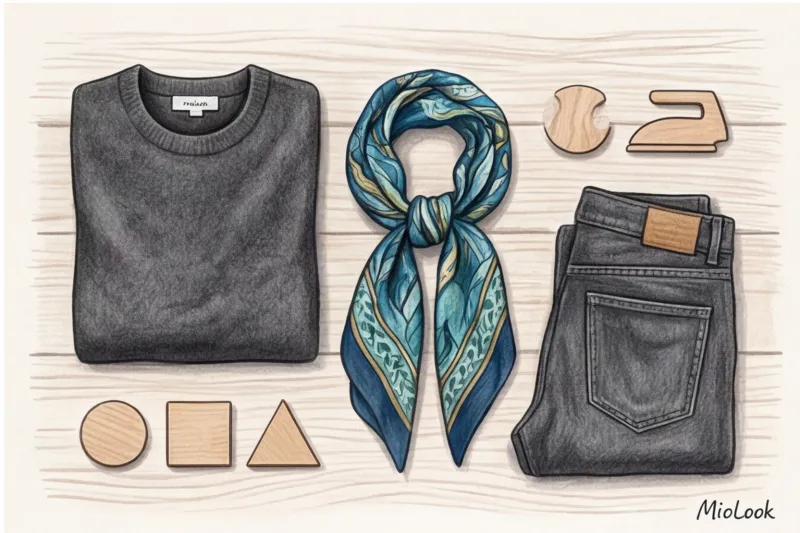
You don't need to memorize all 50+ existing symbols. The International Textile Labeling System (ISO 3758 standard), developed by the GINETEX association, is based on the basic logic of five figures.
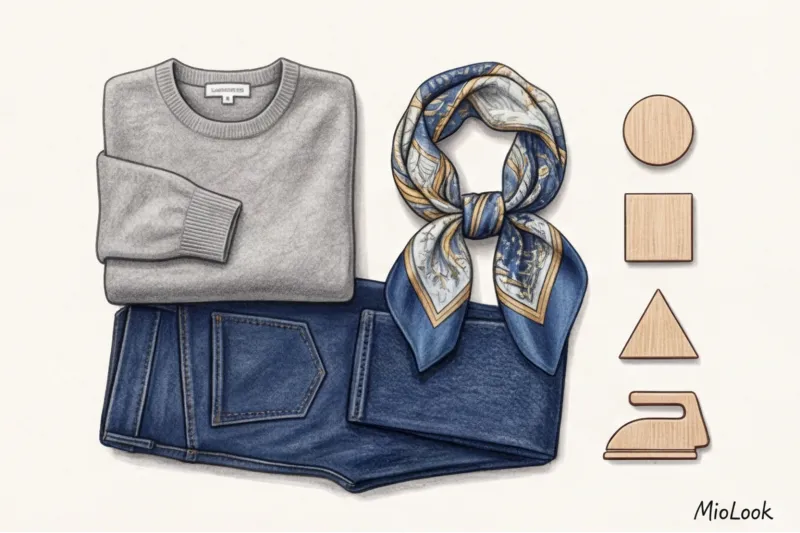
Remember this basic principle and you will be able to read any label:
- A basin of water — these are wet processes (washing). It is responsible for temperature and mechanical action.
- Triangle — This is chemistry (bleaching). Imagine a laboratory flask.
- Square — this is drying. Everything that has to do with air and a centrifuge.
- Iron - this is ironing and steaming (temperature modes).
- Circle — this is a professional territory (dry cleaning and wet cleaning).
Washing (Base of Water): The Main Mistakes That Kill Fabric
Have you noticed how quickly your favorite black jeans from the mass market turn into dull gray sweatpants with baggy knees? The problem isn't the quality of the denim. The problem is the numbers inside the pelvic symbol.
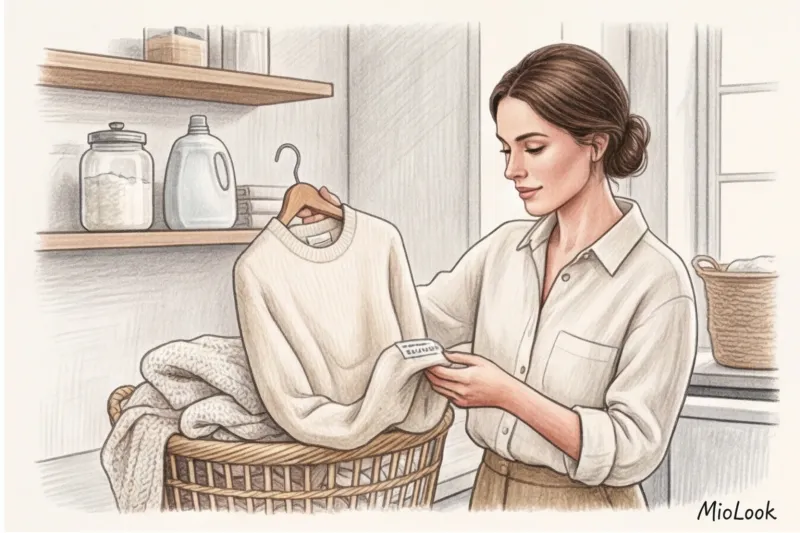
The difference between 30°C and 40°C seems insignificant to us, given that the human body temperature is 36.6°C. But for fabric, this is a critical threshold. A study by the Swedish RISE Institute (2022) demonstrated that temperatures above 40°C destroy the polyurethane bonds in elastane fibers in just 5-7 washing cycles. The garment simply loses its ability to "spring back."
Look carefully at lines under the pelvis - this is an indicator of mechanics (drum speed):
- No lines: standard wash and spin cycle (for cotton, linen, blended fabrics).
- One line: Delicate wash. The drum speed is reduced, and the machine adds more water to reduce friction between fabrics (synthetics, viscose).
- Two lines: Extra delicate wash. Minimal mechanical impact (silk, fine wool).
If your hand is in the basin, it's strictly hand-wash. And no, the "Hand Wash" machine setting doesn't replace it when it comes to fluffy mohair or alpaca. A crossed-out basin means no contact with water—don't try to spot-wash a stain on such a jacket under the tap; it will leave a hard halo.
Drying (Square): Why Tumble Drying is the Enemy of Elastane and Fit
Machine drying (a circle in a square) is a brilliant invention for bed linens and towels, but it's the worst enemy of your clothes' shrinkage.
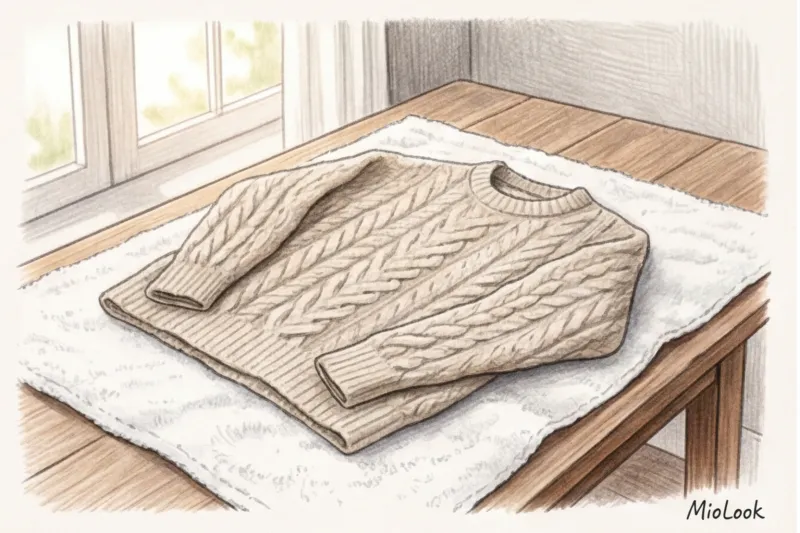
The dots inside the circle indicate the temperature: one dot is gentle drying (low temperature), two dots are normal drying. However, I strongly recommend air drying clothes containing more than 2% elastane. The hot air in the dryer literally "bake" the elastane, making it brittle.
For natural drying, draw lines in a square:
- Vertical lines: hang dry.
- Horizontal line: Dry flat. This is critical for heavy knits.
- Oblique lines in the left corner: dry in the shade.
A life hack from my practice: Never hang a damp cashmere or wool sweater on a hanger. Water weighs down the yarn, and the weight will cause the sweater to stretch 10-15 centimeters, creating unsightly "bumps" on the shoulders. First, roll the sweater in a dry terry towel to squeeze out the water without wringing, then lay it flat on a dry towel.
Bleaching (Triangle): Chemical Treatment
Everything is simple here, but the price of error is high:
- Empty triangle: You can use any bleach, including aggressive chlorine (a rarity in a modern wardrobe).
- Triangle with two diagonal lines: Only oxygen-based bleaches (chlorine-free) are allowed. They gently remove dirt using oxygen bubbles and are color-safe.
- Crossed triangle: Bleaching is strictly prohibited.
Your perfect look starts here
Join thousands of users who look flawless every day with MioLook. Save your skincare routine right in the app.
Get access — €0.99 onceIroning: temperature setting to maintain a matte finish
Ironing without taking the temperature into account is the main reason for the appearance of las (treacherous shiny stripes on seams and darts) on trousers and jackets.
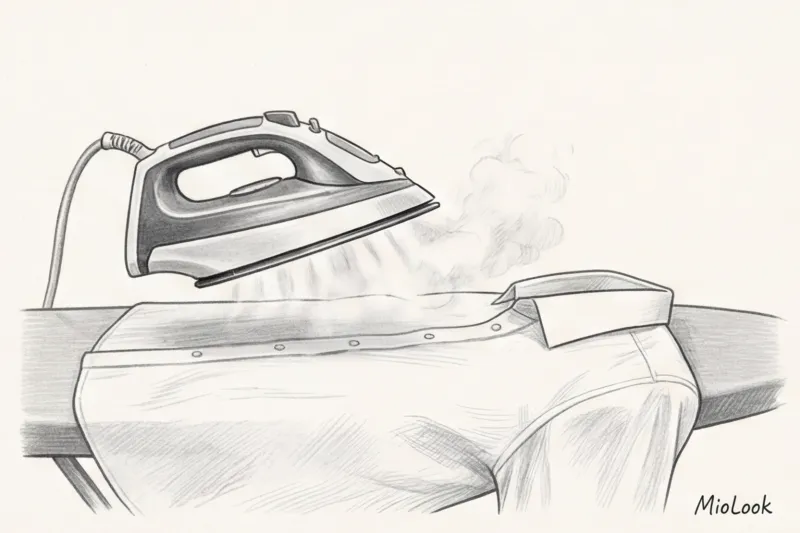
The dots on the iron are synchronized with the controller of your home appliance:
- Single point (up to 110°C): Silk, polyester, nylon, acrylic. Iron only without steam! Steam can warp delicate synthetics.
- Two points (up to 150°C): wool, viscose, polyester blends.
- Three points (up to 200°C): thick cotton and linen.
As a fabric expert, I must warn you: ironing synthetics (like a polyester blouse) on three spots won't just crease them; it will also melt the fibers locally. The fabric will permanently lose its elegant matte finish, taking on a cheap, glossy sheen at the folds. When in doubt, always iron the garment inside out or through a damp ironing pad (a thin cotton cloth).
Professional Care (Circle): When Dry Cleaning Is Essential and When It's a Marketing Stunt
The letters inside the circle (P, F, W) are a cheat sheet for the dry cleaner, indicating which solvent can be used (perchloroethylene, hydrocarbons, or wet cleaning). You don't need to learn these letters. But you do need to know another secret.
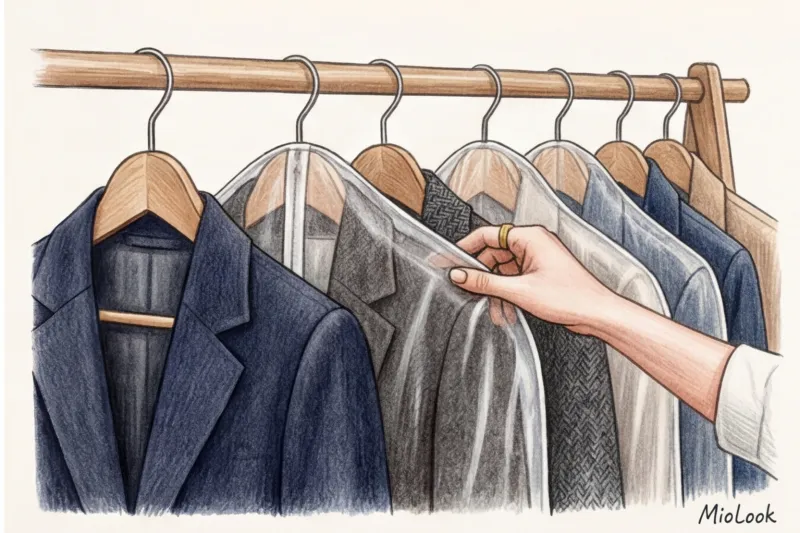
There's a huge myth surrounding the "Dry Clean Only" symbol (an empty circle or a circle with the letter P). Brands (especially in the mid-price segment) are slapping this symbol on knitwear en masse as a safety precaution. According to McKinsey (2024), up to 30% of "Dry Clean Only" labels on sweaters are not technologically sound.
Moreover, harsh chemicals in dry cleaning dry out the natural fibers. Real cashmere and 100% merino wool love Water. If you hand-wash them in cool water with a special shampoo containing lanolin (a natural animal wax), the yarn will fluff up, become incredibly soft, and last longer.
But there is an important limitation: when does this NOT work? Never attempt to wash complexly constructed items at home. Structured jackets, interlining coats, and items with complex linings and heavy hardware are dry clean only. Water will destroy the adhesives within the fabric, causing the jacket to develop permanent blisters at the lapels.
Checklist: How to cut off tags without losing the care instructions
Tags are a pain. They prick, chafe, show through thin silk blouses, and ruin the silhouette of form-fitting dresses. Cutting them is possible and necessary, but it should be done wisely.
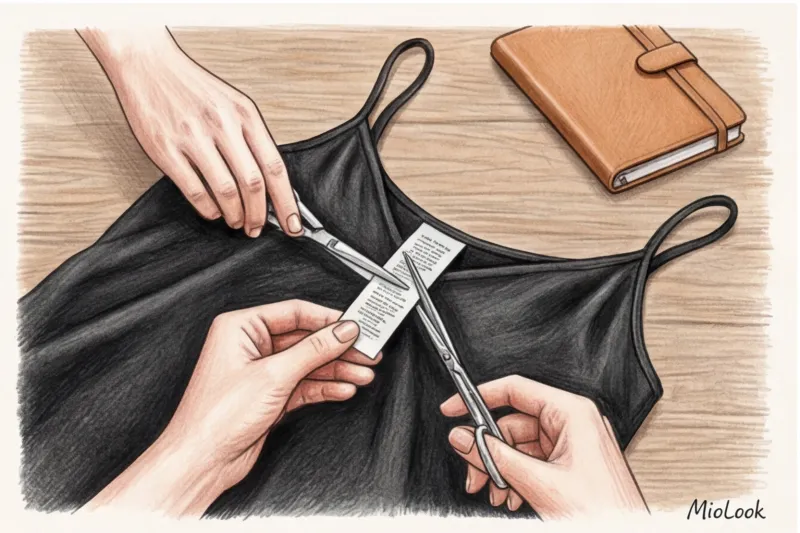
- Never remove the label with your hands. You risk tearing a piece of the main fabric and damaging the overlocker. Use sharp nail scissors or a seam ripper, leaving a 1-2 mm seam allowance.
- Digitize care. Before cutting off the tag, take a photo of the item and then take a macro photo of the tag in the next frame.
- Use smart tools. My clients upload photos of new items to MioLook — you can record the composition and care instructions for each item in the profile. When washing, you won't have to guess whether it's viscose or polyester, or at what temperature to wash it.
If the tags have already been cut off and the composition is unknown, apply the "presumption of delicacy": wash the item as if it were the most capricious silk - at 30°C, on the minimum spin cycle, inside out and placing it in a special mesh bag.
Proper wardrobe maintenance isn't a chore. It's conscious management of your assets. Understanding the basic symbols on clothing labels gives you control over your everyday appearance, protecting your money and time. Treat tags like a garment's passport, and your favorite outfits will delight you for years to come, maintaining their salon-fresh appearance.