In 12 years of working as a fashion journalist and stylist, I've learned one absolute rule: no other item of clothing inspires as much tears and despair in fitting rooms as a swimsuit. Neon lights, mirrors on every side, and a tiny flap of fabric that seems to betray every croissant eaten. We're used to blaming our bodies for this. But the truth is, 90% of the time, it's not your body that's to blame, but a simple ignorance of the laws of physics and optics.
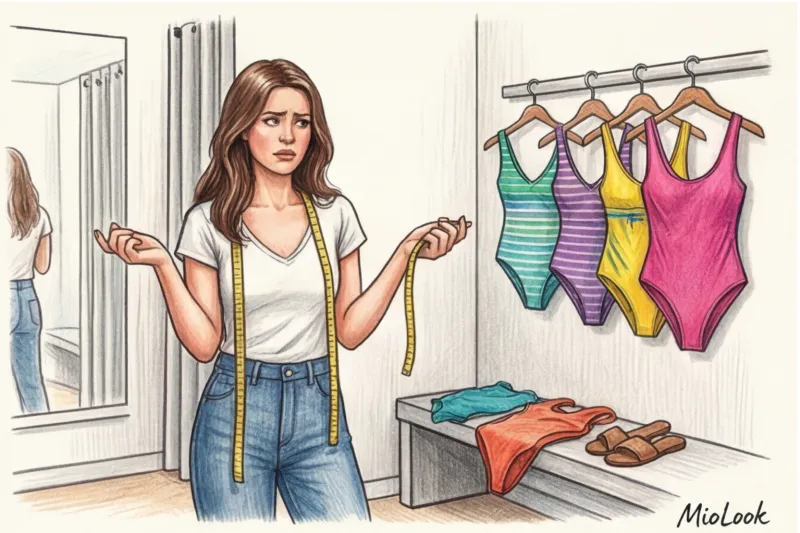
Today, we won't be discussing how to choose a swimsuit for your body type using tired fruit metaphors like "pears" or "apples." These outdated concepts only serve to create insecurities. We'll approach the matter like architects: working with 3D volumes, tension lines, and visual weight.
Forget about "apples" and meters: why the old rules don't work on the beach
I once had two clients come to me for a cruise wardrobe. Both had identical measurements: 92-68-96. According to the old classification, they were classic hourglass figures. But when they tried on identical bikinis, the results were diametrically opposed. The first one looked perfect, while the second felt bulky and disproportionate. Why?
Because a tape measure measures a flat, 2D circumference. It doesn't take into account the projection of the buttocks, the width of the chest, the height of the hips, or the distribution of muscle and fat tissue. We discussed this architectural concept in more detail in our A complete guide to defining your silhouette without a tape measure.
The swimsuit hugs a 3D volume. The psychology of modern beachwear isn't based on "hiding flaws" (it's physically impossible to hide anything in a bikini). Our goal is to control the viewer's focus, redirecting the eye through cut, color, and fabric texture.
Your perfect look starts here
Join thousands of users who look flawless every day with MioLook. The smart algorithm takes your unique proportions into account.
Get access — €0.99 onceHow to choose a swimsuit based on your body type: 3D volume architecture
When designing shapewear, designers use the principles of optical illusions. One of the most famous is the Müller-Lyer illusion (when a line with outward-facing creases appears longer than a line with inward-facing creases). This works quite literally in swimwear: hip cutouts, print placement, and neckline shape act like those creases, visually elongating or widening your body.
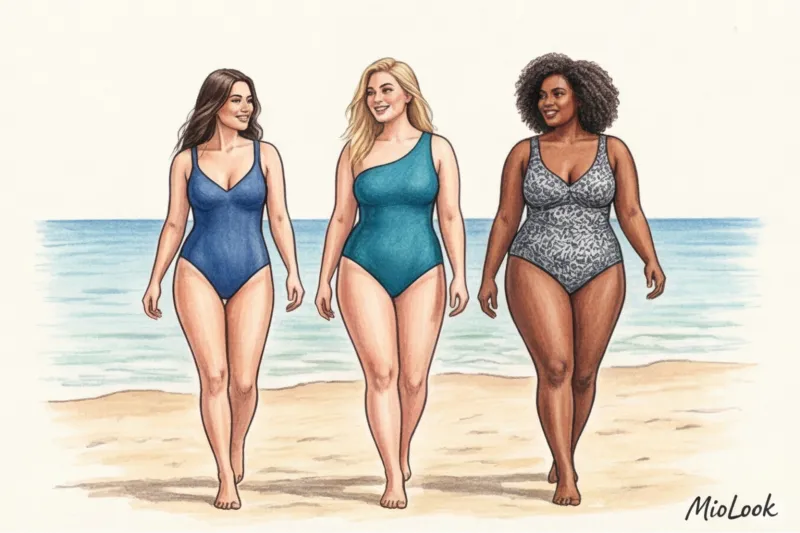
Let's look at the three main areas of visual weight and how to work with them in practice.
Lower visual weight (Emphasis on hips and buttocks)
If volume is concentrated in the lower part of the body, your task is to balance the top without weighing down the bottom with unnecessary details.
What we categorically remove: Boy shorts. This is the biggest mistake I see on the beach. The horizontal cut of the shorts runs right across the widest part of the thigh, visually cutting off the leg and adding a minimal size.
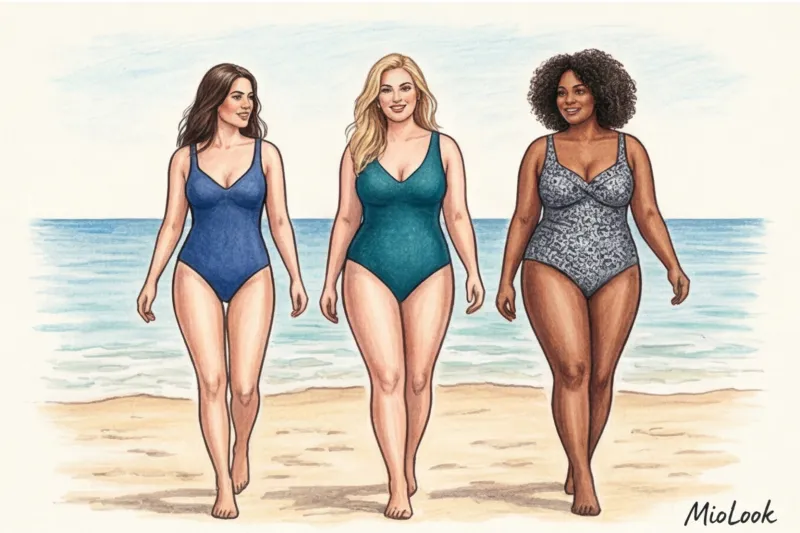
- Bottom: Opt for high necklines (French cuts) in the 80s style. By exposing your iliac crotch, you create the famous Müller-Lyer illusion, dramatically lengthening your legs. The fabric of your swimsuit should be matte, dark, and smooth.
- Upper part: Here we add architectural volume. Ruffles, flounces, dense ribbed textures, light or bright prints.
Upper visual weight (Broad back or full chest)
For a figure with a dominant top, the main rule is a reliable frame and a softened shoulder line.
Main danger: Halter bras. Firstly, if you have a full bust, you'll end up with deep, painful folds on your neck by evening. Secondly, the diagonal line converging toward the neck visually makes the shoulders appear even broader and more massive, creating a swimmer's silhouette.
- Upper part: Look for wide, straight straps (like a classic bra), deep V-necklines, and mandatory underwire support. A built-in, soft cup without underwire won't support a cup larger than a C-cup.
- Bottom: Create balance with volume at the bottom. Tie-side bottoms, metal rings, draping, or large, bold prints will draw the eye.
Central visual weight (rounded belly)
When volume is concentrated in the waist area, our goal is to elongate the silhouette and create artificial verticals.
One of my clients tried to hide her postpartum belly with high-waisted, retro, pin-up style bikini bottoms. The result was disastrous: the tight elastic band dug into the softest part of her waist, creating an unsightly roll (the "muffin top" effect). Retro bikini bottoms only work if they have a soft, seamless edge at the top.
"If you're looking to contour your midsection, look for styles with wraps or diagonal draping. Asymmetry disrupts the monolithic volume, forcing the eye to follow the diagonal line rather than rest on the waistline."
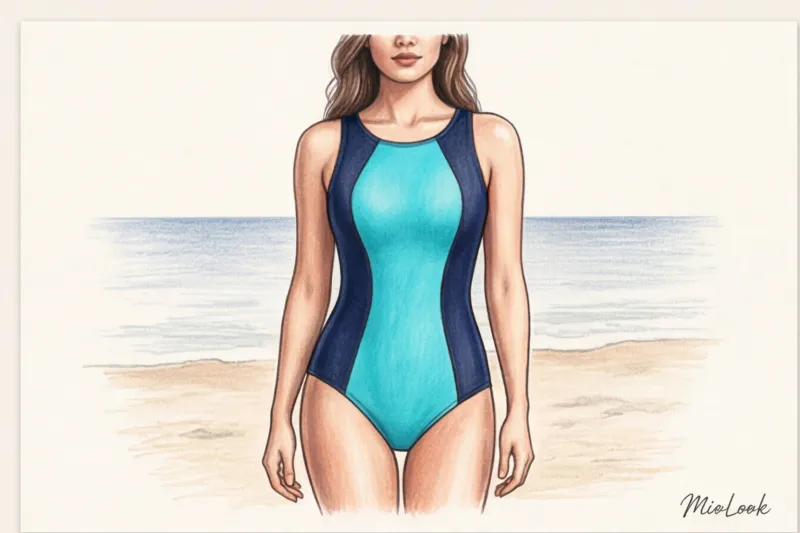
Color blocking works great: a one-piece swimsuit with a light or printed center panel and matte black sides. This visually "cuts off" a few centimeters on each side.
Ready to get started?
Try the MioLook plan for free—no commitments required. Create your perfect digital wardrobe and discover the perfect styles for you.
Get access — €0.99 onceThe Biggest Myth: Why a Black Swimsuit Doesn't Make You Look Slimmer
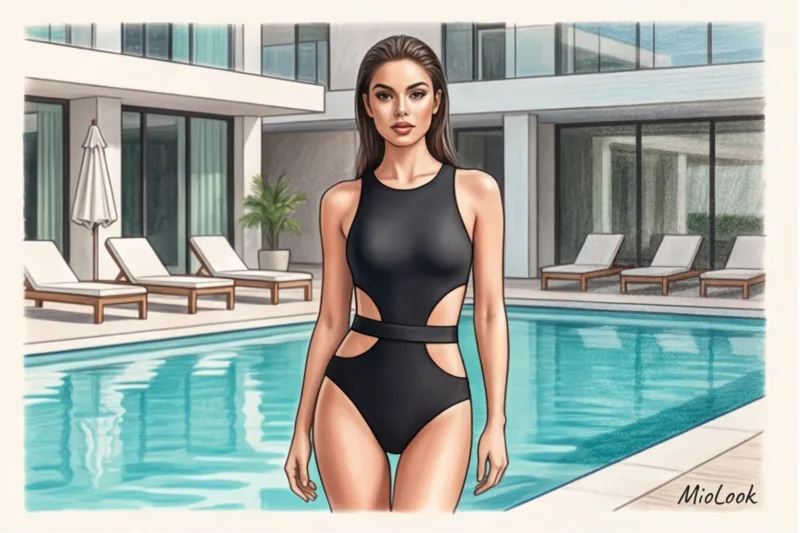
This is the most counterintuitive insight, the one that sparks the most debate in my workshops. We're used to thinking that "black is slimming." In the city, in the office, in the dim light of a restaurant—yes. On a brightly sunlit beach—definitely not.
Remember the physics of light: black absorbs light. When you stand in a black one-piece swimsuit against a backdrop of light sand, a sparkling sea, and a bright sky, the contrast is incredibly sharp. Your figure is defined as if outlined with a thick black marker. Every fold, every curve (even those you didn't realize you had) becomes apparent.
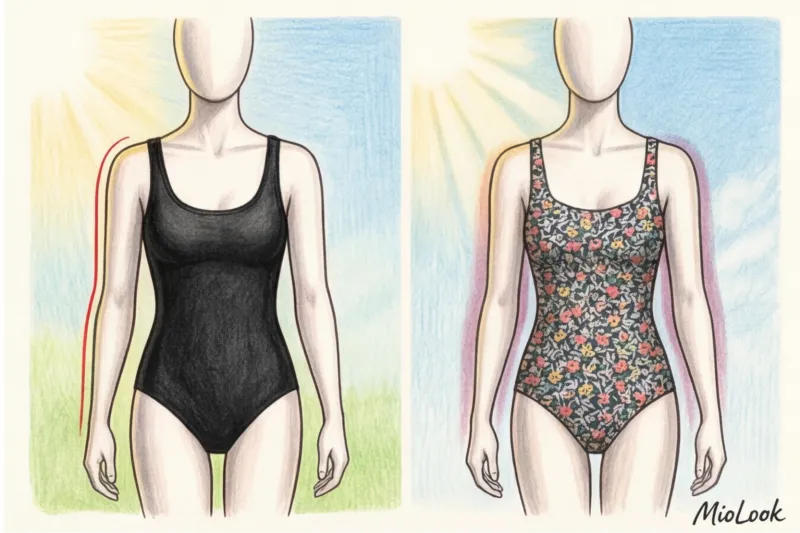
Research agency WGSN confirms in its 2024 Beach Fashion Report that small, chaotic prints work best for visual correction in bright light.
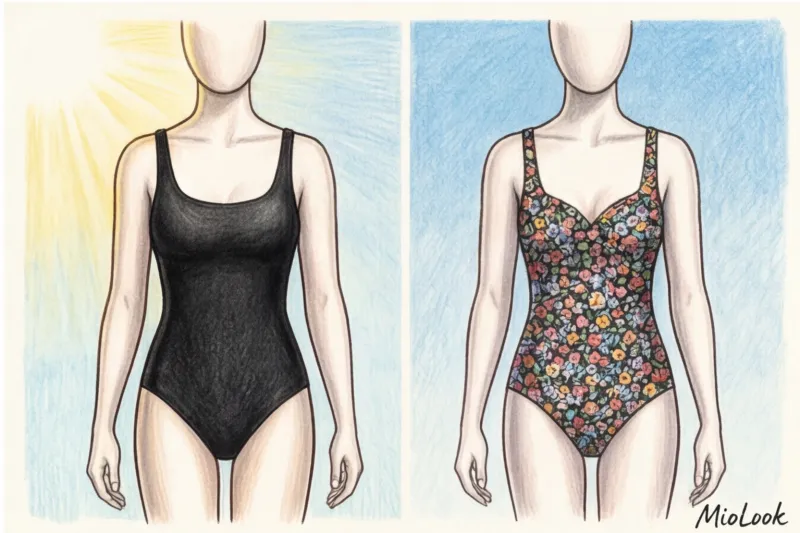
Microfloral prints, abstract designs, and small leopard prints create a visual "noise" or camouflage effect. The viewer's eye can't focus on a specific point or crease, blurring the boundaries of the body. The fabric must be matte. Any gloss, satin, or lurex will act as a highlighter, subtly illuminating all the volumes.
Read the label: fabric composition is more important than style
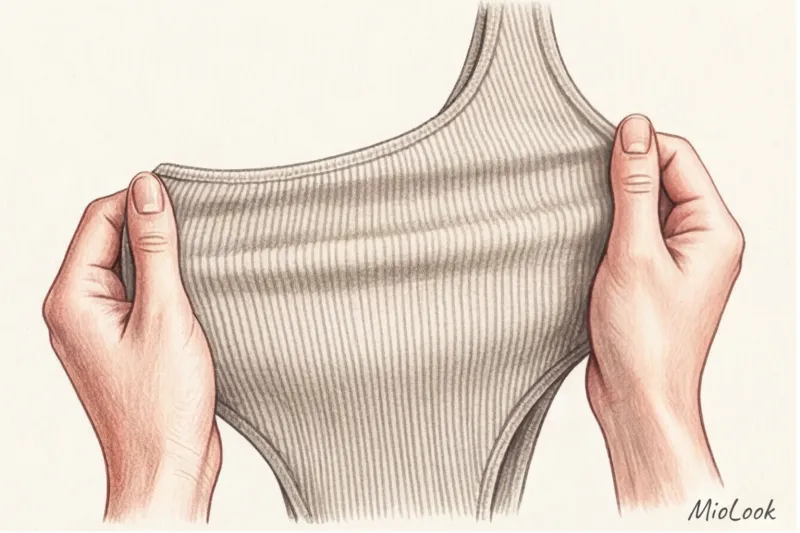
Most online articles scream, "Choose high-quality fabrics!" But what does this mean in practice? If you're looking for a swimsuit that will actually perform shapewear (shaping and sculpting), you need to look for one specific line on the label: the percentage of elastane (aka spandex or lycra).
If a swimsuit contains 5-10% elastane, it will simply hug the body softly. There will be no shaping. For a true sculpting effect look for 20% to 30% elastane Lycra's technologists (holders of the patent for the original elastane) have proven that this density is capable of creating a supportive corset without rigid underwire.
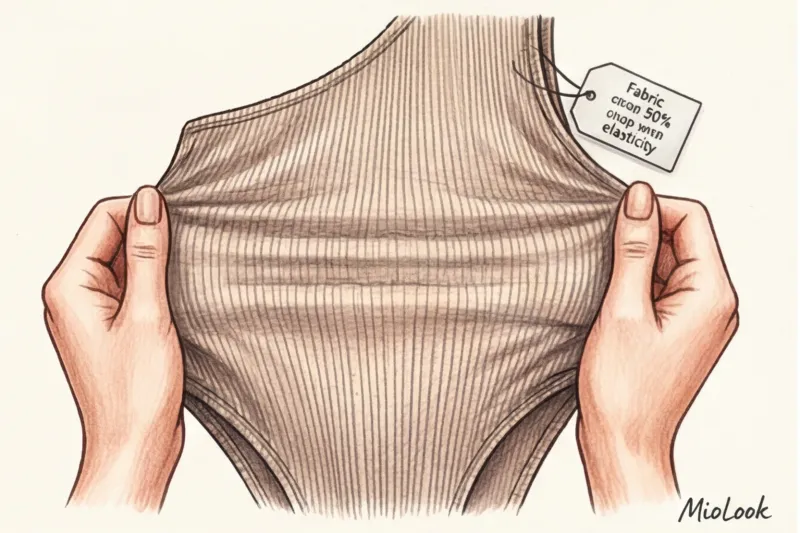
- Base material: Avoid cheap polyester—it fades quickly, retains moisture, and develops an unpleasant odor when exposed to sunlight. Look for polyamide (Nylon)—it's silky to the touch, dries quickly, and drapes luxuriously.
- Hidden secret: High-quality one-piece swimsuits always have an internal lining on the stomach made of a special mesh - PowerNet It is this that holds its shape while the outer fabric drapes beautifully.
Important limitation: Honesty requires a disclaimer. Thick, shaping swimsuits (with 30% elastane and powernet) have a significant drawback: they take significantly longer to dry and are hotter. If you're planning a vacation in Dubai at 42°C and spending most of your time simply lounging on a sun lounger, it's better to sacrifice a tight fit in favor of a thin, breathable material.
Try MioLook
A smart AI stylist will select the perfect look for you, taking into account your preferences for color, texture, and comfort level.
Get access — €0.99 onceStylist checklist: "beach crash test" in the fitting room
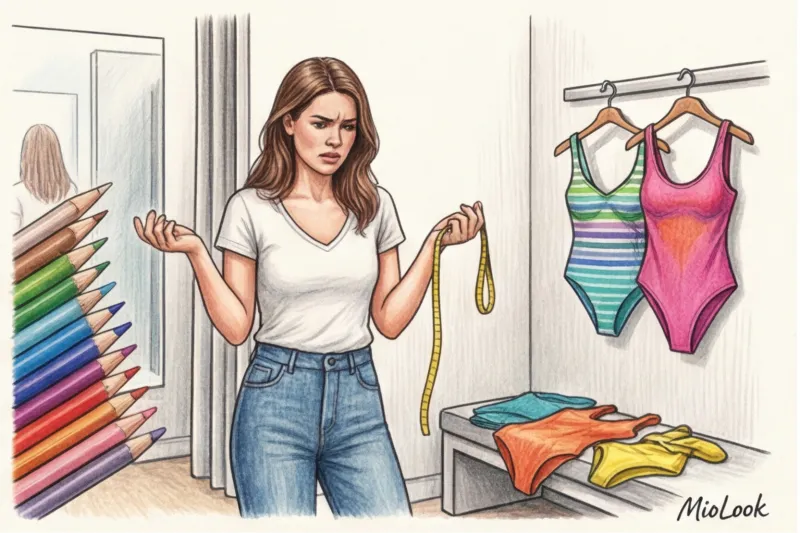
"It fit perfectly in the store, but I almost lost it in the sea" is a classic complaint. To avoid this, I make my clients conduct a real crash test in the fitting room. Forget about simply standing straight in front of the mirror and sucking in your stomach.
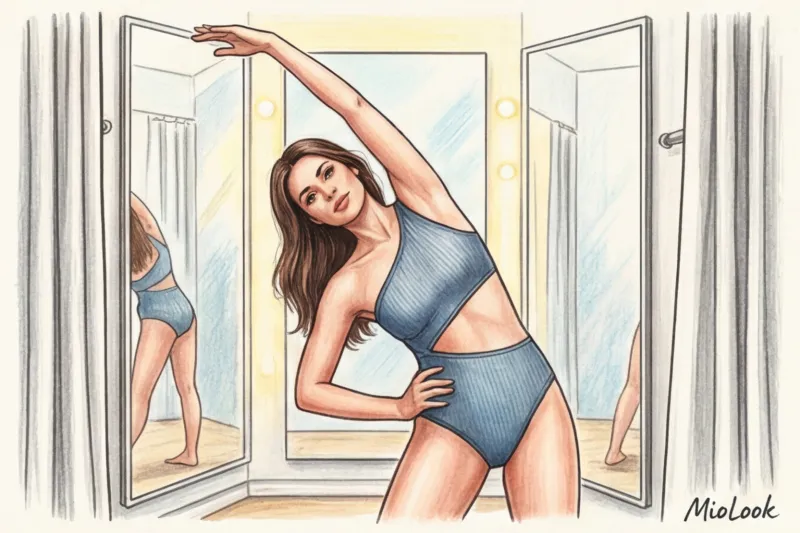
- Twist test: Sit on the pouf in the fitting room (yes, in your swimsuit) and relax your stomach. If the swimsuit immediately bunches up into a thin tube under your belly, it's not your style.
- Volleyball Test: Raise both arms sharply and stretch. Is your bra slipping down your neck? Are your briefs cutting into the wrong places? We're leaving that swimsuit on the hanger.
- Gravity test: Lean forward at a 90-degree angle. If you have a full bust, it should stay inside the cups rather than trying to escape into the cleavage.
And remember about lighting. The light in 90% of fitting rooms falls directly from above, creating harsh shadows and highlighting cellulite even where it doesn't exist. On the beach, under the open sky, the light is diffused—you'll look ten times better than in that cubicle.
Create your perfect beach capsule with MioLook
A swimsuit is just the foundation of your beach look. It doesn't make you stylish on its own. The magic lies in the styling: how it pairs with a sheer linen shirt, a wide-brimmed hat, chunky sunglasses, and sandals. We wrote about how to create harmonious outfits in our guide. creating a capsule wardrobe.
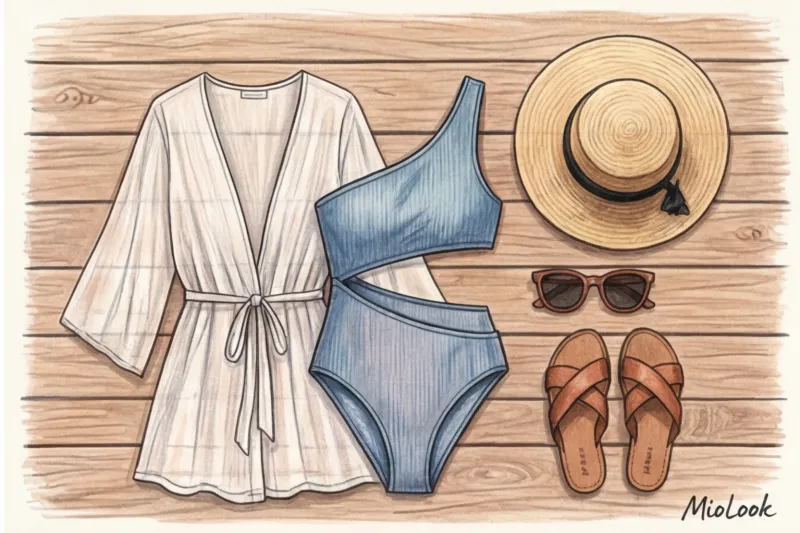
To avoid buying unnecessary items and to know for sure whether a terracotta swimsuit will fit into your current summer wardrobe, upload your items to the MioLook app. Artificial intelligence will analyze your digital capsule wardrobe and take your preferences into account. appearance color type and will suggest which shades and silhouettes will work best on you.
Ultimately, the best thing you can take with you to the beach is confident posture. A well-chosen swimsuit, a clever print, and a sturdy fabric aren't meant to squeeze you into some non-existent standard. They're meant to make you feel so comfortable and secure that you forget what you're wearing and simply enjoy the sea.