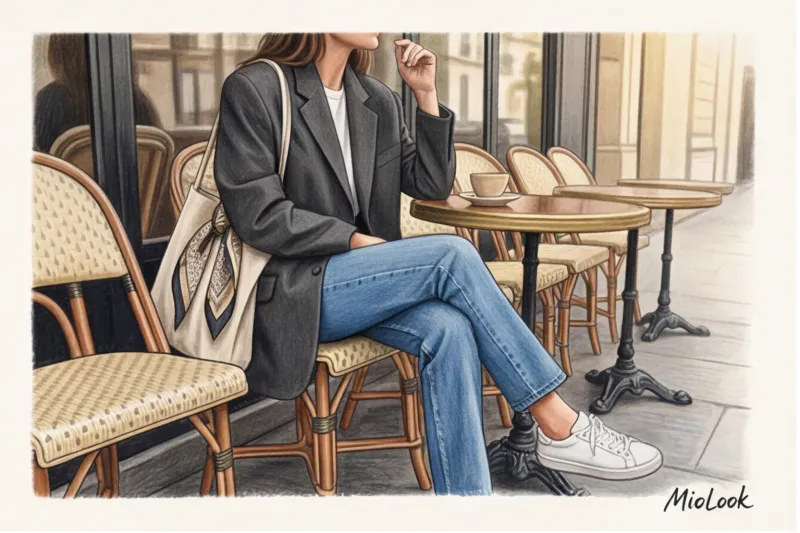
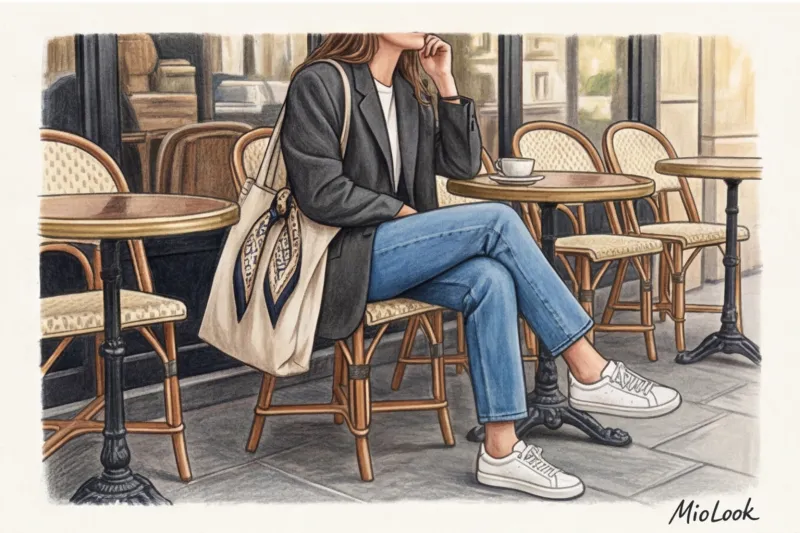
When I first came to Paris to study textiles, my suitcase was full of stereotypes. I carefully packed a red felt beret and a sturdy leather bag, planning to look like a French film heroine. The reality of Paris's 11th arrondissement quickly dispelled this glossy arrogance. Sitting on the terrace of a local café, I gazed in amazement at the real Parisians. They wore faded vintage jeans, men's jackets, and expensive silk scarves casually tied to the handles of faded canvas shopping bags.
In our The Complete Guide to French Clothing Style: Secrets of Parisian Women We've already covered the basics of a wardrobe. Today, we'll go deeper. We won't be discussing tired clichés. Instead, I suggest you look at French-style accessories through the prism of textile physics, conscious consumption and healthy pragmatism.
French-Style Accessories: Breaking Souvenir Shop Stereotypes
The most important rule you need to understand is: if your look looks like it took you more than fifteen minutes to get ready, you've failed the "Frenchness" test. Aesthetics effortless chic (casual chic) is built on utility. Accessories here are primarily functional, and only then decorative.
In my experience, when clients try to emulate the looks from the TV series "Emily in Paris," they make the same mistake: they overload the silhouette. They throw on everything they have: a statement belt, a beret, and a complex bag. True French women do things differently. They use accessories to solve a practical problem: to protect their neck from the wind, to tuck away unwanted hair, or to make trousers fit tighter. Beauty is born precisely from this functional honesty.
Your perfect look starts here
Join thousands of users who look flawless every day with MioLook.
Get access — €0.99 onceThe Anatomy of a Silk Scarf: An Investment, Not Just a Piece of Fabric
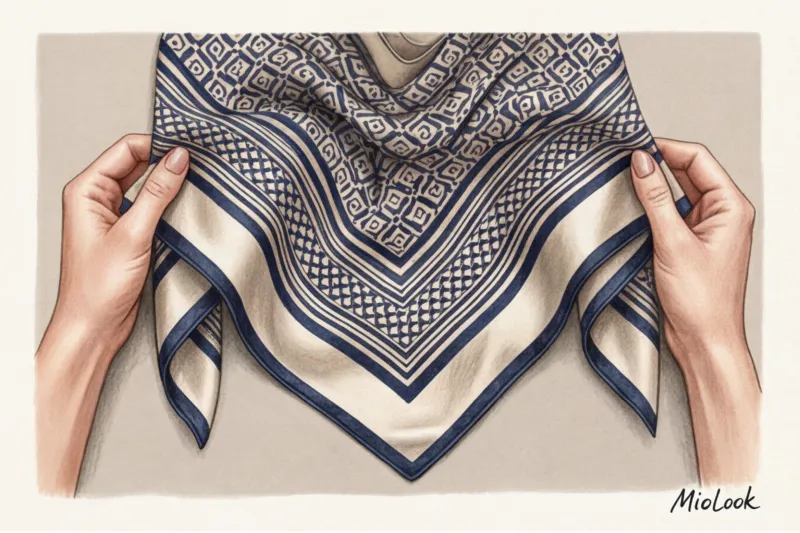
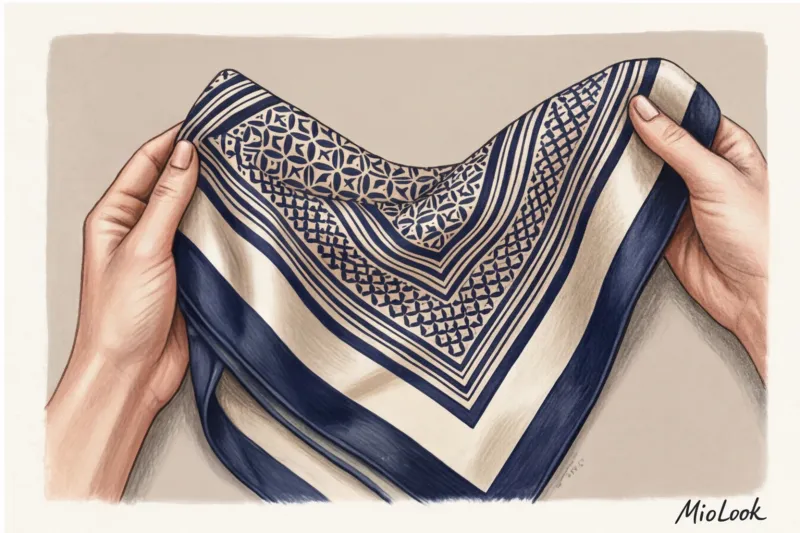
A silk square is more than just a square of fabric; it's a masterpiece of textile engineering. Historically, this tradition originated in the Lyon manufactories, where artisans understood the unique thermoregulating properties of natural silk thread. Silk's physics are such that in hot weather, it wicks away heat from the body, while in cooler weather, it retains it thanks to the microscopic air pockets between the fibers.
According to McKinsey's 2024 Circular Economy in Fashion report, the life cycle of a high-quality silk accessory is over 20 years, while its mass-market polyester counterpart ends up in landfill after an average of eight months. In terms of carbon footprint and cost per wear, buying a single vintage scarf for €150–€200 is much more sustainable and cost-effective than buying synthetics each season for €15.
How to distinguish high-quality silk: density, edge, and print
Over 12 years of working with fabrics, I've learned to determine the quality of silk with my eyes closed. Here are three objective criteria that cannot be faked:
- Density in momme. This is a Japanese unit of measurement for silk weight. High-quality silk that will drape beautifully, rather than hang like a dull rag, should have a density of 14 to 18 momi. This silk feels like dense, slightly cool water in your hands.
- Hand rolled stitch (roulotté). Look at the edge of the scarf. Premium brands (and good vintage ones) always have the edge folded over. facial side and hand-stitched with silk thread. Machine stitching is a sign of cost-effective production.
- Through print. The pattern on the intricate Lyon silk is applied in such a way that it appears almost equally vibrant on both sides. If the back of your scarf is dull and whitish, it's a cheap digital print.
Casualness as an Art: 5 Unconventional Ways to Wear a Bob
The main paradox of French chic: the more expensive and prestigious an accessory, the more casually and utilitarianly it should be treated. Wearing a handmade masterpiece strictly around the neck with a perfect suit is flight attendant style. Tying it to the handle of a worn bag is the French way.
A strict pioneer knot at the neck adds age. Let's tone down the pretentiousness of expensive items. Here are some ways to integrate silk into everyday life:
- Instead of a hair tie. Gather your hair into a low, messy bun and wrap the scarf around it, letting the ends hang loose.
- Like a belt. Twist the bob into a rope and thread it through the belt loops of vintage Levi's jeans. The contrast of rough denim and soft silk is a classic styling touch.
- On the handle of the bag. Works perfectly with basic canvas shoppers or baskets. Important limitation: This technique absolutely doesn't work with rigid office briefcases—it creates a dissonance between the relaxed look and the strict dress code.
- Like a bracelet. Wrap a thin scarf around your wrist in several layers next to your metal watch.
- Under the collar of a man's shirt. Leave the top three buttons unbuttoned and tie the scarf as low and loosely as possible around your collarbones.
Access to MioLook for €0.99 — one-time payment
A smart AI stylist will select the perfect look based on your wardrobe.
Get access — €0.99 onceBeret: How to Wear This Headwear Without Looking Comical
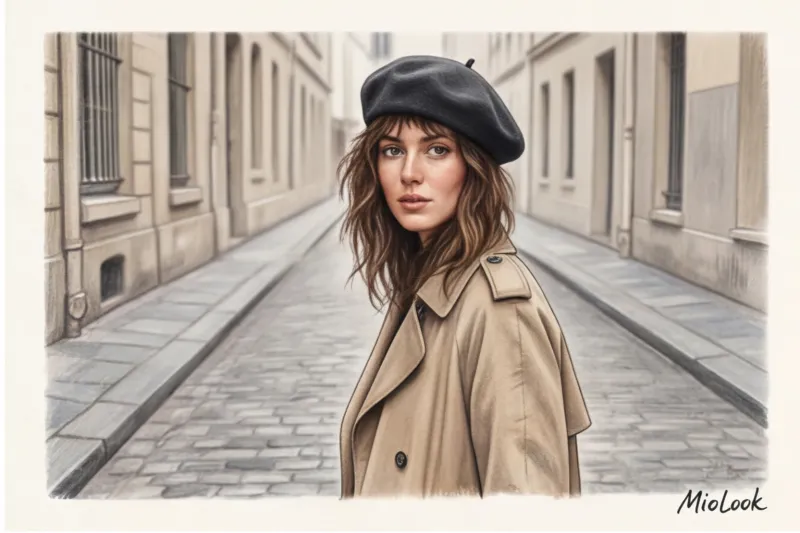
If you go into any tourist shop near Notre Dame, you'll see hundreds of stiff, stiff berets in bright red or acid yellow. Leave them there. A true Parisian wears a beret for only one reason: it's cold outside.
A proper beret is made not from cheap felt, but from soft, flexible merino wool. The physics of long merino fiber is such that it practically doesn't pill (doesn't form lumps), unlike acrylic blends. The color palette should be as neutral as possible: deep anthracite, navy blue, khaki, or muted burgundy.
How to achieve the right fit? The beret shouldn't sit on top of your head like a frisbee or fall over your forehead like a swimming cap. Pull it back slightly and asymmetrically fold it to one side, letting strands of hair fall around your face. This will create that perfect, relaxed geometric shape.
Minimalism in jewelry: the "one noticeable detail" rule
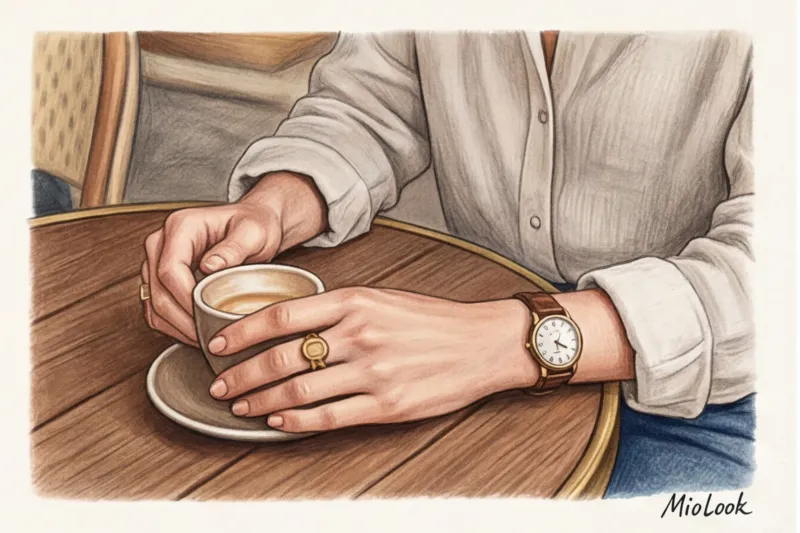
The era of the perfect jewelry set (when a necklace, earrings, and ring all share the same design) is long gone. In the French sense of style, such an approach is considered bad form—it overly reveals that you've "dressed up." The emphasis is on texture, timelessness, and personal history.
Instead of buying shiny new outfits, invest in pieces with character. I covered this topic in detail in the article "Status Accessories: What Marks a Successful Expert" The foundation of Parisian minimalism is distressed matte gold, a vintage watch on a textured leather strap, and perhaps one chunky signet ring.
The "bare neck" concept deserves special attention. If you're wearing a white shirt or top with a deep V-neck, your collarbones are the best adornment. The absence of a pendant often creates a more sensual and confident look than a scattering of diamonds.
Bags and Shoes: Why Functionality Always Wins
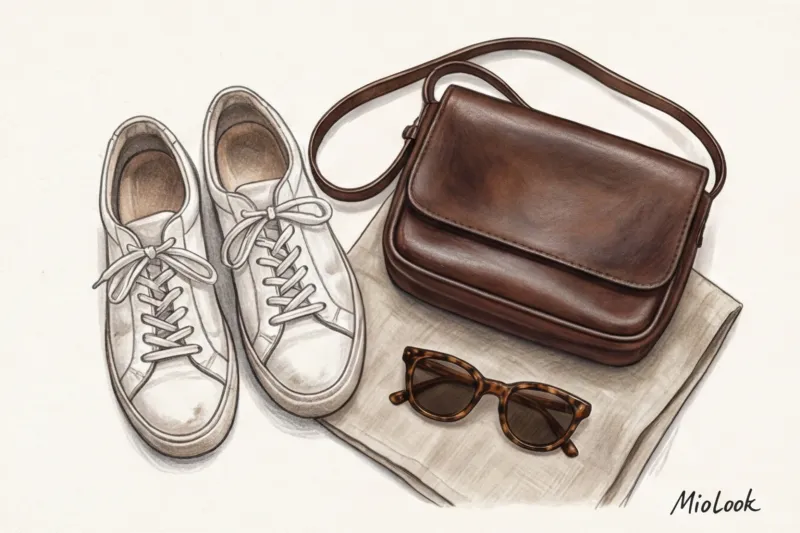
You'll never see a woman with impeccable French style balancing precariously on 16-inch stilettos on the cobblestones of the Marais. The paradox of Parisian footwear is that flat shoes predominate. Scruffy white sneakers (usually from the local brand Veja), classic leather loafers, or neat ballet flats are the basics.
When it comes to bags, "quiet luxury" reigns supreme. Enormous gold logos give way to high-quality, unmarked vegetable-tanned leather. The aging process of this leather is unique: over time, it develops a noble patina, darkens in places where it touches the hand, and becomes softer. A slightly worn leather crossbody bag for €300–€500 in European terms has a far higher cachet than a crisp, brand-new boutique bag that screams its price.
Digitizing Accessories: How to Create Casual Chic Without the Stress
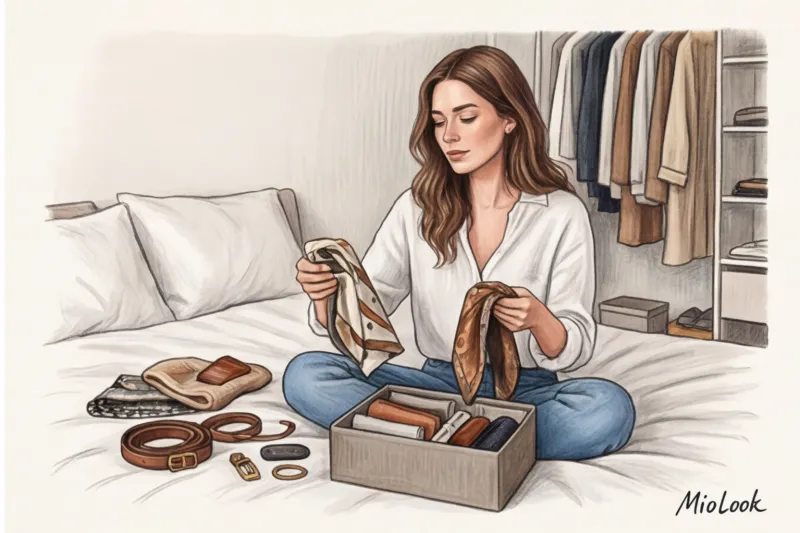
Let's be honest: putting together a casually sloppy look can be more challenging than pulling off a smart three-piece suit. This apparent simplicity requires a perfect understanding of your basics. When your accessories are crumpled in a dark drawer, you'll end up wearing the same watch and forgetting about those great vintage belts.
One of my clients constantly complained that she had "nothing to complete her look," even though her shelves were overflowing with scarves. The problem was easily solved. We loaded all her things into MioLook — an app for smart wardrobe management. By creating virtual capsules where each silk scarf was pre-assigned to a specific jacket or bag, we achieved amazing results. The rate of impulse purchases for "just one more cute scarf" dropped by 70%, and morning dressing time was reduced to two minutes.
The stylist's secret is simple: image formulas should not be created in a panic five minutes before going out, but in advance, in a calm environment, using a digital tool.
Checklist: Auditing Your Accessories for French Chic
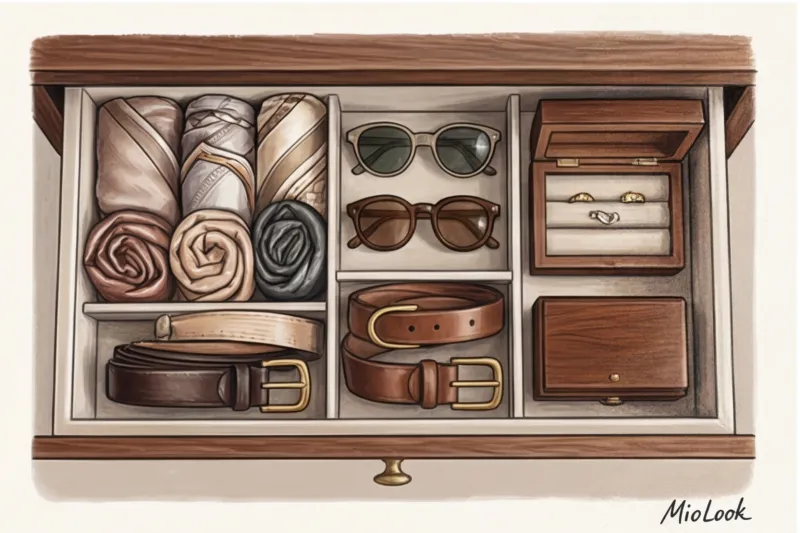
If you want to redefine your wardrobe, start with a ruthless inventory. Here are three filters every accessory should pass through:
- Materials test. Get rid of plastic hardware, squeaky polyester, and peeling gold trim. Stick with silk, merino wool, genuine leather, and high-quality alloys. It's better to have three perfect belts than fifteen dubious ones.
- Testing for multifunctionality. Can you use this item in at least three different situations? If a velvet choker only goes with one specific New Year's Eve party dress, it's a bad investment.
- Effortless test. Is your outfit looking too polished? If your bag's color is perfectly coordinated with your shoes and belt, break the harmony. Replace the black bag with a sophisticated cognac or olive shade.
French style isn't a collection of specific items you can buy from a list. It's an attitude toward yourself and your clothes. It's the confidence that you're more important than the brand name on your bag, and that your personal comfort always trumps fleeting trends.