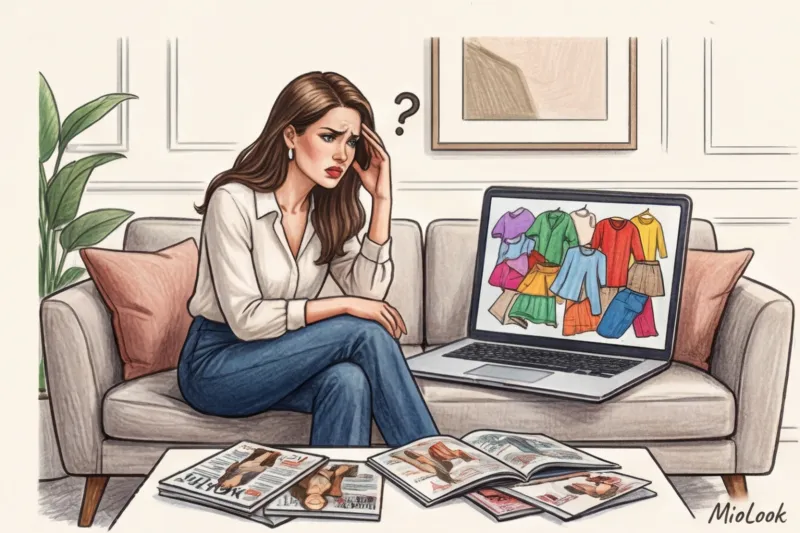
Last Friday, my client Elena, a partner at a major law firm, angrily closed the tab of a well-known luxury online store. Her virtual shopping cart contained €1,500 worth of items—an impeccable camel-colored wool three-piece suit and a basic silk blouse. But when she went to checkout and tried to choose shoes, the site's algorithm cheerfully suggested neon chunky-soled sneakers and leopard-print pumps from last year's sale.
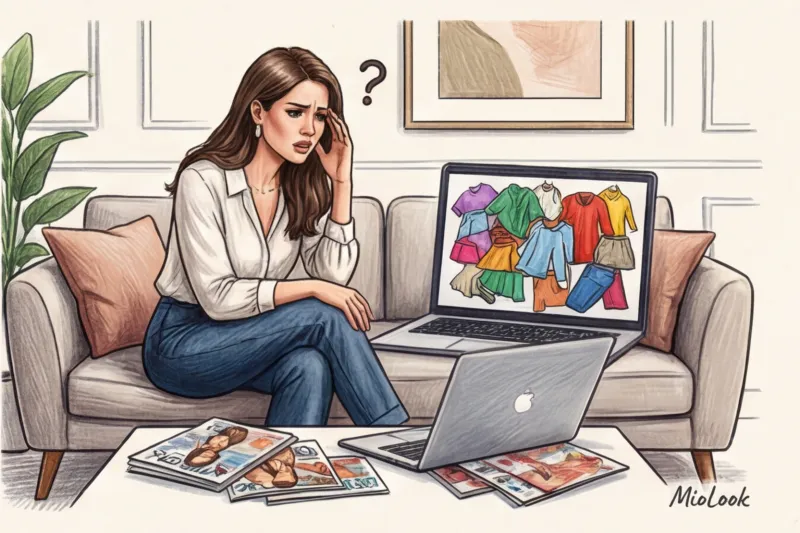
Why did this happen? Because the store was using outdated recommendation algorithms. We've already covered the tectonic shift in online shopping in our The complete guide to personalization in e-commerce and AI stylists. Today Artificial intelligence in fashion retail It's not just lines of code that try to guess your preferences based on your clicks. It's a fully-fledged digital partner that solves the modern woman's biggest pain point: how to look expensive and stylish while spending minimal time choosing.
The Death of the "People Also Buy" Algorithm: Why Basic Recommendations No Longer Work
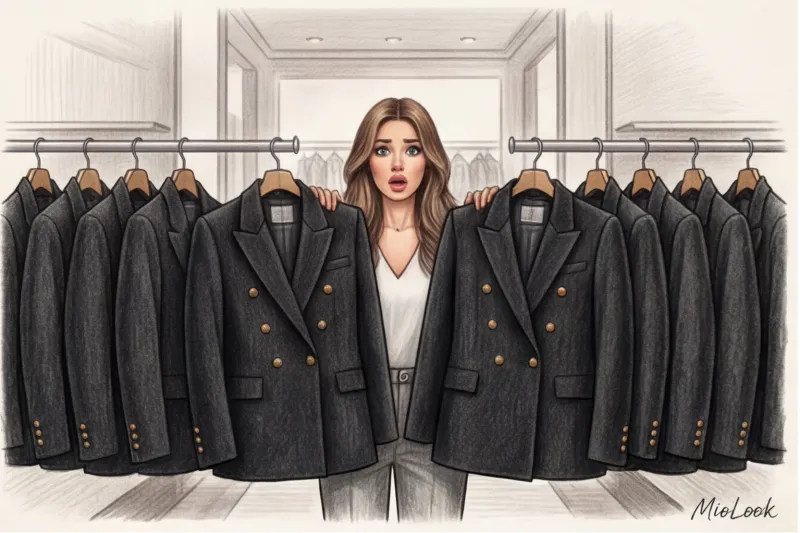
I'll say it bluntly: the classic "Customers Also Bought" block on online store pages isn't just useless—it's toxic to your sales and destroys customer trust. Collaborative filtering works like a crowd. If ten people before you accidentally bought a tailored double-breasted jacket and pink flip-flops (say, while putting together an order for themselves and their teenage daughter), the algorithm will associate these items forever.
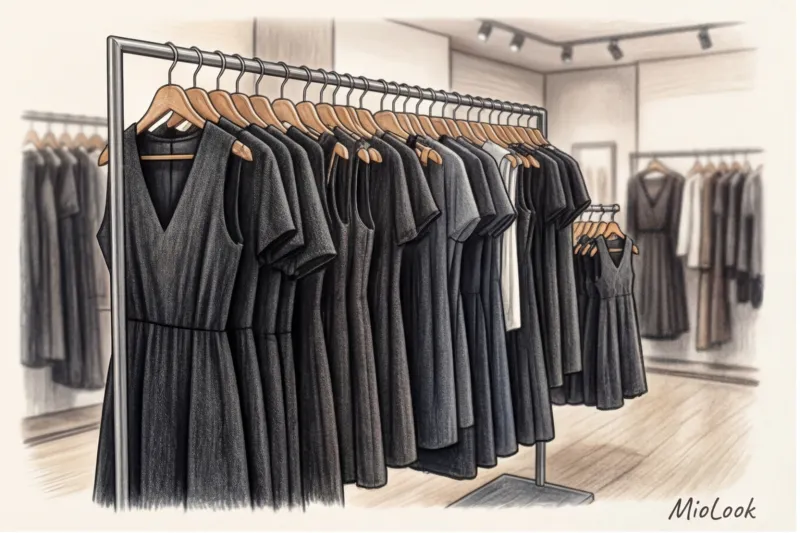
But high-net-worth shoppers seeking the status and aesthetics of Massimo Dutti or COS don't want to dress "like everyone else." They come looking for solutions. According to the National Retail Federation (NRF) for 2023, the phenomenon Decision Fatigue Decision fatigue (decision fatigue) leads online stores with over 1,000 SKUs to lose up to 60% of potential sales during the catalog browsing stage. A woman simply gets tired of scrolling through hundreds of disparate items.
"A client doesn't want to buy a gray jacket. They want to buy confidence for tomorrow's board meeting. And if your website suggests pairing a jacket with random jeans instead of well-chosen palazzo pants, you're losing money"—that's the rule I repeat to every brand during my consultations.
This is where artificial intelligence comes into play, trained not just by user purchases, but by strict rules of style, proportions, and color.
Access to MioLook for €0.99 — one-time payment
A smart AI stylist will select the perfect look for you, eliminating the hassle of choosing.
Get access — €0.99 onceKey Trends: How Artificial Intelligence is Changing the Rules of Fashion Retail
The last couple of years have seen a quantum leap: the industry has moved from predictive AI (analyzing past purchases: "You bought a blue dress, here are five more blue dresses for you") to generative AI. This new AI creates entirely new stylistic solutions tailored to a specific request.
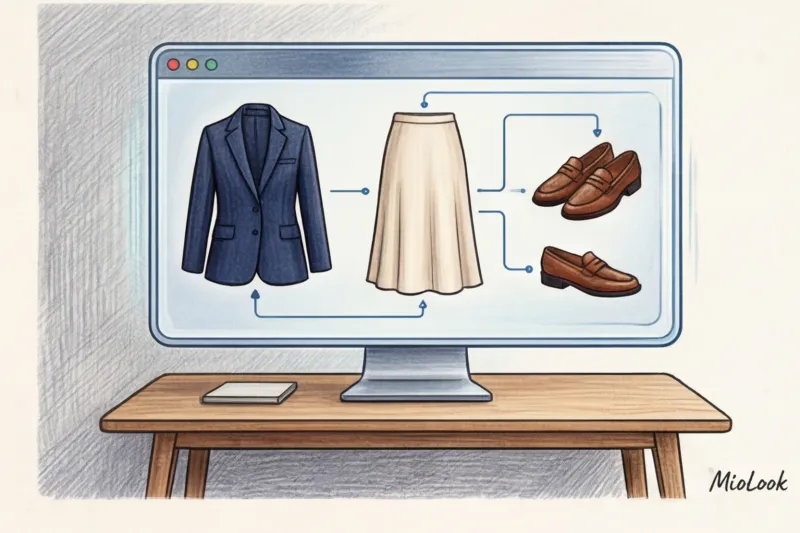
Over 12 years of working as a personal stylist, I've conducted hundreds of wardrobe analyses and realized that style has its own mathematics. This mathematics—levels of contrast in appearance, an understanding of dress codes from strict Business Traditional to relaxed Casual Friday—is now being integrated into machine learning. The Digital Styling Assistant concept transforms a faceless catalog into your personal fashion expert.
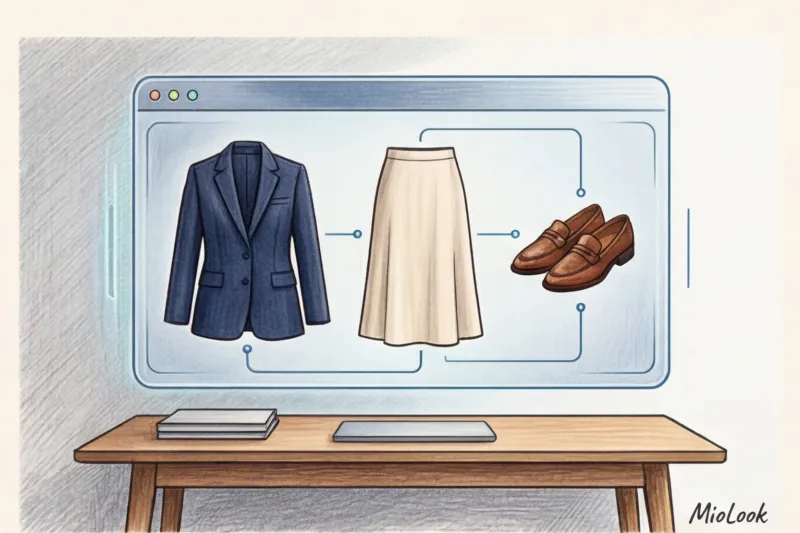
Trend 1: From single products to capsule generation
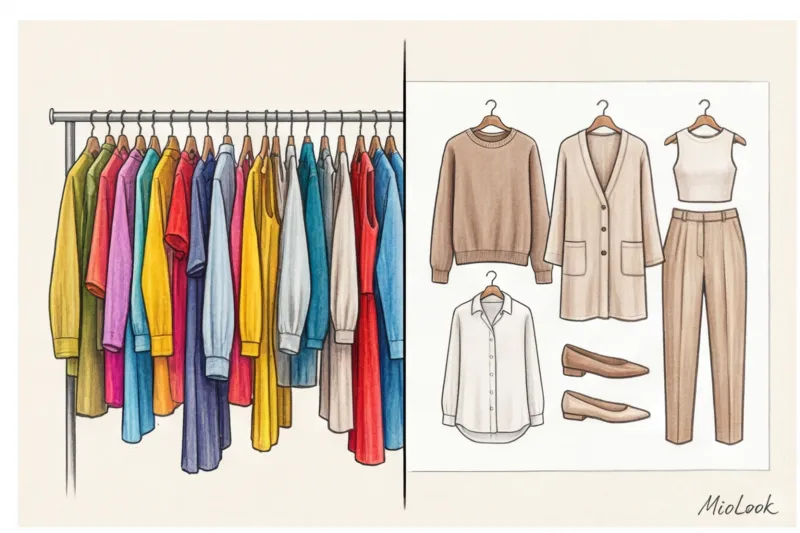
My favorite shopping technique with clients is the "cross-selling 2.0" formula. We don't buy similar items, we buy complementary ones. A classic stylistic formula "structured jacket + bias-cut midi skirt + leather loafers" It gives an instant sense of poise and status. Artificial intelligence in fashion retail today can generate such capsule collections automatically.
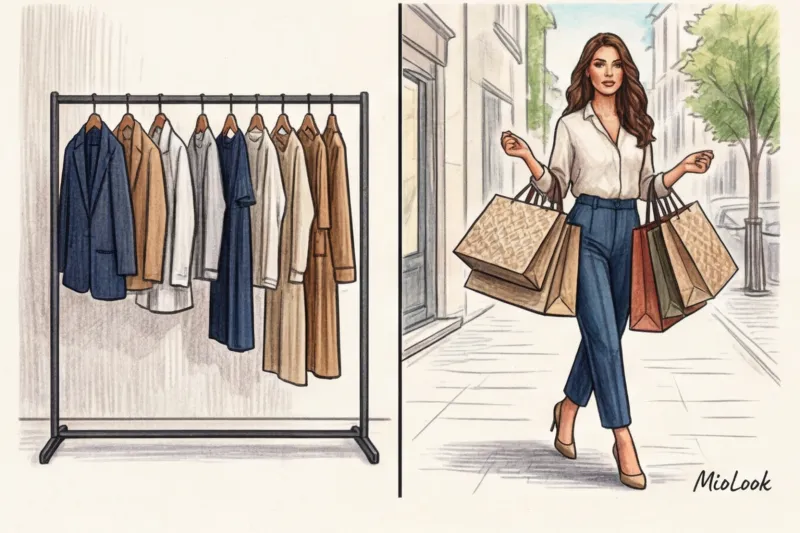
Moreover, advanced systems can analyze a customer's existing wardrobe. You upload a photo of your favorite Levi's straight jeans, and the online store's algorithm (or a smart app like MioLook ) pairs them with the perfect tweed jacket and a basic T-shirt from the brand's current collection. No random purchases that then hang in the closet with the tags for years.
Trend 2: Smart virtual fitting rooms and digital twins
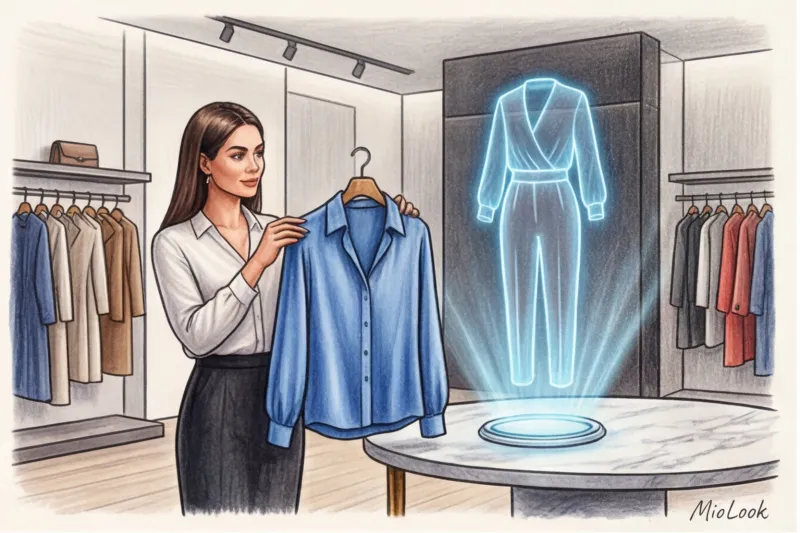
Virtual try-on finally stops looking like a cheap computer game. Modern algorithms take into account body types without outdated stereotypes like "pear-shaped" or "apple-shaped." AI analyzes real proportions: torso length, shoulder slope, and hip circumference.
To be honest, there are some limitations here. In my experience, So far, no neural network in the world can 100% accurately predict how heavy natural silk will behave dynamically. Or complex asymmetrical draping. This is the true limit of technology for 2024. But for 80% of everyday wardrobe items (cotton with a weight of 180 g/m², denim, wool blends, viscose), the virtual fitting room works flawlessly, reducing return rates by a significant 25-30%.
Your perfect look starts here
Join thousands of users who look flawless every day with MioLook. Digitize your wardrobe in minutes.
Get access — €0.99 onceReal-World Cases: How AI Stylists Increase Brands' Average Bills
Let's look at the numbers, because aesthetics are all well and good, but retail is always about business. According to McKinsey & Company's extensive study "The State of Fashion" (2024), implementing generative AI in e-commerce can increase conversion by 40%. And the secret lies in personalized storefronts.
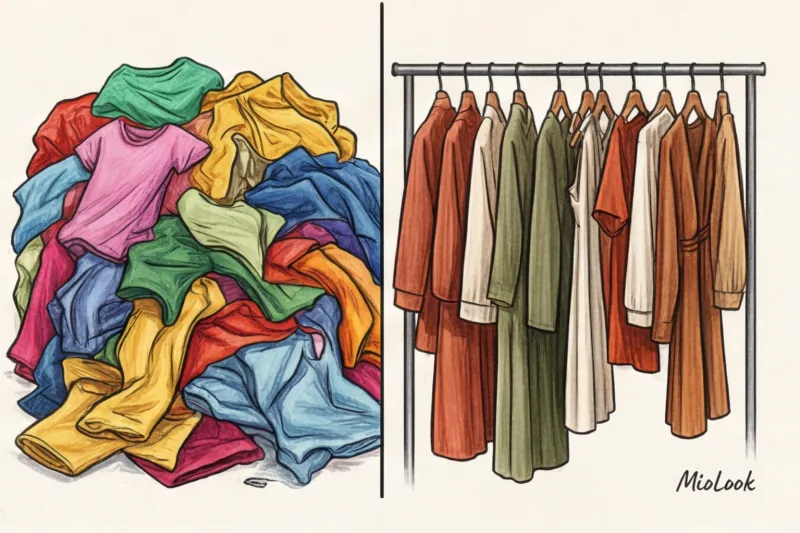
Imagine three different women visiting the same brand's homepage. The first, a young mother on maternity leave, sees cozy cashmere suits and comfortable sneakers. The second, a corporate lawyer, receives a selection of formal suits and non-iron shirts. The third, planning a vacation to the Amalfi Coast, sees linen dresses and straw bags. Each sees their own "perfect store."
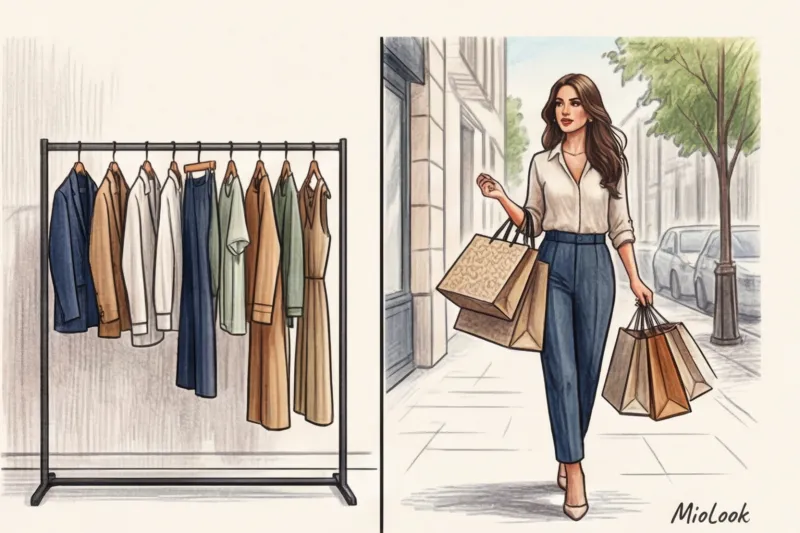
The implementation of styling AI modules, like those developed by MioLook for the B2B segment, directly impacts the IPT (Items Per Transaction) metric. If a customer sees a stunning finished look, she's highly likely to add not only the €80 pair of trousers, but also the matching €30 belt and €40 top to her cart. The average order value (AOV) grows organically, without the pushy "buy-buy-buy" mentality.
Hidden Threat: The Main Mistake in Implementing AI in an Online Store
Sounds perfect, right? But there's a huge trap here. Many brands make a fatal mistake: they delegate AI implementation exclusively to the IT department, without involving fashion experts. Without a fashion director, AI is simply a very fast storekeeper, not a stylist.
The main problem lies in the catalog markup (tagging). The programmer will mark the product as Jacket, gray, 100% wool, buttons, pockets But a neural network will never create a stylish look from this because it doesn't understand the context. For a stylist, this same product is "State smart-casual, Ruler archetype, high-density fabric, suitable for winter and mid-season, requires smooth textures in pairs.".
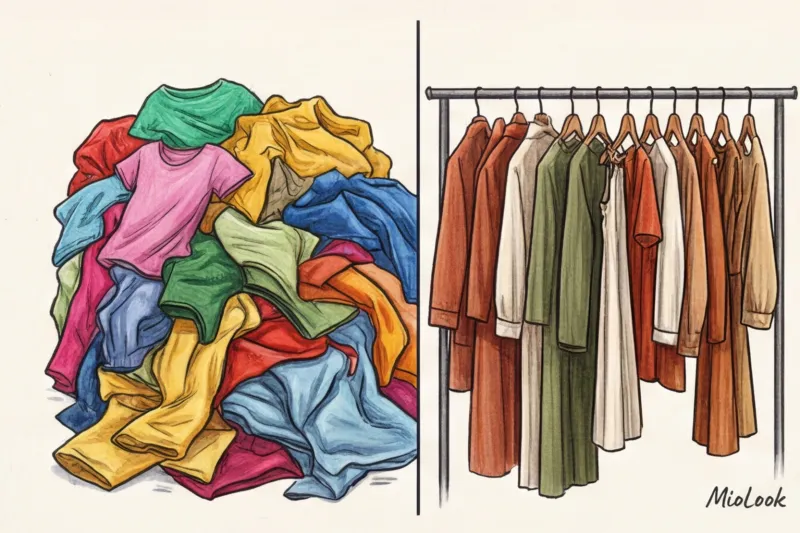
AI especially often “breaks down” on the Mediterranean approach to style – the very one effortless elegance (casual elegance), so beloved by French and Italian women. Artificial intelligence, trained simply to compare popular products, tends to overload an image. It suggests wearing a statement belt, statement earrings, and a bright bag all at once. The result is a stylistic hodgepodge. True elegance is the ability to stop in time, and this is something the neural network needs to be purposefully trained to achieve.
Business Checklist: Preparing a Fashion Brand for Artificial Intelligence Integration
If you're a brand owner or e-commerce director, don't rush to buy the first AI solution you see. To ensure the technology generates revenue rather than headaches, follow this step-by-step plan:
- Audit of the current product base (SKU). Translate your technical tags into style language. Add parameters to each item: occasion (office, date, vacation), seasonality, archetype, contrast level. Without clean data, AI will produce junk results.
- Defining the main business goal. What's your biggest pain point? If customers are returning clothes en masse because they don't fit well (this applies to online brands with purchases in the €50–€150 range), you need AI fitting and a virtual fitting room. If returns are low, but people are buying one item at a time (this applies to premium brands over €300), invest in an AI stylist to generate capsule collections.
- Creating high-quality visual content. No algorithm can save bad photos. AI must be able to "read" fabric density. Provide macro shots of textures, show how the fabric flows in motion, and achieve impeccable color rendition.
- Testing on real people. Entrust the final review of the algorithm-generated looks to human stylists. Let them eliminate absurd combinations before your VIP clients see them.
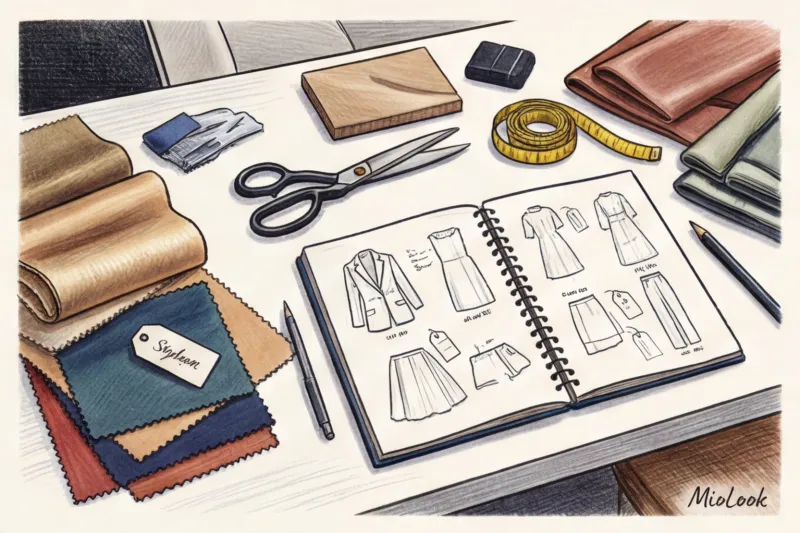
The future of fashion retail is already here, and it doesn't belong to soulless machines, as skeptics predicted. The future belongs to symbiosis of technology and human sense of beauty Artificial intelligence takes care of the routine—sifting through thousands of options in a split second, remembering all sizes and fabric compositions. And we, stylists and shoppers, retain the most important thing—the right to choose what makes us feel confident, beautiful, and absolutely irresistible.
Ready to get started?
Try the MioLook free plan—no commitments required. See how AI is changing your approach to everyday style.
Get access — €0.99 once