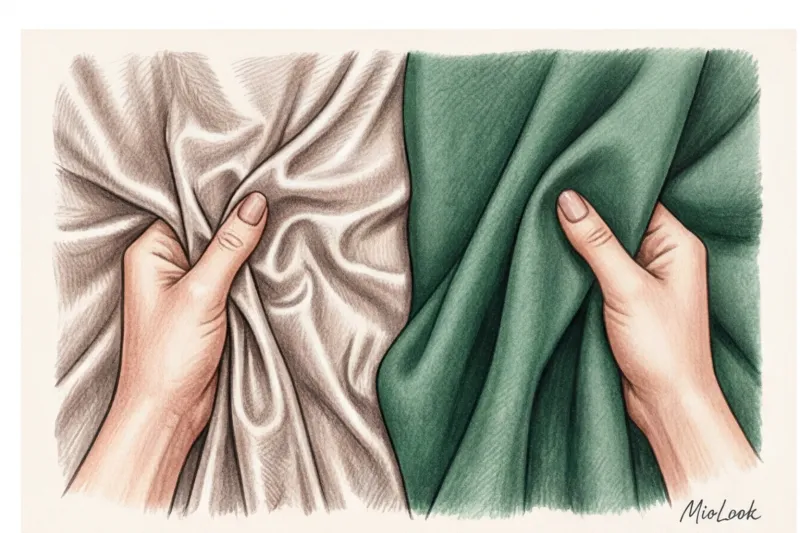
Every December, clients come to me with the same request: to find "something black and loose" to safely survive the New Year's Eve party. For decades, the industry has taught us that a curvy figure should be hidden. As a result, the seemingly perfect corporate outfit for plus-size women turns into a shapeless shell that not only fails to conceal the nuances but also visually adds a few dozen pounds.
We have covered the basic rules of the festive dress code in more detail in our a complete guide to the perfect corporate look But today I want to talk about something else. We'll cast aside outdated stereotypes and look at styling through the lens of fabric physics and cut architecture. Spoiler: fabric density solves 90% of fit issues, and a well-chosen underwear foundation will do more for your figure than any pre-holiday diet.
Fabric architecture: why cheap knitwear is the enemy of a plus-size corporate outfit
According to statistics from the analytical agency WGSN (2024), approximately 80% of plus-size eveningwear lines in the mass-market segment are made from thin, low-quality polyester and viscose. Brands cut costs by offering items that only look good on a hanger.
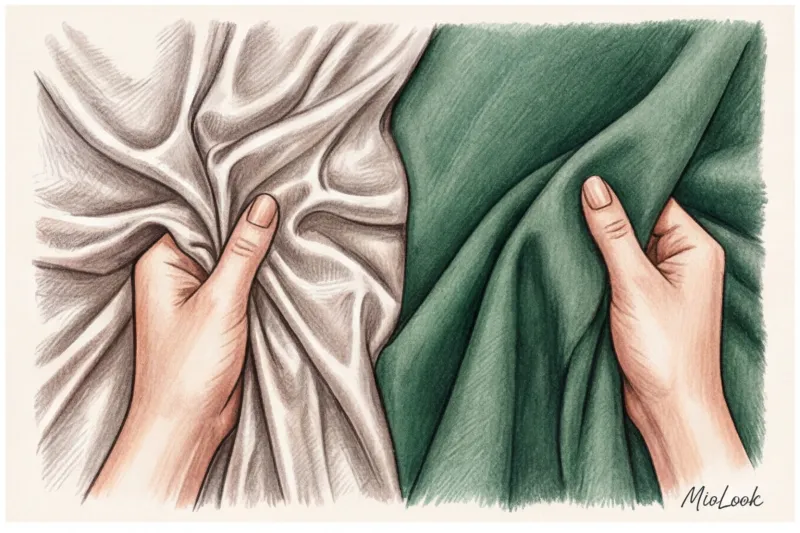
The difference between a good and a bad fit lies in the drape factor. Fine knits don't drape—they cling. They treacherously emphasize the contours of lingerie, the slightest creases in the skin, and create a "caterpillar" effect. High-quality fabric, on the other hand, works like a sculptor. It holds its own shape, creating a new, defined silhouette over your body.
Instead of flimsy viscose, look for crepe, dense matte silk (or its high-quality synthetic equivalents with a weight of at least 180 g/m²), suiting wool, and gabardine. These materials create straight, confident lines.
Matte vs. Gloss Textures: Managing Light
Another pitfall of eveningwear is glitter. According to research by the Fashion Institute of Technology (FIT) on the visual perception of clothing, reflective fabrics (cheap satin, sequins on fine mesh, high-pile velvet) act like a magnifying glass. They catch the light and visually expand the area they cover.
"A glossy finish always adds volume. If you want to visually sculpt your silhouette, a completely matte finish that absorbs light is your best friend."
Access to MioLook for €0.99 — one-time payment
A smart AI stylist will select the perfect look based on your proportions and preferences.
Get access — €0.99 onceThe Myth of Loungesuits and Black: What's Really Slimming
Perhaps the most harmful advice one can give a plus-size woman is "wear oversized clothes to hide your belly." Oversized clothes on a larger figure don't hide the fullness. They make the figure look monumental, turning it into a monolithic square.
The stylists' secret lies in the semi-fitted silhouette. There should be about 2-3 centimeters of air between your body and the fabric. This creates the illusion that you're much slimmer underneath than you appear.
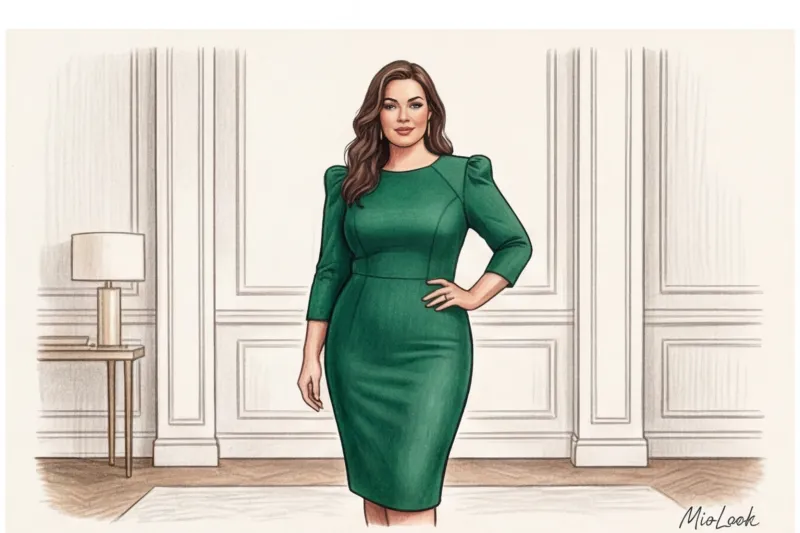
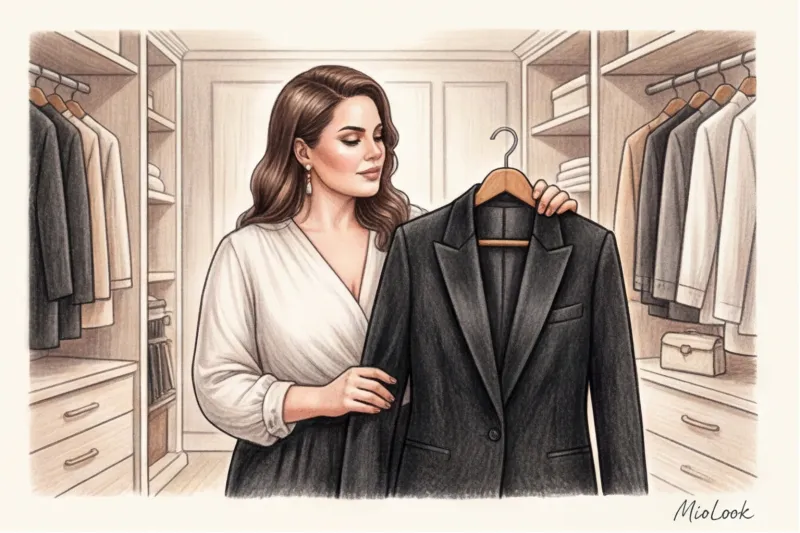
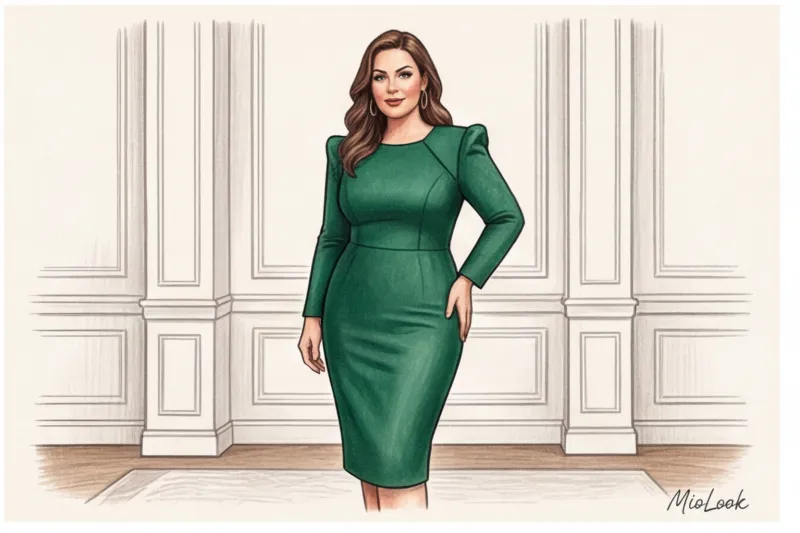
I had a telling case in my practice. My client, Elena (size 54), brought a black polyester lurex smock dress for a fitting. We replaced it with a structured emerald tuxedo. The effect was stunning: the defined shoulders elongated her posture, and the deep color brightened her complexion. Black in inexpensive fabric is more fattening than matte white or burgundy in expensive wool suiting.
The formula for the perfect look: 3 win-win options for plus-size
Forget the "one event, one new dress" rule. Let's put together outfits that will not only make you the star of the evening but also easily integrate into your everyday wardrobe.
A status tuxedo or pantsuit
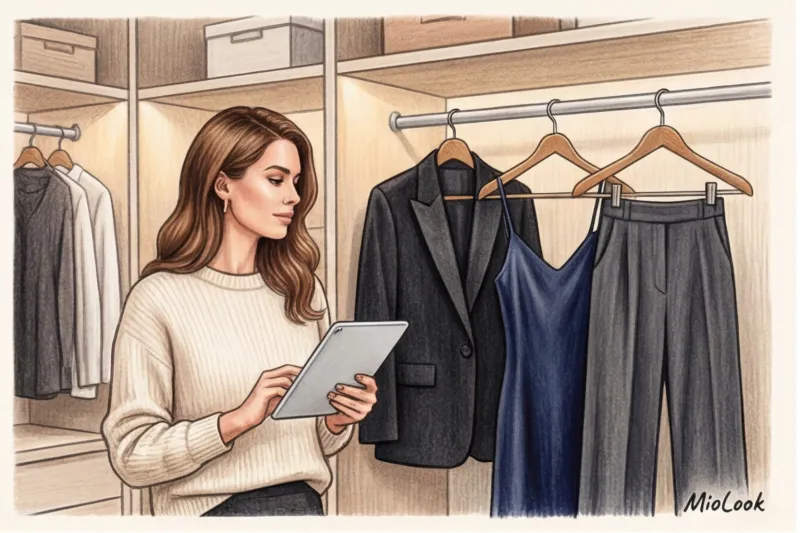
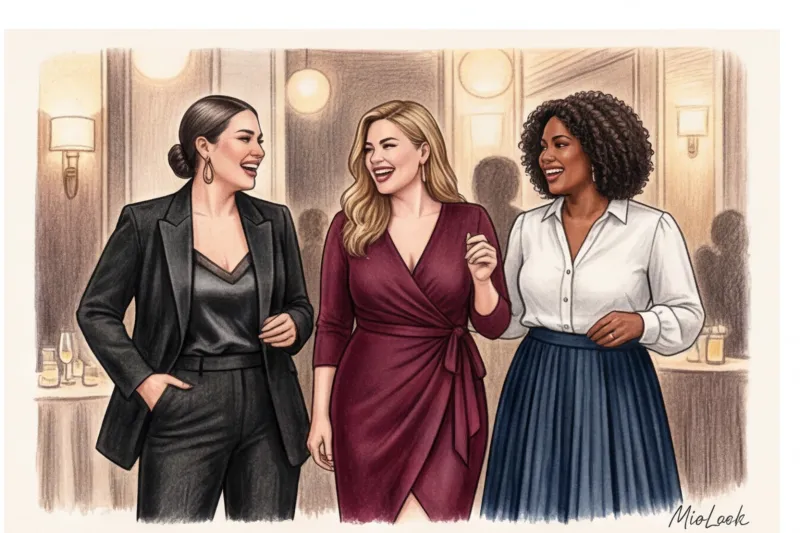
An unbuttoned jacket is a powerful contouring tool. It creates two vertical lines that visually "cut off" the sides. Choose a mid-thigh length jacket (it should cover the widest part) and high-waisted trousers with pleats at the waist. Wear a silk top with wide straps under the jacket. Add some statement earrings, and the look is complete.
Wrap dress made of thick material
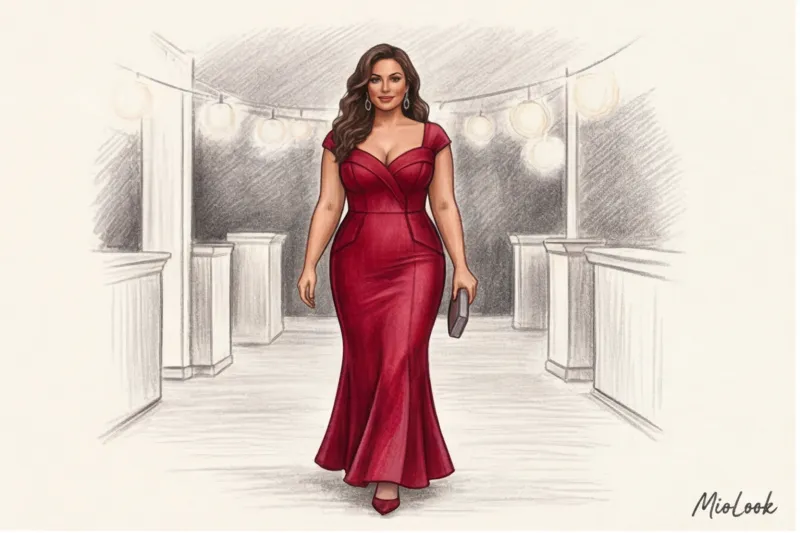
The cut, created by Diane von Furstenberg, is ingenious. The V-neckline elongates the neck, and the diagonal wrap line creates the waist exactly where you want it. The key is to make sure the material is heavy. If the fabric is too light, the hem will fly apart as you walk, creating discomfort. Be sure to check that the wrap fits securely across the chest.
A-line midi skirt with an architectural top
Playing with proportions works flawlessly. A thick midi skirt (for example, made of taffeta, heavy cotton, or faux leather) will conceal the hips, while a simple top with a square or V-neckline will accentuate the décolleté. We often use this technique when putting together autumn casual for women wardrobe, but in the evening (with the addition of heels and bright lipstick) it looks incredibly elegant.
Your perfect look starts here
Join thousands of users who look flawless every day with MioLook. Digitize your wardrobe in just a few clicks.
Get access — €0.99 onceInvestment, not spending: Calculating Cost Per Wear for Evening Wardrobe
Many women fall into a psychological trap: buying a cheap dress for one evening so they won't feel bad about throwing it away. Let's calculate the math of style—the Cost Per Wear metric.
Let's say you bought a sparkly dress from a mass-market store for €50. You wore it to a corporate event once. The cost per event = €50.
Now let's imagine you bought a great pantsuit for €200. You wore it to a corporate event (with a silk top), then the jacket with jeans for a meet-up with friends, and the pants with a sweater for the office. Over the course of a year, you'll wear the suit at least 20 times. The cost per outing is €10.
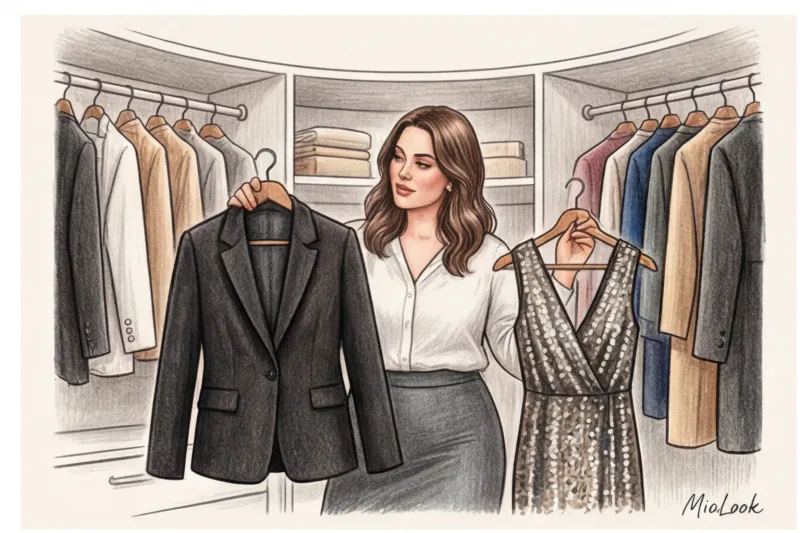
I always recommend my clients to use the "smart wardrobe" function in MioLook to track the actual wearability of items. The program clearly demonstrates that a high-quality base pays for itself faster than disposable trends.
Lingerie styling: the invisible foundation of a festive look
I'll let you in on a professional secret: without the right underwear, even a Tom Ford suit won't work. Stylists always start working with plus-size figures by combing through their underwear drawers.
Avoid textured lace for evening wear. It shows through the fabric and disrupts the silhouette. Opt for completely smooth, seamless lingerie in a nude (not white!) color.
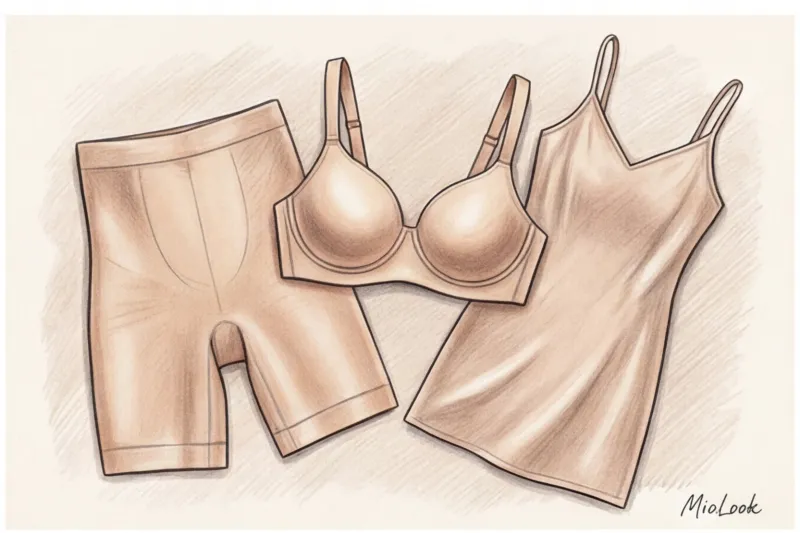
When it comes to shapewear, be careful. Don't go two sizes too small in the hopes of becoming a stick figure. You'll simply be unable to breathe, sit, or eat at a party, and the over-contracted areas will create bulges in the most unexpected places. Opt for a lighter form of shaping (smoothing shapewear)—high-waisted shorts that will simply smooth out the skin and prevent chafing on your thighs.
Pay special attention to your bra. Wide straps (at least 1.5 cm), smooth molded cups, and a wide back (with 3-4 hooks) will ensure the correct bust height, which will automatically make your waist appear smaller.
Pre-purchase checklist: how to check the quality of an item in the fitting room
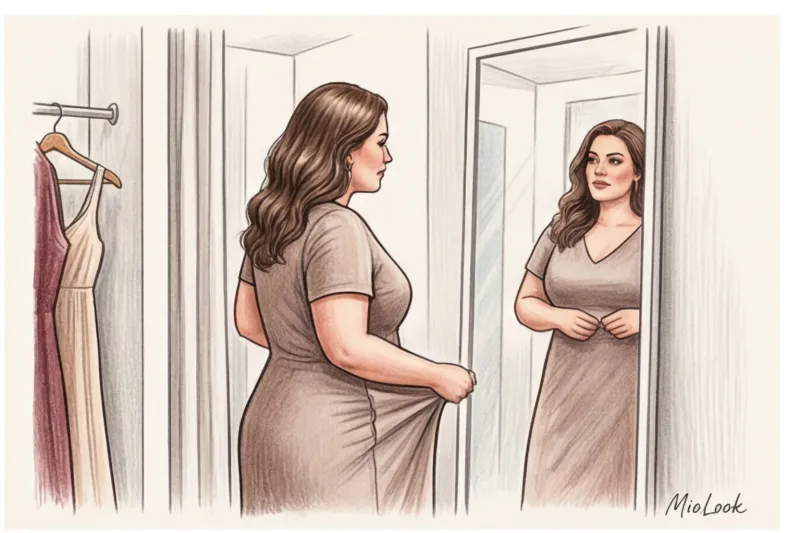
Store lighting can often be deceiving. To avoid disappointment at home, give the item a thorough test drive right in the fitting room.
- Crease test. Squeeze the hem of your dress tightly in your fist for 10 seconds. If the fabric is still wrinkled like paper, return it to the hanger. You'll be sitting at a corporate party, and after the first toast, your dress will be covered in creases.
- Checking the seams. Gently tug the fabric around the side seams and buttocks. If the threads are fraying or holes are forming, the garment will burst if you move awkwardly.
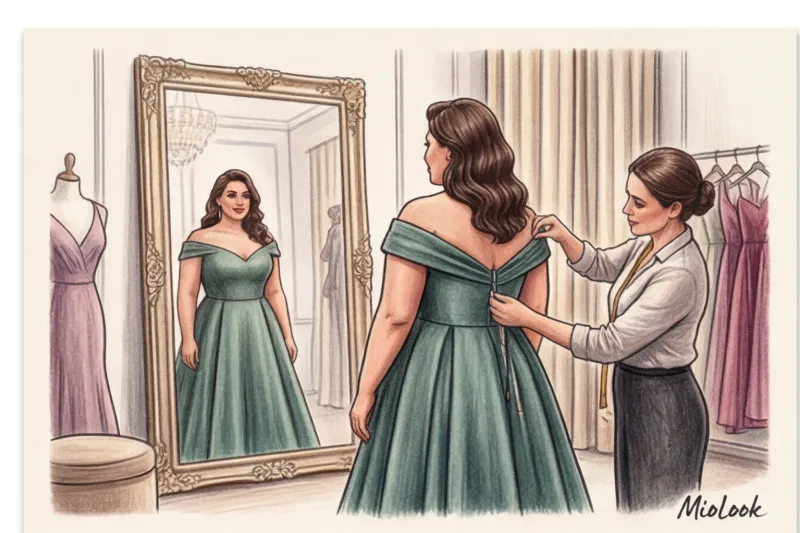
- Test in motion. Be sure to sit on the ottoman. Raise your arms up (as if reaching for a glass). Bend over. Clothing should not be tight, ride up above a critical point, or restrict your shoulders.
- Lining assessment. A 100% cheap polyester lining will make you sweat, and the dress will become staticky and stick to your legs. Look for a viscose or cupro lining.
Ready to get started?
Try MioLook's free plan—no commitments required. Upload your items and let the AI create dozens of new outfits for you every day.
Get access — €0.99 onceSummary: Building a Smart Holiday Wardrobe
Choosing a corporate outfit for plus-size women isn't about finding a compromise between "pretty" and "not making you look fat." It's about the mathematics of tailoring, understanding the physics of fabrics, and a love of comfort. Forgo shiny hoodies in favor of structured jackets, matte textures, and the right underwear.
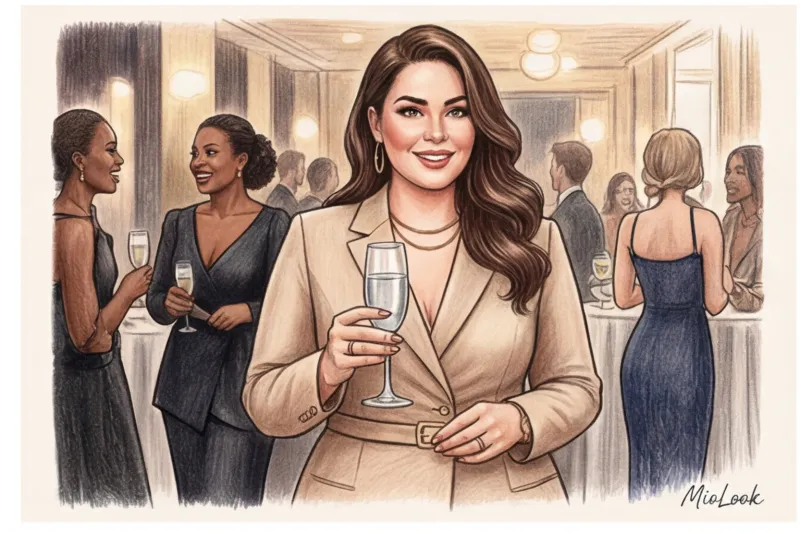
Remember the most important rule: clothes should serve you, not you them. Invest in pieces that make you laugh, dance, and feel like a luxurious woman, not like a mannequin afraid to take a breath.