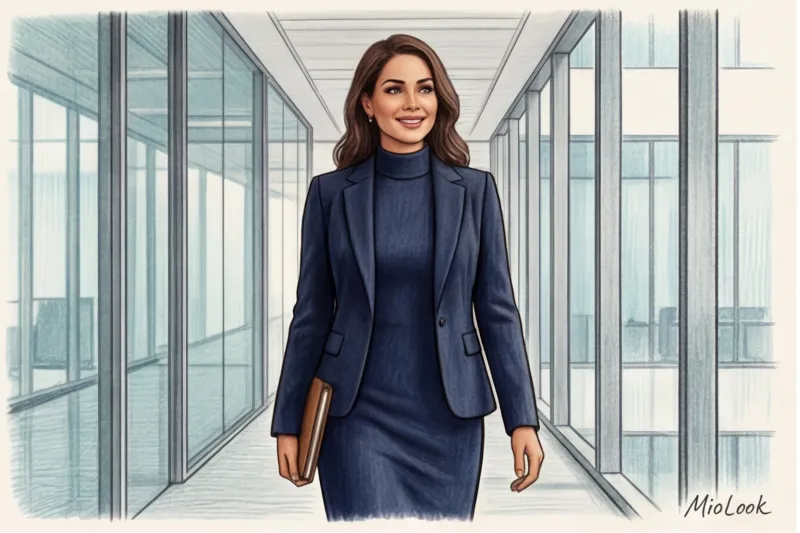
A year ago, a client, a successful corporate litigation attorney, approached me. She came with a very specific request: "Katarzyna, I need a complete wardrobe overhaul. I'm tired of wearing mass-market shirts to the tailor, only to have the seamstress sew up the neckline or sew hidden buttons on the chest." Her argument was ironclad: in the courtroom or during tough negotiations, nothing should distract her opponents from her face and arguments. The right one closed clothing for the office became for her not a question of religious beliefs, but an instrument of psychological dominance.
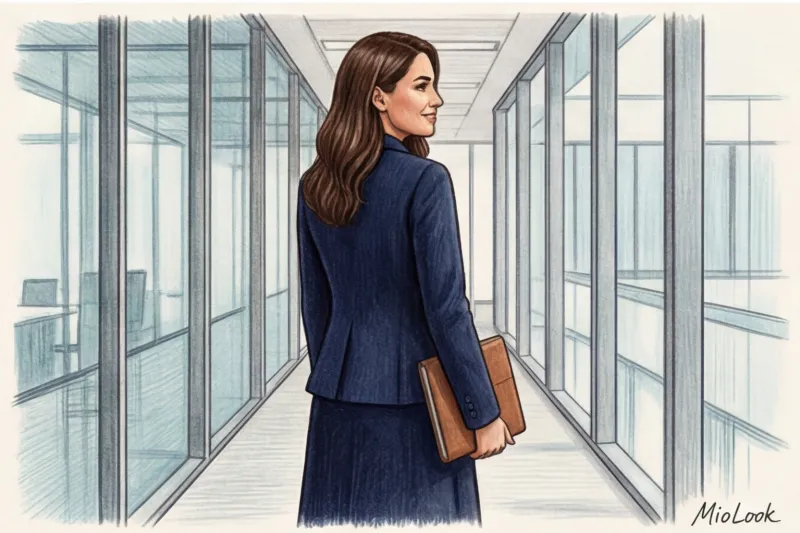
We talked about the evolution of this trend in more detail in our full A guide to virtual online try-ons for modest fashion But today I want to talk about practice. As a stylist with many years of experience working in Europe, I see attitudes toward business dress codes changing. We're moving away from the forced sexuality of the 2000s toward intelligent elegance.
Why Closed-Leg Office Wear Is the New Status Marker
The concept of "modest fashion" has long since transcended religion. Today, it's a conscious choice of personal boundaries. In a world where social media algorithms and fast-fashion brands scream transparency and microskirts, the decision to cover one's body becomes a quiet act of rebellion.
The numbers speak for themselves. According to a McKinsey report (2024), demand for minimalist, covered-up clothing among women over 30 has grown by 34% over the past year. Why is this happening? Traditional corporate protocol (White Collar Dress Code) has always been based on the principle: the higher the status, the more formal and covered the silhouette. A covered-up cut literally forces your interlocutor to look you in the eye, shifting the focus from your body to your intellect.
"My executive clients increasingly ask me to select a capsule collection that will make them look authoritative, not 'on trend.' Cover-ups are armor that say, 'I'm here to do business, not to please you,'" – from my wardrobe review experience.
The Biggest Mistake in Modest Style: Oversized vs. Architectural
Let's get one thing straight: 90% of women who try to dress more modestly get it wrong. Baggy, oversized clothes don't make you look more professional. They make you look sloppy. Hiding your figure behind shapeless robes is the worst career strategy.
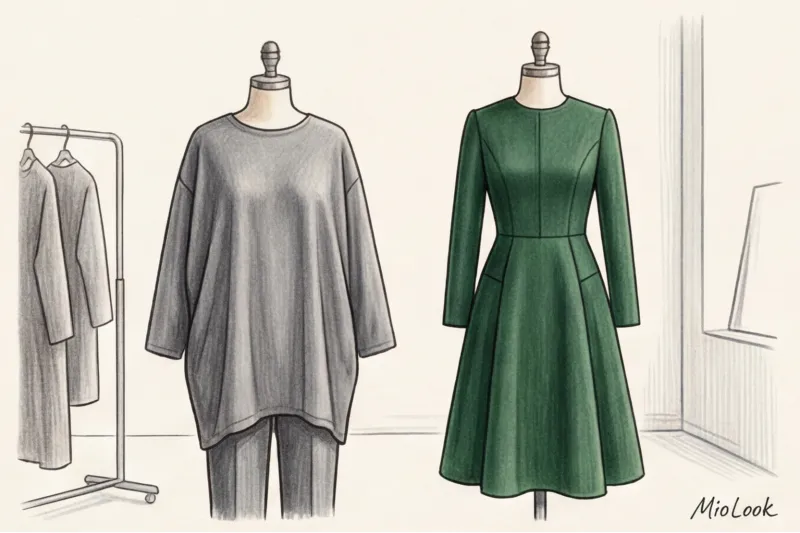
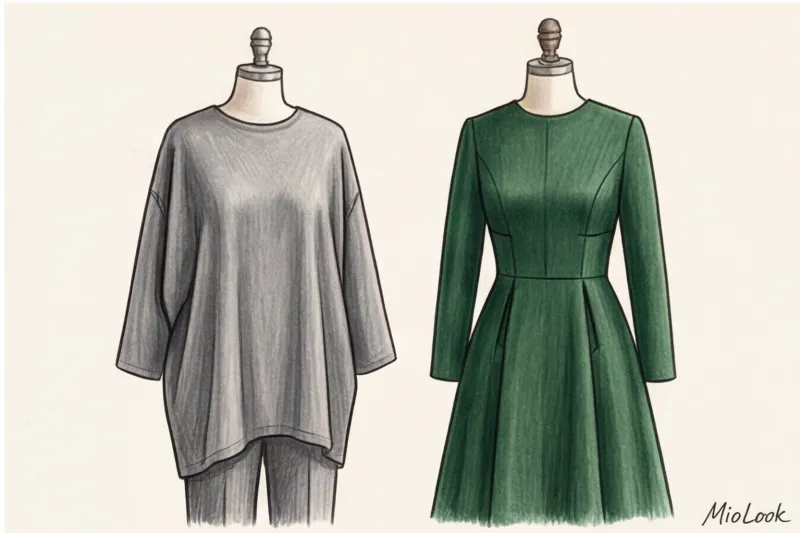
Here's my main stylistic insight: Closed clothing requires a much more rigid and precise cut to fit the figure than open clothing When you cover your décolleté, arms, and knees, the fabric takes center stage. The "architectural cut" rule comes into play.
Let's compare two scenarios. You can buy a shapeless, soft cardigan for €40 at an inexpensive high-street store. It will flatter your figure, but after a couple of hours of wearing it, it will stretch out and your shoulders will sag. The alternative is a structured wool jacket or midi dress from COS or Massimo Dutti for €150. They have a defined shoulder line, proper darts, and a defined waist (even if the garment isn't tight!). The silhouette is closed, but it holds its shape. This is the difference between "I just hid in the sweater" and "I control the space."
Basic elements of a closed business wardrobe
To create a functional capsule that will work for you, and not drain your money on constant updates, all you need is a small set of the right things.
Blouses and shirts without "surprises"
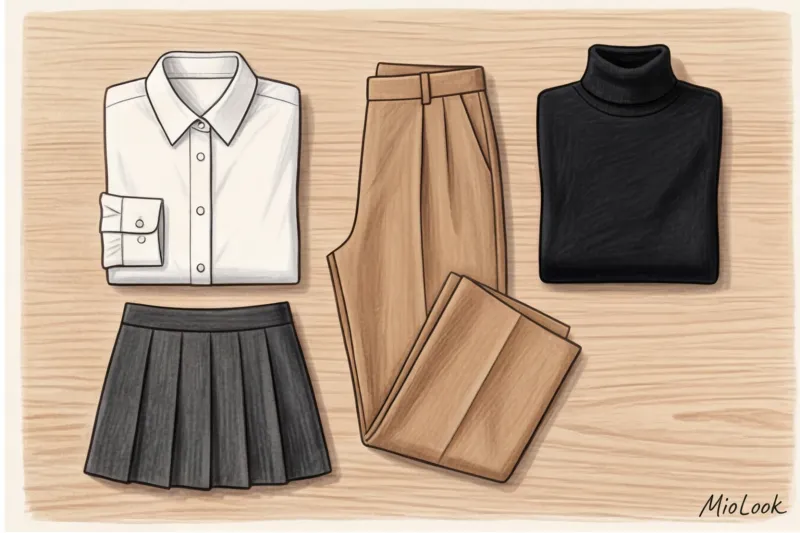
The most common complaint my clients have is buttons coming apart at the chest. To avoid this, look for shirts with a hidden placket (where the buttons are hidden under a layer of fabric). This instantly makes the garment look more expensive. The correct sleeve length for a modest business attire is just to the wrist bone.
If you're tired of the classic collar, consider blouses with a stand-up collar or a pussy-bow tie. The latter offer a luxurious, aristocratic alternative to any low neckline. The only exception: If you have a short neck, a large bow under your chin can make your look bulky. In this case, choose an asymmetrical cut or narrow ribbon ties.
Midi skirts and trousers with the right fit
A back vent on a classic pencil skirt is a hidden danger. While it looks decent in the fitting room while standing, the moment you sit down in a conference chair, the slit splits, revealing thigh higher than is appropriate. How do we solve this problem for our clients? We switch to A-line silhouettes or pleated skirts made of heavy wool. They drape elegantly and cover the knees in any fit.
When it comes to trousers, wide-leg styles with a high waist and pleats are your best friend. They're not tight anywhere, provide comfort for eight hours of sitting at the computer, and look incredibly classy, especially when paired with shoes with a small, stable heel.
Jackets and high-density knitwear
Fine ribbed knitwear is the worst enemy of a low-key look. Sure, it might have a high collar, but if the fabric hugs every curve and shows through the lace of your bra, there's no room for modesty. Opt for chunky, plain-knit sweaters.
Double-breasted jackets are best. When buttoned, they securely cover the hip line and create that architectural frame we discussed above.
Your perfect look starts here
Join thousands of users who look flawless every day with MioLook, finding the perfect combination of business attire.
Start for freeFabric Analysis: How to Choose Fabrics That Don't See Through
I've personally tested dozens of white shirts from Zara, H&M, COS, and premium brands. Most of them fail the office lighting test. Stylists have an unspoken rule: if you have to wear a tank top or top under your office blouse to keep it from showing through, it's a bad blouse. It makes getting ready difficult and makes you sweat.
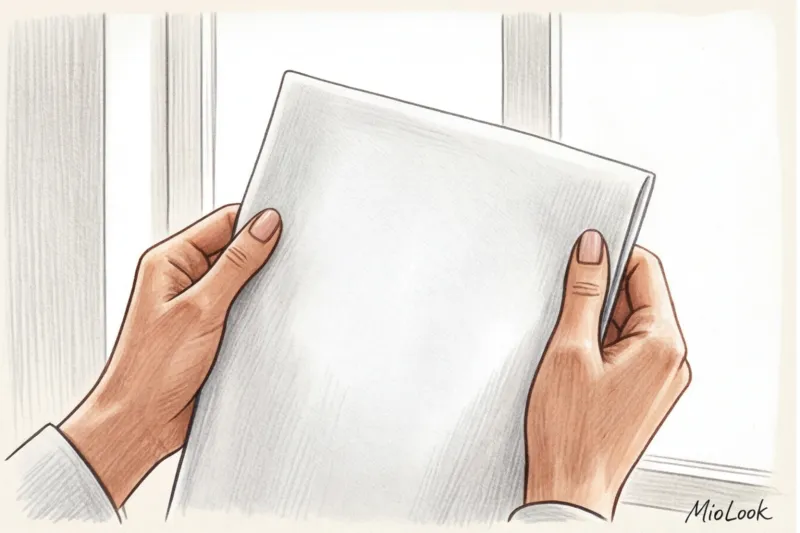
How do you test fabric? Go to a window or hold the fabric up to a bright light in the fitting room. If you can clearly see the outline of your fingers through the material, keep the item in the store.
- Cotton: Look for the "two-ply" label. A shirt like this will cost around €70-€90, but it's thick, opaque, and hardly wrinkles. The math is simple: one such item is cheaper than three flimsy €30 shirts, which you'd have to buy tops to go with it.
- Silk: The technical standard for silk density is measured in momme. For an opaque business blouse, look for a momme of 19 or higher. Anything below 16 will show through.
- Dresses and skirts: Be sure to check for a lining. Ideally, it should be made of viscose or cupro, not "glass" polyester, which will generate static electricity. your office tights.
Layering without excess volume: smart styling tips
In the fall and winter, the desire to dress modestly and warmly often leads to the "cabbage effect." You put on a shirt, then a sweater, then a jacket... and suddenly you can't bend your arms, and you feel hot in a well-heated office.
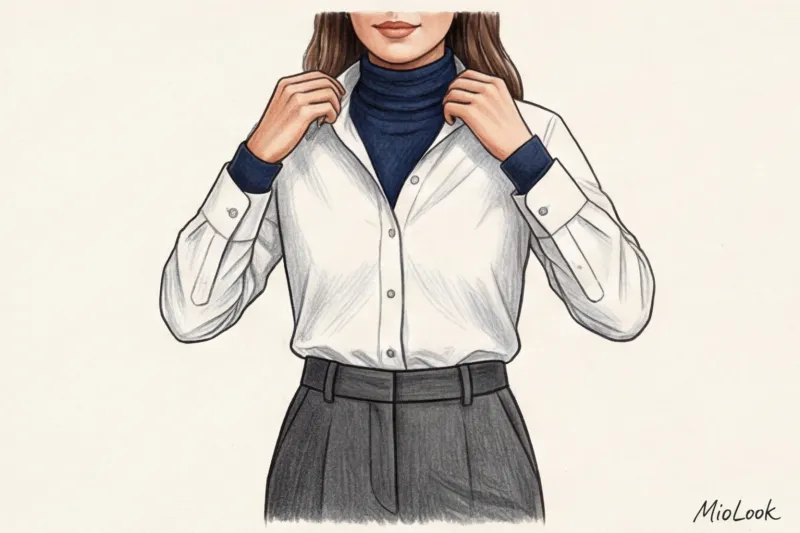
How to avoid excess volume:
- Thermal turtlenecks: Instead of a chunky sweater under a jacket, wear an ultra-thin thermal turtleneck (like the basics in a heavy micromodal) underneath a classic shirt. You'll get a closed neckline and warmth, but still retain the crispness of a cotton collar.
- Removable collars and bibs: It's a brilliant invention! You wear a stand-up collar bib under a thick V-neck sweater. Visually, it looks like you're wearing a full-length shirt, but in reality, you won't feel hot, and the fabric won't bunch up at the sleeves.
- Sundress made of thick wool: Wear a silk blouse underneath. It looks formal, feminine, and absolutely within the bounds of the most conservative business style.
MioLook AI Stylist: How Virtual Try-Ons Make Shopping Easier
Let's be honest: finding good, high-necked clothing in the catalogs of brands targeting Zoomers is a real challenge. Models on websites often pose in awkward positions, obscuring the actual fit of the garment. You order a dress hoping it will cover your knees, but what you get is a miniskirt.
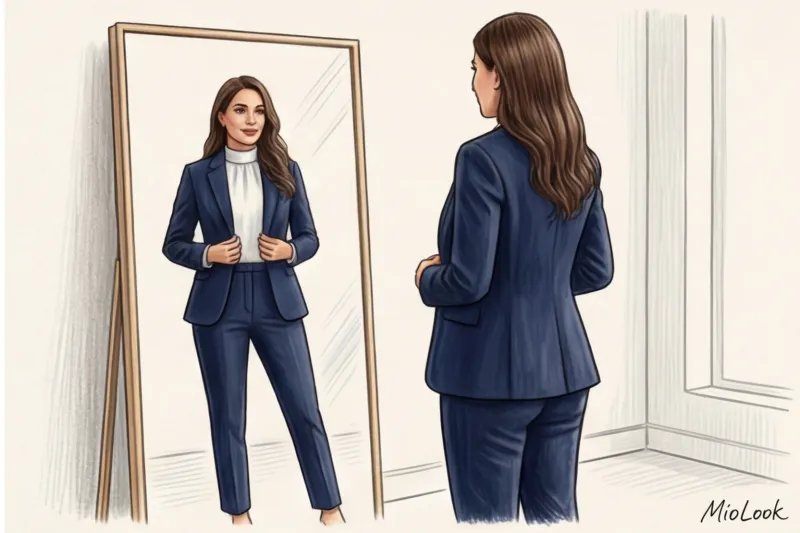
This is where fashion tech comes in. Using the smart fitting feature in the MioLook app, you can upload a photo of yourself and literally try on the item you've chosen. The AI algorithm analyzes your proportions and shows how a specific jacket or midi dress will flatter your body type. Will that double-breasted jacket adequately cover your hips? Will the high collar of your blouse make your shoulders look too broad?
For busy women, this is a lifesaver. You can try on dozens of formal looks over your morning coffee, avoiding impulse purchases and the tedious process of returning unsuitable items.
Try MioLook
A smart AI stylist will choose the perfect look for you and help you evaluate the fit of high-necked clothing before purchasing.
Start for freeChecklist: Wardrobe audit for compliance with the modest dress code
When I do wardrobe reviews with clients, we don't just look at items on hangers. We test them in motion. Conduct this mini-audit tonight with your favorite office capsule wardrobe.
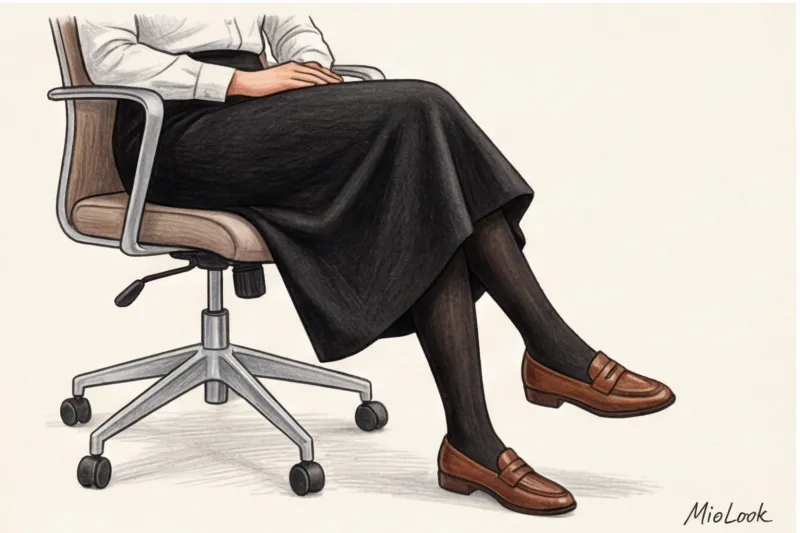
- Test "Sit on a chair". Put on a skirt or dress. Sit on a chair in front of a mirror. Cross your legs. Where is the hem now? If it's slipped to mid-thigh, revealing too much, the item isn't suitable for serious negotiations.
- Raise your hands test. Put on your pants/skirt and blouse. Reach up, as if you were reaching for a folder on the top shelf. Is your lower back or stomach exposed? If so, the bottom isn't high enough, or the top is too short.
- Test "Office lamps". Wear a white shirt over contrasting underwear (e.g., black) and stand under a bright white light (in a bathroom or under a fluorescent desk lamp). If you can see the outline of your underwear, everyone in the conference room will see it. For the office, we only wear smooth, nude underwear (matching your skin tone) under white, but the fabric of the blouse itself should conceal the texture.
Creating a closed business wardrobe isn't about abandoning style for boredom. It's about reaching a higher level of fashion intelligence. When you stop trying to impress with the depth of your neckline, you start impressing with the quality of your cut, the impeccable fit, and the texture of your luxurious fabrics. Invest in the density of your materials and the clean lines of your silhouette—these are the details that speak louder than any logo.