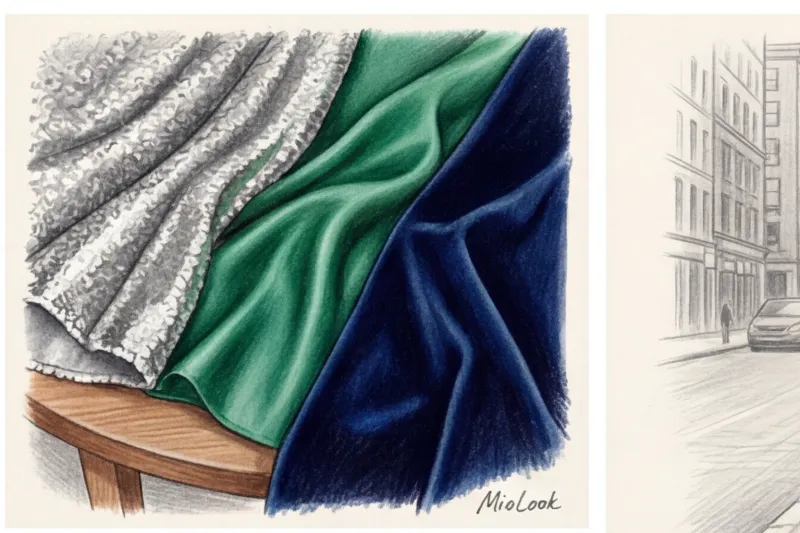
A clever combination of textures in an evening look: why it's more important than color
Take a look at your closet right now. How many "one-night dresses" are hanging there? Last week, I was auditing a new client's wardrobe and pulled eight mass-market party dresses with the tags still attached from the back shelves. Eight dresses bought in a fit of pre-holiday panic, each averaging €60. That's a total of €480, frozen in polyester that will never see the light of day again.
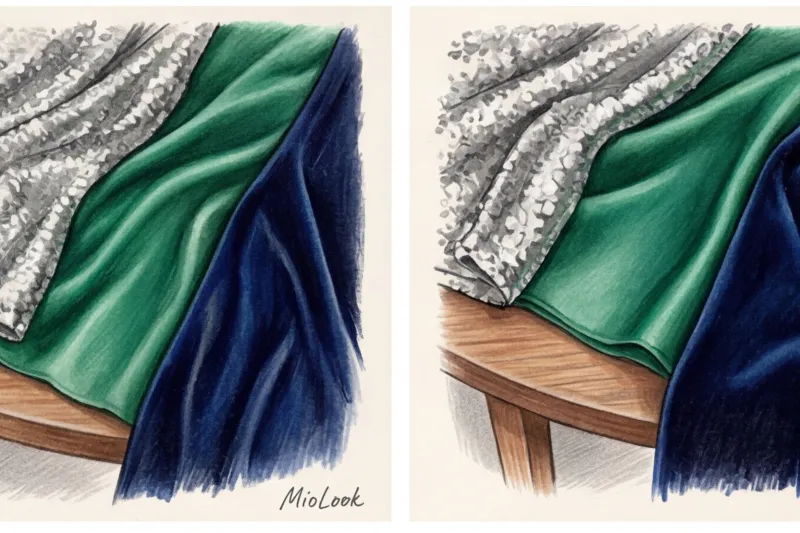
I've already covered the one-time purchase trap in more detail in our complete guide: How to Build a Basic Evening Wardrobe: A Dressy Capsule The main idea is simple: it's time to abandon the "dressy dress" paradigm in favor of a smart evening capsule collection. And the secret to its success lies not in color, but in the physics of fabrics. It's the clever combination of textures in an evening look that distinguishes high-status style from banal consumerism.
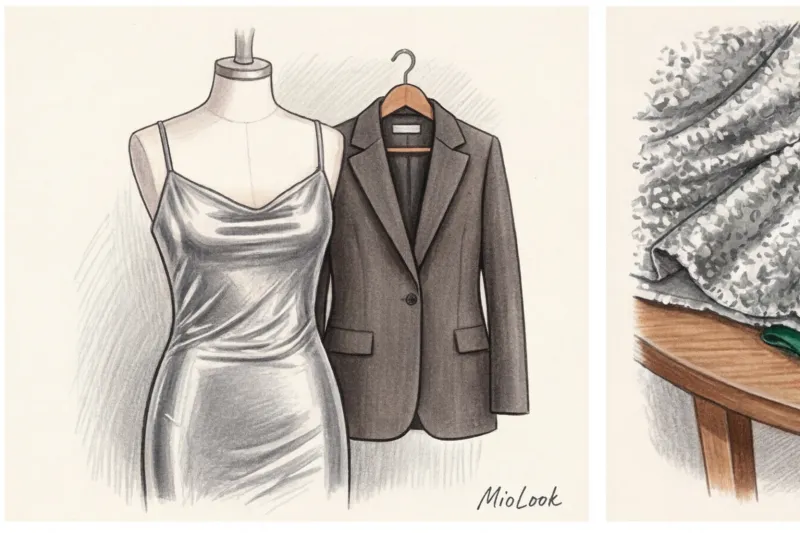
Any fabric is a tool for working with light:
- Gloss (silk, satin) works like a mirror, reflecting light and drawing attention to the curves.
- Pile (velvet, suede) absorbs light, creating depth, but visually weighing down the silhouette.
- Relief (sequins, beads) breaks the light into hundreds of glares.
If you understand how these three physical properties interact, you'll be able to assemble luxurious outfits with your eyes closed. And most importantly, each item will be 100% cost-per-wear.
Silk: Liquid Metal and the Foundation of a Elegant Capsule
Silk is the most cost-effective investment in an evening wardrobe. But not all silks are the same. In the textile industry, silk weight and density are measured in momme (mm). Fast fashion brands often use 12 mm fabric—it's translucent, easily comes apart at the seams, and is prone to static. For a quality capsule collection, look for 16 mm, and ideally 19 mm. In my experience, such a garment lasts three times longer.
"A good silk skirt should be cut on the bias. Only this cut allows the fabric to flow over the hips without bunching up into unsightly folds at the crotch." This is a basic rule of clothing designers that is often overlooked by consumers.
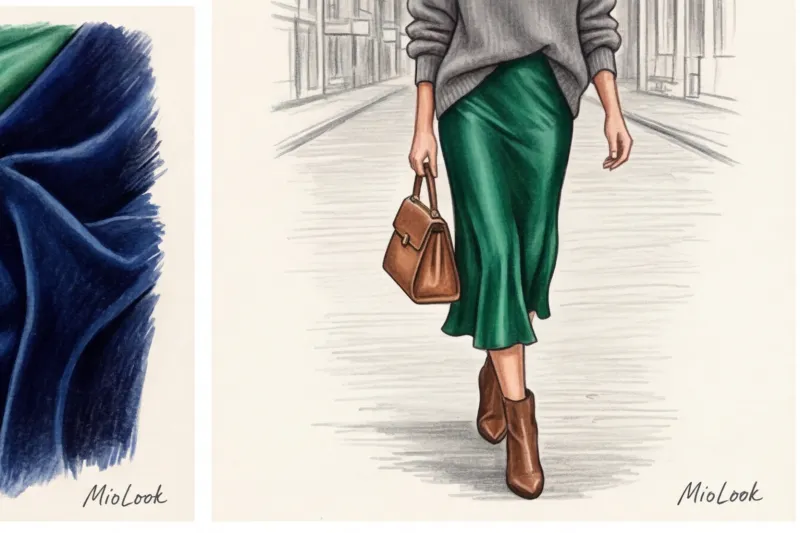
Your essential essentials: a silk midi skirt (slip skirt) and a lingerie-style top without cheap lace. Excellent options in thick silk regularly appear in the premium Massimo Dutti and COS lines in the €90–€120 range.
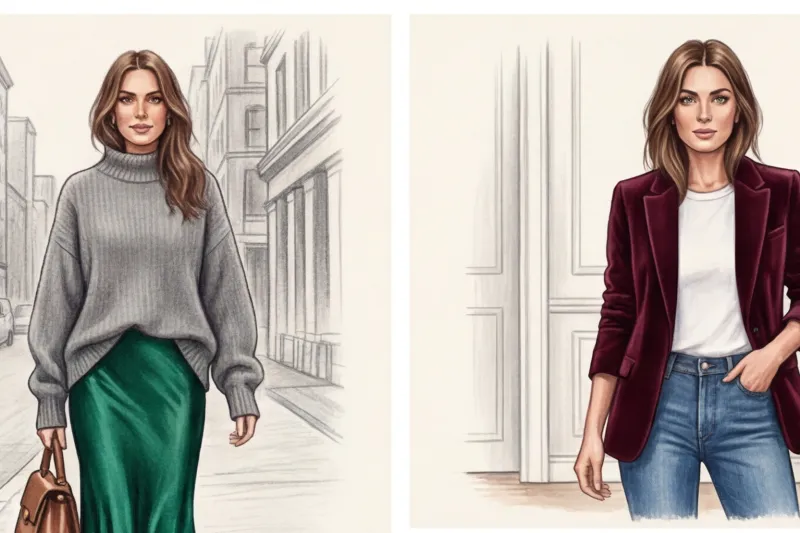
What to mix silk with to tone down the pretentiousness
To prevent a silk skirt from hanging in your closet from holiday to holiday, use the rule of contrasting weights. A fluid, flowing texture requires a rough, matte companion. Pair a silk midi with a chunky cashmere sweater or thick, structured denim. This instantly transforms the look from evening to elegant everyday.
Your perfect look starts here
Join thousands of users who look flawless and cleverly combine items every day with MioLook.
Start for freeVelvet: How to Avoid the Theatre Doorman Effect
There's a dangerous style myth: a velvet dress is the pinnacle of elegance. The reality is far harsher. Heavy, head-to-toe velvet is almost guaranteed to add 10 years to a woman's appearance and visually widen the figure due to the light-absorbing properties of the nap.
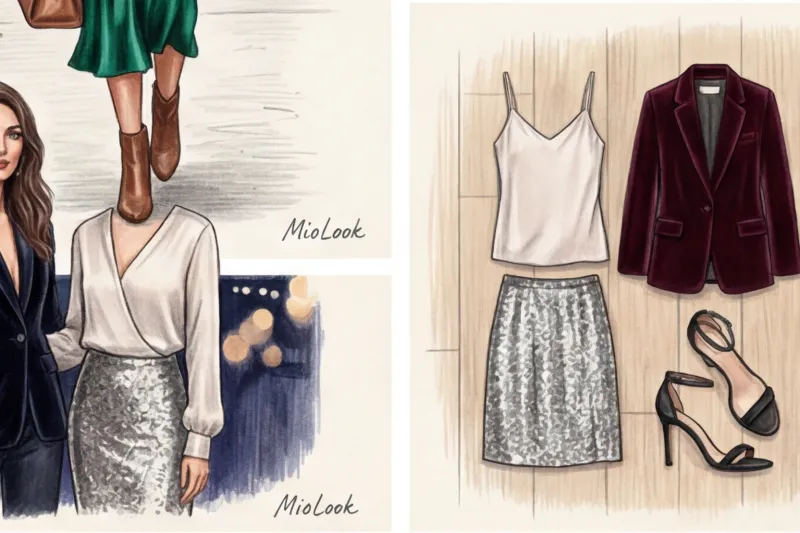
One day, a client named Anna came to me: she'd bought a heavy burgundy velvet sheath dress for a corporate event and complained that she looked "like a retired head teacher." We removed the dress and replaced it with a deep blue men's velvet jacket (found at &OtherStories for €130), layered it over a weightless silk top and paired it with tailored suit trousers. The effect was stunning: Anna now looked modern, daring, and classy.
The "air" rule: Velvet is a sultry texture. It requires exposed skin (rolled sleeves, deep necklines) or lightweight complementary fabrics, such as translucent chiffon or fine silk.
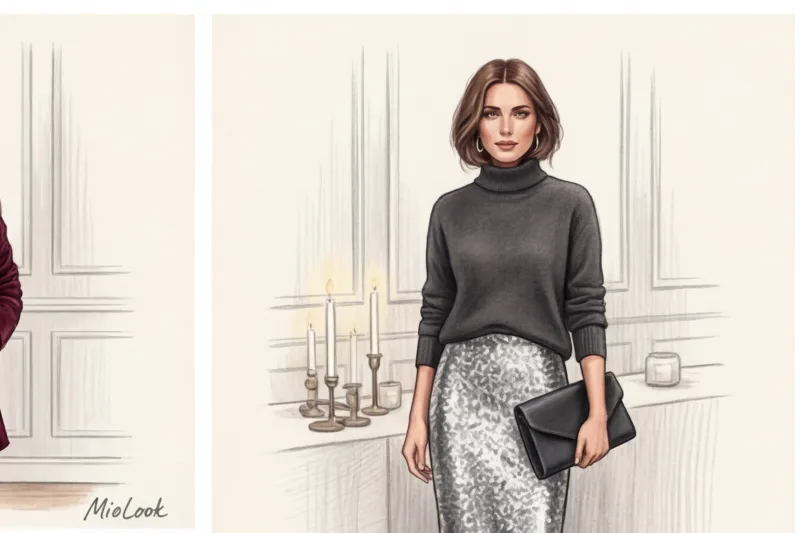
Sequins: The Mathematics of Smart Investments
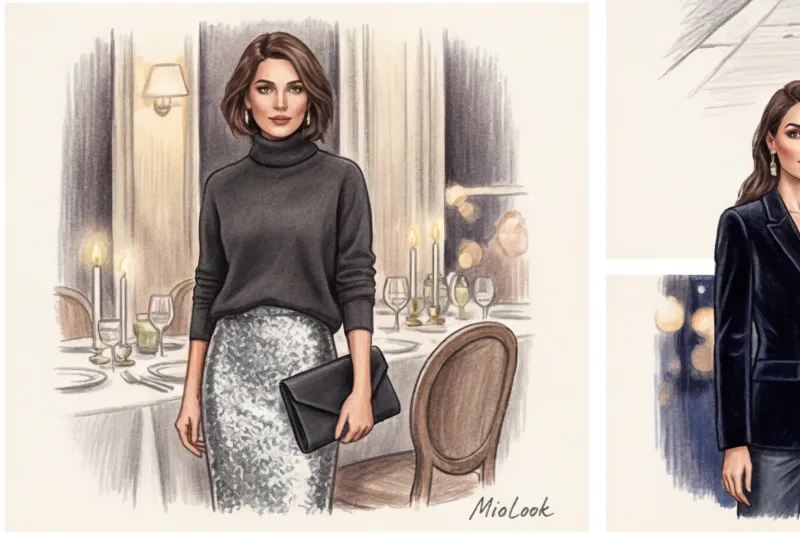
Buying a sequin dress is a financial crime against your wallet. Let's calculate the cost-per-wear. You'll wear a Zara dress for €80 exactly once (to a corporate event) because it's too eye-catching. Cost per outing = €80. If you buy a sequin skirt for €100 and wear it with an oversized sweater to a restaurant, with a white shirt to an exhibition, and with a T-shirt to a party, after 10 outings it'll only cost €10.
Vogue Business's 2024 analysis confirms this trend: the macro trend for "everyday sequins" is completely replacing traditional evening dresses in European street style.
When choosing, pay attention to the type of glitter. Matte sequins always look more expensive and refined than glossy disco options. And be sure to check the inner armhole seams: cheaply sewn sequins will rub off your inner arms and bleed within a couple of hours of dancing.
Formulas: How to combine textures in an evening look
Can you wear everything at once? No. I use a strict rule: there should be no more than two active (evening) textures in an outfit, and they must be separated by a third, neutral one.
Why do silk and sequins often clash? Both textures reflect light. Wearing a silk top with a sequin skirt will turn you into a disco ball. They need to be balanced with a matte texture.
- Formula 1: Sequins (skirt) + Velvet (jacket) + Matte cotton (basic T-shirt) = a sophisticated, yet relaxed evening look.
- Formula 2: Silk (slip dress) + Velvet (long jacket) = bohemian chic.
- Formula 3: Silk (skirt) + Matte wool (sweater) + Metallic leather (shoes or clutch) = Scandinavian minimalism.
Ready to get started?
Digitize your elegant pieces in the MioLook app. Our algorithm will show you new velvet and silk combinations based on what you already own.
Start for freeChecklist: Putting together an evening capsule based on textures
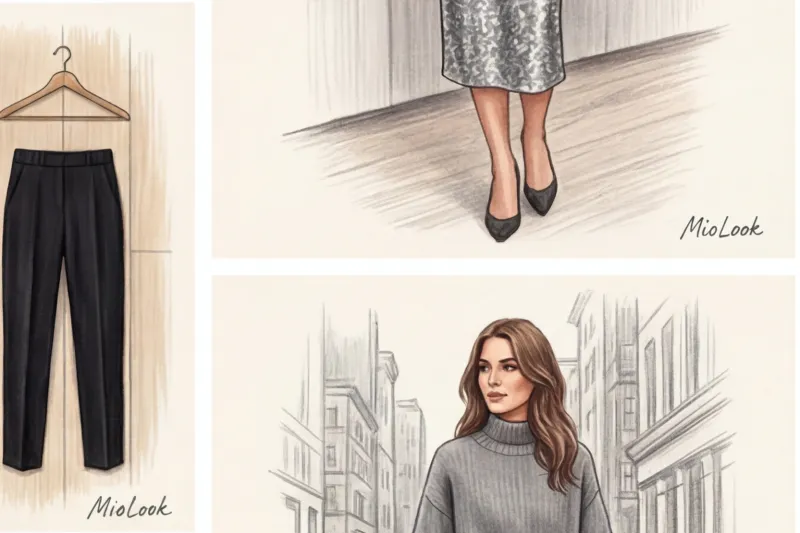
To solve the "nothing to wear for a holiday" problem for the next five years, you don't need a huge budget. You just need five items, 80% of which are easily found in high-end mass-market stores.
- Silk midi skirt. Neutral (pearl, champagne) or deep dark shade (chocolate, emerald).
- Velvet jacket of men's cut. Look for slightly longer styles that cover the groin.
- Accented sequin hem. Pencil skirt or loose trousers with elastic.
- Basic matte element. A thin cashmere jumper or a thick (from 180 g/m²) cotton T-shirt of perfect cut.
- Silk top or blouse. No prints or unnecessary decoration.
Common mistakes when styling complex fabrics
Even the most carefully crafted combinations of textures in an evening look can fall apart due to technical errors that are rarely covered in glossy magazines.
The first problem is a cheap lining. In 12 years of working as a stylist, I've learned this rule: always turn a velvet jacket inside out. If the lining is 100% polyester or acetate, the item stays in the store. These materials create a greenhouse effect, and after 15 minutes in a warm room, you'll start sweating. Look for linings made exclusively of viscose or cupro.
The second problem is static electricity. Silk paired with synthetic tights will inevitably stick to your legs, ruining your silhouette. A high-quality antistatic is literally an investment in your appearance; it's always a good idea to keep one in your purse.
And finally, overload. Complex textures are already embellishment. If you're wearing velvet or sequins, forget about stone-studded necklaces and massive chandelier earrings. Opt for sleek, minimalist metal. Let's be honest: these rules don't work for every situation. If the invitation specifies a strict black-tie dress code, you'll have to buy a classic floor-length gown. But for 95% of parties, corporate events, and theater outings, the math of texture is your best tool.
Give up the idea of buying a "one-night look." Invest in the right textures, pair them with everyday pieces, and your wardrobe will work for you, not you for it.