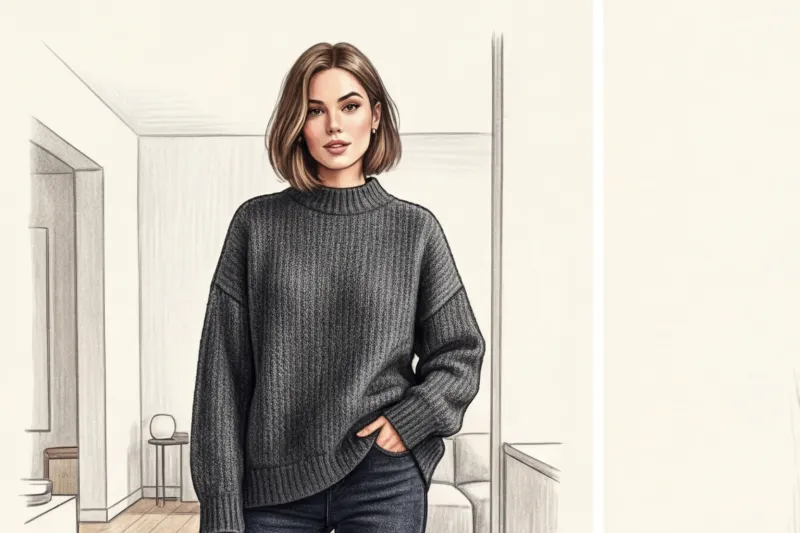
One of my clients in Milan once threw a pile of clothes onto the fitting room sofa in a fit: "I bought five oversized sweaters from different stores, but I only wear one—from Massimo Dutti. The others make me look like a square chest of drawers." Sound familiar? We're used to blaming our figure, winter weight gain, or a "bad angle," but after 12 years as a personal stylist, I've learned one hard and fast rule. Oversized clothes don't make you look fat because of the volume. They make you look like a ball because of the cheap, stiff texture and the lazy cuts.
Today we'll shift the focus from clichéd advice like "just wear skinny jeans" to the architecture of the garment itself. You'll learn How to wear an oversized sweater , applying the laws of physics and geometry to create a fragile appearance. We've already discussed the fundamental rules of selection in our guide. A Basic Knitwear Wardrobe: How to Put Together a Capsule , and here we will analyze the mechanics of landing using specific examples.
The Main Trap: Why Some Oversized Styles Make You Look Slimmer, While Others Make You Look Like a Cloud
The main mistake I see on the streets of European capitals is trying to pass off an item two sizes too big as truly oversized. These are completely different design solutions. A truly oversized cut is a well-thought-out "architecture of comfort," with a deliberately lowered armhole and a mathematically calculated sleeve width.
My main personal style test in the fitting room is the "heavy edge rule." The difference lies in the weight of the garment itself. A cheap, fluffy acrylic jumper weighs about 300 grams. It's lightweight, staticky, and inevitably "bubbled" around the waist, visually adding 5-7 kilograms. But a high-quality sweater made of thick cotton-wool or heavy viscose weighs 600-800 grams.
What happens to heavy knitwear? Under its own weight, it's pulled downward. Instead of horizontal volume, vertical folds form, acting as stretch lines. This is why the designers of premium lines like COS and & Other Stories often use blends with heavy viscose or ultra-dense merino wool to add heft to the silhouette.
How to Wear an Oversized Sweater and Maintain Fragility: The "Open Joint Rule"
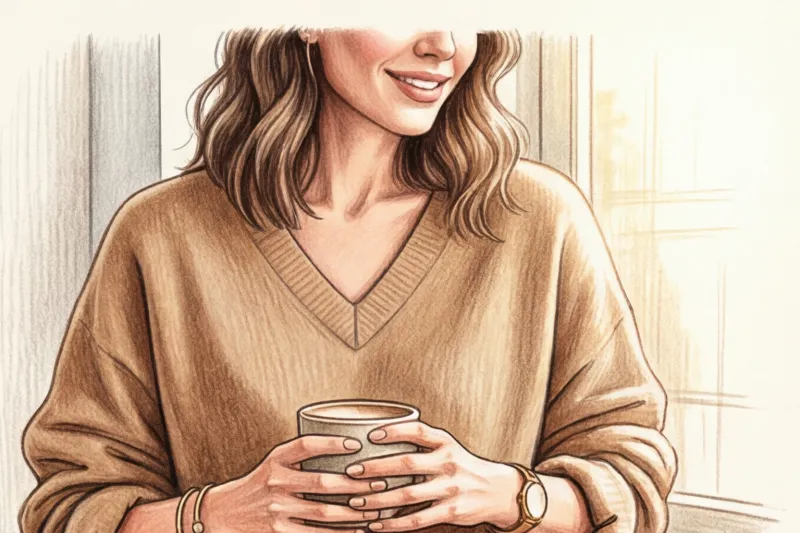
Our brain judges the size of an object by its narrowest points. This is a basic law of visual perception. If you wear a huge tent-like sweater and completely hide your arms and neck, those around you will subconsciously imagine an equally monumental body beneath the fabric.
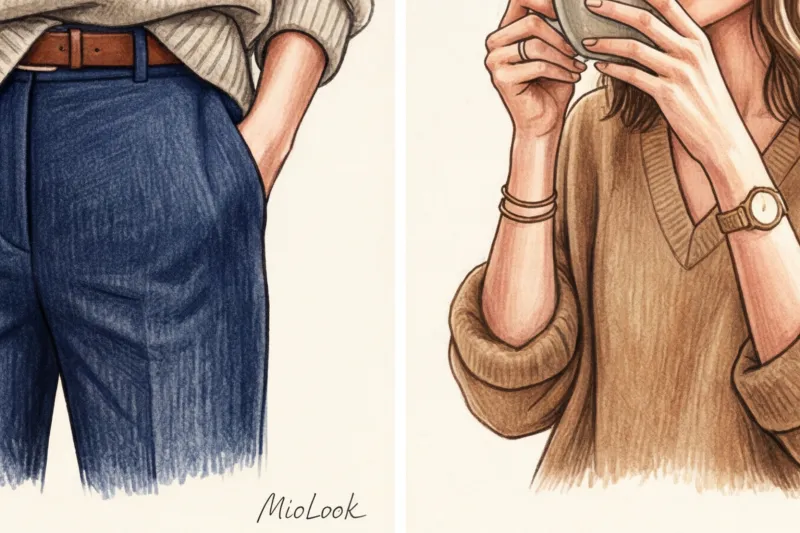
The secret to preserving fragility lies in the "knuckle rule." Show off the most delicate parts of your body. Simply roll up your sleeves slightly to expose your wrists, or choose a V-neck to show off your collarbones. I always recommend adding a metal watch or a stiff bracelet to an exposed wrist. The thin metal against the thick wool creates an aggressive texture contrast, making your hand appear even more graceful.
"The most dangerous wardrobe item for plus-size women is a tight, oversized turtleneck with long, tight sleeves. It blurs the lines of the neck and turns the figure into a monolithic block. Always leave some air between the garment and your joints."
It's important to note here: this technique works flawlessly, but it requires careful proportions. If you're unsure how a particular neckline cuts your silhouette, take a photo of yourself in the fitting room mirror and upload it to MioLook The AI stylist will instantly analyze the lines and tell you if the balance is imbalanced.
Your perfect look starts here
Join thousands of users who look flawless every day with a smart wardrobe analyzer.
Start for freeEngineered tailoring: what to look for in the fitting rooms of Zara, H&M, and Massimo Dutti
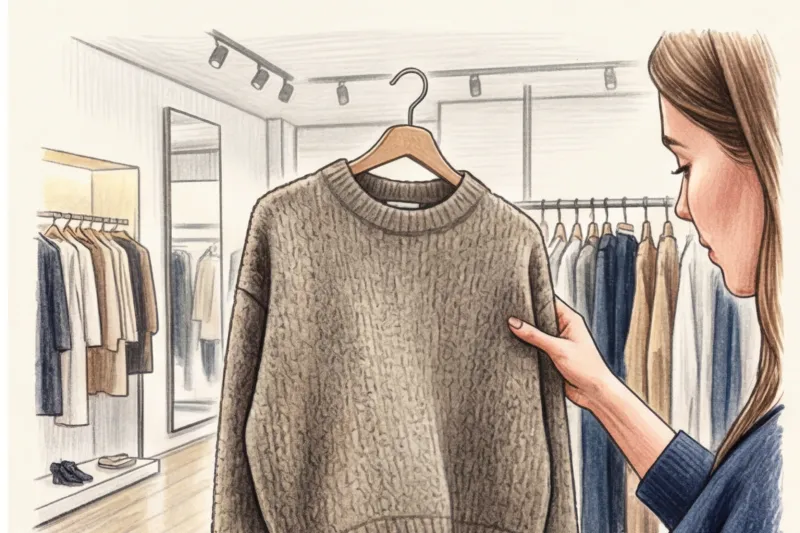
Let's take a look at mass-market clothing. In the €40–€60 price range (for example, in Zara or H&M's basic lines), a critical design flaw is often encountered: a tight hem. Manufacturers skimp on patterns and simply tighten the wide hem.
What happens when you put on such a sweater? The sweater hugs your hips tightly at their widest point, with excess fabric hanging over the top like a life preserver. A proper architectural sweater (often found at Massimo Dutti in the €90–€150 range) has a straight cut. The elastic at the bottom serves a purely decorative function—it shouldn't constrict the fabric. The sweater should fall freely, creating a gap between the knitwear and your body.
Also, pay attention to the length. There are only two ideal options: either a cropped oversize (to the hipbone) or a longer model that reaches the groin area. If the hem of the sweater ends exactly at the widest horizontal line of your hips, it will visually widen them by half. By the way, if you're looking for a way... How to hide broad shoulders , a hypertrophied dropped shoulder seam (5-7 cm below the natural joint) will become your best ally.
How to wear oversized knitwear: debunking the skinny jeans myth
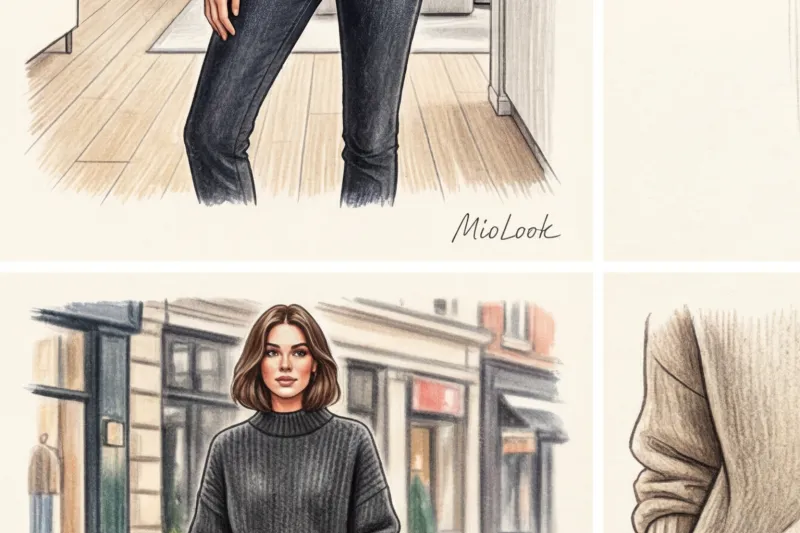
Ten years ago, fashion magazines hammered it into our heads: "A voluminous top must be offset by fitted bottoms." Thus was born the "tent sweater and leggings" uniform. According to analytical reports from the WGSN Trend Institute (2024), this silhouette has finally become an anti-trend. It looks dated and distorts proportions, making legs look like matches stuck in a lollipop.
Contemporary styling is based on a counterintuitive rule: volume plus volume can be slimming if you juxtapose textures wisely.
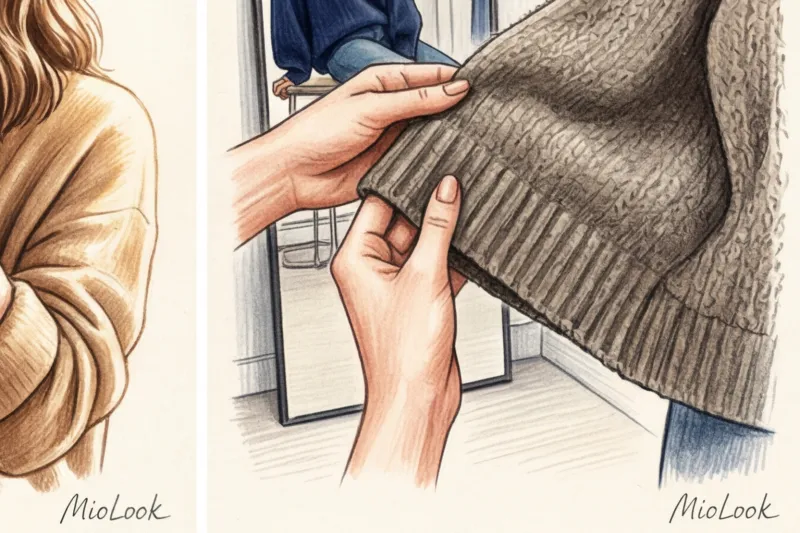
Contrast of textures: heavy knit and flowing silk
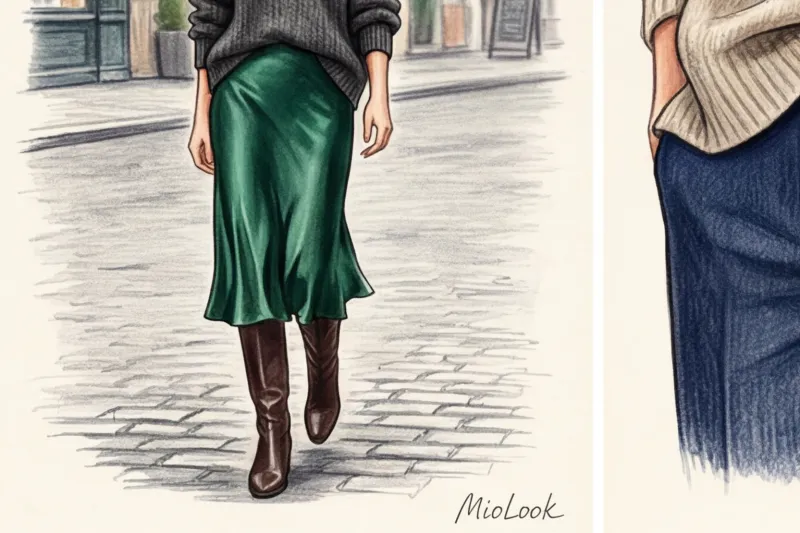
My favorite look, which delights nine out of ten clients, is pairing a chunky, almost mannish wool sweater with a flowing satin maxi or midi skirt. The secret lies in the reflectivity. A matte, fluffy yarn absorbs light, creating a substantial and heavy look. Smooth silk or satin, on the other hand, reflects light, creating highlights and movement with every step.
A heavy top makes your bottoms appear weightless, making you look fragile. This trick is especially great when you need to transform cozy knitwear for an evening out or a date.
Structure vs. Softness: Palazzo and Strict Skirts
For office dress code, if you want to incorporate a cozy piece into smart casual For a stylish look, wear palazzo pants in a heavy suiting fabric with a sharply pressed crease. The soft, oversized silhouette requires a sharp, graphic counterbalance. A central vertical crease on wide-leg pants will elongate your height and tie a relaxed top together into a cohesive, elegant ensemble.
Ready to rethink your approach to style?
Try MioLook for free: A smart AI stylist will analyze your parameters and select the perfect texture combinations.
Try MioLookThe Art of Tucking: 3 Ways to Tame Excess Fabric
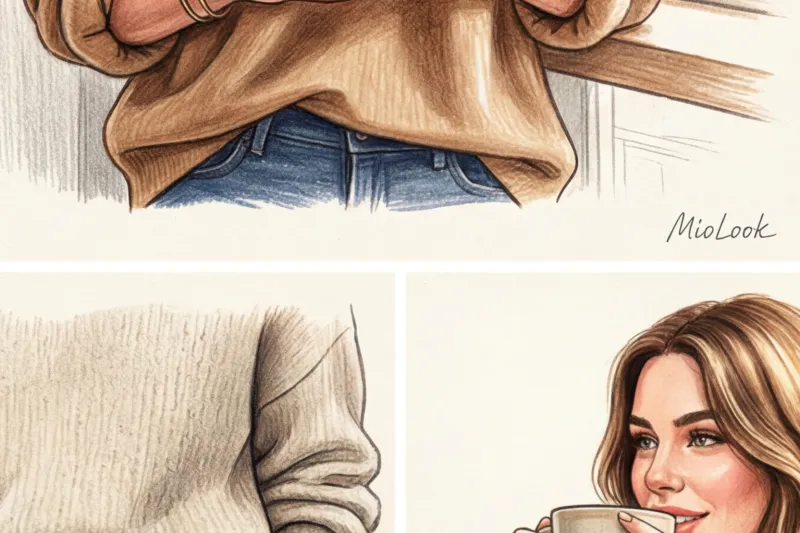
Not every sweater can be simply thrown on and gone. Sometimes the fabric needs to be disciplined. But there's a serious limitation here: if the knitwear is thicker than 5-7 millimeters (especially tight cable knits), trying to tuck it into jeans will result in a "roll" at the stomach. For such garments, only workarounds are suitable.
- French tuck (front only). A classic, but with a twist. The tuck should be exactly the width of the belt buckle, no wider. The side edges should drape freely, hiding any creases. If an unsightly "tail" forms at the back, the fabric is too stiff for this method.
- Life hack with a belt. Place a thin leather belt over the sweater, wrapping it around your waist. Then pull the fabric up slightly so it hangs over the belt, completely hiding it. This will shorten the garment without having to tuck thick yarn into tight pants.
- Asymmetrical edge. Tuck your sweater in at only one side (closer to your hip). This will create a diagonal crease across your stomach. Diagonal lines are a powerful visual enhancement tool; they always conceal the actual waist size.
Stylist Checklist: 4 Questions to Ask Before Buying a Chunky Sweater
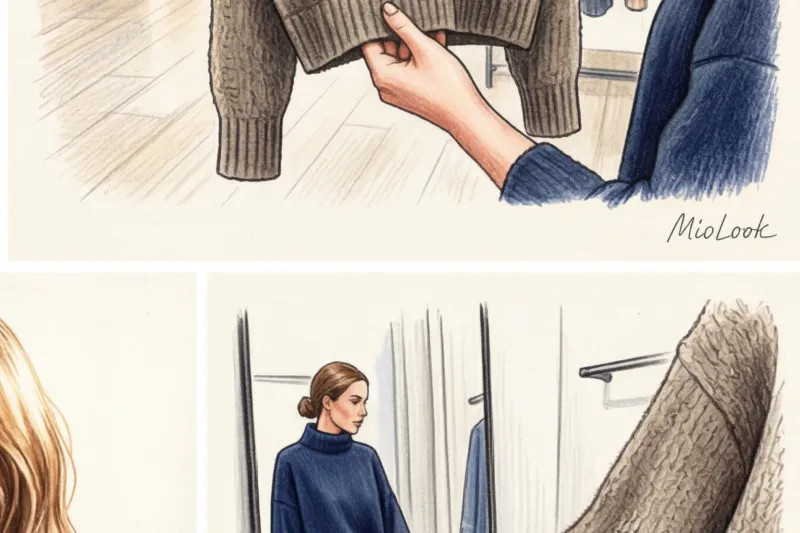
To prevent mistake-making items from languishing in your closet, keep this checklist. Before taking that bulky sweater to the checkout, put it on, stand in front of a full-length mirror, and honestly answer these four questions:
- Does the fabric flow down? (If it stands up straight and sticks out on the back when you turn your body, return it to the hanger).
- Where is the shoulder seam? (In a correct oversize, it should fall at least 5 cm below the anatomical edge of the shoulder).
- What does the bottom elastic do? (It shouldn't hug your hips and create a barrel-shaped silhouette.)
- Are my fragility points visible? (Roll up your sleeves: if your exposed wrists contrast sharply with the volume of the sleeves, you've found the perfect style.)
Managing your personal style starts with digitizing your best looks. When you find that perfect heavy sweater, add it to your virtual wardrobe in MioLook , so that the app can help you put together dozens of unique outfits for every day.
Chunky knitwear isn't a way to hide from the world in a cozy cocoon. It's a tool for playing with proportions. Let the heavy fabric do the work, expose your wrists, add a touch of shimmer to a silk skirt, and watch as oversized clothing transforms from a shapeless sack into the most elegant piece in your wardrobe.