
Anna, a top manager at a major IT company, stood in front of the mirror in the ladies' room of the conference room, barely holding back tears. She was wearing an impeccable, perfectly tailored wool Jil Sander suit worth around €2,000, expensive loafers, and a simple watch. The geometric design of the outfit was masterfully crafted. But as soon as we stepped out into the harsh fluorescent light, all this status minimalism shattered: her foundation had become unsightly and began to flake off her face in tiny pellets.
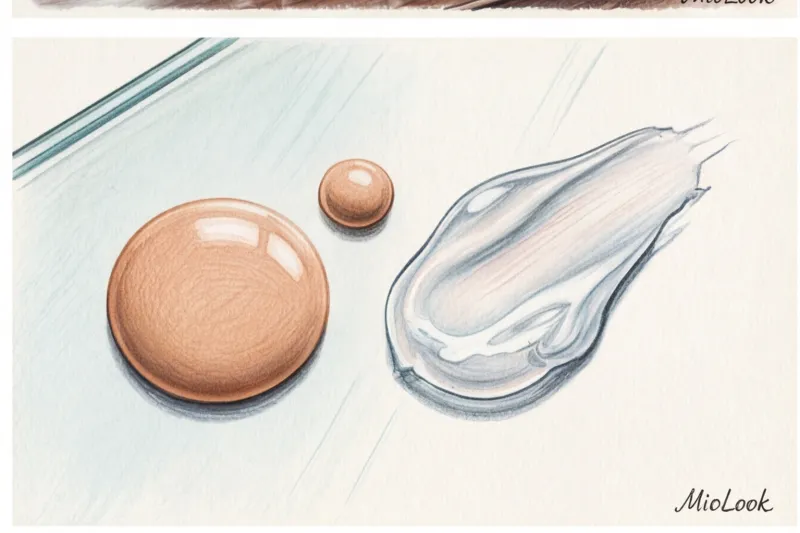
As a practicing stylist, over 12 years of work, I've learned a hard and fast rule: no amount of Italian cashmere, even the most expensive, will save your look if you have problems with grooming and makeup. The effect of "cheap," unkempt skin instantly negates the status of any garment. And more often than not, the cause lies not in poor cosmetics, but in a basic ignorance of the laws of chemistry.
In this article we will look at, Why does foundation roll off my face? , and apply a systematic, "wardrobe" approach to layering makeup. (By the way, we wrote in more detail about properly preparing a base in our complete guide: Basic Facial Skin Care: The Secret to Long-Lasting Makeup ).
Why does foundation roll off my face? It's chemistry, not magic.
Let's be honest: makeup can't take revenge. If your foundation is blotchy, it's because there's a texture clash. In our wardrobe, we know that a heavy wool skirt will cling to thin tights without an anti-static agent, and silk will slide. The same laws of physics apply to the face.
Imagine trying to apply expensive acrylic paint to an uneven wall generously coated with oil. The paint won't adhere to the surface; it will begin to bead and roll off. The main rule of makeup artists, borrowed from chemistry: like dissolves in like.
Conflict of bases: water versus silicone
According to statistics that we often discuss with fellow makeup artists on shoots, 80% of creasing cases are caused by one simple mistake: applying a water-based product over a silicone one.
Take your jars and look at the ingredients (INCI). If the first words in your primer or day cream are Dimethicone , Cyclopentasiloxane or any other words ending in -cone and -siloxane—you're looking at a silicone base. It creates a smooth, waterproof film on the skin. Now look at your foundation. If it proudly says "siloxane" in the first place... Aqua (water), and there are almost no silicones in the composition, I have bad news for you. Water will never adhere to the silicone film. With the slightest rubbing with a sponge or brush, this mixture will turn into those annoying pellets.
Access to MioLook for €0.99 — one-time payment
A smart AI stylist will create the perfect look, taking into account every detail—from makeup to accessories.
Get access — €0.99 onceThe biggest morning routine mistakes that ruin your makeup's longevity
According to a recent WGSN Beauty report (2024), the "skinimalism" trend is finally replacing multi-step Korean skincare in European women's morning routines. And thank goodness for that. The "I'll just throw on all my best stuff" syndrome is the main enemy of a perfect foundation.
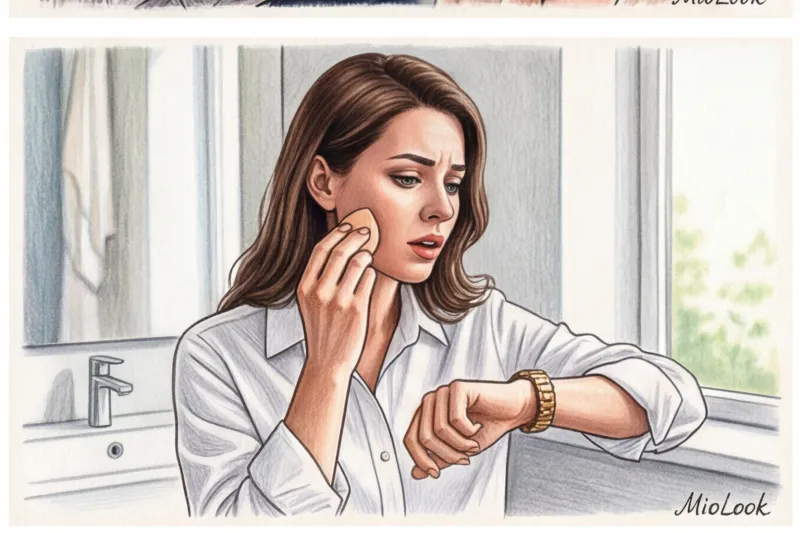
- Rushing and ignoring timings. This isn't a myth, but a technological necessity. A lightweight serum with hyaluronic acid needs 1-2 minutes to set. A thick moisturizer with ceramides, however, will require 10 to 15 minutes. If you apply foundation over damp, unabsorbed cream, it will simply "flow."
- Overload of layers. Toner, essence, serum, thick cream, sunscreen (SPF), primer, and finally, foundation. That's seven layers! Skin physically can't absorb that much product.
- Residues of exfoliants. One of my clients had been complaining about peeling skin for a long time. It turned out she'd been using a cellulose-based peeling peel in the morning and hadn't washed her face properly afterward. Her foundation was clinging to the microscopic peel residue, mimicking the horrific peeling sensation.
"Morning makeup is a no-brainer. If you don't have time to wait between layers, you'll inevitably end up with a blotchy complexion by mid-workday."

As a practitioner, I understand perfectly well: a business woman doesn't have an extra 20 minutes in the morning to sit and wait for her cream to soak in. My life hack for optimization: wash your face and apply serum. While it's soaking in, brush your teeth. Apply the cream, and go iron a shirt or make coffee. Just before you leave, apply foundation.
How to Integrate Skincare and Cosmetics: A Stylist's Guide
To make your makeup look as expensive as your wool blazer, you need to create the right layering. For office makeup, too many layers are detrimental: under the harsh office lighting, any overload looks like a mask.
Step 1: Cleansing and pH balancing.
Wash your face with a gentle cleanser and use a mildly acidic toner. The toner will remove any remaining sebum produced overnight and prepare the skin for a cleansing effect.
Step 2. Dosing of moisture (pea rule).
For your morning routine, choose lightweight gel or fluid textures. A pea-sized amount of cream should be enough for your entire face. Warm it between your fingers and apply it to your face using gentle patting motions.
Step 3. Eliminating unnecessary links.
Ask yourself: do you really need a primer? In 90% of cases, a good moisturizer or modern SPF fluid will do the job perfectly. Primer is a professional tool for photo shoots, but in real life, it often just adds an extra layer that causes creasing.

By the way, in the app MioLook You can not only create a capsule wardrobe but also visualize how your makeup and hair will complement the chosen look. This helps you see the whole picture—from the texture of the sweater to the finish on your skin.
Your perfect look starts here
Join thousands of users who look flawless every day with MioLook. See how makeup complements your wardrobe.
Get access — €0.99 onceThe myth that a luxury tone will save the situation
The most common misconception I encounter is: "I'll just buy a foundation from Armani or La Mer for €100, and it will do the rest." This is an illusion.
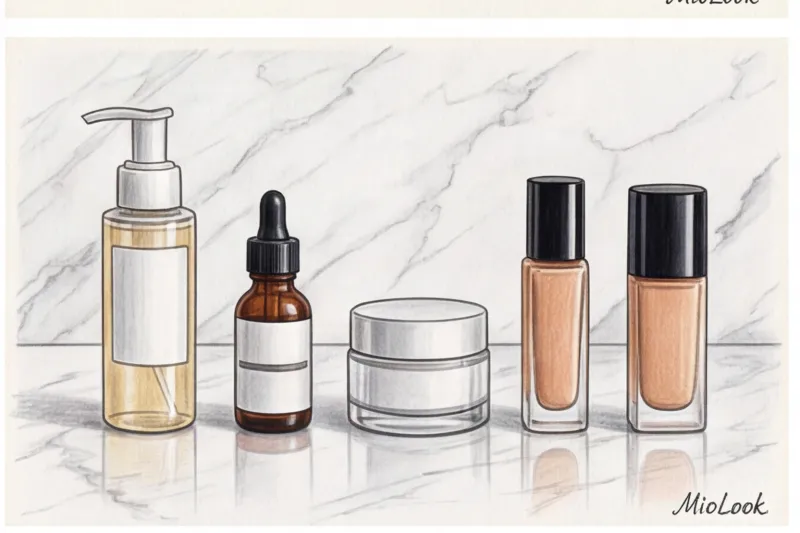
A luxury foundation costing €100–€120 won't solve the pilling problem if you apply it over the wrong base. It's like buying a luxurious Loro Piana cashmere sweater and washing it in the washing machine at 60 degrees with cheap detergent. It's not just the price tag that matters, but also the application method.
Moreover, there's a subtle catch here. Expensive serums and creams from the "heavy luxury" segment, promising results instant radiance and lifting , often achieve this visual effect with a massive dose of silicones and light-reflecting particles. These "Insta-serums" are the main killers of makeup longevity. Properly prepared skin will make a €15 mass-market fluid foundation look flawless, but an unprepared base loaded with silicones will "eat" and crumble a bottle worth hundreds of euros.
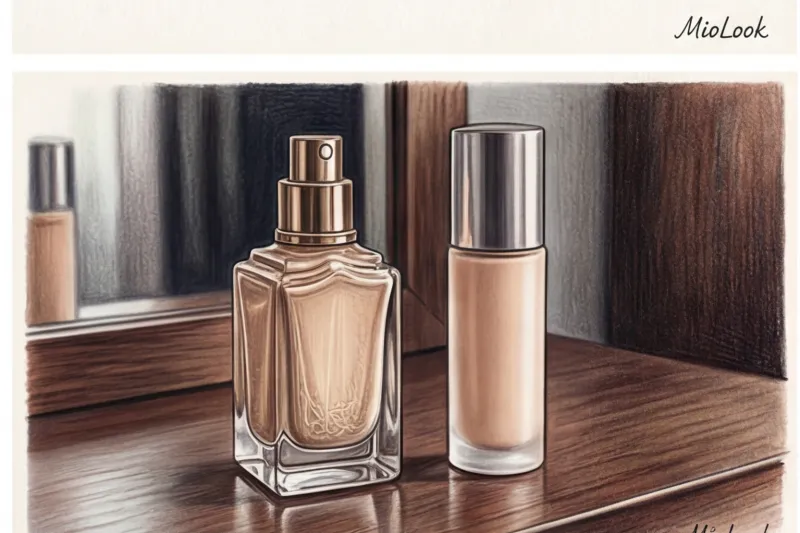
SOS instructions: what to do if your foundation has already started to fade
Imagine this: you're getting ready for an important event, applying foundation, and suddenly, telltale lumps appear on your cheeks and chin. You only have 10 minutes to go. My experience working on photo shoots and stage performances has taught me to act quickly.
What you should absolutely not do:
- Don't try to rub the foundation in with your fingers—you'll only make it worse, pulling the remaining product into huge bald spots.
- Never apply powder on top! It will set this texture in place, turning your face into a layered cake.
What works (insider trick):
Take a clean sponge (beauty blender), wet it well with water and squeeze it out in a towel. Then generously spray the sponge with makeup setting spray (or hydrating mist). Soft, exceptionally impressive Using stamping motions, apply the product to problem areas. The moisture and fixative will help slightly dissolve the edges of the spots and "pin" the pigment to the skin.
When it does NOT work: Let's be honest—if your foundation isn't just caked, but has already oxidized (turned brown) and separated into sebum particles, this trick won't help. In that case, it's quicker and more aesthetically pleasing to spot-cleanse the problem area with micellar water and apply a thin layer of concealer.

Ready to get started?
Try the free plan—no commitments required. Organize your wardrobe and beauty routine.
Get access — €0.99 onceChecklist: Compatibility Test Your Jars
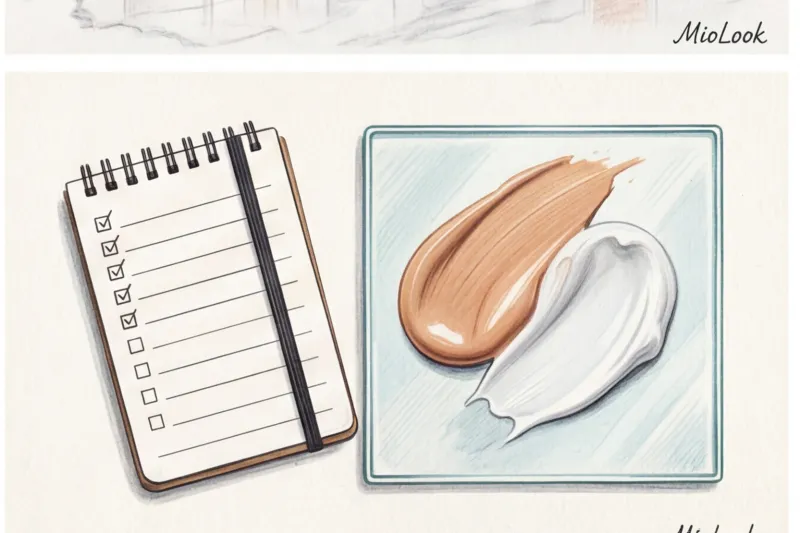
I love practical, measurable steps. To prevent your morning routine from turning into a "will it work or not" lottery, take stock of your makeup bag this evening.
- Hand test. Apply a drop of your regular day cream (or primer) to the back of your hand and spread.
- Excerpt. Wait 2-3 minutes, simulating a morning break.
- Layering. Apply a drop of your foundation on top and begin to lightly rub it in with your finger.
- Result. If the texture glides on smoothly and blends with your skin, bingo, you've got a perfect match. If rubbery flakes or pellets appear after 10 seconds of rubbing, these products are chemically incompatible.
Keep only those skincare and foundation pairs that pass this crash test in your daily routine. Separate the rest: use the silicone cream at night or on makeup-free days, and apply the clashing foundation to bare skin, moisturized only with a light, watery toner.
Remember: style isn't just about the clothes you wear. It's about grooming, design, and attention to detail. You can put together the perfect capsule wardrobe of basics, but clean, fresh skin without foundation stains will be the finishing touch that elevates your look from "okay" to "flawless."