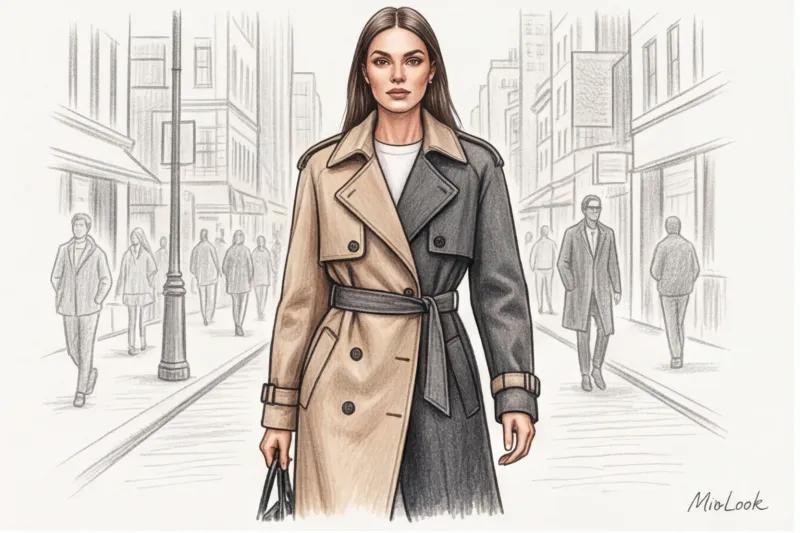
Open any DIY video on social media, and you'll almost certainly see the same scenario: someone takes a stretched-out T-shirt from a mass-market store, mercilessly cuts it with scissors, sews on a couple of uneven patches, and proudly calls it design. In 12 years of working as a stylist and textile researcher, I've learned one hard truth: that's not design. It's discarded trash.
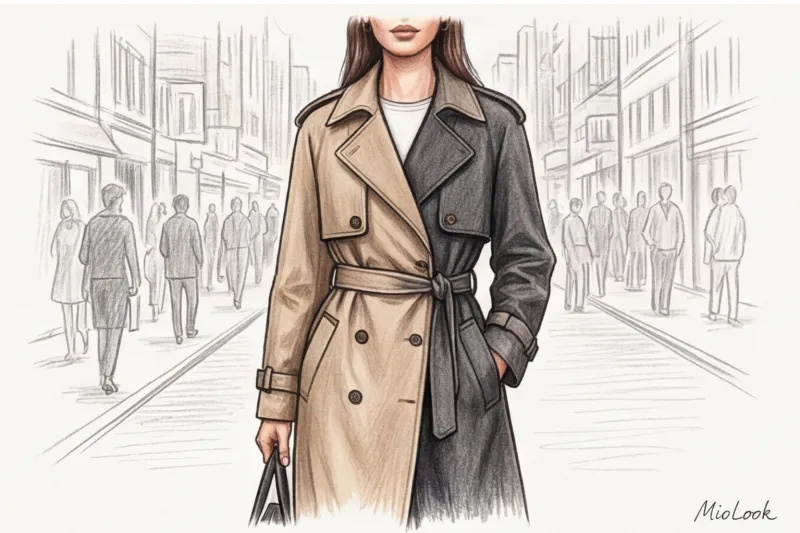
Literate clothing upcycling — this isn't a group of skilled hands. It's a complex architectural process, the goal of which is to create a couture, expensive-looking piece that will last for decades. Unlike simple recycling, we don't reduce the value of the source material, but rather increase it manifold. We've already discussed the global principles of this approach in more detail in our the complete guide to conscious fashion and creating an eco-friendly wardrobe.
Today, we'll explore upcycling from the perspective of tailoring, textile materials science, and contemporary styling. No faux pas—only pure aesthetics and precise lines.
Clothing upcycling: why it's the new couture, not just a sewing class
According to a 2023 UNEP report, up to 73% of all clothing produced globally ends up in landfills or incinerated. Research by the Ellen MacArthur Foundation confirms that we wear clothes half as long as we did fifteen years ago. And the fashion industry's response to this crisis has been paradoxical: the most expensive brands have begun cutting up old clothes.
Maison Margiela pioneered this trend with its renowned Artisanal line. Later, Marine Serre and Balenciaga took up the idea, proving that deconstruction is the pinnacle of tailoring. When you rip apart a vintage men's jacket to create a fitted women's vest, you're not remaking it. You're redesigning it, altering the very DNA of the garment.
The difference between downcycling (turning a sweater into a duster) and upcycling lies in the final quality. Your goal is to make sure no one would ever guess that the garment was remade at home. It should look as if you bought it at a concept store for a pretty penny.
The Source Rule: Which Fabrics Are Worth Your Time
My most important, most immutable rule, which I repeat to all my clients: cheap fabric remains cheap fabric after reworking. This is counterintuitive, as many people think upcycling is designed specifically for saving "bad" items. Nothing of the sort.
You can't create a structured Balenciaga jacket from a loose polyester blazer. Upcycling only makes sense when you have a great piece in your hands. source — a fabric whose production today would cost a huge amount of money.
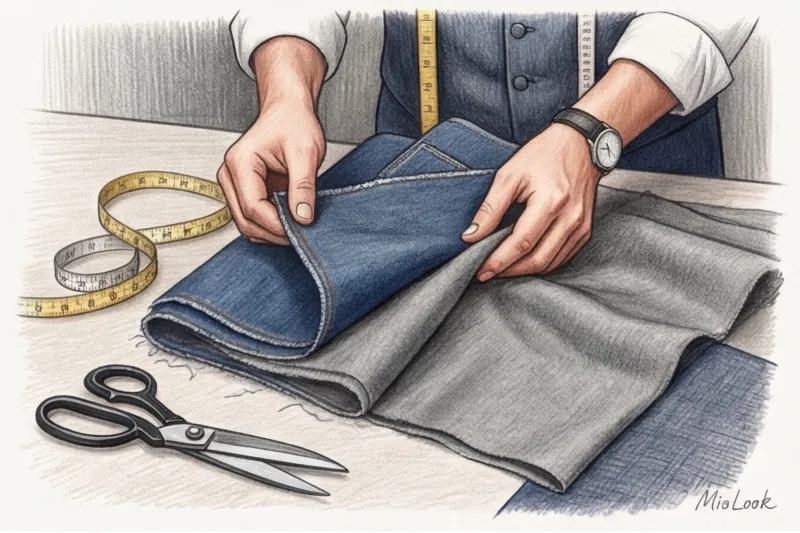
Ideal candidates for remodeling
If you're heading to a vintage store or clearing out the back of your closet, look for the following materials:
- Vintage Heavy Denim (100% Cotton): Look for old Levi's, Wrangler, or Lee jeans without any elastane. Real denim with a denim weight of 12 ounces or more holds its shape perfectly, and when deconstructed, its edges create a beautiful, dense fringe rather than dull, hanging threads.
- Men's suits made of 100% wool: It's a gold mine. Old-school men's jackets have stunning internal architecture: horsehair piping, high-quality interfacing, and a dense viscose or cupro lining.
- Thick cotton shirts (poplin, oxford): The perfect base for creating asymmetrical tops and complex blouses. Find premium men's shirts at resale.
What's better to recycle (and not sew)
I strongly recommend not to even touch the following items with scissors - they are beyond saving:
- Thin knitwear with pilling (especially if it contains cheap acrylic or low-density viscose).
- Items with an elastane content greater than 5%. Elastane threads are prone to "fatigue"—over time, they break within the fabric, permanently losing their elasticity. Remaking stretched-out skinny jeans into a stylish skirt won't work—the fabric will ripple.
- Faded blouses made from mass-market polyester. They become staticky, don't respond well to heat and humidity treatment (iron), and always look homemade when altered.
Your perfect look starts here
Join thousands of users who look flawless every day with MioLook. Digitize your wardrobe and find new combinations in seconds.
Get access — €0.99 once5 Stylish Upcycling Techniques That Look Expensive
So, you've found the perfect 100% wool blazer or heavy denim jacket. What do you do with it to make the result look like it came straight out of a runway collection? Here are five of my favorite techniques.
1. Splicing (merging). My absolute favorite. You take two similar but contrasting pieces—for example, a light blue and a dark blue denim jacket—cut them exactly in half at the back, and sew them together. The result is an asymmetrical, intricate piece. Vetements often uses this technique.
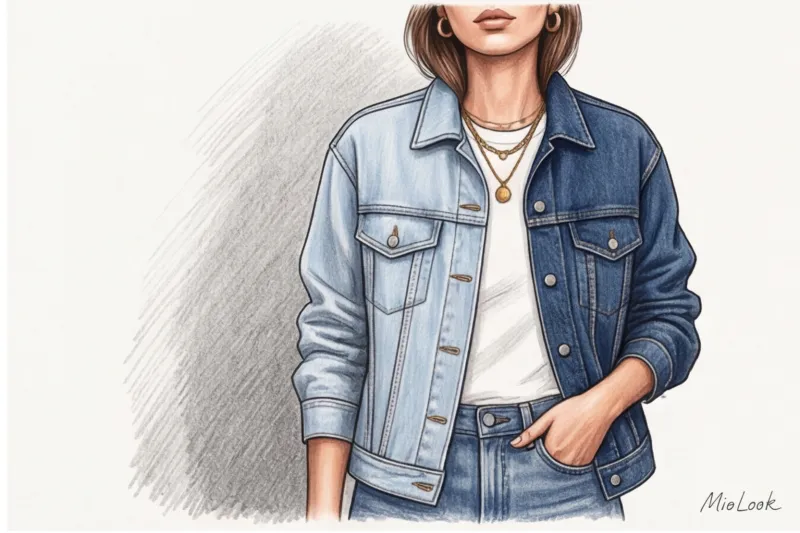
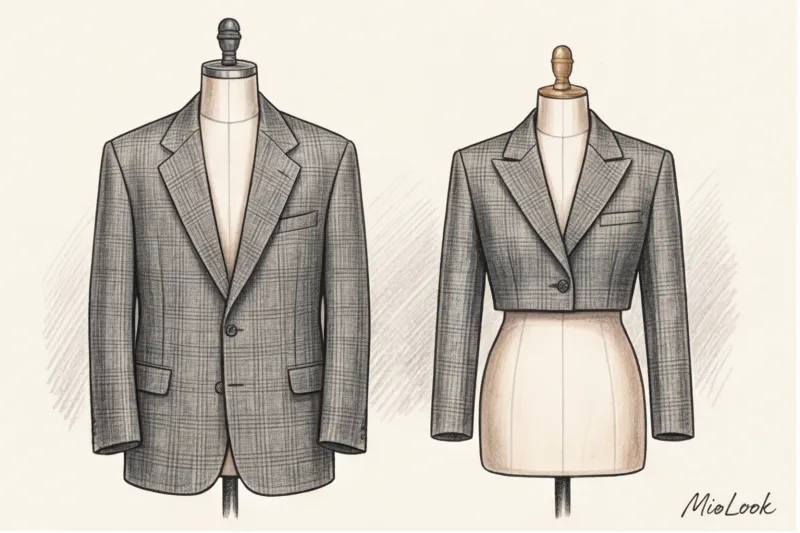
2. Architectural cut. Transforming a bulky men's blazer into a fitted cropped jacket. The secret here is to preserve the original, accentuated shoulders (the shoulder pads remain in place), but radically shorten the length and create deep darts at the waist. The result is an hourglass silhouette with an exaggerated top.
3. Minimalist deconstruction. Sometimes it's enough to simply cut off the bottom edge of a thick wool skirt or jeans and secure the edge properly. The key word is "secure." To prevent the edge from fraying further than desired, professionals use a hidden machine stitch in the same color as the fabric, 5 mm above the edge.
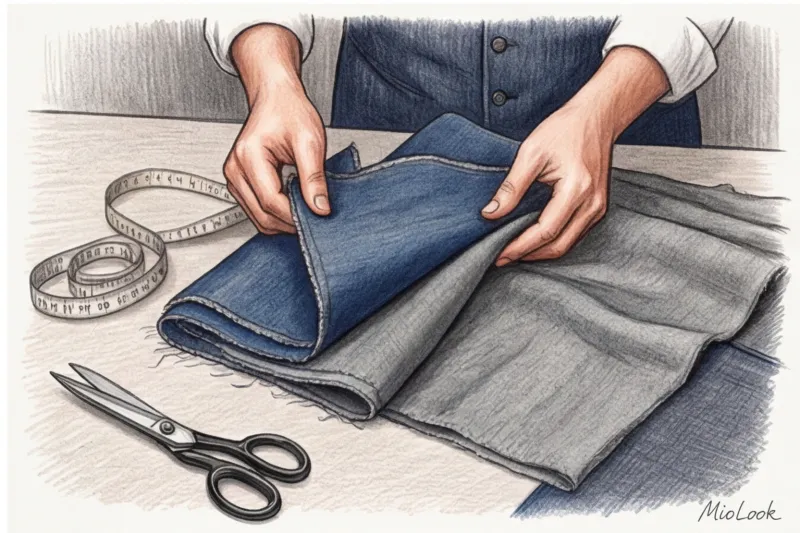
4. The "inverted cut" technique. The back of expensive items often looks just as good as the front. Linen seams (French seams), bias binding—all of these can be done on the front side of the garment. Turn the item inside out, reverse the direction of the buttons, and you've got an avant-garde wardrobe staple.
5. Integration of fittings. Replacing plastic buttons with vintage metal, horn, or mother-of-pearl ones instantly increases the price of a garment several times over. Adding large metal eyelets along the hem of a cropped hoodie transforms a sporty staple into a grunge-inspired look.
Common mistakes beginners make: how to avoid turning something into a "handmade disaster"
I once had a client come to me and tell me she wanted to remake her grandfather's luxurious vintage jacket (pure English wool!) into a modern vest. She simply cut off the sleeves with scissors. The armholes stretched, the fabric sagged, and the garment was almost ruined. I had to take it to a tailor I knew to restore its shape.
To prevent your experiments from ending in tears, avoid these mistakes:
- Ignoring the shared thread. Fabric has a direction (warp and weft threads). If, when recutting, you place the new piece off-center (just a couple of degrees off!), after the first wash, the pant leg will begin to curl around the leg, and the side seam of the shirt will fall onto the stomach.
- Excessive decoration. Rhinestones, chaotic beading, silly appliqués, and homespun tie-dye are a surefire way to look cheap. The best embellishments are clean lines and the texture of the fabric itself.
- Incorrect threads and needles. If you sew 14-ounce heavyweight denim with thin polyester thread and a #80 needle, the seam will split within a day. Each fabric requires its own sewing tool. For jeans, use a #100-110 Jeans needle and reinforced thread.
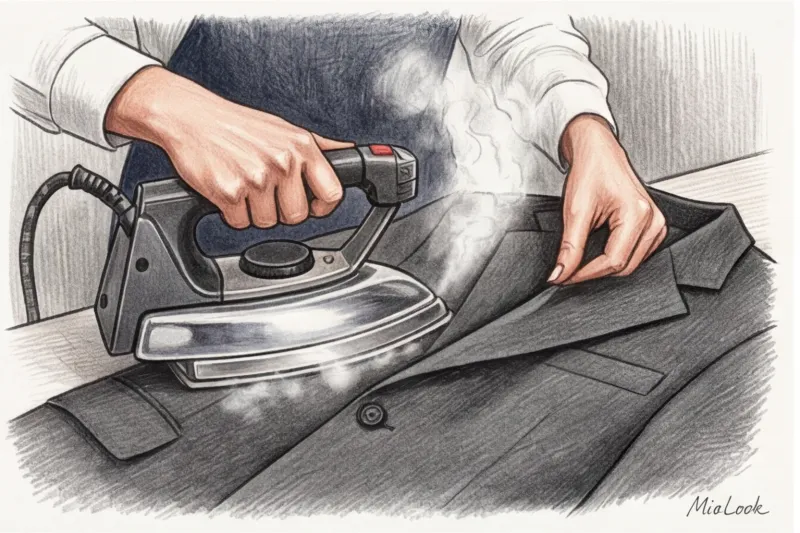
- Absence of WTO (wet heat treatment). Remember the tailor's mantra: "An iron sews better than a machine." Every single new seam should be steam-pressed. Steam-pressing ensures flat seams and a professional-looking fit. Without an iron, any alteration looks homemade.
Upcycling without a sewing machine: is it possible?
What if you don't have a sewing machine but want to alter something? At fashion shoots, stylists constantly alter the design of garments right on the models, without a single stitch.
The most powerful tool is adhesive web This is a thin hot-melt adhesive tape that's available at any sewing store. It can be used to hem trousers perfectly, shorten the hem of a skirt, or secure cuffs on jacket sleeves. Simply place the tape between layers of fabric and iron with a hot, steaming iron.
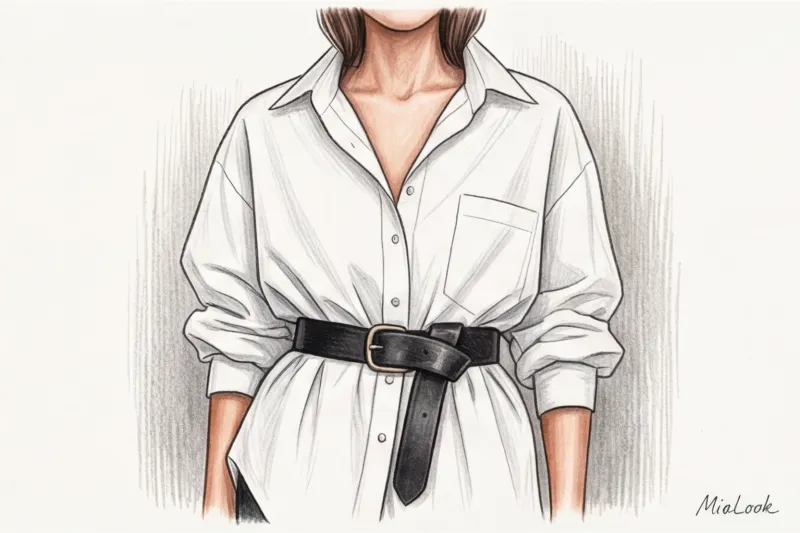
The second method is strategic draping Take an oversized men's shirt. Instead of buttoning it straight up, cross the front panels (like a kimono) and pin them to the waistband of your trousers from the inside. This will create a sophisticated, asymmetrical top with a deep V-neck.
Use harnesses, wide leather belts, and silk scarves to create new knots and change the proportions of bulky items without cutting off a centimeter.
Access to MioLook for €0.99 — one-time payment
A smart AI stylist will select the perfect look and suggest how to best style your new upcycled items.
Get access — €0.99 onceYour First Project: A Step-by-Step Plan for Remaking a Men's Shirt
For those ready to try their hand, I've put together a simple yet incredibly effective tutorial. We'll be making a designer asymmetrical blouse.
What you need: A quality men's shirt (look for brands like Eton, Ralph Lauren, or Massimo Dutti on resale platforms). Pay attention to the collar—it shouldn't be worn out.
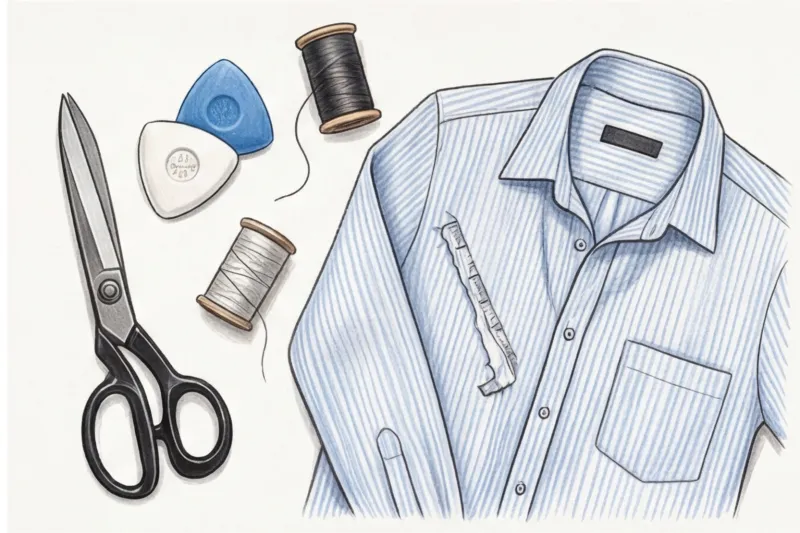
- Step 1: Fitting and marking with chalk. Put the shirt on unbuttoned. Wrap the left front over the right waist. Use tailor's chalk to mark the spot where you need to sew on a new button to create the wrap effect.
- Step 2: Remove the collar. Using sharp scissors, carefully trim the collar itself, leaving only the stand-up collar (the bottom part where the button is sewn). You can carefully fray the edge with a needle to create an even, millimeter-wide fringe. This will create a subtle grunge effect against the otherwise classic backdrop.
- Step 3: Transferring buttons. Cut all the buttons off the center placket (except the top button on the stand) and sew one main button onto the waist point you marked with chalk.
- Step 4: Wardrobe integration. Take a photo of the result and upload it to MioLook so that the neural network can immediately offer you dozens of options for combining this non-standard item with your database.
Integrating repurposed pieces into a capsule wardrobe
An upcycled garment is, by definition, a statement piece (an accent piece in a wardrobe). It draws all the attention to itself due to its unconventional cut or combined textures. Therefore, a strict balance rule.
If you're wearing a jacket spliced from two different types of denim, everything else should be as simple as possible. A basic white T-shirt made of heavy cotton, straight-leg black trousers or jeans that match one half of the jacket, and minimalist footwear (loafers or white sneakers without logos).
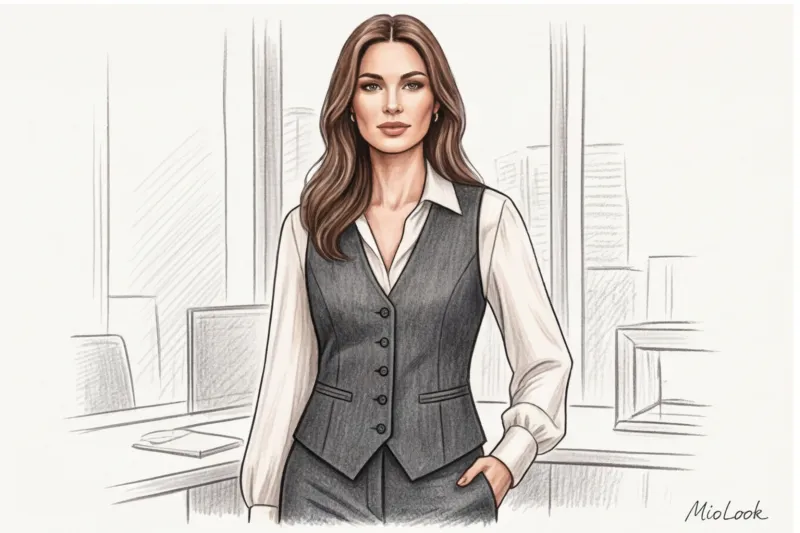
A re-purposed men's blazer, transformed into a structured waistcoat with hyper-shoulders, will fit perfectly into business casual for women Wear it over a smooth silk blouse or a thin merino turtleneck. It's perfect for a Friday night at the office where everyone wears jeans, but you want to look a little more put-together and demonstrate your refined taste.
Clothing upcycling teaches us to view things not as finished products, but as high-quality raw materials. Once you master the basic principles of fabric architecture, your wardrobe will no longer be dependent on mass-market trends. You'll begin to see the potential in ideal textures and create pieces that are impossible to find in any store.