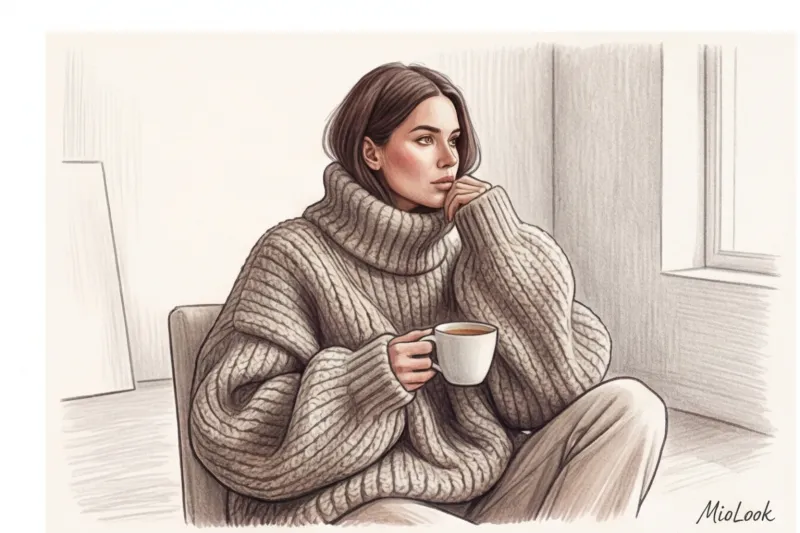
I vividly remember my initial shock at the Vetements show in Paris in 2015. Demna Gvasalia sent models down the runway in hoodies you could literally drown in and jackets with the shoulders of heavyweight wrestlers. The fashion critics in the front row raised their eyebrows skeptically: "Who would wear these bags?" But less than a decade later, exaggerated volume has become our basic uniform. We've stopped asking whether it's fashionable and started using it as a survival tool.
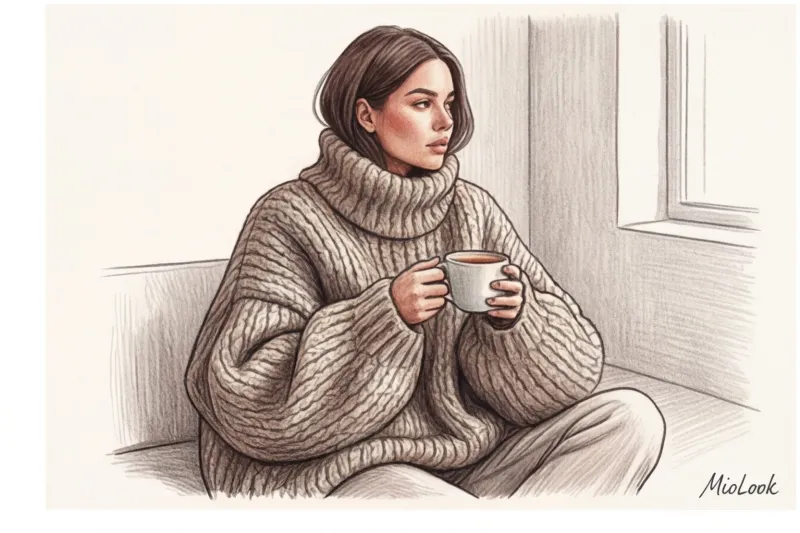
In 12 years of working as a stylist, I've realized one thing: when a client asks for "something loose, so that nothing is tight," it's almost never about trends. The Psychology of Oversized — it's not about fashion. It's about building the architecture of personal boundaries. We talked more about how our brain reacts to fabrics and silhouettes in our complete guide. The Psychology of Style: How Clothing Changes Mood and Brain Today, we'll explore a specific phenomenon: why we so desperately want to hide in meters of thick fabric.
The Psychology of Oversized: More Than Just a Fashion Trend
Oversized fashion has been a staple on the catwalk for a record number of seasons. This isn't due to a lack of imagination on the part of designers, but to the state of society. Our brains interpret clothing not just as a piece of fabric, but as a set of behavioral instructions.
In 2012, Northwestern University researchers Hayo Adam and Adam Galinsky coined the term Enclothed Cognition (the "clothed cognition" effect). They proved that clothing directly influences human cognitive processes. When you wear something that doesn't physically restrict your movement, the brain receives the signal: "I'm safe; I don't need to be on guard."
But it's important to draw a line here. Oversized isn't simply buying a sweatshirt three sizes too big at Zara's men's department. True, architectural oversized (the kind championed for decades by Maison Margiela, COS, and The Row) is a thoughtful cut. The shoulder seam may be dropped, but the armholes are calibrated to the millimeter, allowing you to raise your arm. When a garment is simply too big, it looks sloppy. When a garment is cut oversized, it makes a statement.
The Cocoon of Safety: Why We Physically "Hide" from the World
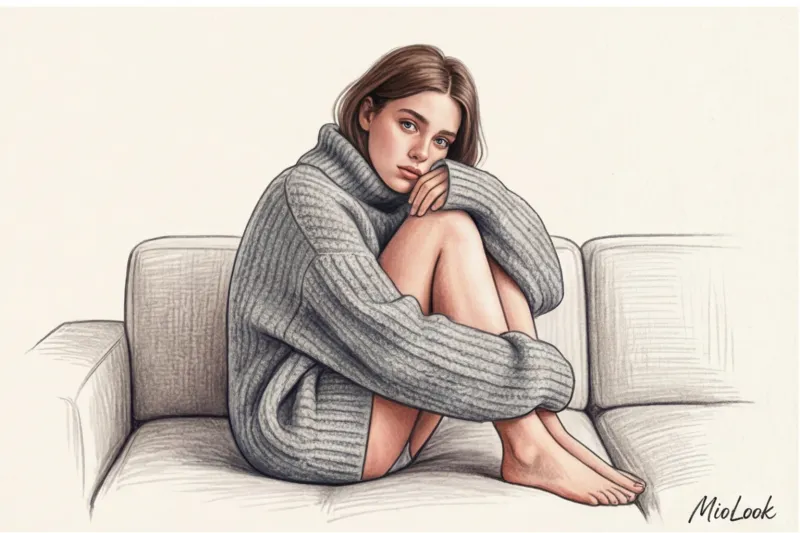
The modern metropolis is an aggressive environment. Constant sensory overload, phone notifications, deadlines. In this reality, clothing takes on the function of a portable home.
"During periods of intense stress, the psyche seeks regression—to a state of childhood where we were protected. A large, chunky knit sweater subconsciously mimics a hug or a heavy blanket, calming the nervous system."
In my practice, this is very evident. As soon as a client experiences burnout at work or a personal crisis, belts, stiff trouser waistbands, and fabrics with added elastane (the so-called bodycon silhouette) are the first to disappear from her wardrobe. A study by the global trend bureau WGSN (2023) confirms this at the macro level: the pandemic has forever changed our tolerance for discomfort. The shift to a 'comfort-first' paradigm has become irreversible. We are no longer willing to tolerate a belt digging into our stomachs for the sake of a flattering silhouette.
Access to MioLook for €0.99 — one-time payment
A smart AI stylist will create the perfect look based on your comfort and aesthetic needs. Create your perfect capsule wardrobe without the stress.
Get access — €0.99 onceRefusal of objectification and protection from the "male gaze"
One of my clients, Anna, is the CTO at a large IT company where 90% of the staff is men. She showed up for our first consultation wearing a shapeless gray hoodie and baggy jeans. "I don't want anyone judging my bust size or waist size at board meetings. I want them to listen to what I have to say," she explained. (By the way, you can read more about such scenarios in the article How to Dress as a Girl in IT: From Hoodies to Smart Casual ).
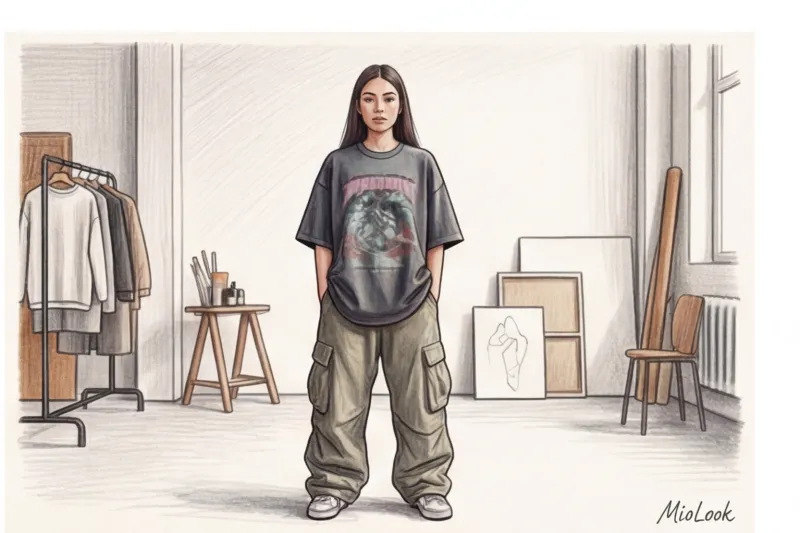
This is a brilliant illustration of how oversized clothing operates on a social level. By concealing the body's contours, we regain control over it. I decide who, when, and to what extent sees my curves. The Billie Eilish phenomenon at the beginning of her career was built on precisely this: her baggy Gucci suits were a manifesto of desexualization. In a world where women's bodies are constantly judged, exaggerated volume becomes an invisibility cloak, shifting the focus from physiology to personality.
The Illusion of Control: The Main Stylistic Mistake in Body Shaping
Now it's time to bust the biggest myth that 9 out of 10 women believe. As a stylist, I say: shapeless, baggy clothes does not hide excess weight On the contrary, it visually adds 5 to 10 kilograms to your weight.
Why does this happen? Here, the physics of optics conflicts with our psychology. When you put on a thin knit robe to "hide your belly," you feel safe because the fabric doesn't press against your skin (tactile comfort). But the human eye perceives the silhouette by the extreme points of the fabric. If your tunic hangs straight from the widest point of your chest, others perceive this entire volume as your body. You become a monolithic cube.
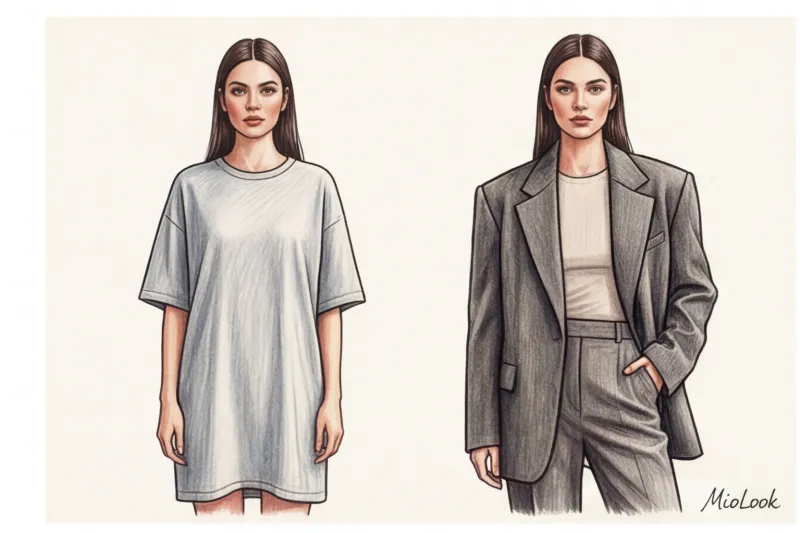
In the psychology of style, there is a clear line between “diagnostic clothing” (when low self-esteem and a desire to disappear are hidden behind shapeless clothes) and “statement clothing” (conscious, fashionable oversize).
How to wear volume without becoming invisible
To make oversized clothing work for you, not against you, use three rules tested on hundreds of wardrobes:
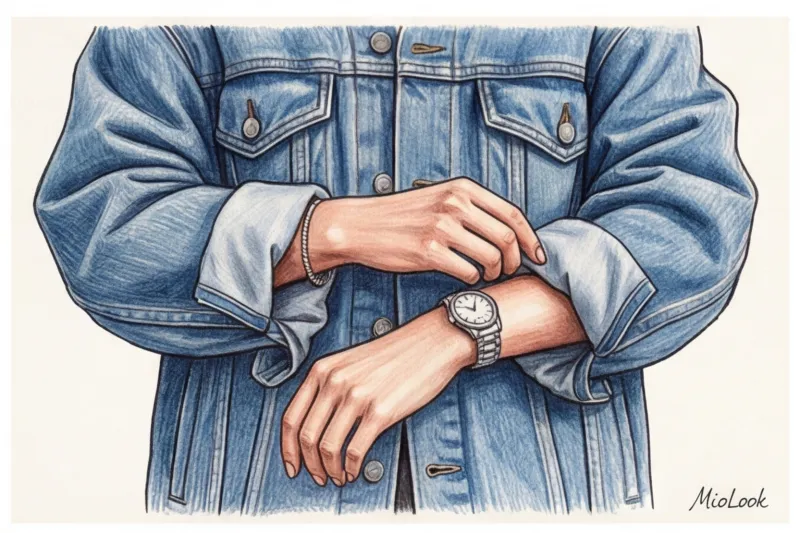
- The rule of balance (demonstration of fragility). Oversized clothing should contrast with your body. Roll up the sleeves of a voluminous jacket to reveal slender wrists. Wear cropped trousers that reveal your ankles. Unbutton the top buttons of your shirt, revealing your collarbones. The observer's mind should see, "Underneath this enormous volume lies a fragile person."
- The hard texture saves everything. An oversized jacket made of thick wool (from 300 g/m²) or a jacket made of stiff denim hold their own shape, creating a frame around your body. But an oversized cardigan made of thin viscose will simply sag limply, highlighting every wrinkle you tried to hide.
- The "cabbage" method. Layer a voluminous piece over a fitted base layer (for example, a loose shirt over a thick top), leaving the top layer unbuttoned. This creates two vertical lines that visually elongate and slim the silhouette.
Your perfect look starts here
Join thousands of users who look flawless every day with MioLook. AI will help you balance proportions in any style.
Get access — €0.99 onceThe exaggerated silhouette as a symbol of power: to take up more space
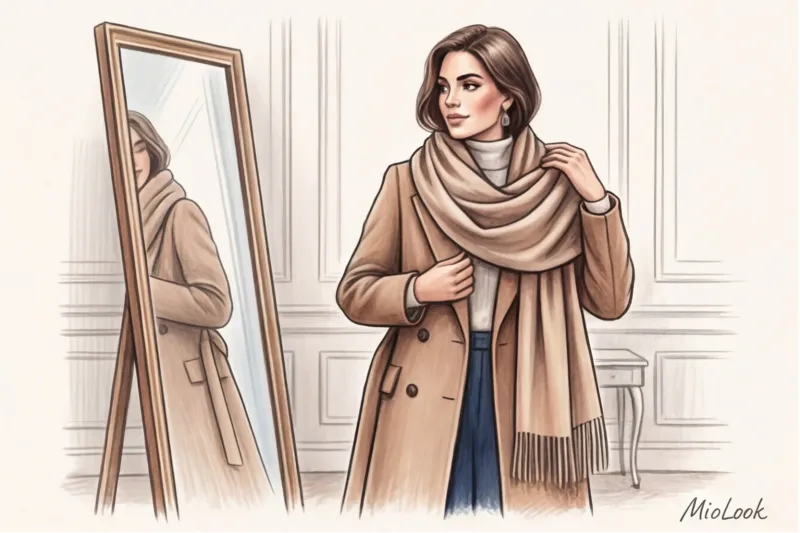
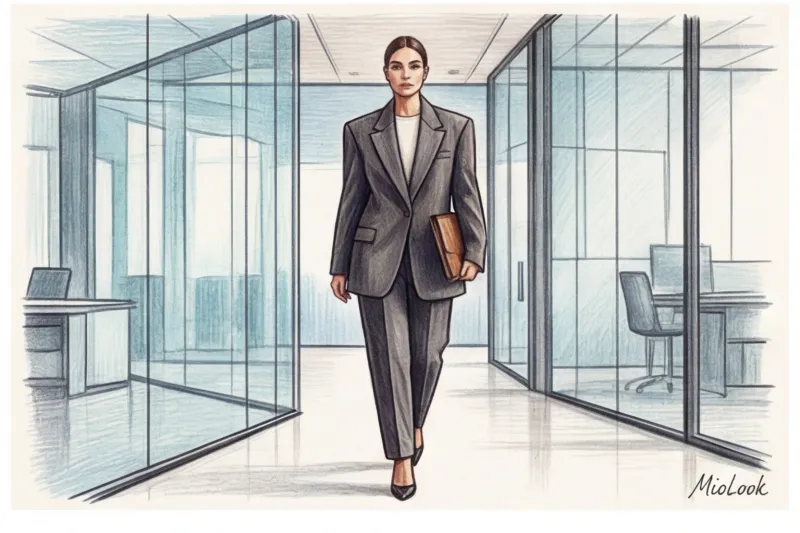
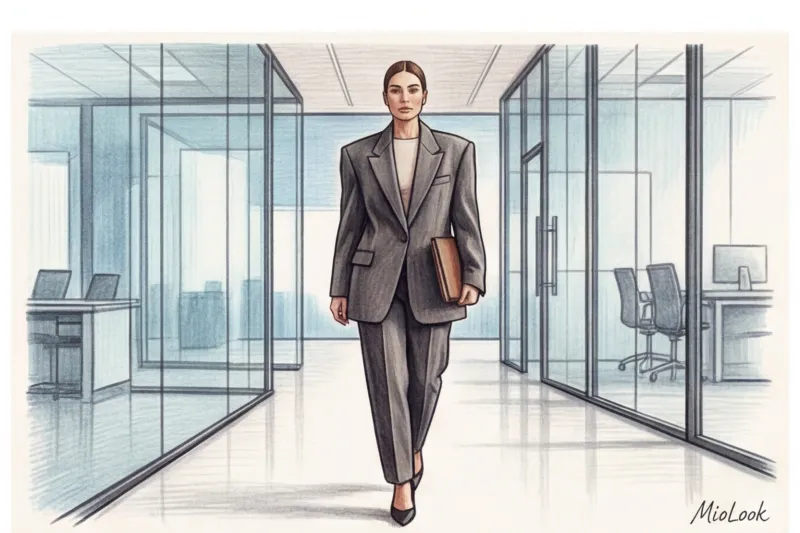
The paradox of oversized clothing is that it can be not only a cocoon for hiding, but also an aggressive instrument of dominance. Think of the power dressing of the 1980s: the shoulders of the Giorgio Armani jackets worn by female brokers as they conquered Wall Street. Broad shoulders have historically been associated with male strength and status.
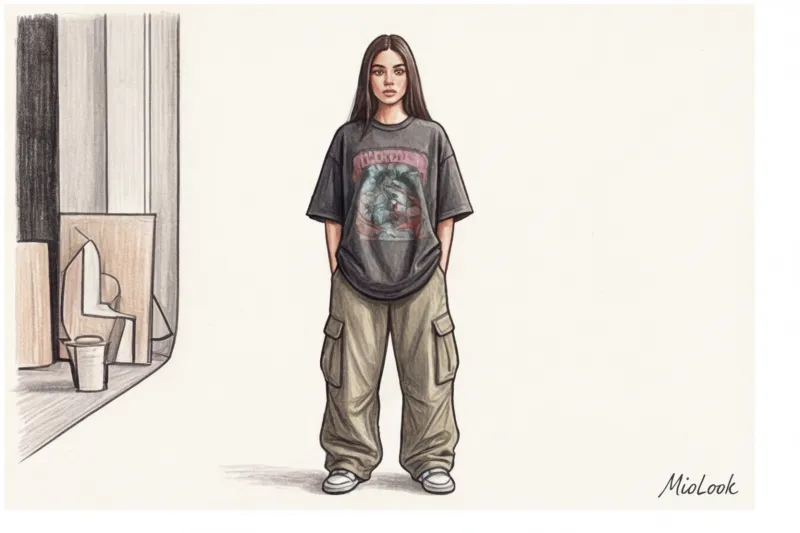
Today, this technique has evolved. By wearing a jacket with exaggerated shoulders (like those from The Frankie Shop or Saint Laurent) or a voluminous double-breasted coat, you physically take up more space. Your gait changes, and your range of motion becomes wider. For women with the Ruler archetype, this is the perfect way to convey authority without having to raise your voice. It's a great technique for creative business style , where a classic formal suit would look too boring.
Checklist: Is your oversized look stylish armor or a symptom of anxiety?
How do you know where style ends and psychological avoidance begins? Take an honest inventory of your closet. If 90% of it consists of shapeless knitwear in neutral shades, it's time to ask yourself a few questions.
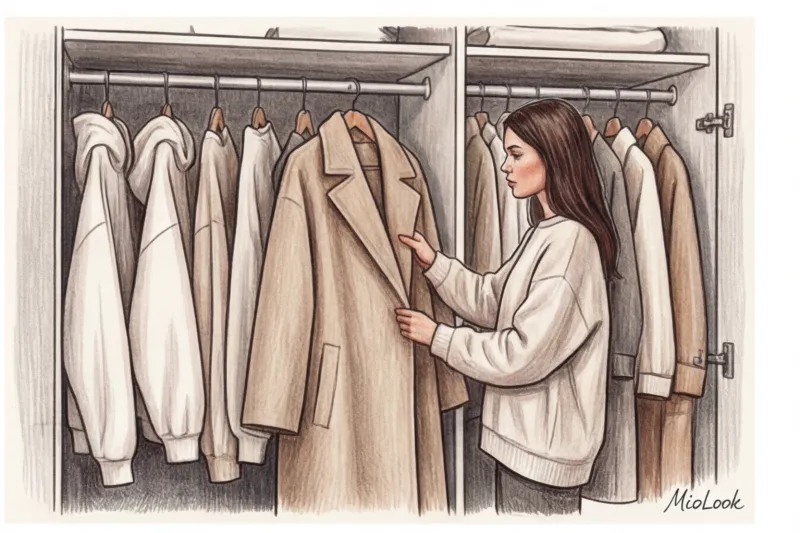
Before buying another item three sizes too big, ask yourself:
- Am I buying this because I like the architecture of the thing, or because I don't want to feel my body?
- How will this thing change my posture? (Spoiler: Heavy, shapeless hoodies often make us slouch, while a structured, oversized jacket flatters our shoulders.)
- Are there things in my wardrobe that show who I really am?
Important disclaimer (when this does NOT work): As a stylist, I never force clients to switch to form-fitting clothing if they're experiencing acute body dysmorphia, severe stress, or postpartum. Clothing shouldn't be an instrument of self-abuse. If you need a cocoon right now, wear one.
But if you feel ready for a gentle step out of your comfort zone, start small. Swap out your soft, baggy cardigan for a straight-cut jacket. Keep your wide-leg pants, but pair them with a fitted top. Swap out your hyper-oversized top for a tailored fit. relaxed fit (semi-fitted silhouette, 2-3 centimeters of air remains between the body and the fabric).
Oversized clothing is a brilliant invention of the fashion industry. It can give you a sense of security, elevate your status, or act as a shield from prying eyes. The key is to ensure you're in control of your size, rather than it slowly erasing you from reality.