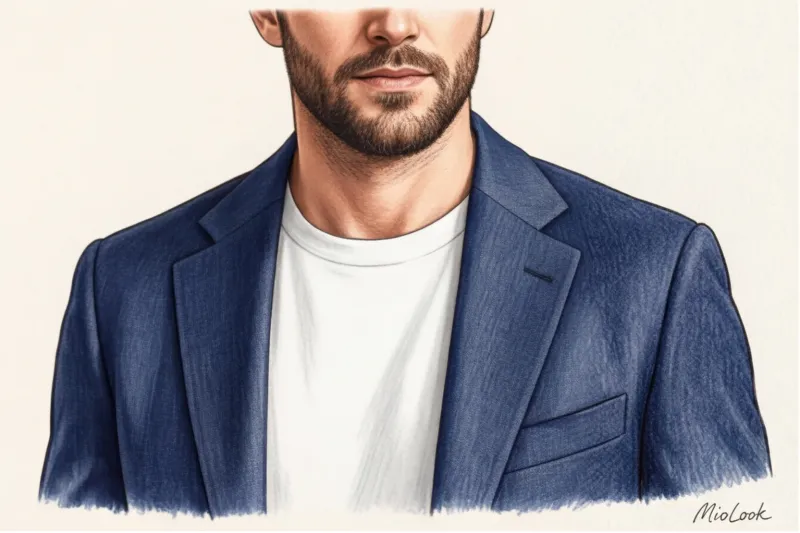
You know what gives away a man's cheap look the fastest? No, not his shoes. And not even his watch. It's the sagging collar of his T-shirt, peeking out from under his expensive jacket. In 12 years of working as a personal stylist, I've learned one ironclad rule: a man can wear an impeccable Tom Ford suit, but if he's wearing a shapeless rag underneath, the whole pretense of status crumbles like a house of cards.
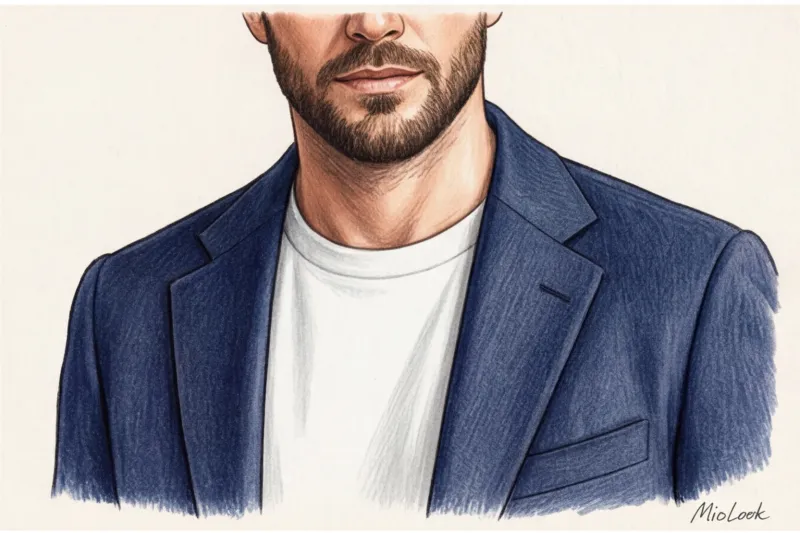
For many men, a basic T-shirt is a consumable item. Bought in bulk, worn until holes are found, and then discarded without regret. But let's face it: it's the foundation of your everyday style. And if we approach choosing a suit like an architectural project, why do we treat knitwear with such disdain?
In this article, I won't be giving you boring "top 10 brands" lists. We'll take a different approach. I'll teach you how to read labels like a textile technologist, understand the density metric (GSM), and find the perfect cut that visually broadens your shoulders and camouflages your belly. We've covered how these elements come together in more detail in our A complete guide to creating a basic wardrobe for men without mistakes.
The Anatomy of the Perfect Basic: Why the Right Basic Men's T-Shirt Is Worth the Investment
Let's draw a clear line: there's undershirt (underwear) and outerwear (a separate item of clothing). An undershirt is designed to absorb sweat under a shirt. It's thin, often translucent, fits snugly, and has a low neckline. Wearing one alone is a stylistic crime.
I once had a client (let's call him Alexander), an entrepreneur in the IT sector, approach me. His wardrobe consisted of fifteen identical black T-shirts, each priced at €15. After three hours of wear, they hung on him like wet paper, highlighting every detail of his figure. We replaced this stash with three perfectly tailored T-shirts made of premium Egyptian cotton, priced between €60 and €80. The result? A completely different silhouette. The fabric held its shape, his shoulders appeared broader, and his look acquired that signature "quiet luxury."
According to WGSN research (2023), the average man wears only 20% of the items in his closet 80% of the time. And the right basic T-shirt is always included in that 20% because it's comfortable.
The psychology of status is simple: neatness = confidence. An unkempt, stretched-out collar ruins even the most expensive look with designer jeans and limited-edition sneakers.
Thick Cotton and the Magic of GSM: How to Read Labels Like a Pro
The label on a €10 T-shirt and a €100 T-shirt almost always says the same thing: "100% cotton." But they look and feel like they're from different planets. Why? The secret lies in the GSM (grams per square meter) measurement.
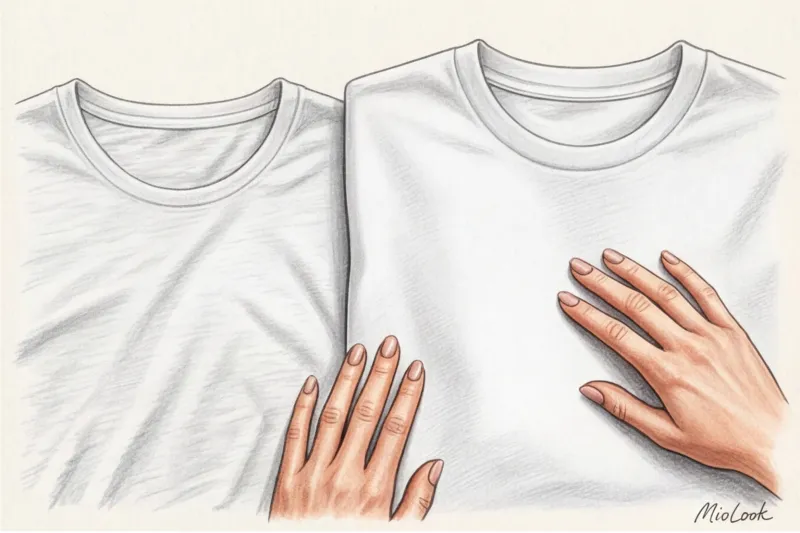
Mass-market brands hate this figure and almost never mention it. Their standard is 120–140 g/m². This is the finest knitwear, which saves millions of euros on production, but mercilessly highlights any fold on the stomach and instantly loses its shape.
Your perfect look starts here
Join thousands of users who look flawless every day with MioLook. Digitize your wardrobe and create looks in one click.
Get access — €0.99 onceGold standard density (180-250 g/m²)
For a men's T-shirt, the ideal GSM starts from 180 and goes up to 250 g/m². This is a dense fabric that falls in straight lines without clinging to the body. I recently conducted a personal crash test: I washed 20 T-shirts from different price ranges 20 times each. Models with a density below 160 GSM lost their original appearance after just five washes (the side seams became warped).
How can you determine the density right in the store? Do the "light test." Put your hand inside the T-shirt: if you can clearly see your skin tone through the fabric (especially white), return the item to the hanger. It's underwear, not a base layer.
Supima, Pima and Mercerized Cotton: What's the Difference?
The quality of the yarn is everything. If the cotton is carded, it consists of short fibers that will quickly form pilling. Look for combed cotton, or even better, Pima or Supima. These are long-staple cottons that are incredibly smooth to the touch and last for years.
And if you need a status item to go with your jacket for an evening event, choose mercerized cotton This chemical treatment removes fuzz from the threads, giving the fabric a light, luxurious silky shine.
Cut Architecture: How the Right Fit Transforms Your Figure
Bespoke tailors on London's Savile Row say, "Knitwear should obey the rules of tailoring." Italians call this effect sprezzatura — casual elegance. The secret is that the garment should delicately cling to the arms and chest, but flow freely through the stomach area.
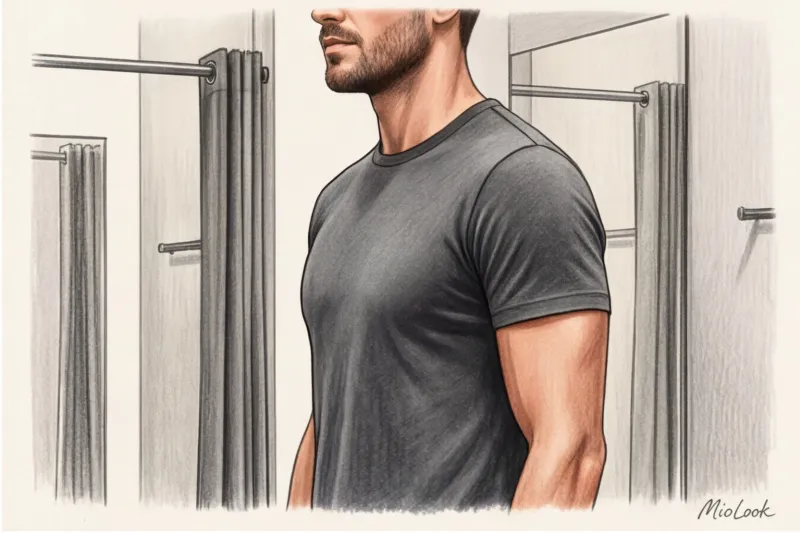
Have you heard of tubular knit? Historically, classic T-shirts were knitted in a tube shape without side seams on special loopwheel machines. They don't twist after washing. But there's a fair limitation: seamless cut is not suitable for everyone Because of the lack of side seams, this T-shirt cannot be tailored to a fitted shape. If you have a prominent belly, the tubular knit will create a boxy shape around you. In this case, it's best to choose a classic, slightly tapered fit.
Shoulder line and ideal sleeve length
The shoulder seam should lie flat on the acromion. If it falls any lower, it's oversized. If it rises any higher, the shirt is too small, and you look like you're wearing your little brother's clothes.
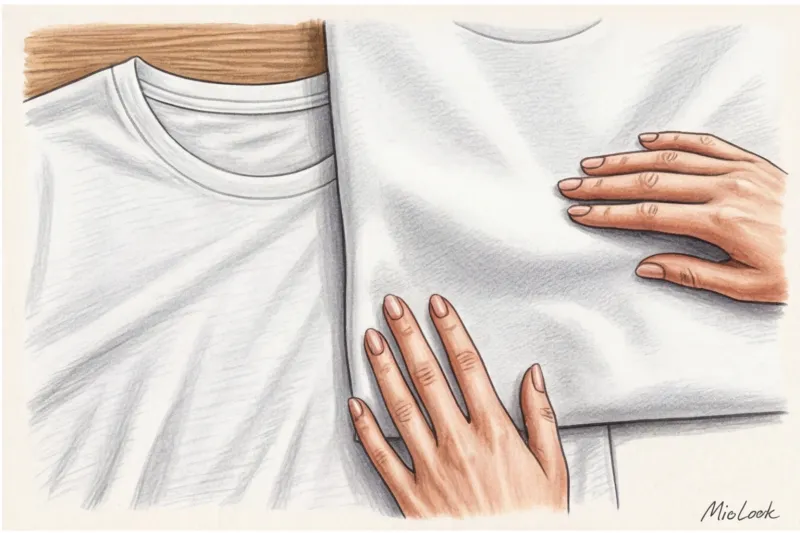
Sleeve length is a critical detail. The right sleeve ends exactly halfway up the bicep and fits snugly. Sleeves that are too long and wide visually reduce the volume of your arms, making them appear thinner.
The length issue: tuck in or wear loose?
The golden rule of length: the bottom of an untucked t-shirt should end exactly halfway down your pants (or at the hipbone). Too short and you'll expose your midriff when you reach for a cup of coffee. Too long and it will dramatically distort your proportions, visually shortening your legs and elongating your torso.
A collar that won't stretch out after a month
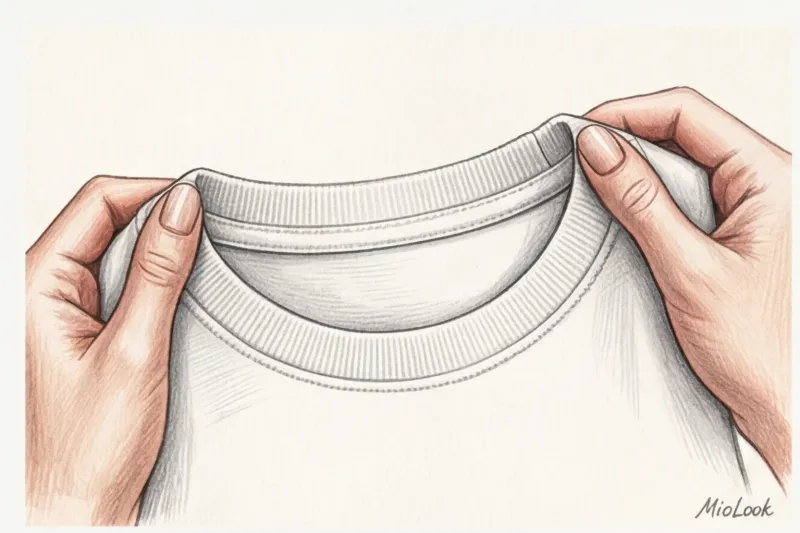
The collar is the face of the T-shirt. Its width (the width of the binding) should ideally be between 1.5 and 2.5 cm. Narrower collars look feminine, while wider collars evoke a retro '90s style.
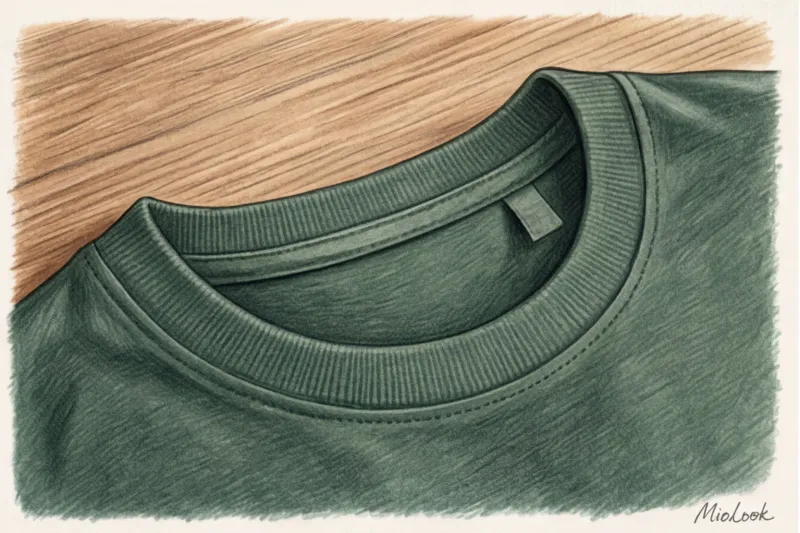
A little styling trick for the fitting room: pull the collar in opposite directions with two fingers and release. A good rib neck fabric containing 2-5% elastane will instantly return to its original shape. If it's wavy, the item won't last a season.
Another key indicator of premium quality is a reinforced shoulder seam. Look inside: it should run from shoulder to shoulder through the neckline at the back. twill tape (twill tape). It prevents the fabric from deforming when the T-shirt is hanging on a hanger.
The biggest myth: "A basic men's T-shirt must be white."
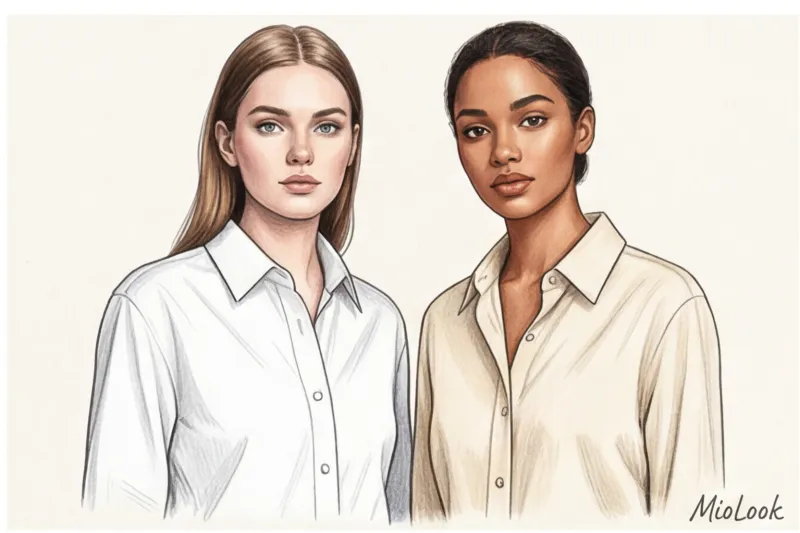
For years, we've been taught to buy basic white t-shirts in packs of three. It's time to break that stereotype. Pure white is a powerful contrast that doesn't suit everyone.
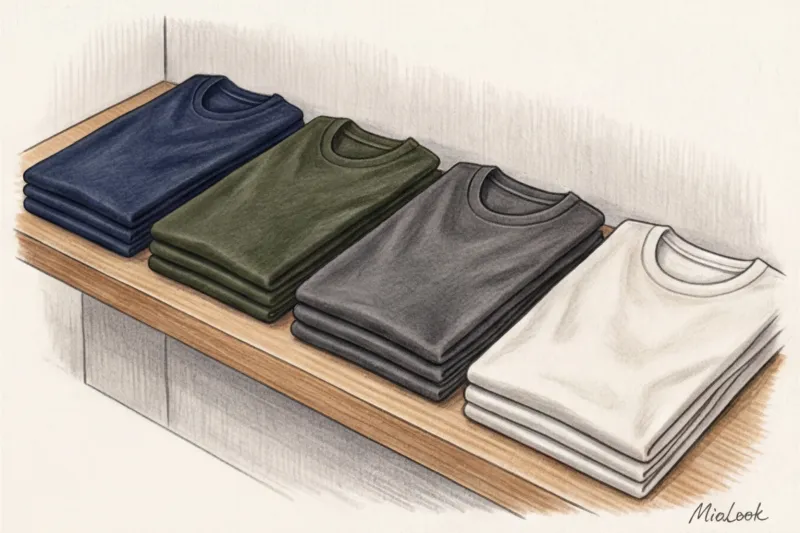
If you have fair skin with a pinkish undertone (typical for northern regions), blinding white will make your face look pale and unhealthy. Furthermore, 100% white mercilessly reveals any flaws in the cut and the slightest transparency of the fabric.
What to choose instead?
- Ivory (Off-white) / Ecru - a softer, more expensive shade of white that doesn't look like lingerie.
- Deep blue (Navy) — an absolute favorite for men. It's slimming, looks classy, and pairs perfectly with any jeans.
- Charcoal - a great alternative to black that doesn't make your face look tired.
- Khaki / Olive - Works great in military or safari styles, especially for men with warm skin tones.
Access to MioLook for €0.99 — one-time payment
A smart AI stylist will create the perfect look for you. Analyze your wardrobe and create stylish capsule collections in one click.
Get access — €0.99 onceStylistic Formulas: Integrating a T-Shirt into Your Wardrobe
A heavy cotton T-shirt is a powerful tool for creating a "quiet luxury" effect. You can add your new purchases to your virtual wardrobe via MioLook app Let AI help you create your daily looks. Here are two of my favorite fail-safe formulas:
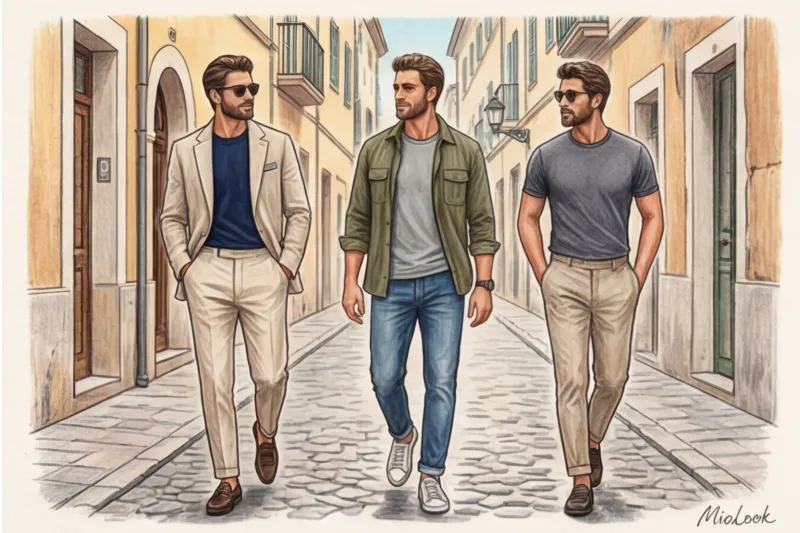
Formula 1 (Smart Casual): A crisp navy T-shirt + an unstructured blazer (without the stiff shoulder pads) + chinos + suede loafers. This is a classy relaxed look that's perfect for an informal meeting, a restaurant, or a Casual Friday office.
Formula 2 (Weekend): A khaki T-shirt + a heavy corduroy or flannel overshirt + dark, unworn denim + Chelsea boots. Layering always adds complexity and a more sophisticated look.
Important rule: Never wear a T-shirt with a classic, tailored suit made of fine worsted wool. It doesn't look fashionable, but rather like you forgot to put on a shirt. A T-shirt pairs well only with suits made of cotton, linen, or thick, textured wool.
Pre-purchase checklist: test drive in the fitting room
Never buy a T-shirt just because it hangs nicely. Knitwear needs to be tested in motion.
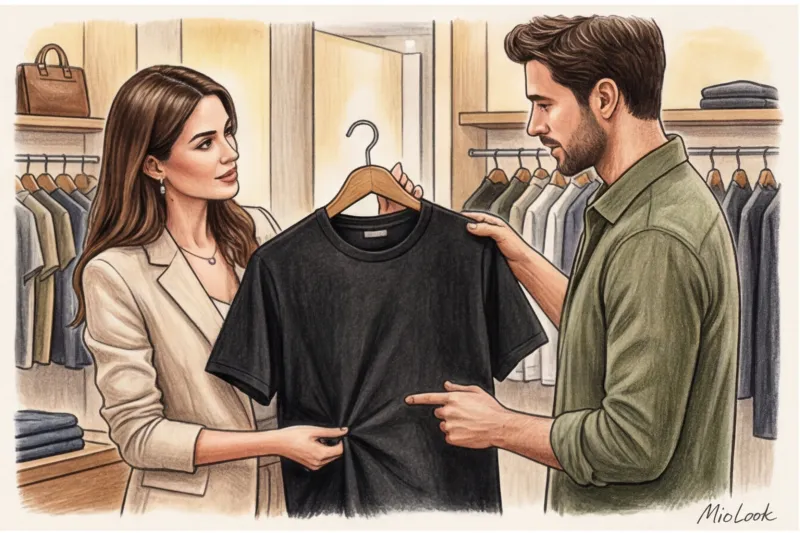
- Freedom of movement test: Raise your arms up as if you were reaching for a book from a high shelf. Is your stomach exposed? If so, look for a long-line style (slightly longer).
- Tension test: Sit on the ottoman in the fitting room and relax. Is the fabric tight around your stomach? High-quality, thick cotton shouldn't feel like a second skin when you change positions.
- Visual inspection: Check the transparency under harsh lamplight. Are the contours of the body visible? (This is especially critical for light shades.)
- Checking the seams (Leg twist): Look at the side seams. If they're not perfectly vertical before washing, but curl back or forth in a spiral, that's a design flaw. After washing, such a T-shirt will be completely crooked.
Invest time in finding "the one." When you find the perfect fit, the right cotton, and the right collar, your everyday style will reach a whole new level of comfort and elegance. Don't skimp on the basics—they're the foundation on which your entire wardrobe is built.