I remember this incident from 2018 vividly. A client sent me a link to a "perfect linen shirt" for €45. In the studio photo, the item fit the model perfectly: not a single wrinkle, a stiff collar, and a perfect geometric shape. But my 14 years of experience as a stylist literally screamed, "Stop." Natural linen physically couldn't look that smooth under the hot studio light, unless it was plastic. We zoomed in, zoomed in on the photo, and bingo—the composition listed was 100% polyester. That's when I realized that the skill... How to determine the quality of clothing online , is not just shopping, it is real visual forensics.
We have already discussed the psychology of digital consumption in more detail in our The complete guide to buying clothes online without returns , but today we'll put theory aside. We'll learn to read pixels, studio shadows, and creases in motion to recognize cheap fabric cleverly hidden behind professional retouching.
E-commerce Illusions: How to Determine Clothing Quality Online When Photos Lie
According to Shopify's 2023 global report, 30 to 40% of all returns in the fashion sector are due to the fact that "the item doesn't look like the picture in real life." Tactile expectations are shattered by the harsh reality of thin knits and crooked seams. Why does this happen? Because the "model syndrome" (clothes are tailored for a height of 175 cm+) is always accompanied by "studio lighting syndrome."
I often see the same trick behind the scenes of commercial shoots for major marketplaces. Harsh, directional lighting (so-called hard light) works wonders: it literally "floods" the loose texture of a cheap €20 sweater, making it appear dense and expensive on the camera's sensor. The main rule to remember: when you're shopping online, you're not buying a pretty picture of a girl, but specific patterns and materials.
Access to MioLook for €0.99 — one-time payment
A smart AI stylist will select the perfect look based on your preferences.
Get access — €0.99 onceOn-site stylist secrets: pins, clips, and a steamer
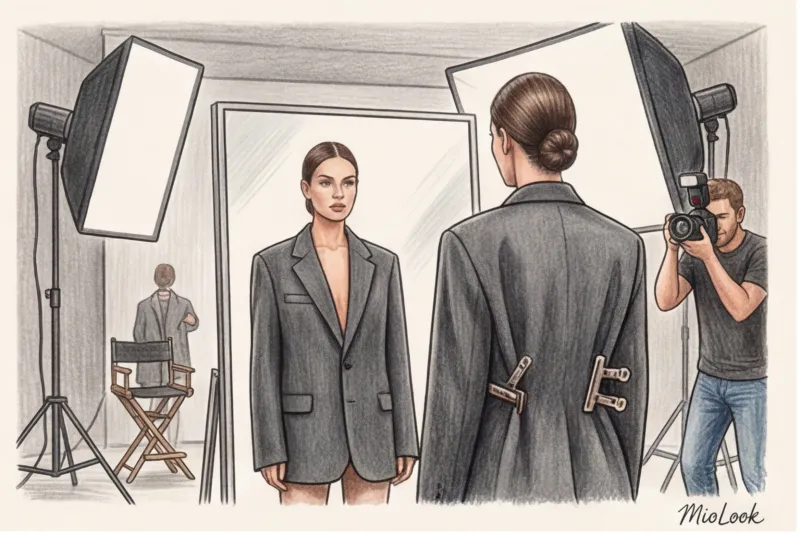
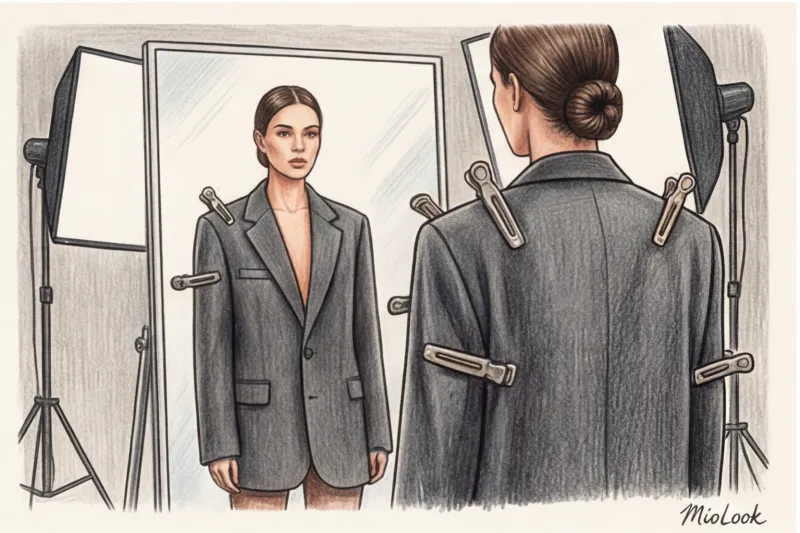
No mass-market jacket fits a person exactly like it does in the product photo. If you see a shapeless, oversized blazer that magically accentuates the model's waist, mentally glance behind her.
- Stationery clips: Stylists use heavy metal "bulldogs" to pull excess fabric down the back. This creates the illusion of an architectural cut. This trick can be recognized by the unnatural tension of the fabric over the shoulders or the horizontal folds under the arms.
- The magic of a steamer: On the model, clothes never have natural creases because an assistant with a hand-held steamer runs up to her before each with the click of the shutter.
- Double-sided tape: Deep necklines and unruly lapels are firmly fixed to the skin with invisible tape.
The Anatomy of a Zoom: Exploring Macro Texture
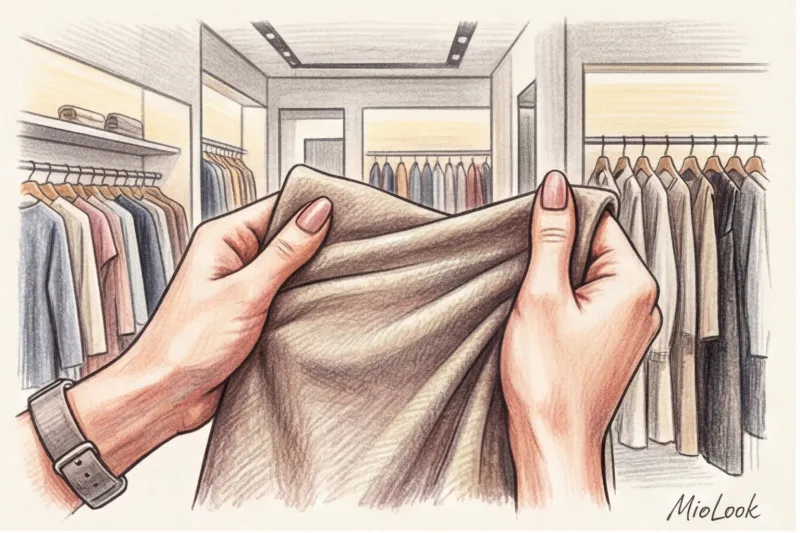
Your main tool in any online store isn't the shopping cart, but the screen magnifier. Enlarging an image typically gives a magnification of 300–400%, which is enough to clearly see the thread count.
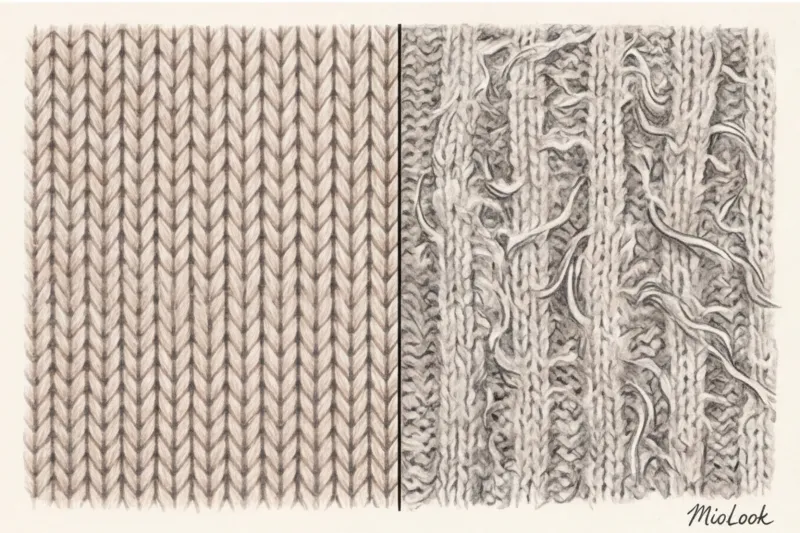
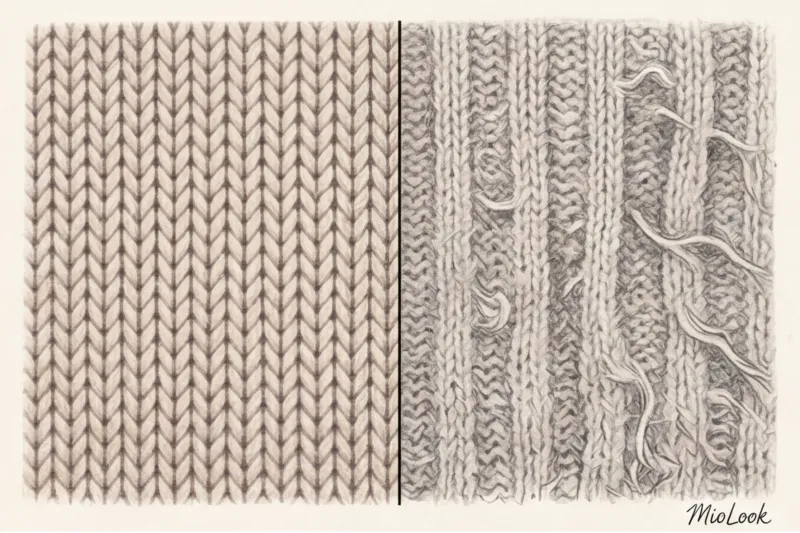
How can you distinguish the fine fuzz of expensive cashmere from the loose fuzz of cheap acrylic? Look closely at the sleeve outline against a white background. High-quality wool produces a neat, short, and even halo. Cheap acrylic or low-twist polyester creates a "dandelion effect"—long, randomly standing hairs of varying thickness. If you see this halo on a new sweater, rest assured: after two weeks of wear, it will become covered in dull, stiff pilling.
Diagonal and ribbed: markers of quality suiting fabrics and denim
If you're looking for basic trousers or quality jeans, look for diagonal creases in the photo. Twill weave is a distinct, visible diagonal structure of the fabric. The more distinct and dense this "rib" is in a macro photograph, the more durable the garment will be. On paper-smooth, budget fabrics, this diagonal creasing is almost impossible to see.
"Always look at photos of the model against a light source (for example, near a window). If the silhouette of the legs is visible through the fabric of the suit pants, the manufacturer has skimped on density, using a material less than 150 g/m², which will stretch out at the knees on the first day."
Your ideal image begins Here
Join thousands of users who look flawless every day with MioLook.
Get access — €0.99 onceWhat Dynamics Say: Video Walkthrough as a Fabric Quality Detector
If a product listing includes a video, ignore the photo and watch it only. Dynamic testing is the only way to assess the fabric's weight and physical properties before purchasing.
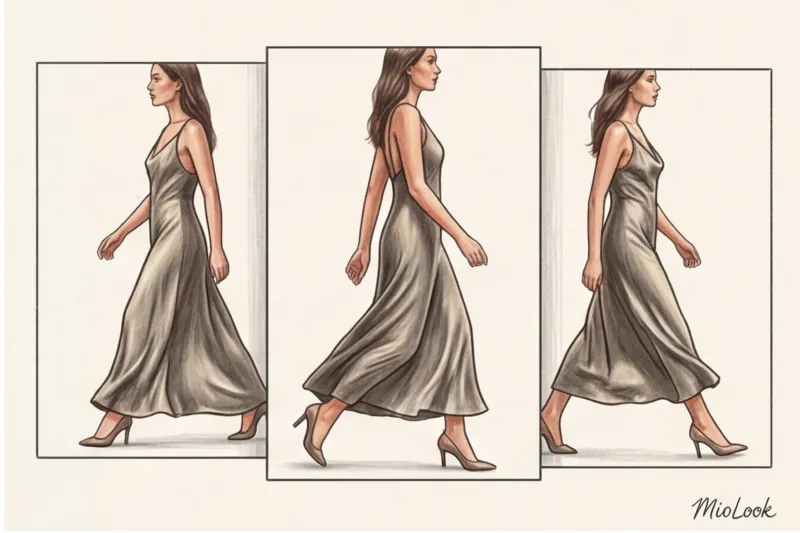
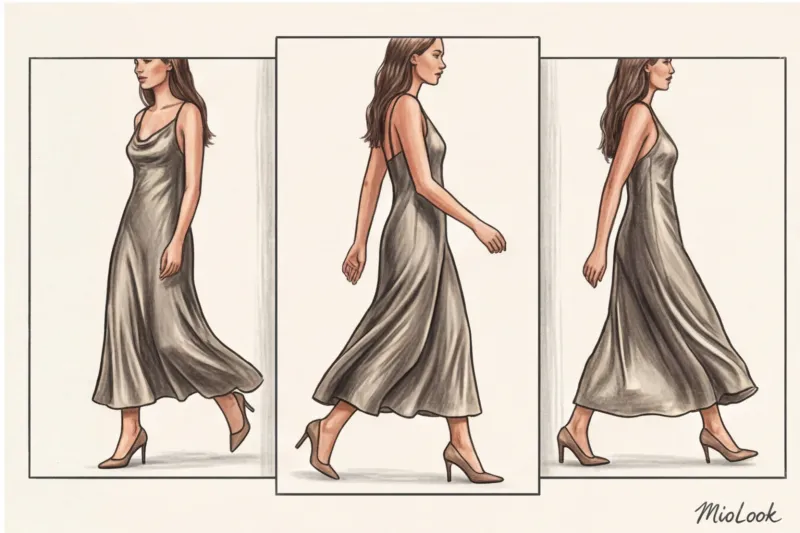
In my practice, I always ask my clients to pay attention to the "flow" effect versus the "cardboard" effect. Heavy, high-quality silk or viscose fall under their own weight, like water. They flow. Cheap polyester, on the other hand, suffers from static electricity—it gets stuck between your legs when you walk, sticks to your tights, and bulges unnaturally. By the way, if you're wondering... Is it hot to wear silk in the summer? , the answer directly depends on its density and how it fits the body in motion.
Do the "shape return" test: carefully watch the moment in the video when the model stops and poses. High-quality fabric instantly returns to its original shape. Cheaper fabric "remembers" creases in the groin area or elbows, even during the five seconds the video lasts.
The Myth of 100% Natural Ingredients: When Synthetics Improve Quality
We're used to scrutinizing labels like "100% cotton" or "100% wool." The eco-trend has taught us to demonize any chemicals. But I'm about to say something that might outrage fashion purists: for a basic, everyday wardrobe, 100% natural ingredients are often a disaster.
Pure cotton fades after five washes. A 100% linen suit wrinkles before you even get from the hallway to the washing machine (about that, How to choose linen that won't wrinkle , I talked about this separately). 100% wool is itchy and deforms.
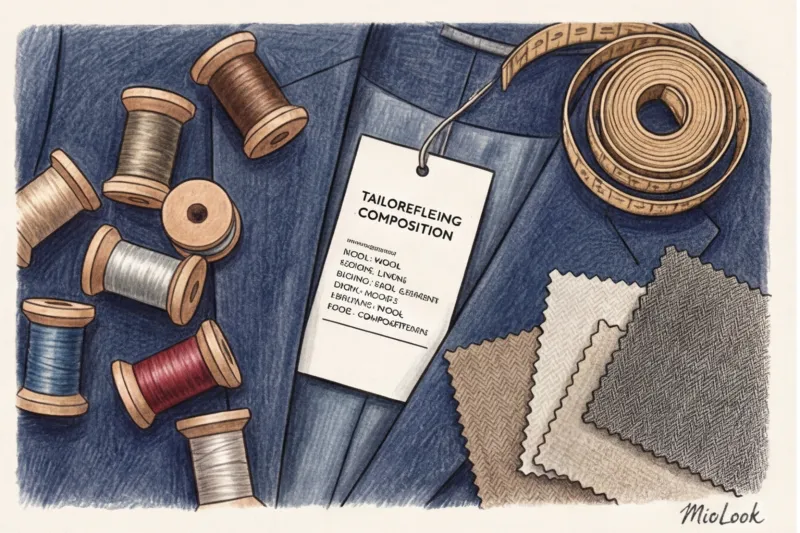
The secret to a classy wardrobe lies in the right proportions. According to a WGSN study (2024) on high-tech materials, it's the addition of 5-15% synthetics that makes a garment durable. If you're buying business trousers in the €100-€150 range, look for 2-5% elastane and around 10-15% polyester or polyamide. This "synthetic reinforcement" will prevent your knees from sagging after eight hours of sitting in an office chair.
Ready to get started?
Try MioLook's free plan—no commitments or card required.
Get access — €0.99 onceSeam Blind Spots: How to Determine the Quality of Clothing Tailoring from Photos
Even if the fabric is magnificent, poor tailoring will give away a budget item. And these flaws can be seen on a computer screen if you know where to look.
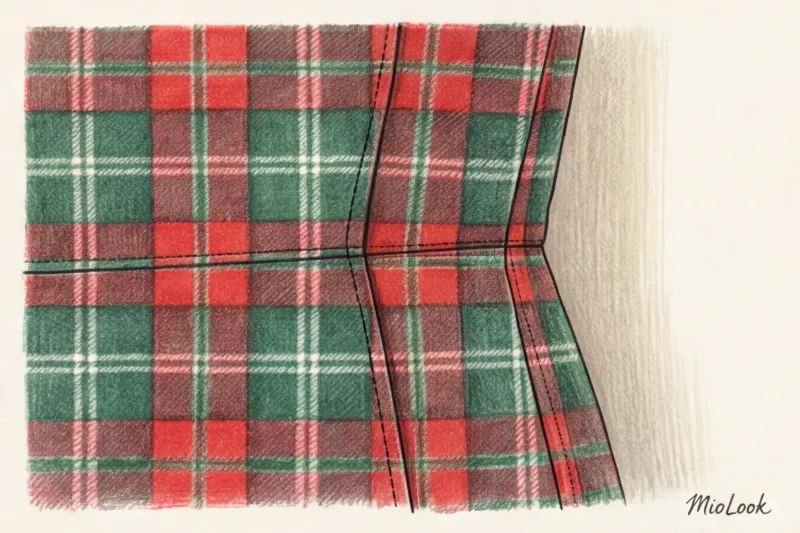
The golden rule of the cell. If you're buying a jacket, coat, or shirt with a print (especially checkered or horizontal striped patterns), immediately zoom in on the side seams and pockets. In premium items, the pattern meets perfectly at the seams, creating a continuous line. In mass-market items (especially those under €50), the manufacturer cuts as much fabric as possible, so the stripes on the sides tend to shift, turning the geometric design into visual chaos.
Tension wrinkles. Take a closer look at the seams on the hips or shoulders. If the fabric is slightly bunched, wrinkled, or slightly wavy along the stitching, this is a sign of poor thread tension on your sewing machine. Such stitching will break with the first sharp movement. We discussed how this affects the appearance of a garment in more detail in the article. How online shopping algorithms make you buy more , masking such defects through aggressive retargeting and beautiful filters.
Hem depth. This is my favorite insider secret. Look at the bottom of your trousers or skirt. Cheap brands hem the edges 1–1.5 cm, saving every millimeter of material. Mid-range and higher-end brands hem the bottoms generously, 4–5 cm. This not only allows you to lengthen the trousers if needed, but also adds just the right amount of weight, making the garment flow beautifully as you walk.
Honest Confession (and Limitation of Method): This visual analysis has one huge blind spot: black items. In photos of all-black clothing, it's virtually impossible to see the seams, texture, or ribbing unless the photographer has set up special backlighting. If you're buying a basic black dress, you'll have to rely solely on video and text.
Stylist Checklist: 5 Steps to Adding an Item to Cart
Theory only works when it becomes a habit. Save this algorithm and run it through every item before paying to minimize disappointment with courier delivery.
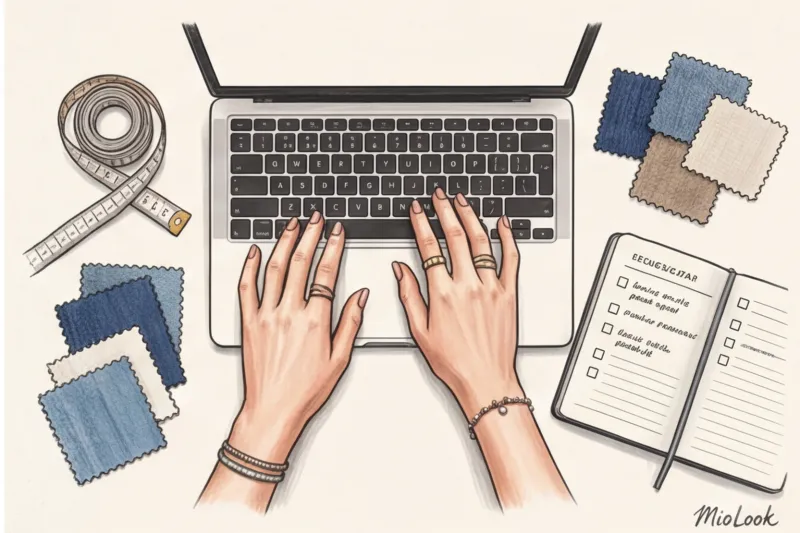
- Analyze the model's pose. If a woman crosses her arms over her stomach, slouches, or keeps her hands in the pockets of her wide-legged pants in every photo, the brand is hiding poor fit in problem areas. Look for photos where the model stands up straight with her arms hanging down.
- Zoom the texture to maximum. Look for a dense diagonal pile on cotton and a short, even pile on wool. See long, protruding hairs on acrylic? Close the tab.
- Be sure to watch the video. We test for "flow" and static. The fabric shouldn't stick to your legs.
- Check the seams on macro shots. We evaluate the print alignment on the sides and the absence of wavy “wrinkles” along the thread lines.
- Study the characteristics block. The ideal composition for an everyday suit or trousers is a base (wool, viscose, cotton) plus the required 5–15% elastane and polyester to protect against deformation.
Online shopping has long ceased to be a lottery for those who understand the rules of the game. Instead of being swayed by a model's beautiful pose against a Parisian balcony, learn to look at clothes with the eyes of a technologist. Invest in tight weaves, the right blends, and deep seams—and then your wardrobe will look expensive, regardless of the logo on the tag.