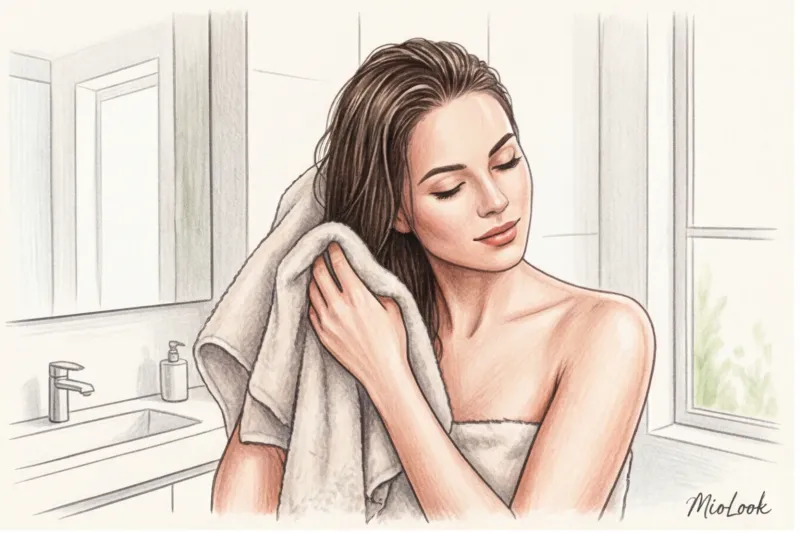
Do you know what most of my new clients have in common? They sincerely believe they're saving their hair when, after a shower, they spend hours with their hair wet, tightly wrapped in a giant turban made from a terrycloth towel. "I dry my hair naturally so I don't burn it," they proudly proclaim, only to complain about dull color, breakage, and a complete lack of volume.
As an image consultant and colorist, I must say bluntly: this is one of the most damaging myths in the beauty industry. A perfectly smooth cuticle is the main reflector of light, giving your look a prestigious look. If you don't know how to properly blow-dry your hair, you're literally wasting all your investment in haircuts, coloring, and expensive suits. A frizzy, unkempt texture can make even a Tom Ford jacket look cheaper.
In this article, we'll explore the physics of the process and styling architecture. Incidentally, heat styling is just the tip of the iceberg. I've covered in more detail how proper cleansing affects the final result in our complete guide. Proper hair care for perfect styling.
The Anatomy of Drying: Why 'Going Natural' Is the Worst Choice for Your Hair
Let's turn to science. According to trichological research (specifically, publications in the Journal of Cosmetic Science in 2011), water that remains in the hair structure for a long time causes irreparable damage. This process is called hygral fatigue (hygral fatigue).
Imagine an expensive silk blouse. You wouldn't soak it in water for three hours, would you? Hair reacts to water in a similar way. Penetrating the cortex, moisture causes the cell membrane complex (CMC) to swell. The hair stretches, and its protein bonds weaken. If you let your hair air dry for two to three hours, the fibers are constantly overstretched and vulnerable. The cuticle (the outer layer of hair scales) remains exposed, catching on clothing and other hair.
Paradoxically, proper blow-drying at low or medium temperatures preserves the hair structure much better than air-drying. A blow-dryer quickly removes excess moisture, allowing the cuticle scales to close tightly. It's the closed, smooth cuticle that creates that mirror-like reflection we perceive as "expensive shine."
How to properly dry your hair with a hairdryer: golden rules and the physics of the process
To make a hair dryer your ally and not your enemy, you need to adhere to the strict laws of physics. The most important of them is 80/20 rule Never dry hair with hot air that's just been dripping wet. It should be exactly 80% towel-dried.
Why is this critical? There is a term in trichology Bubble Hair (bubble hair). When you direct a stream of air at around 100°C onto a thoroughly wet strand, the water inside the hair literally boils. Microscopic steam bubbles form, which rupture the cortex from the inside. In my practice, I've repeatedly demonstrated this effect to my clients through a trichoscope: hair damaged in this way looks like Swiss cheese from the inside and inevitably breaks off.
Access to MioLook for €0.99 — one-time payment
A smart AI stylist will select the perfect look and suggest the best hairstyles for your face shape.
Get access — €0.99 onceTemperature control: how to avoid burning your image
Any quality tool has three temperature settings: cold, warm, and hot. These settings should be used strictly for their intended purpose:
- Warm air - This is the basic mode for removing moisture.
- Hot air — a tool exclusively for styling (changing the shape of a strand of hair using a brush).
- Cold air — recording the result.
"Keratin, the main building block of our hair, begins to melt and denature at 150°C. If you constantly dry your hair at maximum power, you literally burn out its structure."
One of my clients spent about €350 on a complex, multi-dimensional blonde. Two weeks later, she came back to me in a panic—the color had turned a dirty yellow. It turned out she'd been straightening her damp hair every day at the highest temperature. The hot air had simply "cooked" the toning pigment. Remember: the hot setting is only for spot treatments on almost dry hair.
Distance and Angle: The Secret to Mirror-Like Shine
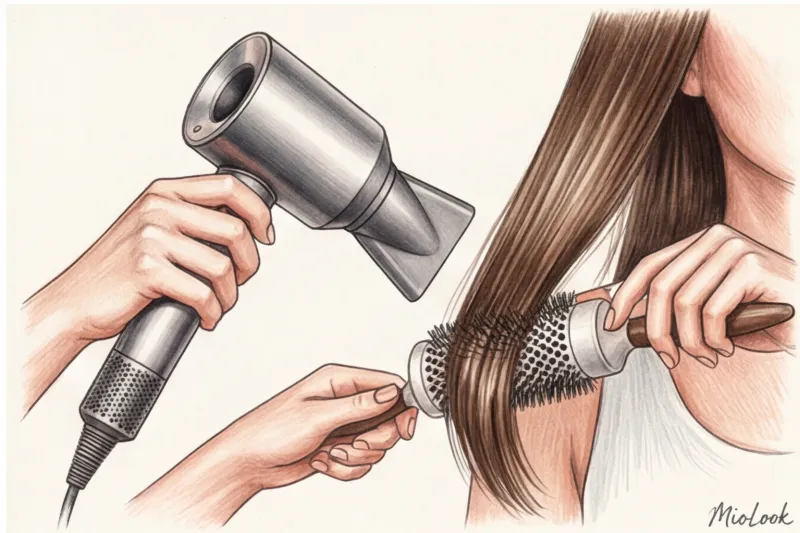
If you want a salon-quality result, pay attention to the geometry. The optimal distance from the nozzle (concentrator) to the strand is strictly 15–20 centimeters Most women instinctively press the hair dryer too close to the brush, thinking this will straighten the hair faster. This is a serious mistake, leading to localized overheating.
The airflow should always be at a 45-degree angle, strictly in the direction of hair growth (from roots to ends). If you direct the air upwards, you'll open the cuticle, and instead of smooth silk, you'll end up with a matte finish.
Canvas Preparation: Care as the Foundation for a Perfect Finish
No styling product, even the most expensive, will work on an over-dried or, conversely, silicone-laden base. Preparation for drying begins in the bathroom.
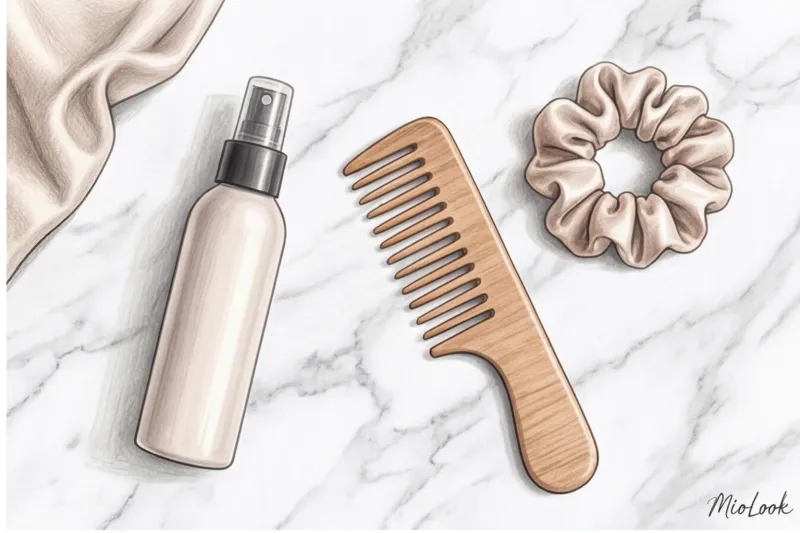
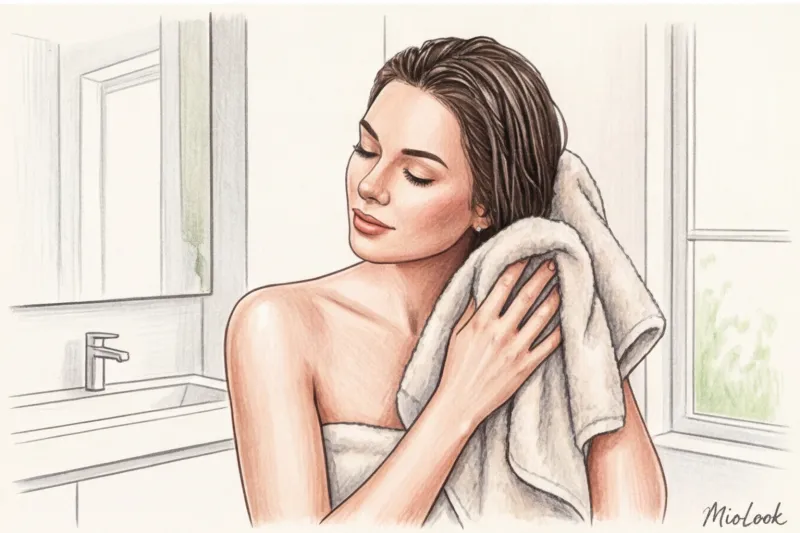
First, get rid of rough terry towels. Their loops can catch and damage swollen cuticles. Use a smooth microfiber towel or an old cotton T-shirt. Don't rub your hair—just gently pat the moisture out using pulsating motions.
Secondly, heat protection isn't a marketing gimmick, but a necessary protective barrier. At the micro level, good heat protection sprays (especially those containing lightweight polymers) create a film that slows down heat transfer. Hair heats up more slowly and evenly. Distribute the product with a wide-tooth comb to ensure the formula coats every strand. Incidentally, a properly prepared base is critical for creating long-lasting hairstyles, which we discussed in the article. Office Hairstyles: 10 Smart Everyday Styles.
Brushing Secrets: Drying Hair for Volume Without Damage
The most common mistake when styling at home is drying your hair all at once. To achieve salon-quality results, divide your hair into four sections: the back of the head, two temples, and the crown. Secure them with clips.
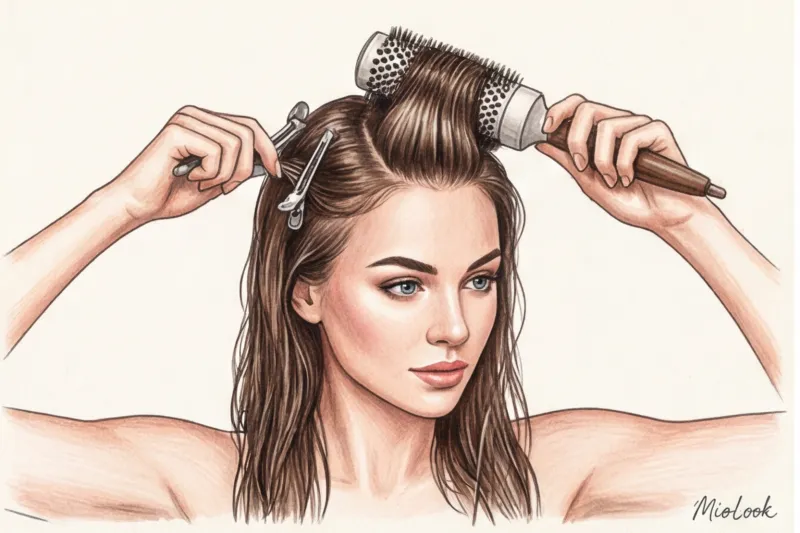
The ideal brushing algorithm looks like this:
- Root frame: Tilt your head or pull a strand straight up at a 90-degree angle to your scalp. Blow-dry the roots with warm air. This will create long-lasting volume that won't fall out after an hour.
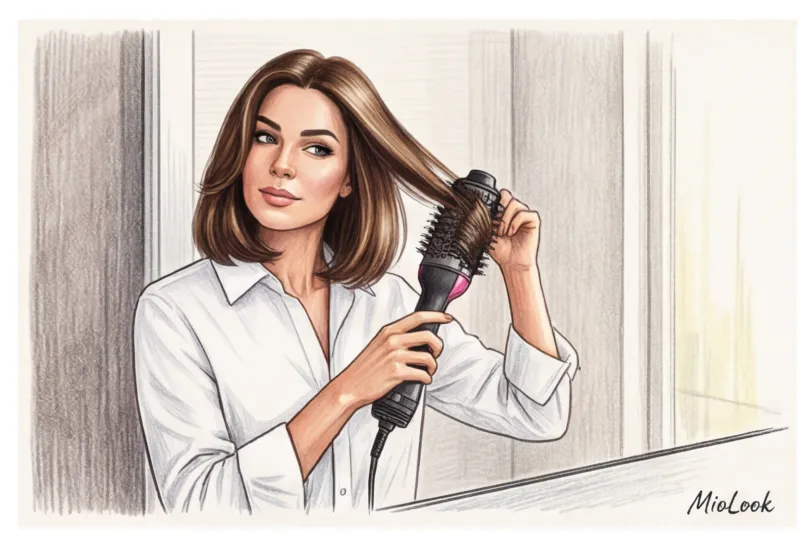
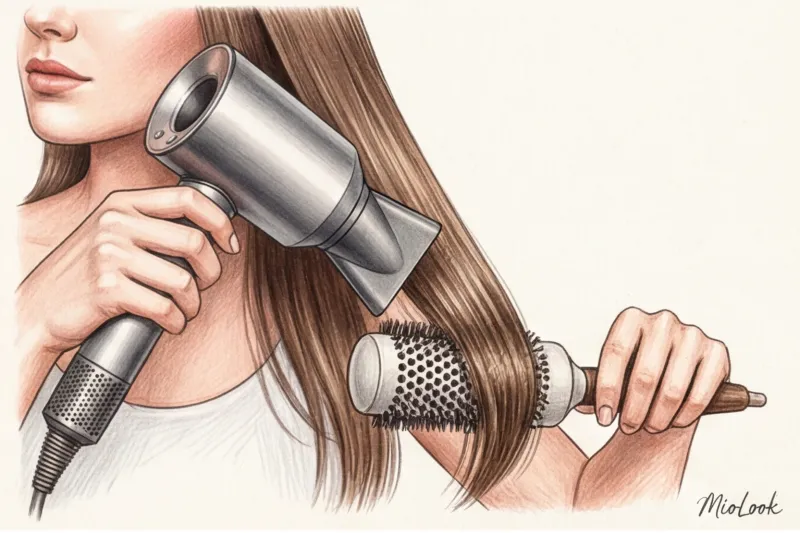
- Working with length: Take a round brush. The strand of hair should be held tightly, but without causing pain. Slowly move the hair dryer along the brush, keeping a distance of 15 cm.
- Cool Shot: This is a crucial step. Once you've heated the strand and set its shape, the keratin becomes flexible. If you drop a hot strand, it will lose its shape under its own weight. Blast it with cold air for 5-7 seconds to "freeze" the curl.
Fair Limit: A cold blast won't work and won't lock in volume if your hair is very thick and porous and you haven't dried it completely. Even the slightest residual moisture inside the cortex will ruin your style when you go outside.
Your perfect look starts here
Join thousands of users who look flawless every day with MioLook. Artificial intelligence will analyze your appearance and suggest the best options.
Get access — €0.99 onceInvesting in Tools: How to Choose a Safe Hair Dryer
Marketers love to sell us on power. They write "2400 W" on the boxes, and it's enough to make you reach for your wallet. But for healthy hair, it's not the heating element's power (watts) that matters, but the speed and density of the airflow. A cheap, high-power hair dryer simply fries your hair with a slow, scalding airflow. A high-quality motor blows moisture away with a powerful jet at a comfortable temperature.
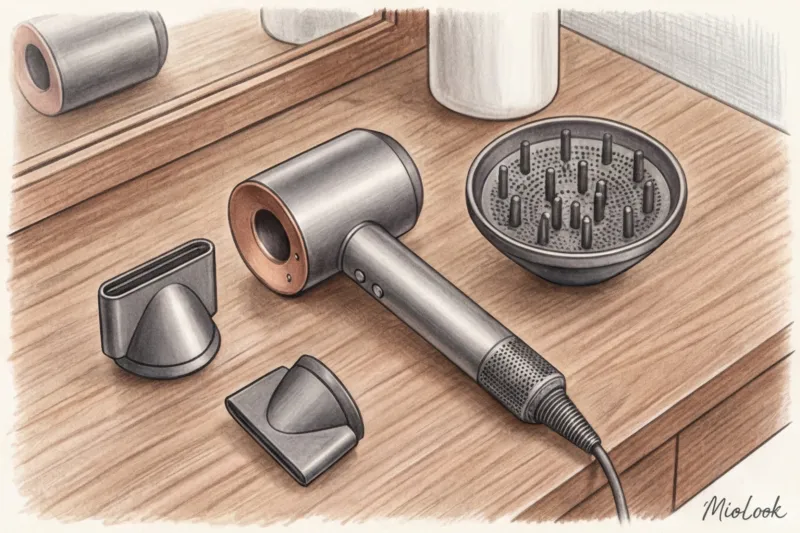
What you should really pay attention to when buying (focus on the budget professional segment from 150 to 450 €):
- Presence of ionization: This isn't a myth. A negative ion generator really does neutralize static and help cuticles adhere more tightly to each other.
- Narrow hub: A hair dryer without a nozzle dries hair chaotically, blowing it in all directions. The ideal nozzle opening should be no wider than 6–8 mm.
- Ergonomics and weight: If your hair dryer weighs more than 600 grams, your wrist will become tired after just five minutes. You'll inadvertently change the nozzle angle (that same 45 degrees) and start blowing perpendicularly onto your hair, causing frizz.
Checklist: 5 Blow-Drying Mistakes That Cheapen Your Look
Even after learning all the rules, we often stumble over everyday habits. Test yourself against this list of home styling anti-trends:
- Drying right in the bathroom. After a hot shower, the humidity in the bathroom reaches 80–90%. You're trying to dry your hair with air that's already saturated with water. Going into the bedroom will make the process twice as fast and safe.
- The dandelion effect. Random back-and-forth movements of the hair dryer will loosen the cuticle. Always move from top to bottom.
- Drying "head down" until the bitter end. This technique is only good for the first 3 minutes of drying the roots. If you dry the entire length this way, the ends will curl out and look untidy.
- Metal brushing + maximum temperature. The metal cylinder of the brush heats up like an iron. You're literally baking your hair between two hot surfaces. Choose brushes with a ceramic coating.
- Skipping heat protection "because it gets dirty." Modern hairsprays don't leave your hair greasy. If you're losing volume, it's because you're spraying too close or using a creamy texture on fine hair. Choose a format that suits your hair type. A perfectly groomed look is crucial for a business environment, as I've written about in detail in this article. Expert Image: A Wardrobe for Your Personal Brand.
Bottom line: proper drying as the architecture of your style
Blow-drying your hair has long been more than just a hygienic routine for removing moisture. It's the foundation of your appearance. You can wear a perfectly tailored dress and apply flawless makeup, but if your hair looks dull, brittle, and frizzy due to the wrong temperature, the whole look loses its luster.
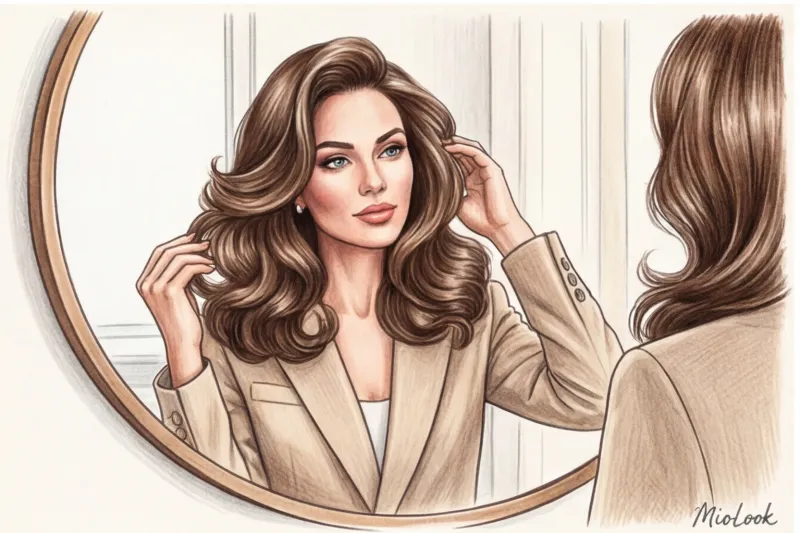
Treat your hair like the finest, most expensive silk. Invest in the right tools, keep your distance, use heat protection, and always finish with a cool blast. Then, your most important natural accessory will look luxurious, no matter what you're wearing.