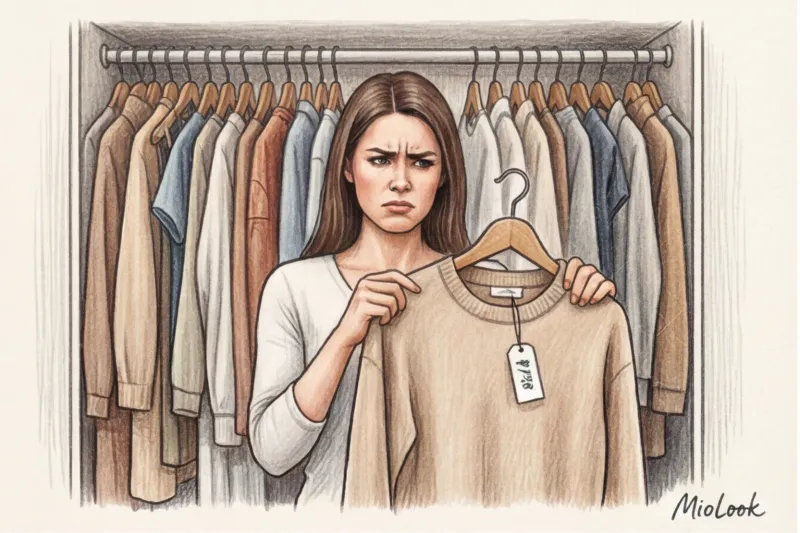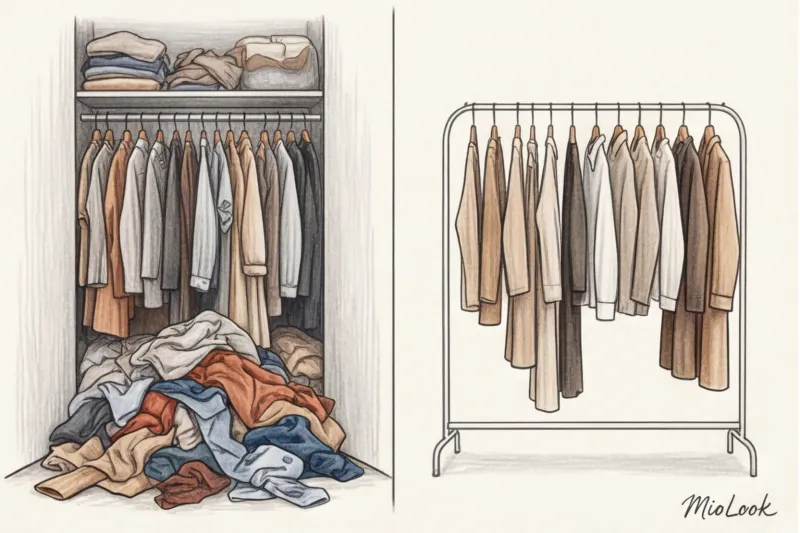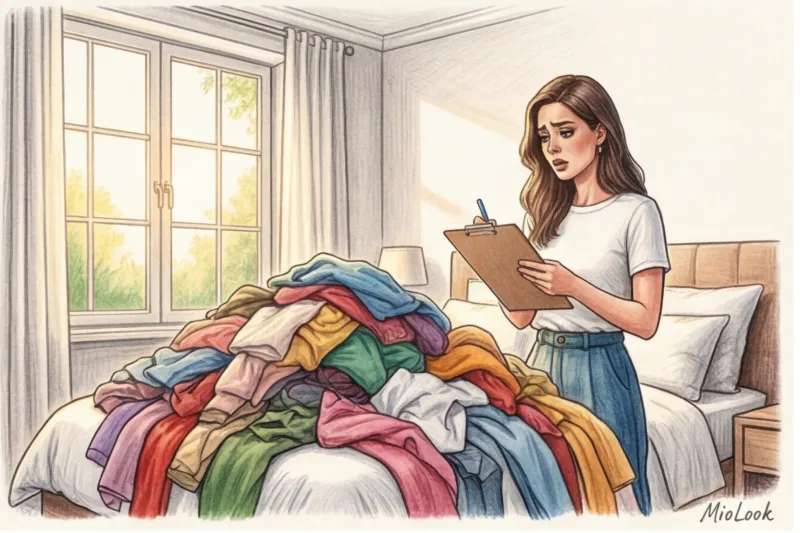
A few years ago, a client came to me with the classic "nothing to wear" problem. We opened her closet, and I was literally overwhelmed by a veritable avalanche of fifteen luxurious evening dresses embellished with sequins and feathers. The problem was that she worked remotely as a financial analyst 24/7, leaving the house only for morning coffee. This dissonance between real life and the contents of her closet is the most common problem I encounter in my practice.
That is why it is literate eco-friendly wardrobe decluttering It's not just sorting clothes into pretty, identical hangers. It's a deep stylistic detox and an honest conversation with yourself. We'll use decluttering as a tool for understanding your true style and completely abandoning the "things for a fantasy life" syndrome. We've written more about how to break free from the constant pursuit of microtrends in our the complete guide to slow fashion.
The Hidden Cost of Impulse Buying: Why Eco-Friendly Decluttering Is Essential
A closet overflowing with a complete lack of wearable outfits is a direct result of the fast fashion industry. Fast fashion brands have conditioned us to view clothing as disposable. You buy a neon top on sale for next to nothing, wear it to a party, and then it settles at the bottom of your drawer.
The numbers are sobering. According to a global report by the Ellen MacArthur Foundation (2021), the average mass-market item is worn only 7-10 times before being thrown away. And the most frightening thing: less than 1% of all textiles produced globally are recycled into new clothing. The rest is incinerated or rots in landfills for decades. Yet, growing cotton and producing just one basic T-shirt requires approximately 2,700 liters of fresh water—that's how much a person drinks in 2.5 years.
Therefore, the process of sorting through your belongings shouldn't be viewed as a weekend spring cleaning, but rather as a rigorous assessment of your personal style. Eco-friendly wardrobe decluttering begins with a change in mindset. We're not just making room for new purchases; we're stopping the conveyor belt.
Your perfect look starts here
Join thousands of users who look flawless every day with MioLook. Digitize your wardrobe in just a few clicks.
Get access — €0.99 onceThe Psychology of the Closet: Why It's So Hard to Let Go
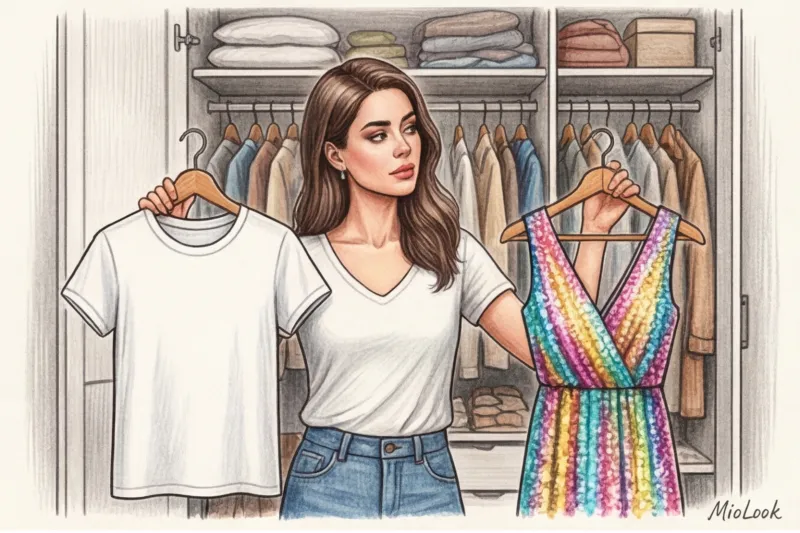
Why do we keep things we don't wear for years? The main trap is our "fantasy self." We buy clothes for a version of ourselves that doesn't exist. One of my clients carefully preserved five strict, sharp-shouldered sheath dresses from her previous corporate job, even though she had been living in Bali and working freelance for two years. These dresses were anchors of her former, high-status, but no longer relevant identity.
The second cognitive bias is the investment fallacy, or sunk cost fallacy. You look at an expensive but uncomfortable designer bag and think, "I spent half my salary on it, let it hang there, maybe I'll need it." Feeling guilty about wasted money makes us stock our shelves. The paradox is that the item won't return the money simply by taking up space. But recycling it sustainably or selling it instantly relieves this psychological burden.
The Joy Myth: Why Marie Kondo's Method Doesn't Work for a Basic Wardrobe
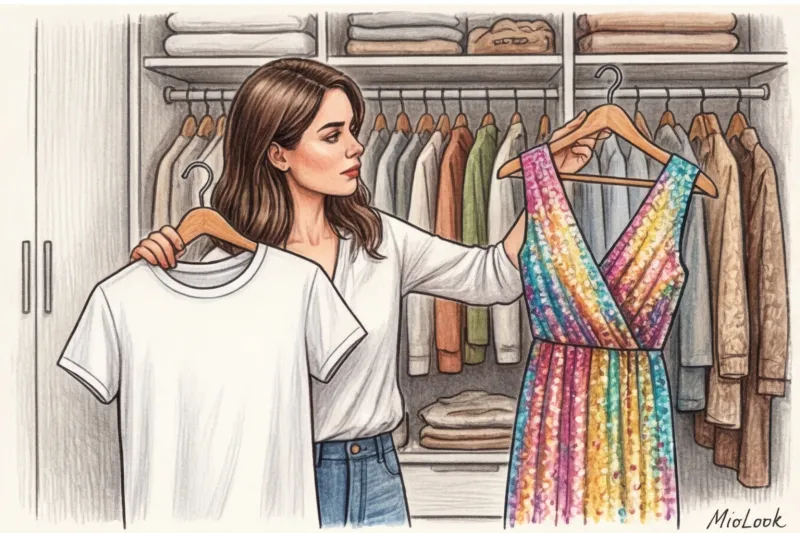
I have great respect for the Japanese philosophy of minimalism, but let's be honest: Marie Kondo's method, with its central question, "Does this thing bring you joy?", is absolutely destructive to a functional wardrobe. If you throw out everything that doesn't spark joy, you'll have nothing left to wear.
Basic pieces don't have to be fun. A sleek beige bra or a basic white 180g/m² T-shirt rarely inspire emotional ecstasy. But they're the invisible glue that holds together 10 other, more complex outfits.
The new, much more effective evaluation criterion is functionality and metrics Cost Per Wear (CPW, cost per wear). A luxurious $500 silk dress worn once is $500 per outing. A pair of perfectly fitting straight-leg jeans for $100 worn three times a week for a year is less than a dollar per outing. My favorite formula for classy casualness is "a basic white shirt + an accent necklace + the perfect pair of jeans." It's not extravagant, but it is impeccable taste.
Eco-Friendly Sorting Algorithm: 4 Smart Categories
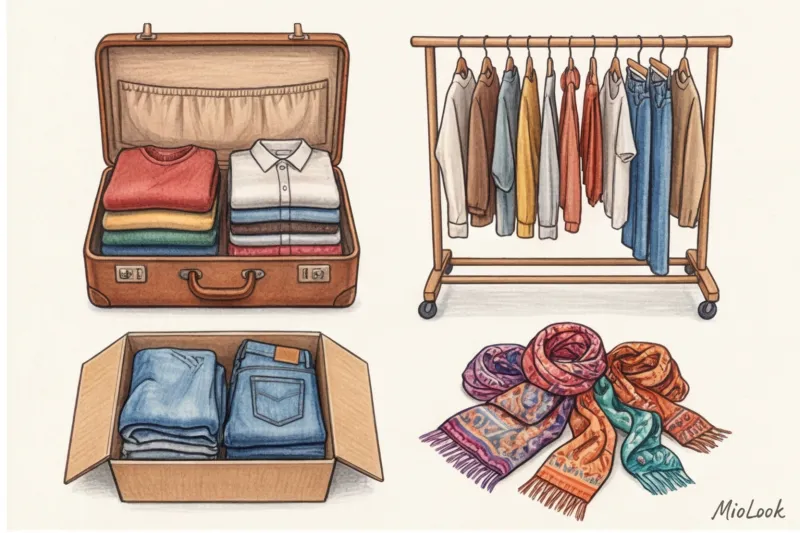
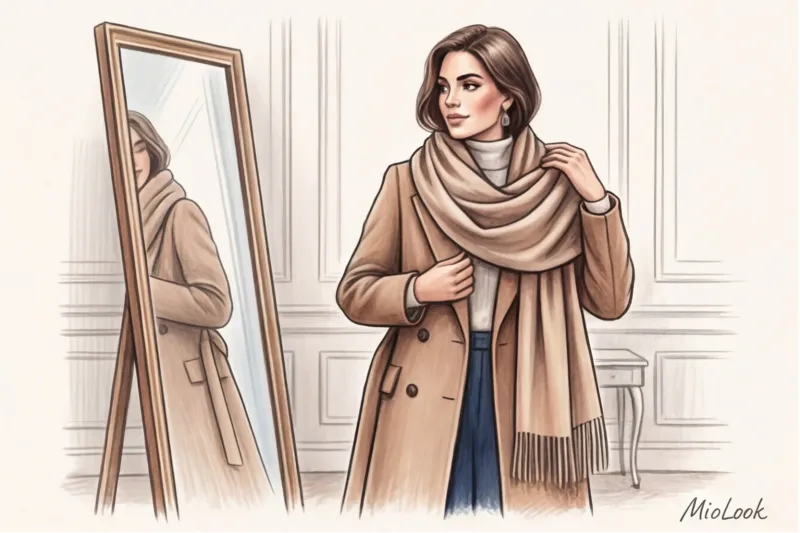
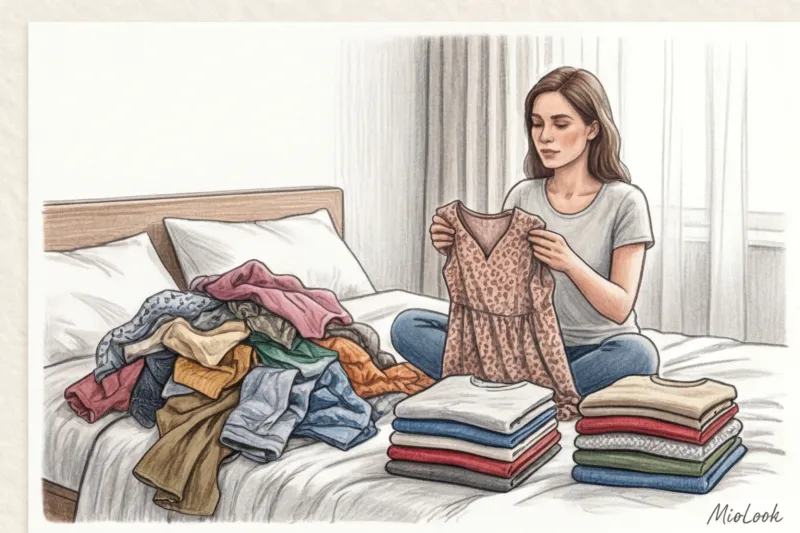
Preparing the space is half the battle. You'll need a full-length mirror, good natural light, and absolute honesty with yourself. Get it out of the closet. absolutely everything Now divide your things strictly into four zones.
- Category 1: “I wear it and love it.” This is your true style DNA. Look at these pieces: what colors predominate? What silhouettes? Digitize this pile through MioLook app This way you can clearly see the real gaps in your capsule.
- Category 2: "Needs renovation or styling." This is where a great jacket that's missing some statement buttons goes, or a skirt that needs to be shortened by 3 centimeters to achieve the perfect proportions.
- Category 3: "Quarantine box". Unsure? Put your things in a box, tape it shut, and date it exactly three months from now. If you haven't thought about the contents or tried to open it during that time, give it to them without looking.
- Category 4: "On the way out." Items that don't fit because of their size, color, or lifestyle. These are the ones we'll be addressing next.
Where to donate unwanted items: eco-friendly and ethical ways

Getting rid of things doesn't mean heading to the trash. There are excellent resale platforms for premium brands (Vestiaire Collective, Oskelly, TSUM Collect, or Avito). The secret to a successful sale: take a photo in daylight of yourself or a mannequin and honestly describe the defects. This will help you recoup some of the investment you've made in purchasing essential items.
As a stylist with a love for Mediterranean aesthetics, I love organizing swap parties My signature scenario: invite four or five friends with similar clothing sizes, open a bottle of good wine, and serve tapas. The swap turns into a fabulous evening, where your boring dress finds a loving owner, and you leave with a gorgeous vintage belt, completely free.
Charity has strict rules. Funds require items that are current, clean, and in good condition. Remember: if you'd be embarrassed to give an item to a friend, don't donate it. Items with stains, snags, or broken zippers create problems for volunteers, not help.
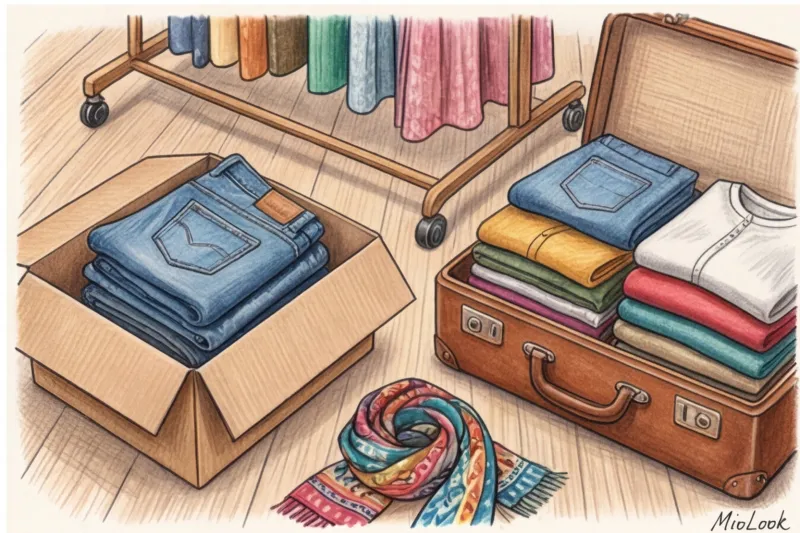
Anything unwearable should be sent for textile recycling. Look for containers from foundations like "Vtoroe Dykhanie" (Second Wind) or global textile drop-off boxes in major shopping malls. Why is this critically important? When cotton ends up in a regular landfill without access to oxygen, it doesn't just decompose—it releases methane, a potent greenhouse gas.
Access to MioLook for €0.99 — one-time payment
A smart AI stylist will select the perfect look from what you decide to keep after decluttering.
Get access — €0.99 onceUpcycling and refurbishment: giving your favorite things a second life
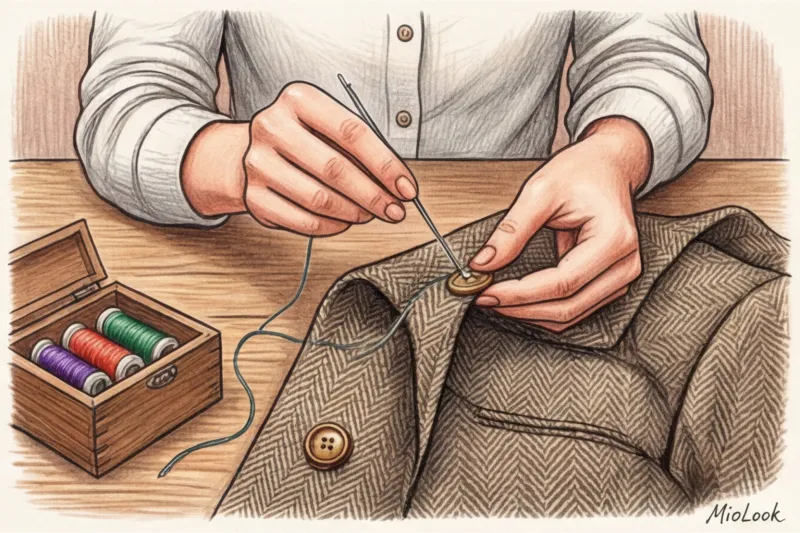
A good tailor is a conscious woman's greatest ally. Over 12 years in the fashion industry, I've saved hundreds of garments with the right adjustments. A tired, high-quality men's shirt made of thick oxford cotton can be transformed into a stylish, asymmetrical summer top. A midi dress that's too tight on your legs can be transformed into a flawless mini with a few swipes of a master's scissors.
But there is an important limitation here. This tip does not work for all fabrics. There's no point in trying to save a 100% acrylic sweater that's stretched out at the elbows—it'll lose its shape again after two washes. Invest your time and money in repairing only high-quality materials: cashmere, heavy cotton, silk, and genuine leather. High-quality shoes and designer bags can be given a second life at professional leather spas.
What to do with faded basics? Your favorite black 100% cotton jeans, which have turned gray after dozens of washes, don't need to be thrown out. Buy a high-quality machine-washable dye—in 40 minutes, you'll have jet-black, like-new pants.
Life After Detox: A Mindful Consumption Checklist
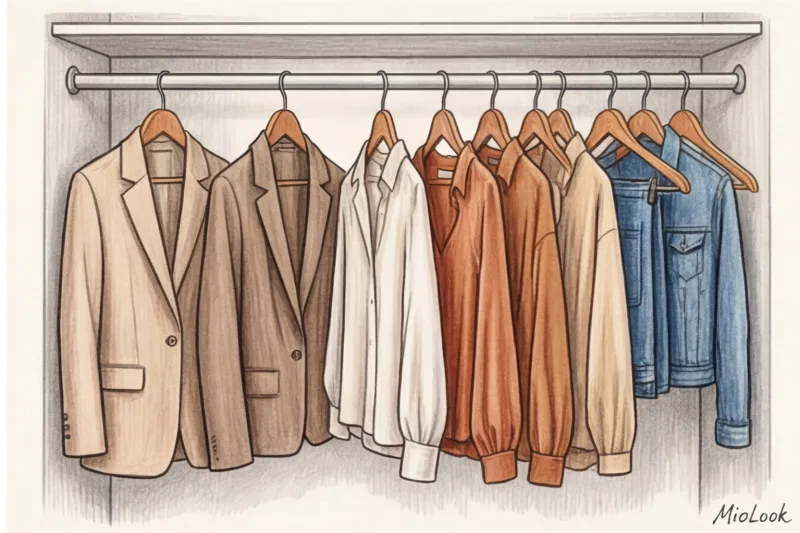
You've done a great job. To prevent your closet from turning into a storage unit again in six months, implement the "One In, One Out" rule. Bought a new cashmere sweater? Donate an old one or sell an item you haven't worn in a while. This creates a strict limit on the size of your wardrobe.
The second defense against aggressive fast fashion marketers is the 72-hour rule. Added an item to your online cart? Close the tab for three days. Experience shows that 8 times out of 10, you won't even remember it.
Use digital tools. By uploading your filtered database to MioLook , you can check right in the store's fitting room whether a potential new item will match at least three items in your closet. This will save you from buying a sixth white blouse that's identical to the previous five.
Your closet isn't a museum of past style mistakes or a repository for unfulfilled fantasies. It's your daily confidence booster. Create a capsule wardrobe that lasts for years, not just until the end of the current season, and you'll forget about the "nothing to wear" problem forever.