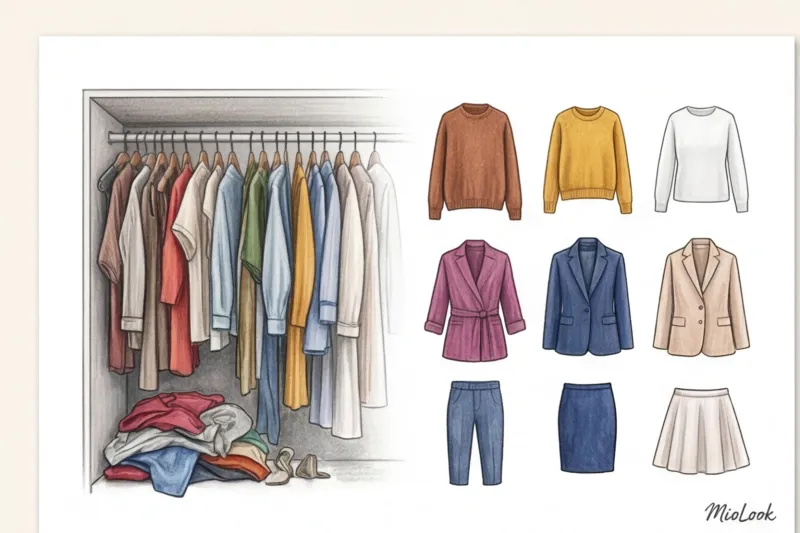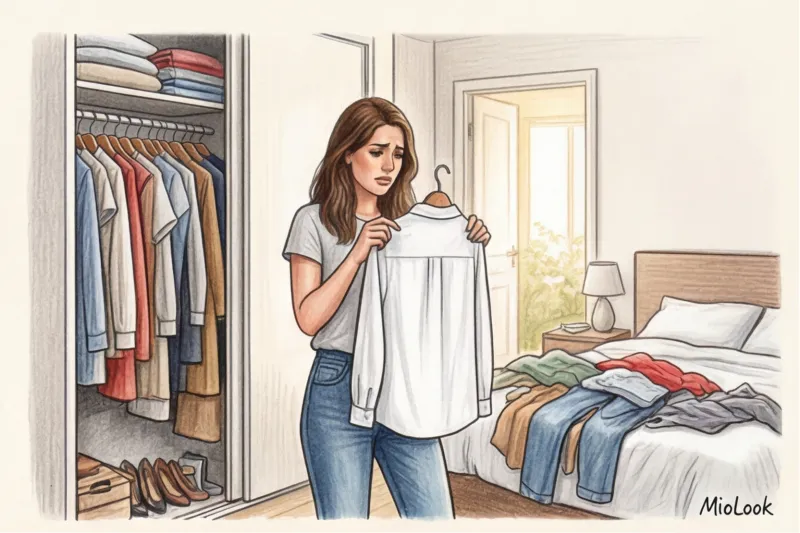
Last month, I was sorting through the closet of a client, a senior executive at an international IT company. In the far corner, we found three identical Loro Piana cashmere sweaters. With tags still attached. She'd simply forgotten about the first two, buried under an avalanche of impulse purchases, and bought them again. Sound familiar? According to a McKinsey study (2023), the modern woman regularly wears only 20-30% of her closet's contents. The rest is frozen capital and daily stress.
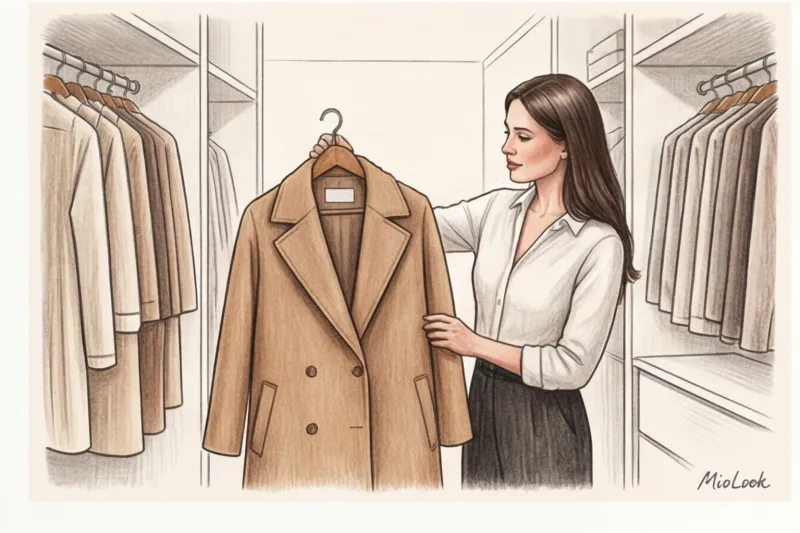
I've already written in more detail about what constitutes true elegance in our complete guide. Timeless Style: How to Create an Elegant Wardrobe But today we'll talk about something else. About how the ideal basic wardrobe app transforms chaos into system with the help of artificial intelligence, and why digitalization is the best friend of classical style.
New Luxury: Why Intuition Is No Longer Enough
The paradox of modern times is this: to create a timeless wardrobe—the kind associated with the handcrafted work of tailors and the legacy of old fashion houses—we need cutting-edge technology. Our intuition often fails us. We buy a fantasy about ourselves (for example, a silk slip dress for imaginary bohemian parties), but live in reality (wool trousers and loafers for the office and meetings).
This is where the strict Pareto principle comes into play. Over 12 years as a stylist, I've uncovered an inexorable statistic: my clients wear 20% of their clothes 80% of the time. The shift from emotional shopping to analytical shopping is a new form of luxury. When you rely on data, not on a momentary impulse in front of a Zara or Massimo Dutti window, you stop subsidizing your own visual noise.
Access to MioLook for €0.99 — one-time payment
A smart AI stylist will select the perfect look based on your real wardrobe.
Get access — €0.99 onceThe Blank Slate Myth: How a Basic Wardrobe App Reveals Your Mistakes
The most common mistake I see newbies make is trying to photograph and upload every single T-shirt they bought on sale five years ago. Let's be honest: digitizing a bad wardrobe will simply create a digital bad wardrobe.
A good basic wardrobe app isn't a virtual shelf for storing your style faux pas. It's a strict auditor. When you start documenting your looks, AI quickly identifies "ghost items." These are the clothes that hang on hangers for years, not fitting into any real-life scenario.
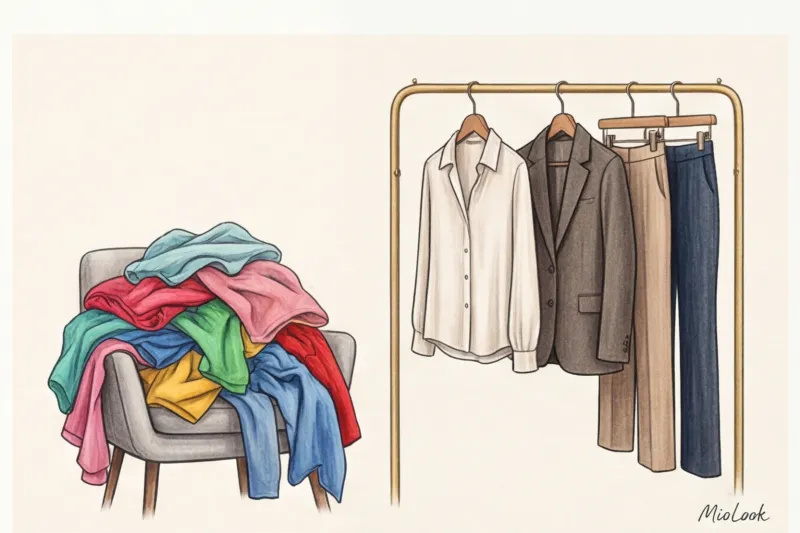
Fair Limit: This method it won't work If you're not ready to give up your illusions, the algorithm will mercilessly show you that the neon skirt you bought on vacation has been worn exactly zero times in three years. It's painful, but incredibly therapeutic. The ideal app shouldn't store your mistakes—it should highlight them so you never repeat them again.
Elegance Analytics: How AI Calculates Your Personal Uniform
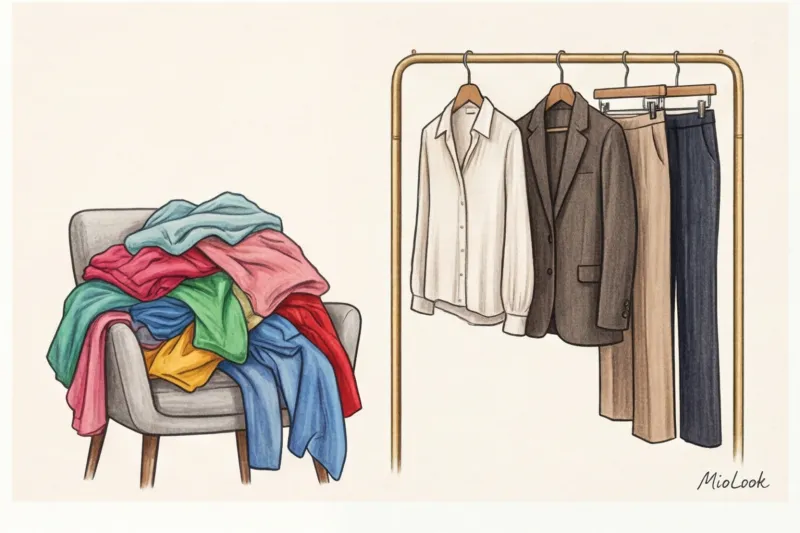
Forget glossy lists like "10 Things Every Woman Should Own." A crisp white poplin shirt isn't for everyone—for some, it looks like a waiter's uniform, while others simply feel uncomfortable in the stiff fabric. True timeless style is based on a completely different concept.
True timeless style is based on the concept of a "personal uniform"—a set of silhouettes that are mathematically calibrated to fit your life, not tied to the advice of fashion influencers.
How does it work technically? Artificial intelligence analyzes your most frequent and successful combinations. It detects patterns you might not notice on your own. For example, the algorithm might reveal that you feel most confident in a combination of structured bottoms and a voluminous, soft top. According to a WGSN report (2024), data-driven wardrobe personalization reduces clothing returns by 40% because women begin to understand their actual, rather than imagined, proportions.
The Math of Luxury: The Cost-per-Wear (CPW) Formula
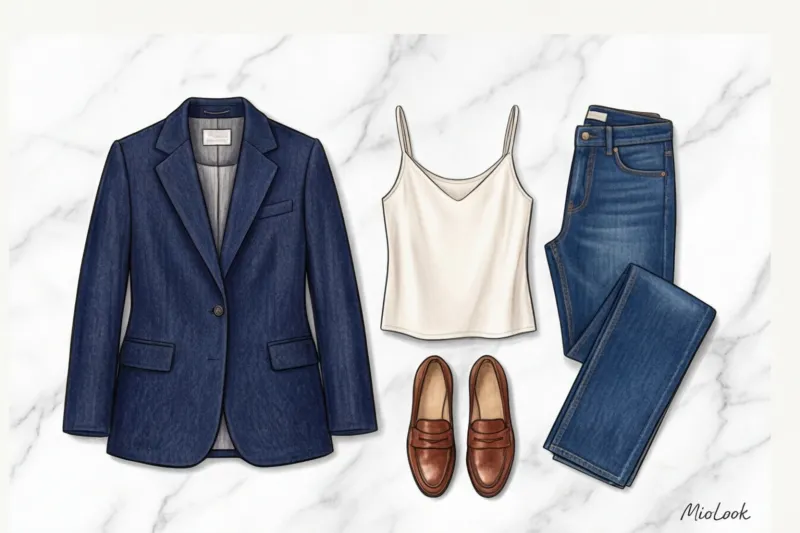
Professional buyers and stylists don't think in terms of price tags, but rather in terms of cost-per-wear (CPW). The formula is simple: divide the price of an item by the number of days you wear it.
Let's do the math. A $50 acrylic sweater from a mass-market store that will pill after three washes and be worn five times will cost you $10 per wear. A basic $300 Mongolian cashmere jumper that you wear 100 times over three seasons will cost you $3 per wear. The expensive item ends up being three times cheaper!
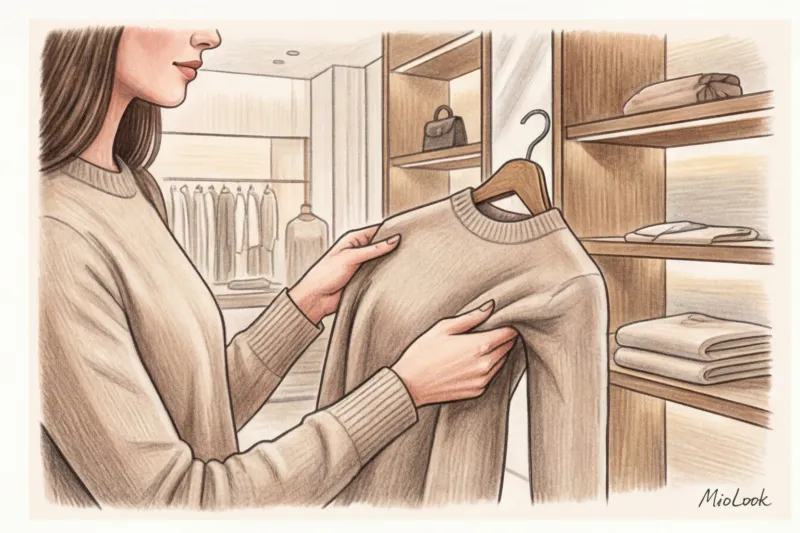
Previously, you had to keep this math in your head or enter it into spreadsheets. Today, AI does it for you, automatically calculating the CPW of every item in your closet. You can clearly see which investments are paying off and which are a drain on your budget.
Your perfect look starts here
Join thousands of users who look flawless every day and save on purchases with MioLook.
Get access — €0.99 onceInvesting Smart: Protecting Yourself from Emotional Buying
As a buyer, I always evaluate a potential purchase through the prism of its integration into existing capsule collections. My golden rule is the "rule of three new looks." Before you even ring up the checkout, you should come up with at least three outfits with this item from what's already in stock. already hanging in your closet.
This is where the basic wardrobe app truly reveals its potential. You use a virtual fitting room: upload a photo of the jacket you want and ask the AI to pair it with your trousers, jeans, and dresses. If only one look comes together, the item stays in the store, no matter how beautiful it is.
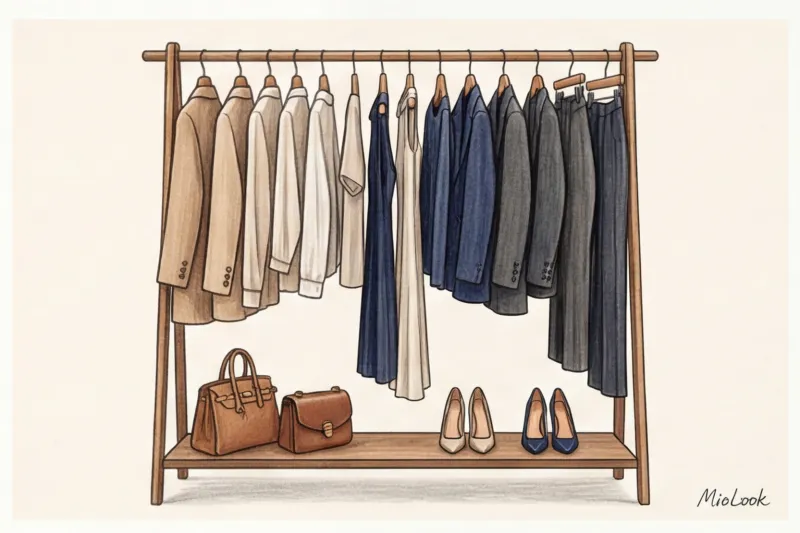
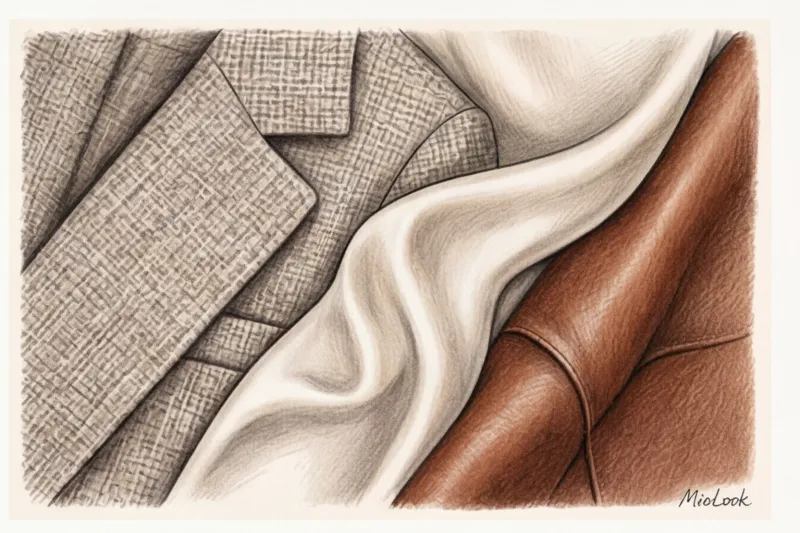
When you start seeing your wardrobe as a unified system on your smartphone screen, the magic of impulse shopping fades. You stop buying that fifth pair of black pants because you can clearly see the previous four. Instead, the focus shifts to texture: you start looking for thick silk with a 19-mommie count, the right merino wool, and smooth leather.
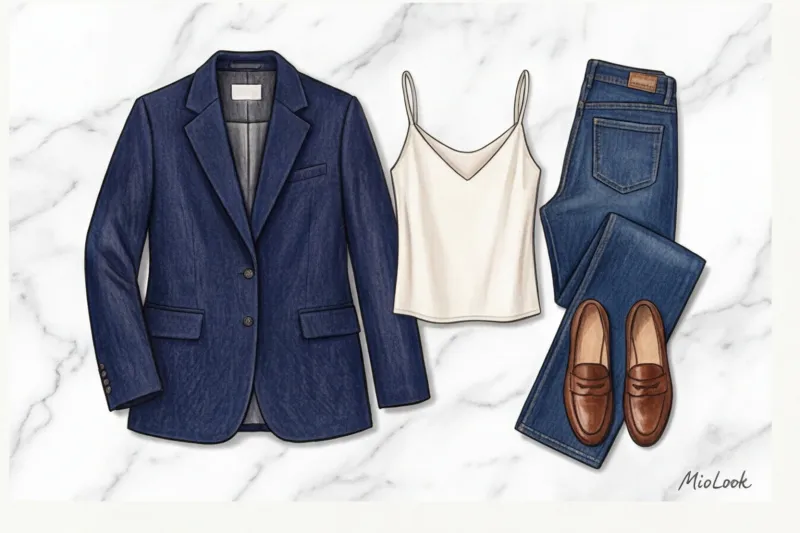
The MioLook Algorithm: Creating a Timeless Capsule Step by Step
How to translate theory into practice? I offer my clients the following algorithm for working with an AI assistant. You can do this right now using the "smart wardrobe" feature in MioLook.
- Step 1: Hard audit. Upload only "anchor" investment pieces to the app. A good wool coat, a perfectly fitting jacket, quality leather shoes, cashmere. Put away those stretched-out lounge tees—they don't contribute to your style.
- Step 2: Palette Analysis. Let the algorithm analyze the colors of your favorite pieces. You'll be surprised, but AI often identifies dominant, elegant shades that you intuitively choose (for example, deep navy, camel, or cool graphite).
- Step 3: Generate new connections. Use AI for a fresh perspective. Ask the algorithm to create outfits from the items you've uploaded. I promise it will suggest at least two or three combinations you never even considered (for example, wearing a silk shirt under a thin turtleneck).
- Step 4: Smart Shopping List. Once the database is digitized, the AI will automatically highlight strategic gaps. You'll go to the store not for "something new to brighten your mood," but for the specific dark chocolate-colored suede loafers that will complete 12 of your looks.
Ready to get started?
Try the MioLook free plan—no commitments or hidden fees. Digitize your wardrobe today.
Get access — €0.99 onceThe Future of Style: When Technology Serves Craft
Many fear that algorithms will rob fashion of its soul and make us all the same. But in my experience, the exact opposite is happening. Artificial intelligence doesn't replace your taste—it takes over the routine. It acts as your personal analyst, allowing you to be creative.
True luxury today is mindfulness and order. When you don't have to spend 20 minutes every morning frantically rummaging through hangers looking for what to wear to an important meeting, you have time to enjoy the process. You begin to notice how beautifully heavy silk drapes, how perfectly the seams on your jacket are finished, how gracefully high-quality Italian leather ages.
Smart wardrobe management isn't about restrictions. It's about the freedom to be yourself every day. Digitize your wardrobe, find your personal uniform, and let technology free up your time for what really matters.